X-Men United #2 annotations
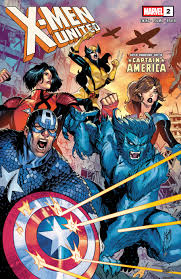 X-MEN UNITED #2
“Open Wounds”
Writer: Eve L Ewing
Artist: Tiago Palma
Colour artist: Brian Reber
Letterer: Joe Sabino
Editor: Tom Brevoort
COVER: Captain America, Melée, Wolverine (Laura), Beast and Kitty Pryde in a World War II setting. Not a scene from the issue.
THE X-MEN:
This issue is no clearer about the nature of Graymatter Lane than the previous one was. Once again, it’s reiterated that Graymatter Lane is on the psychic plane and that if you die there then you die “in real life”, which makes it sound like it’s a projection; and once again, people seem to be able to travel from there directly to places in the real world. There’s a dining pavilion – does it serve real food or just illusions? On balance Graymatter Lane seems to be a pocket of the psychic plane that people physically travel to, even though most of the environment being a psychic projection… but I’m honestly unsure what the intention is.
Cyclops. His plan was apparently to get Kid Omega to fake an attack on the school in the expectation that it wouldn’t be able to cope, thus proving his point that it was a bad idea. This plan fails spectacularly, but Scott refuses to concede that this has gone badly, or that he ought to have warned Ben, and simply acts as if things had gone to plan. Iceman seems to regard this refusal to apologise as entirely in character.
Kid Omega. He claims that Cyclops goaded him into helping with this plan by presenting it as an opportunity to show up Emma. However, for some reason he makes his move when almost nobody is in the building (other than Ben Liu), meaning that it goes practically unnoticed by everyone except Emma. You have to wonder whether he was even seriously trying, though he makes a show of winding up both Emma and Scott. Emma has no apparent difficulty subduing him, though he is in an area of her own creation.
Emma Frost. She sees right through Cyclops’ plan, and understandably annoyed by it. She claims that his real objection to the school is that he doesn’t trust her, though that would seem very out of character for him, given how long she’s had a role in teaching for the X-Men. In this story, though, they seem to have fallen out quite badly.
She’s offered the X-Men’s services to Captain America to locate survivors of experiments to re-create the Super-Soldier Serum (see below). She hasn’t discussed it with anyone else, but argues that it will be good practice for some students, and means that Cap will owe them a favour in future. A passing comment later in the issue suggests that she’s also hoping Cap will “learn something” that might make him more sympathetic to mutant interests. It’s unlikely that this would simply be the fact of the government experiments on black soldiers, since he already knows about them. It may be that she has a more precise expectation of what he’s going to encounter than she lets on, but we’ll come to that.
She brushes off concerns about the privacy implications of using the Empathy Engine to locate survivors for Cap, pointing out (correctly) that this would also be an objection to using the Engine for anyone at all.
Kitty Pryde. She’s still wondering about whether the school is a bad idea because of the risk of infiltration, the implication being that mutants ought to avoid large gatherings altogether. She’s uncertain about whether to help Cap or not, and ultimately dithers and abstains.
Prodigy. Naturally enough, he’s in favour of mutant institutions (presumably the NYX community centre is still out there?). He argues that the idea that neither option is truly safe and gathering together allows mutants to make the best world they can.
He’s persuaded to help Cap, not so much for Emma’s realpolitik reasons, but because he buys into the value of the exercise and accepts her answer to his objections about privacy. He makes it fairly clear that, as a black character, he is unimpressed by the argument that this is not a mutant issue.
Iceman. Not remotely interested in offering mutant resources to help with a non-mutant problem.
Magneto. He regard’s Cap’s proposal as a waste of time, and indeed as something intended more to assuage his own feelings of guilt than to actually do any good for the survivors.
Wolverine (Laura Kinney). She’s assigned to help Cap on the reasonable basis that her back story as a creation of the Facility gives her a personal interest in any event involving dodgy experiments to create human weapons.
Beast. His rather garbled plan is to use the Empathy Engine to identify survivors of the experiments by scanning the memories of World War II veterans collectively and seeing what picture emerges by consensus. Axo makes clear that he’s vastly overstating the reliability of this method. Nonetheless, it does apparently succeed in locating Maurice Canfield.
Gambit, Rogue, Nightcrawler, Magik and Wolverine (Logan) all cameo in the dining pavilion.
GUEST STAR:
Captain America. This is the Steve Rogers version. Much of this story is based on the 2003 miniseries Truth: Red White & Black, in which 300 black soldiers were experimented on in an attempt to replicate Captain America’s Super-Soldier Serum. The events of that series have been brought back to Cap’s mind by someone anonymously sending him an obituary of one of the men, Francis Maclean. The suggestion seems to be that this has brought home to him that others might still be alive – though presumably not for long, since if they were old enough to enlist during World War II, they would be at least approaching 100 today. In the absence of any records, he wants the X-Men to use the Empathy Engine (which is supposed to be for locating mutant students) to help him track down the survivors. Emma has put this idea in mind.
STUDENT MENTORS:
Melée. She’s assigned to help Cap for “stealth”, which is not a quality she’s conspicuously demonstrated in Exceptional X-Men so far – nor, for that matter, a quality obviously required for the exercise of tracking down some ageing survivors in order that Cap can have a nice sit down and a cup of tea with them. Somewhat more plausibly, it’s suggested that she would have an interest in the job because of the way the Bureau of Indian Affairs moved her family to Chicago in the 1950s. The fact that she’s half Potawatomi was previously mentioned in Exceptional X-Men #3; I don’t think the Bureau has come up before, but there was indeed a programme of relocations to Chicago at that time.
She’s completely dismissive about the reliability of government records.
Axo. Helps use the Empathy Engine to locate Maurice Canfield, despite his obvious doubts about the method.
Rift. Shows up to open a portal to Canfield’s location. Presumably he just defines the destination as “wherever the Empathy Engine identified”, because the Engine itself turns out to be pointing to the same location at four different points in time: 1946, 1968 (specifically, the day of Martin Luther King’s assassination), 1987 (the day of Reagan’s “tear down this wall” speech at the Brandenburg Gate) and an unspecified time frame.
STUDENTS:
Ben Liu. Somehow he gets separated from everyone else and, as a result, is the only mutant to actually get caught in the fire illusion while believing it to be real. He’s understandably annoyed.
Jitter. On loan from Uncanny X-Men, she’s assigned to help Cap on the grounds that she’s a “nice wild card for the unexpected, and could use the practice”. The issue doesn’t actually explain what her powers are (basically, she can acquire any skill she wants for 60 seconds).
VILLAINS:
Maurice Canfield. Canfield isn’t a new character – he was one of the handful of experimental subjects from Truth: Red White & Blue who actually made it into the field. Steve has heard of him before, and understands him to be a “society fellow, upper crust”, “smart” and “political”. All of that is basically correct, though it’s not clear whether Steve actually appreciates quite how socialist Maurice was; he wound up in the army after being convicted of protesting against US involvement in World War II. In Truth #4, Canfield learns that his parents were falsely told that he was dead, after which his father killed his mother and committed suicide. Canfield then gets into a fight in which he apparently dies.
We see the 1946 and 2026 versions of Canfield, but not the versions from 1968 and 1987. In 1946, he seems quite genial and politely welcomes the group (three of whom then vanish to other timeframes). He may be expecting them. His home seems in decent shape in the first three time frames, but looks abandoned and dilapidated in 2026. Truth #1 gives his age in 1940 as 25, implying that he should now be over 110 years old. That suggests that the final time frame which we see in the story is still in the past, or simply that his version of the super-soldier serum slowed his ageing.

This issue was incomprehensible to me until I remembered that in the AoR Rift was able to shift people backwards in time.
After that it remained nigh incomprehensible, since I have no idea whether the characters actually travelled in time or wound up in gestalt psychic ideas of years past collected via the Empathy Engine.
Seriously, how can a book so utterly fail to explain its premise? Greymatter Lane is on the psychic plane. Okay. But Rift is sending people physically from GL to real-world locations. So it has to be a physical pocket dimension (somehow within the psychic/astral plane, shaped by telepathy), except that’s not how it’s described. And it doesn’t gel with the ‘if you die here, you die for real’ speeches, since if they were physically transported into a pocket dimension, that wouldn’t need to be said.
I liked Exceptional X-Men. I even enjoyed Expatriate X-Men, thought that was chaotic to the extreme. But this… I want to like this, I generally like school books, but it’s such an incoherent mess.
I like that Prodigy is elevated to staff, that suits him and follows from his role in NYX. I like individual character scenes (Kitty/Magneto in particular). But none of it gels.
Ewing seems utterly incapable of having characters interact with any level of subtlety or complexity – in Exceptional it was Kitty whining and screaming about the “normal life” she was robbed of while Bobby just stood there scratching his frozen dome, now it’s Scott and Emma having a level of hostility that really makes no sense for either of them to have towards the other. It’s all exclamation points and people pointing at each other.
A lot of people thought Scott’s behavior, including not telling Ben the fire was fake, was out of character. Especially since his plan involved terrorizing minors with a fake fire. He’s not this much of a jerk in MacKay’s run.
“However, for some reason he makes his move when almost nobody is in the building (other than Ben Liu), meaning that it goes practically unnoticed by everyone except Emma. You have to wonder whether he was even seriously trying,”
No one was in the school proper but plenty of people were in the dining pavilion, which presumably would have had to have been evecuated if the fire was real.
Note that it’s implied Emma sent Cap the obituary.
Is there a reason why they need the Empathy Engine to search for the survivors? Wouldn’t a sufficiently powerful telepath suffice? (In fairness, Scott has Quentin and the last Cerebro and he’s not on good terms with Emma at the moment and Emma arguably isn’t powerful enough on her own to find the survivors.)
“Shows up to open a portal to Canfield’s location. Presumably he just defines the destination as “wherever the Empathy Engine identified”, because the Engine itself turns out to be pointing to the same location at four different points in time: 1946, 1968 (specifically, the day of Martin Luther King’s assassination), 1987 (the day of Reagan’s “tear down this wall” speech at the Brandenburg Gate) and an unspecified time frame.”
It was confusing whether they were traveling to a physical location or still in the astral plane. This is how Beast describes it:
“With the empathy engine we can create a psychosomatic composite of the world by piecing together a pastiche of thei memories…. There will be gaps and errors. But it will be an acceptable simulacrum of that point in time.”
Then later he explains:
“Temporal instabilties. We’re cobbling together memories. Say one person remembers a street from 1945– another person remembers it from 1960. People have stronger memories of major events, not their breakfast. The result is a quantum uncertainty. We can pin down location but not time, and not for so many people at once.”
This kind of hubris endangering his friends seems more like the Chairman than the Factory Beast.
I seem to recall that back when Leah Williams was writing X-Factor, she talked in some interview about using the Trial of Magneto series to build an ’empathy engine’ for Wanda. I understood that as meaning she was trying to tell a story that would get readers to care about the character again.
I lost interest in the entire Krakoa project around that time, and the first Trial of Magneto issues did not land for me, but for some reason the idea about stories working as ’empathy engines’ stuck with me.
I wonder if Williams coined that phrase or picked it up from elsewhere. (A quick google search only turns up garbage about AI, and I’m going to resist doing a deep dive to investigate.) In any case, I’m kind of amused that it’s turned up as an in-universe device, and I wonder if it’s a deliberate reference from Ewing – if so, it’s a *very* obscure bit of x-books trivia to draw from!
There was actually an “empathy engine” used in the Vertigo Hellblazer comic, during the Denise Mina run (“Empathy is the Enemy”).
This issue is fucking horrible. A plot that relies upon incomprehensible mechanics with a cast that is written wildly out of character across the board. We’ve seen these types of philosophical divides before. After their falling out during “Schism,” Cyclops disagreed with the concept of Wolverine running a new mutant school. But far from attacking it to “prove his point” or out of resentment towards Logan, Scott doubled down on his more reactionary direction in service of PROTECTING the school from threats. Because saving mutant lives was more important than dictating how those mutants chose to live their lives. This is mustache-twirling sitcom villain nonsense.
Emma has used her powers to basically host psychic Zoom meetings before. It’s within the repertoire of any capable telepath. Why not simply do this to “assemble” the school? It gets around the problem of mutants physically gathering in large numbers and the risk of actual death. If she needs some extra juice to pull it off, how hard is it to build or otherwise acquire an old school Cerebro? She never plucked that knowledge out of Xavier’s mind at any point over the years? Or just enlist Forge to do it, whatever. But these easy answers would invalidate the need for the Greymatter Institute, a setting whose nature and parameters remain totally unclear. Which is a pretty big problem considering how the book’s very premise hinges on it.
The story itself pointing out how Beast’s plan with the Empathy Engine shouldn’t work doesn’t change the fact that it… REALLY shouldn’t work. Bad technobabble even by the standards we’re used to. I could handwave this if not for the issue’s other flaws, but add it to the pile.
Kitty just comes across as an indecisive idiot.
This title sounded promising as a means of restoring some much needed mission and focus to the line. As it stands, I’m hard pressed to think of a series that’s as much of a disappointment in recent memory, with just two issues under its belt.
After the first issue, I think I said I was cautiously optimistic about the series and would look to future issues to see if it was worth continuing. I am no longer optimistic.
I’m just going to say it about the current batch of X-writers: Chuck Austen was better. He may have wrote insane stories, but they at least had some semblance of coherency. The current books are like a 3-year old continuously making things up from page to page without any semblance of sense. Any next page could have “and then the princess got on a rocket ship with her unicorn and flew to Paris” and that would make as much sense as these books.
I’m going to start using this when I invite people into my home. “Come in, just be aware that if you die here, you die in real life too. No, this isn’t foreshadowing.”
I won’t judge a book I haven’t read based on a synopsis…but I’ll sure continue not buying it based on one.
This one was just awful. The characterization of both Cyclops and Magneto was off (how does Cyclops come up with a plan that bad when planning is his whole thing? Why is Magneto in a wheelchair in the psychic plane? And does Magneto really have no thoughts about WWII veterans as the only one at the school who lived through it?). Captain America is already generally pro-mutant most of the time (we can all try to just forget AvX), so I’m not sure what Emma is hoping to gain currying favor with him.
The students in this book are the least interesting group yet, and that’s an impressive feat when the Outliars are in play.
Honestly, I can buy that Cyclops could stage an attack in the name of security. He’s a brilliant tactician, but he has the emotional intelligence of a rutabaga.
Magneto wouldn’t have had much contact with US soldiers in WWII, it was mostly Germans and Russians.
Wolverine did though.
@MasterMahan, I certainly could see Cyclops attacking the psychic school run by his ex. It’s just that I can’t see him attacking it so poorly.
He’s got to have a stack of three-ring binders on his desk labeled “Someone decides to reopen the school but doesn’t think at all about security”, at least one volume of which is entitled “For if they decide to use Sinister tech.”
@MasterMahan: Except, as Cyke68 points out, this isn’t a new scenario for Scott. He didn’t do this when Logan set up the Jean Grey School; what’s so different about Graymatter Lane? That it’s using Sinister tech? But his attack isn’t designed to do anything about that, it’s not like he implemented some anti-Sinister strategy that would’ve flushed out Essex’s influence.
I love how on the cover there’s a big crowd of heroes on the offensive, but the bad guys are ignoring them and just shooting at Captain America’s shield. Maybe they’re having target practice?
“If she needs some extra juice to pull it off, how hard is it to build or otherwise acquire an old school Cerebro? She never plucked that knowledge out of Xavier’s mind at any point over the years?”
Emma even had her own knock-off Cerebro back in the 1980s when she was teaching the Hellions and running the Massachusetts Academy.
@Sam: “I’m just going to say it about the current batch of X-writers: Chuck Austen was better.”
Not sure I can go this far yet — at minimum, MacKay is fine in a Lobdell-ish way and Simone has done other work I’ve loved — but it’s far closer than it should be. And the worst part for me is that I have no idea who I’d want to be next. There’s no one I can think of whose work elsewhere has me wanting to see their take on X-Men.
(Ryan North would probably be great but I’d rather keep him on FF indefinitely, as far as Marvel team books go.)
Oh, that’s easy. I’d love Al Ewing on proper X-Men. He’s been on Krakoa’s margins (SWORD, X-Men Red), before that his New/USAvengers was a stealth New Mutants reunion book, but he didn’t write an actual X-Men ongoing (terrestrial, doing X-Men things).
Or give another shot to writers who were left holding the holding pattern bag right before Krakoa – Matthew Rosenberg or Kelly Thompson (she’s still at Marvel, if only thanks to Jeff).
What a mess.
@Krzysiek Ceran — Kelly Thompson would be a great fit for another X-book, but you underestimate a major complication. She has been writing Absolute Wonder Woman, a consistent top 10 seller for 18 issues and counting, for a year and a half. DC trusted her with only their second Absolute title at the time, and she has delivered. In contrast, Thompson only briefly graced Amazing Spider-Man and X-Men as part of 5 writer committees. True, Thompson wrote 50 issues of Captain Marvel, but that was a B-tier book and everyone knew it.
Jeff is a visual comedy slapstick strip, so I have no idea of Thompson really scripts every panel or writes it “Marvel Style.” I doubt her residuals on Jeff — a character she co-created who is now a video game darling — that she gets from Disney are above somewhere between jack and squat. DC, at least, offers pittances. Disney offers a $5000 non-disclosure check that most creators have publically called “insulting.”
Perhaps the biggest problem is the X-Men Thompson would thrive with writing the most — Rogue and Gambit — are busy in Simone’s book. I don’t doubt Simone is willing to share, but again, a relaunch of Mr. & Mrs. X is a B-book where nothing counts.
Now, DC’s continuity is theoretical, even outside Absolute. The difference is at Marvel, editors micromanage and force crossovers on people, then don’t do anything to maintain the integrity of anything that anyone wrote (and then cancel you after 5-10 issues, even if sales are decent). DC editors, at least, let writers go nuts because nobody has any expectations that anything anyone writes will last beyond a trade paperback reprint. Unless you’re Mark Waid.
Unless Thompson was really desperate to write whatever B or C-List title Tommy B would throw at her, then cancel at issue 10, I don’t think she would have much to gain at this stage of her career. She likely has more traction at DC, or another publisher.
I’m surprised that we don’t have clarification about Graymatter Lane yet. It used to be that stories in Marvel comics might have mistakes or unclear developments, but the writers and editors would clear them up in interviews——and yeah, sure, that was justly criticized when it happened a sub-optimal (we should just be able to understand a story by reading it, of course), but it was something.
Is it that we essentially no longer have a comics press doing these constant fluff interviews at all? Or are those interviews being done in places we’re not engaging with them (maybe podcasts)?
Hm.
Jed MacKay’s X-Men has been a slow burn, but it does hold my attention a lot better now that he’s spun up all his major ideas and the overarching 3k plot is seemingly moving into its third act. Editorial keeps dicking around with the book as a launching pad for shitty crossovers dictated by schedules and spreadsheets rather than story, and you can tell he’s not writing the title to that sort of cadence but dutifully going along when the steering wheel gets yanked away. I think I’m onboard to see this run through to its conclusion, albeit content to read on Unlimited.
Umm. Also. Since Gail Simone recently brought up the unusual distinction with respect to her tenure on Uncanny X-Men, aren’t we approaching the point where MacKay belongs in the very pedantic conversation, “Most Prolific Writers of a Series Called X-Men?” He’ll have written 32 consecutive issues through June (as solicited), and will presumably continue on at least through the DNX event this fall (unless that miniseries is replacing X-Men for the duration, in which case, the soonest his run could end I guess is with #34 in August). This places him second only to, who… Fabian Nicieza? Gerry Duggan? As having written the most issues of an adjectiveless X-Men volume. And I feel like he could very well surpass them if the run manages to exceed like 35 issues.
Speaking of Simone, her Uncanny just isn’t connecting with me. It’s not badly written, I just find myself completely apathetic to everything that’s been presented thus far.
If we’re pitching hypothetical new writers, I agree that Al Ewing seems a fine choice. It’s definitely surprising he hasn’t gotten a shot at one of the core books already. Another writer who’s occasionally worked in the margins over the years but has consistently impressed me is Ed Brisson. And hey, remember that cup of coffee Mark Waid had in the ’90s? Realistically he’s probably too old school to get the gig, but I’d be curious to see what his vision for the X-books would be if he had his druthers. Same on Kurt Busiek who is just a personal favorite, although I don’t believe he’s done any Marvel work for some years now.
Mike Carey holds the record for writing adjectiveless X-Men. Carey’s second place as a writer of any X-book after only Claremont, which is very surprising since you think of Carey as mainly a Vertigo writer. He wrote X-Men for over 100 consecutive issues. So, maybe MacKay would be in fourth place at that point.
Waid is exclusive with DC and seems pretty happy at DC. He’s one of their top writers. I’m not sure what happened between Waid and Marvel, but it seemed like they had a falling out at the end of his last stint with Marvel. They abruptly cancelled his run on Dr. Strange (I think it may have been Covid related), but he immediately left Marvel after it happened and went to DC. It seemed like something happened.
Busiek was last at Marvel writing The Marvels, which was around 2022.
I thought of Mike Carey, but I have no idea how to account for X-Men: Legacy. I know it was just a continuation of his X-Men run, but it is TECHNICALLY a renaming, without starting from a new #1. For whatever it’s worth, Marvel Unlimited has it broken out separately from X-Men, starting with #208. Then there’s a second volume of X-Men: Legacy, which is Si Spurrier’s Legion series, starting from a new #1 and concluding after 25 issues with… #300. Yes, they restored X-Men: Legacy’s legacy numbering with #300 and ended it.
So while the REAL answer should be Carey, the point of the exercise is to be incredibly stupid and pedantic about it since arbitrary renumberings and legacy (not to be confused with X-Men: Legacy) numberings mean that all of this is whatever they want it to be.
I need a lobotomy.
Guess I missed Waid’s latest falling out with Marvel. He seems to give them another try under each new administration, only to inevitably walk away disgruntled. DC does seem a better fit for his sensibilities. Although you have to wonder how many years of continuous work-for-hire one can tolerate before becoming completely jaded and regarding every new assignment as simply a paycheck (even while maintaining a standard of quality). Waid’s done no shortage of creator-owned projects, but also has remained a constant presence at either Marvel or DC since about 1991, with no significant gaps aside from his brief CrossGen stint in the early 2000s. His output waxes and wanes, but he seems to always keep at least one foot in the door.
Sigh, this is so disappointing for such a great concept with hints of brilliance (Prodigy.) I find it hard to believe Eve Ewing is capable of turning in something this terrible. Obviously I’d love to have Al Ewing back, but if I could make any personnel change it would be getting Brevoort out of here.
His mediocre fingerprints are all over the line, frankly.
It should be really easy to define a Sci-fi base and it’s rules and stick to them. The Limbo Mansion in IvX or the Infinite Mansion int Mighty Avengers where 2 high concept bases for teams that raise no questions on how they worked. Even Karkoa with so many writers touching it over 4 years of comics remain consistent in how it work. Ewing should have been clear on the rules and signed them of with editorial before pen ever hit paper.
The Brevoort-era has been marked by a lack of clear storytelling and logic. Concepts aren’t nailed down or explained, making for some frustrating reads. I’m not surprised that this series has so many problems, even 2 issues in. I’ve liked most of the Eve Ewing comics I’ve read, but I think this one might be unsalvagable.
Actually, you know who could be announced that would get me excited about X-Men again? Rainbow Rowell. She would absolutely nail the soapy side of things. Get her on one main book and someone who leans a little more “action-y” or high-concept on the other (Al Ewing would be great, yeah, but even a Joshua Williamson or Ed Brisson or Sam Humphries or Zeb Wells could be a good balance).
To build out the line, give Ashley Allen whatever version of New Mutants she wants, give Eve Ewing whatever incarnation of her Exceptional X-Men she wants, maybe let Simone keep the Outliers going in a book focused on them. (But give all of those people firmer editorial oversight than they seem to have now.) I’d see if I could get Lavalle back to handle whatever Logan/Sabretooth title he wants to do.
Looking over that list, I realize the current/recent lineup actually had a few gems and a lot of potential, just held back by careless editorial and the lack of strong line-leading “true” X-Men books.
I was thinking Joshua Williamson, too. His plotting is solid, and he can capture different character voices.
Zeb Wells had a great run on New Mutants a while back that was marred by crossovers and constantly changing artists. I’d love to see him given a shot at the X-Men where he’s left alone for a bit.
@ThomH,
Paul Rabin just died when Torment murdered him , and you want to bring him back already?! LOL
Hey! Speaking of writers I don’t want to see back on the X-Men, Tini Howard is on Jeopardy. She’s not doing so well as of yet.
“Hey! Speaking of writers I don’t want to see back on the X-Men, Tini Howard is on Jeopardy. She’s not doing so well as of yet.”
Ken Jennings: “Today’s Final Jeopardy Category is: England.”
Tini Howard: ‘D’oh!”
“…a few gems, and a lot of potential just held back..”
Well said. I completely agree.
[…] UNITED #2. (Annotations here.) Erm. Right. Well. So… this is certainly a thing, isn’t […]
@Thom H: after New Mutants and Hellions, I’d read another X-book written by Zeb Wells. He’s good at writing damaged, oddball characters. He’d be my choice for the main X-Men title if he was allowed to write Nanny and Orphan Maker into the book.
If we can’t have Al Ewing and Kieron Gillen back, I don’t know who I’d want to write X-Men. Joshua Williamson isn’t a bad suggestion, but he strikes me as a better fit for Avengers. I could see Phillip Kennedy Johnson doing a good job. His Warworld Saga in Action Comics made good use of a large cast and themes of oppression. Maybe Chris Condon? I like Ultimate Wolverine, and his too-short run on Green Arrow was very good.
@Maxwell Hammer: LOL!
I totally forgot about Hellions! Definitely doubling down on Wells now.