Wolverine #24 annotations
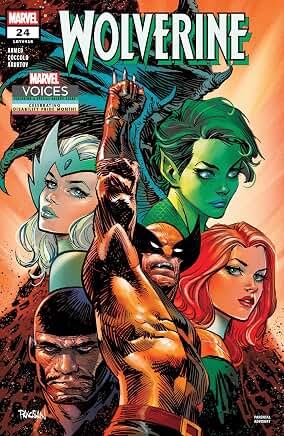
WOLVERINE vol 8 #24
“Master and Monster”
Writer: Saladin Ahmed
Artist: Martín Cóccolo
Colour artist: Jesus Aburtov
Letterer: Cory Petit
Editor: Tom Brevoort
COVER: Wolverine (with broken claws) posing in front of headshots of Alpha Flight. Apparently no one gave artist Dan Panosian anything beyond a list of names, because he’s drawn current members Puck, Snowbird and Marrina and the previous Vindicator, Heather Hudson. The current Vindicator, Agent Arsenault, wears a black and white costume, and per X-Men #12, she has short blonde hair.
There’s a back-up strip, which is the fourth part of the serial for Disability Pride Month – as before, there’s no attempt to recap the plot and no indication of where you can read previous chapters. They’re in Amazing Spider-Man #32, Uncanny X-Men #31 and Fantastic Four #14, if you care. But it’s got nothing to do with the X-books so I won’t be saying any more about it – except to wonder why Finesse seems to be the highest-profile explicitly autistic character in a universe that includes Reed Richards. (Or, hell, Scott Summers, but that’s another matter…)
WOLVERINE:
He says that his healing factor has been suppressed for “days”, though that might just mean issue #21 when he realised the problem. He wouldn’t have expected his broken claws to grow back overnight after issue #20, and as I’ve pointed out before, presumably his other injuries from that fight healed as normal. His healing factor is still working to some minor extent, so he comes round fairly quickly after being knocked out cold.
Understandably, he doesn’t have much sympathy for Mor – the story here is about him needing to defend the guy from Alpha Flight anyway.
SUPPORTING CAST:
Puck, Snowbird and Marrina show up in pursuit of Mor, as foreshadowed in issue #22. Remarkably, Wolverine only makes the connection at that point, even though he phoned up Puck specifically to ask about Department H nanotech. Let’s assume that without his healing factor, Wolverine isn’t really on top form mentally.
The three regular members of Alpha Flight have minimal dialogue and continue to take orders from the new Vindicator. To be fair, this is a perfectly legitimate Department H mission, since Mor really has done a runner with some highly sensitive technology. As in issues #15-16, Puck seems willing to fight Wolverine at least for the purposes of keeping him at bay. (Snowbird is also ordered to fight him, but we don’t see her response to that order before things go out of control with Mor.)
VILLAINS:
Dr Murat Mor. A flashback expands on the story that Mor already gave us last issue. He claims to have spent “years” working “as an expert in medical nanotech” – which sits a little oddly with Dr Reyes claiming in issue #22 that the field was purely theoretical, but perhaps the idea is that he was a scientist rather than the doctor that the art seems to depict.
Hoping to get access to more resources to save his wife, he signed up for Department H. Somehow or other, Department H was already in possession of “nanites carrying the techno-organic virus variant once borne by the mutant villain Post”, and even more bizarrely, Mor claims to have “read about them in an old medical journal”. The original Post was a herald of Onslaught, introduced with much fanfare in X-Men #50 (which is where he fought Wolverine). For those who may not remember, “Onslaught” was a notoriously chaotic storyline where the X-office was throwing out foreshadowing without any apparent clue of where any of it was going, and such plans as they did have seem to have got hijacked anyway when “Onslaught” was derailed to provide a catalyst for the unrelated “Heroes Reborn” event.
In his debut, Post was simply a random powerful guy who abducted the X-Men, fought them for a bit, and generally foreshadowed that Onslaught was a big deal. Not long after that, Cable #33 gave him an origin story as a mutant who had received a blood transfusion from Cable at one point, which is where he got infected with the techno-organic virus. Beyond that, Post didn’t come to much – he drifted around the second-tier titles for a while, and eventually got killed off in Cable #87.
Post never had anything to do with Alpha Flight, but presumably his nanites have wound up in their possession through the black market or something. Mor’s big idea was to modify the nanites to cure cancer, and to test them on himself, with predictable results. He says that the virus has begun taking over his body “and my thoughts”, so there may be a suggestion that he’s being rebuilt into Post himself.
His last-ditch plan was then to steal Wolverine’s healing factor, and so he came up with the cardiac-arrest-inducing device from issues #15-16 as a way of tricking Department H into implanting a “time-released healing siphon” into Wolverine’s bloodstream. He also hired Taskmaster to test the healing siphon and, supposedly, “to bring you in for a direct appeal”. (In issue #22, Taskmaster evidently interpreted this instruction as “abduct him”.)
In time-honoured tragic fashion, Mor has compromised his humanity for nothing, because his wife died this afternoon. He says that he can reverse the process, but doesn’t get a chance before Alpha Flight attack.
When cornered or anxious, he turns into his Post form. In this form, aside from brief moments when it’s wearing off, he speaks robotically and says things like “Commencing threat reduction.” The original Post wasn’t like this – he had a normal personality (well, as much as any one-dimensional henchthug does). Occasionally, he mutters things about keeping a promise to his dead wife. Aside from that, the Post personality seems to be mainly interested in escaping threats and getting to safety, and seems to perceive itself as acting in self-defence.
Agent Mehta and Taskmaster both have one-panel cameos in Mor’s origin flashback.
Vindicator. Agent Arsenault is still Alpha Flight’s field leader despite Mehta’s obvious irritation with her in issue #16. Consistent with her previous appearances in this series, she’s obnoxious and high-handed and views Wolverine as a traitor. When she debuted in Jed MacKay’s X-Men, she seemed to be depicted as someone who was fundamentally competent in other respects; Ahmed seems to write her as an overconfident loudmouth who makes matters worse by going in guns blazing.

Probably too many uncomfortable Elon Musk connotations with Reed Richards by explicitly revealing him on the spectrum. Next thing you know, he’ll be saying offensive comments as during the Silver Age again while having his cult on the internet making the excuse that he has Asperger’s and shouldn’t be getting judged for his being a horrible person.
Never once thought of Reed or Scott as in the spectrum, myself. They are just focused
@Chris V, Luis Dantas- Reed and Scott are very much a case of Depending On the Writer. Stan wrote Reed as relatively socially skilled. And Claremont wrote Scott socially unskilled but capable of learning. And many writers have had Reed and Scott come up with plans that required correctly understanding the thinking and the emotions of their teammates and enemies.
However, some writers seem to see Reed and Scott as being “on the spectrum”. Teen Scott from the Time-Displaced X-Men sometimes seemed to be on the spectrum in ways that Adult Scott isn’t usually. Scott in particular seems to have a large fanbase who think he’s autistic.
I can see an argument for Reed being neurodivergent based on various factors, but also, he’s a guy who can literally stretch his brain which could account for a degree of… flexibility, no pun intended, where his characterization is concerned. On the spectrum? *hand wobbles*
Scott? I’m sorry, but he’s been defined as a character with brain damage for as long as I can remember, and while that mainly affects his powers, it might possibly inform his personality. But again, he’s not one I’d put on the spectrum. He’s just an intensely type A personality who’s been forced to express control at all times since he was a child, and who was trained to be the leader of a paramilitary team for just as long.
Hank Pym is bipolar, Tony Stark is probably a narcissist with addictive tendencies and some sort of obsessive trait, Hank McCoy is… well, a mess. Bruce Banner is dissociative identity disorder taken to an extreme.
But actual autistic characters? You had the M twins (but not Monet), Laura Dean and Goblyn from Alpha Flight, Johnny Do from New Universe’s Psi-Force, Legion depending on who’s writing him/which alter is running the show (he’s plot-conveniently anything you want or need him to be so take that for what it’s worth. Also, he was most explicitly presented as autistic in the ’80s in his earliest appearances, much less so after the first storyline.)
Heck, even Finesse wasn’t explicitly labeled as autistic for quite a long time. Neurodivergent from the start, but I feel like pinning her down as autistic is a recent development. But she’s probably one of the best cases they have given that this is comics and while lots and lots of characters come off as neurodivergent by sheer virtue of being themselves, actual diagnosed accurate autism is very far and few between.
Which was the problem with those characters being “diagnosed” as autistic in the past was that autism was so little understood by the majority of laymen until relatively recently that most of those characters came across as a pop psychology stereotype or a complete misunderstanding of the condition. Legion had very little in common with autism even given understanding of the meaning back in the 1980s. Although, the same was often true of Schizophrenia (sometimes even moreso for this diagnosis) or DID.
It seems to me that the idea goes against the grain of the very genre.
It is a whole plotline when Iron Man or Wolverine loses control of the repulsors or claws. With very specific exceptions, hardly any superhero ever applies too much or too little force, attention, effort or time.
Those are the people who adapt superbly and instantly to the unusual, the unexpected, the superlative. They are not allowed to have shortcomings or even challenges that are not epic or actively dangerous. Not in 2026 at least.
I know this comic must be terrible and that’s why nobody is actually discussing it, but how do Wolverine’s broken and presumably blunt claws cut their way out of his hand?
And without a healing factor, why aren’t his hands constantly bleeding from the *compound fractures* that are his natural bone claws?
If you’re going to break Wolverine’s powers, at least think that idea through a little bit.
@Si *
@Thom H
No-Prize: like all other mutants (and humans) who got resurrected by The 616-Five, 616-Wolverine got his own mutations already fixed** on 616-Krakoa LOL
*do you happen to be Simon Spurrier the writer ? He’s the only other Simon I’ve ever encountered who shortens his first name to “Si”
**which is why I personally that 1) 616-Chamber’s face is actually already fixed under all that psychic energy, it’s just being covered by it (just like My Hero Academia’s Endeavour) and 2) 616-Cyclop’s inability to fully control his optic blasts are actually due to the constantly-concussive nature of their extra-dminensional energies themselves , which obviously must come from Cytorrak’s Crimson Cosmos (I.e. so-called“The Punch Dimension”, which if not the CC itself per se, must necessarily be adjacent to it, just as the Brimstone Dimension must by its very nature be right next to the DarkForce Dimension)
@Chris V- Isn’t part of the problem that autism was considered a form of schizophrenia before 1980? So many writers in the 1980s conflated the symptoms of schizophrenia and autism. Legion was probably intended by Claremont to be schizophrenic, not autistic. And then there’s the Alan Moore Swamp Thing story with “autistic ” kids- I think he was confusing autistic with schizophrenic. (Although one kid became “autistic” after seeing his parents murdered in front of him- maybe Moore was thinking of catatonic?)
I wonder how much longer robotspeak like this will stick around in comics. It’s had a bit of a retrofuturist feel for a while, but given the real world existence and ubiquity of LLMs that can produce natural language, a robot or cyborg that can only speak in a wooden script isn’t too impressive.
Or, looking at it from the other side, maybe I would be less resistant to using an LLM if it called me selffriend.
I once instructed one of the LLMs I use to alternate among five specific dialects in sequence. It was hilarious.
I must remember to add “Warlock self-speech” to the list next time. Maybe with a side of Century’s three-word redundancy pattern for extra points.
Ryan North seems to write Reed Richards as neurodivergent in every way short of a direct diagnosis. It’s a pretty well-constructed presentation, with Reed possessing real, deep empathy but having trouble with processing and expressing emotional cues the way most other people do.
Laura Dean is a good example of the poor understanding of autism in the 1980s and 1990s, as she was explicitly written as having been “cured” of her autism once she spent some time around other people outside the Dreamqueen’s dimension. (In retrospect, Laura would be better diagnosed as having complex PTSD of some kind.)
I’d suggest that the worst autism spectrum characters ave always been the “savant” types, who fall straight into the most offensive and dated stereotypes (and really aren’t used much at all anymore). The worst of these was probably Tweedledope of the Crazy Gang being explicitly labeled an “idiot savant” in the 1989 Marvel Handbook.
Also, Finesse strikes me as a questionable choice for representation, since Avengers Academy seemed to suggest that she had some form of antisocial personality disorder, what with her blackmail of Quicksilver and her decision to kill Jeremy Briggs in a way that struck directly at Laura/X-23’s trauma.
Finesse’s general amorality, which is treated as a side effect of her powers, would play into some negative stereotypes of people on the spectrum if that’s how she’s now being labeled.
@Omar- Tweedledope is an odd example because he’s basically a figment of Jim Jaspers’s imagination brought to life. So he SHOULD reflect Jaspers’s misconceptions and biases instead of reality.
The terms “idiot”, “moron”, and “imbecile” used to be considered psychological classifications. The idea of the “idiot savant” is still recognized but as “savant syndrome”. It is no longer associated with autism spectrum though, as research has shown that only some people who fit the definition of “savant syndrome” are also on the autism spectrum.
I don’t know that Tweedledope was ever presented as autistic, but he could still fit the classification of savant syndrome, just the terminology used in the Handbook would be outdated and was even kind of offensive by the ‘80s.
“I know this comic must be terrible and that’s why nobody is actually discussing”
To be fair, that’s true for maybr half the conversations on here. Which isn’t a good sign for the line as a whole…
Yeah, it’s great. Come for the reviews of the X-Men line, stay for the conversations about autism and Russian literature. Anything to not have to talk about the boring retreads happening in the majority of the books or whatever Simone happens to be writing as “Uncanny X-Men” this month.
No I’m not Si Spurrier. Simon isn’t too common a name, but it is regularly shortened to Si in the UK and so also my home, Australia. I’ve been called Si since I was a baby.
Creator Simon Spencer, who wrote a number of series for Vertigo Comics, usually went by Si Spencer also. Although, since he is dead, Si is probably not Si Spencer slumming either.
@Michael: Tweedledope was a nameless cipher in his original appearances in the “Twisted World”/Jaspers Warp story, and then a very minor named character who travels in a rat-drawn sleigh in the later Jamie Delano and Alan Davis stories.
The “idiot savant” term seems to be from the ’89 Marvel Handbook, and there’s no real sense that it’s meant to suggest anything about Jim Jaspers.
Instead, it seems like the writers’ own phrase to explain Tweedledope’s abilities in the early Excalibur stories, such as his seeming creation of Widget in issue #1 and his construction of a mind-swapping device in issues #4 through 5.
@Chris V: The movie Rain Man came out in 1988 and greatly popularized the idea of the “autistic savant” in popular culture, and the movie’s many imitators helped cement this as the popular notion of autism.
I recall some effort on the part of the psychiatric community in those years to emphasize that not all people on the spectrum are “savants.”
I did quick search in PubMed, and it seems that the phrase “idiot savant” was still in use in the scholarly literature even in the 1980s with a few uses persisting into the early 1990s.
Sorry, that should be “Crooked World,” not “Twisted World.”
[…] #24. (Annotations here.) Business as usual for this book, really. At this point, it’s hard to keep finding things to […]
The thing with the spectrum is that it’s a … spectrum, not a binary. That may sound obvious but yeah. I think it’s very fair to read Scott and Reed as somewhere on the spectrum.
The misuse of “autistic” in older comics reminded me of obscure Spider-Man foe “Schizoid Man” who was criticized in the letter page even at the time (1979) as being, well, not “schizoid”. He’d be a good one for the OHOTOHOTMU and I am honestly shocked that he had more than one subsequent appearance (in X-Men Legacy no less…)
“No I’m not Si Spurrier.” – Simon Spurrier
Something that Si Spurrier would definitely say.