Daredevil Villains #86: Blackheart
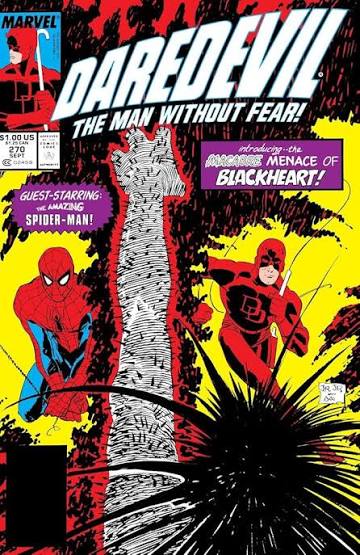 DAREDEVIL #270 (September 1989)
“Blackheart!”
Writer: Ann Nocenti
Penciller: John Romita Jr
Inkers: Mike Manley & Al Williamson
Colourists: Max Scheele
Letterer: Joe Rosen
Editor: Ralph Macchio
We skipped over quite a few issues last time, so for anyone wondering what was in them: issues #259-263 are the end of the Typhoid Mary storyline, with the last two of those issues doubling as Inferno tie-ins. Issue #264 is a fill-in story with the Owl. (Yes, I know there are some gimmicky street gangs in it too, but it’s an Owl story.) Issue #265 is another Inferno tie-in. Issue #266 was a Christmas story with guest villain Mephisto. And issue #267, which we covered last time, has Bullet and the debut of Skip Ash, with Daredevil leaving New York City to spend some time upstate.
Issue #268 is a small town crime story, and issue #269 has Freedom Force as the guest villains. So that brings us to issue #270. I skipped over Mephisto earlier, but he does show up quite extensive in the next year or so. Nonetheless, he’s still an outside villain, as the storyline acknowledged – it ends with the Silver Surfer showing up to deal with him, and Daredevil leaving the two of them to get on with it. Besides, we get to talk about those issues anyway, thanks to Blackheart, who is a Daredevil original.
Issue #270 opens by telling us about a hilltop which has been cursed since a woman was murdered there in 1658. Strange roses bloom there. In the present day, a sexual assault between two teenagers tips the location over the edge, causing Blackheart to spontaneously emerge from the ground. His character design that only really makes sense in Romita’s blocky, stylised art. He’s essentially a thorn-covered black silhouette, with some bluish highlights that give only the impression of a face. The narrator refers to his “blinding darkness”, and you can see the idea.
On seeing the two teenagers, Blackheart recognises the girl as good, and is delighted by their reaction to him. So he kills them both. Mephisto shows up to congratulate his “son” on his first kill. Blackheart attacks Mephisto on sight, to no apparent effect. Mephisto is very pleased with his son’s feistiness, but lectures him about knowing his place, and tells him that he needs to show more imagination “explore more sublime forms of evil”. For example, it would have been much more impressive to lure the innocent girl into committing a murder. Mephisto then gives Blackheart a human form, warns him that he needs a disguise because evil loses its power when it’s seen too clearly, and sends him out into the world.
All that is the first half of the issue. The second half is very straightforward, perhaps because the whole point is that Blackheart isn’t very sophisticated. For some reason, even though we’re in the middle of the upstate New York period, Daredevil is in Coney Island. Blackheart attacks Daredevil, and a passing Spider-Man gets involved too. The broad idea is that Blackheart is trying to lure Daredevil into killing him, but Spider-Man snaps him out of it, and when the fight attracts a crowd (making him too visible and undermining his power) Blackheart teleports away. The issue ends with a very stylised splash page of the hill. The narrator tells us that Blackheart has collapsed onto the hill, sinking into the ground, and hoping to be allowed to rest in peace – but the art is virtually abstract.
In his first appearance, Blackheart is barely a character. He doesn’t speak, he mostly acts on instinct, he’s presented as a confused child, and when he does have a coherent thought, it’s relayed to us via the third person narrator. He seems to be simply a toy of Mephisto, who becomes less co-operative the more self-aware he becomes.
When Nocenti comes back to Blackheart in issues #278-282, he’s matured somewhat. Issue #278 opens with Mephisto repeating his lecture about imaginative evil, and so Blackheart has another go at luring Daredevil. This time, he makes his presence known, but stays in a meek, human disguise, and provokes Daredevil into beating him up – which is just following Mephisto’s formula. But he also points out all Daredevil’s own traits of aloof superiority. By issue #280, he’s hanging around on the fringes of the story, disguised as minor characters, and influencing Daredevil’s makeshift supporting cast to fight.
Blackheart decides that Mephisto’s vision is old and tired, and that he’s the next generation of evil. He starts questioning Mephisto to his face about whether there’s any point in being worshipped by the damned. But ultimately he concedes that he can’t actually corrupt Daredevil and co, just make them squabble. So, at Mephisto’s suggestion, Blackheart just pulls the whole bunch of them directly into Hell, where they spend the next few issues. From Blackheart’s point of view, the message he draws from his own failure is that humans aren’t as controllable as Mephisto makes out, which in turn implies that Mephisto’s control of his kingdom must be more tenuous than it appears. So he decides to lead a revolution.
In part, these stories are a response to the fall of the Berlin Wall – Blackheart argues that Mephisto represents a form of authoritarian dictatorship which is now becoming obsolete. But Blackheart also argues that Mephisto has allowed himself to become the humans’ image of evil, and that he is just as trapped and cursed as everyone else in Hell – this is Mephisto as the dictator with no exit strategy. Mephisto keeps squashing Blackheart but can’t make him go away. Finally, Mephisto punishes Blackheart by exiling him to earth, intending that Blackheart will learn why reigning in Hell is better than living among humans. Blackheart will keep his powers, but it’ll drive him mad to use them. And that’s how Blackheart is left by Nocenti, evidently intended as a workable character for future use.
Nocenti didn’t come back to him, but he did find a place in books like Ghost Rider where he could serve as a more straightforward agent of Mephisto, or as a rival claimant on the throne of Hell. Somehow, he eventually wound up in the Avengers Academy Infinity Comic. Being the son of Mephisto is a pretty flexible concept, after all, and Romita’s design for him is great when the art style can accommodate it.
But the angle in Nocenti’s stories is more specifically about the idea of a new generation of evil. The fill-in story in issue #264 also touches on this theme, with the Owl forced to work with a bunch of disrespectful gang members who treat him as a joke. In that story, though, it’s the younger generation who come across as idiots, since it was an issue drawn by Steve Ditko, with a meta angle of “respect your elders”. Here, Mephisto sees well worn tropes as something eternal and artistic, while Blackheart apparently follows through on the literal implications of Mephisto that evil should be creative.
The oddity about this story is that Blackheart doesn’t really end up representing a new manifestation of evil at all. Presumably the idea is that evil will manifest in new ways in new circumstances, but there’s little sense of what that might be. At times Blackheart comes across as a noble rebel paying lip service to the idea that he’s evil.
You can also question whether he’s really viable as a future Daredevil villain. The Mephisto arc is fantastic, and features some of Romita’s best art, but it also works in part because it’s such a departure – after that story, Nocenti tacks back towards normalcy. There’s a place for outright magic in Daredevil, but it’s probably a sparing one. Still, in banishing him to Earth, Nocenti was clearly trying to create a Blackheart who could exist among humans as an Antichrist figure, a corrupter, or perhaps simply as an ambiguous revolutionary; she was trying to incarnate a Mephisto-type character in such a way that he could function as a Daredevil villain who was forced by circumstances to act with subtlety. That balance could have worked.

The weird thing about the Avengers Academy issues is that they actually attempt to redeem Blackheart.
Blackheart also appeared in the very weird Christopher Cantwell Hellcat series which seemed to suggest Patsy was demonic all along. Cantwell was trying to make a point about the dangers of seeing people as completely good or completely evil but it just turned into a muddled mess and every writer that’s used Patsy since has ignored it.
Your description of Blackheart had me wondering when Dan Simmons’ Hyperion was published. 1989. JRJR could have read it and was influenced by the Shrike. Or even just seen it on the cover. But there’s no information I could find about where the visual inspiration came from.
@Joe- The problem is that according to GoodReads Hyperion was published on May 26th, 1989 and according to MarvelWiki Daredevil 270 on May 2nd, 1989.
@Michael Aha, that’s more information than I could find. I was thinking that if Hyperion came out in January and this comic came out in September, there was a chance. So much for that theory!
My first introduction to Blackheart was Mackies wolverine ghost rider punisher mini, and it sequels. He has always felt a GR character form that reason though those crossovers and the later next generation venom. X-23 red hulk ones have always done well in making him feel. As big a threat as his dad.
There is so. Much oddness in Avengers academy including Blackhearts story being based around the pre teen Billy and Tommy that means I don’t think it will ever be treated as cannon in the future,
With his dad going playing the unpopular hits of Brand new day over in Cap, and Hela doing queen in black we might need an new Hell lord for future stories
@Alastair- I don’t know why people are taking Cap’s deal with Mephisto at face value. We saw Cap and Doom talking about Mephisto a few pages earlier but we didn’t see all of their conversation. And the Red Skull warns that things could go wrong if Doom takes over Hell. My guess is that Cap’s deal with Mephisto is a trick, like Billy Batson’s deal in Underworld Unleashed or T’Challa’s deal in Priest’s run. But then Doom tries to take over Hell, and things go wrong. and that’s where the red skies and demons in Black Panther/ Namor: Doomed come from.
I just meant giving the hero a Faustian deal, I expect a much better outcome the BND. Especially with Cap its still to close to secret empire to do so anything that breaks the character I have faith this will be a satisfying story and a way to tank the book
Again, the story about Blackheart is a continuation of Nocenti looking at the concept of free will. We see Nocenti again with an inversion of the monotheistic template of “free will”, in that humans can choose to do good, but free will also gives humanity the ability to choose evil. So, the fact of evil’s existence is predicated on free will. Yet, Blackheart sees free will as the very reason why Mephisto cannot hope to win against humanity. Humanity is, in effect, more powerful than Mephisto due to humanity having free will while Blackheart sees Mephisto as lacking in free will. Mephisto is what he was, basically, created to be…evil and, as mentioned in the article, trapped in his own authoritarian rule over Hell.
Meanwhile, we see a more “traditional” reference to free will with the evolution of Blackheart. Blackheart is created by a being who, apparently, lacks free will, but yet the creation gains the ability of free will. Blackheart, unlike Mephisto, can make the choice to be (or perform) evil. At the same time, this paradoxically gives this being created by a being who has no freedom except to choose evil the ability to also perform good. He can see the goodness in humanity’s ability to achieve freedom, while Mephisto is, once again, trapped in the old paradigms of only seeing “freedom” to mean that humanity can damn itself.
“His character design that only really makes sense in Romita’s blocky, stylised art.”
He also looks great in 2D sprite form in the Capcom fighting games.
I don’t know if JR Jr watched Star Trek: The Next Generation, but the episode “Skin of Evil” had aired in 1988. It featured an oily, black, vaguely-humanoid creature that was the embodiment of evil. It’s possible there was some influence there.
Are you suggesting Black heart killed Tasha Yar? That has to be his most evil act.
Are any villains of note introduced in the DD annuals of this era? They were often tryouts for new villains.
No! The Annuals were terrible at this time. Nocenti didn’t have the time to write them. They mostly had subpar writers in place of her (Gregory Wright). It was usually a crossover. There was “Atlantis Attacks” followed by “Lifeform” (the Annual crossover for all the leftover Marvel books), then “The Von Strucker Gambit” (which had almost zero to do with DD). Those were the Annuals from the Nocenti years.
It was in the 1993 Annuals (post-Nocenti) when Marvel decided to introduce a new character that no one cared about and was probably never heard of again. Daredevil’s 1993 Annual introduced the character find known as…the Devourer. I’m guessing it was the Devourer’s only appearance.
The weird thing about Daredevil is that there were NO annuals before 1976 and 1989. Most other major Marvel series had multiple Annuals during the 1977-1988 period. At first it was because Daredevil was bimonthly and Marvel had a policy of not doing Annuals for very low selling series, which bimonthly series usually were. But Daredevil went monthly in 1981 and it never got an annual again until 1989.
And when Daredevil DID get an Annual again, they mistakenly numbered it as 4 instead of 5.
@Chris V- The Von Strucker Gambit was during the Chichester years.
The Devourer was created by Greg Wright. Coincidentally, his only return appearance was in Daredevil 335-336, which were also written by Greg Wright.
I’ve always liked Romita’s Mephisto design. The template being an ordinary man with a receding hairline, only his reddish skin giving a hint that he’s not just some bloke in his undies. And Romita makes him this thing that’s not remotely human, which becomes increasingly gigantic and bloated as he feeds on the characters’ torment/loses his cool at Blackheart/Romita watched Empire Strikes Back (whichever it was).
I suspect that the original intent was to have the story happen somewhere outside of New York. Spider-Man is initially seen as a passenger inside either a charter bus or a tour bus and his dialogue mentions the “book tour”.
That is a reference to the promotion of the photobook “Webs”, first mentioned in Amazing Spider-Man #304 (circa the same time of publication as Daredevil #258). It was the pretext for Peter to travel to Nevada, where he met the Joe Fixit version of Hulk. Daredevil #270 does not require him to be anywhere near New York City, just to be near an amusement park with a roller coaster.
Then again, Coney Island is some fifteen miles from Hell’s Kitchen, so I _”may”_ be splitting hairs…
It should be noted that the Nocenti also had Cap appear during the upstate New York period, only in this case it was even worse because it takes place DURING a Captain America story. Daredevil 283 takes place during the Streets of Poison storyline in Captain America, where Cap is acting irrational to due to drugs he inhaled in one of the Red Skull’s warehouse. That story takes place in New York City. Yet, Matt encounters Steve in a town in upstate New York. There’s no explanaaion how Steve got there. except a vague line about following a lead that didn’t pan out,.
I’m seriously wondering if Nocenti understood how much distance there was between New York City and what is usually considered upstate New York. She seemed to think it was just a brief hike away.
I’m sure it’s just a joke, but it should be noted that Nocenti attended university at SUNY-New Paltz, which is north of New York City. Looking online, it is actually 80 miles north of NYC. Nocenti has also lived in New York City. So, I’d say she’s very aware of the geography of New York (I mean, she might have been high for a good amount of that time so maybe it did seem like the length of a hike, heh). Chalk her use of directions up to the surrealism of her stream of consciousness prose, where someone can exist in two locations at once.
Speaking of Ghost Rider connections, Blackheart was also the villain in one of the Nicolas Cage Ghost Rider movies, if memory serves…
“Are any villains of note introduced in the DD annuals of this era? They were often tryouts for new villains.”
Annuals do count for these posts, but at this point Marvel hadn’t published a Daredevil Annual in over a decade. The 1989 Annual came out a few weeks after this, but it’s an Atlantis Attacks crossover.
I’ve only read one comic book with Blackheart, and that was the Fantastic Four 1999 Annual, during the Chris Claremont run where Blackheart was part of a new Hellfire Club Inner Circle led by Selene. Ladrönn’s art was also a good fit for the JRJR design.
Otherwise I’ve seen a lot of him in the Capcom games: “Dark Thunder!”
@Michael
Captain America #374-377 happen between Daredevil #283-284 and feature quite a few characters better associated with DD at the time, including Kingpin, Bullseye and Typhoid Mary.
#284 does not spell it out, but Matt’s unusual state of mind is a direct result of having been beaten by Crossbones and then by Captain America shortly after the events of Daredevil #282 and #283. Mark Gruenwald went to considerable lengths to spotlight Daredevil’s cast in those issues, apparently to little consequence. They technically ought to be important for DD – Crossbones even unmasks Matt at one point, and the Kingpin fights Red Skull mano-a-mano – but ultimately they are just easy to forget.
The stretch of DD from Inferno through the journey to hell arc was prime stuff for me. Blew my 13 year old mind that superhero comics could get this weird.
While I was reading Daredevil during this period as a kid, Blackheart is still almost a footnote in my mind. He absolutely stands out as a Ghost Rider villain, and I echo the earlier statement about Hearts of Darkness being my core memory for the character. Howard Mackie was not a subtle writer, and one would think him picking up a Nocenti character would be disastrous, but he does a good job with Blackheart.
Nocenti had planned for the second Longshot miniseries, which Art Adam’s never got around to doing, to feature Mephisto as a villain. I suspect much of this phase of her Daredevil run consists of ideas that were originally for Longshot. The trophy wife thing certainly fits Longshot’s themes.
Blackheart had a mildly interesting role in the early ‘90s in Marvel UK’s Warheads book. He was secretly the voice in the mind of the seeress character, Misha. If I recall this was tied in to BH’s plans to overthrow his father (who was also the much-resented patron of the Warheads’ employers, Mys-Tech).
[…] O’Brien’s tallying of the villains of Daredevil continues, for House to Astonish, as this week we observe the muted emergence of Blackheart, and give consideration to how far […]