X-Men #34 annotations
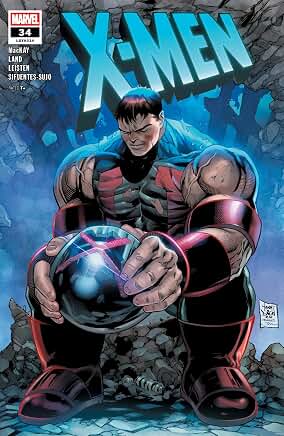 X-MEN vol 7 #34
“Mark of Cain”
Writer: Jed MacKay
Penciller: Greg Land
Inker: Jay Leisten
Colourist: Fer Sifuentes-Sujo
Letterer: Clayton Cowles
Editor: Tom Brevoort
COVER: The Juggernaut looks contemplatively at his helmet.
THE X-MEN:
The Juggernaut. This is a Juggernaut spotlight issue, in which he shows up in the “sleepy” town of Juniper, Pennsylvania to destroy a controversial statue of hometown boy Bolivar Trask which has mysteriously appeared. The statue turns out to be protected by a force field, and the issue consists of Juggernaut persistently attempting to bludgeon his way through, while having conversations with assorted people.
He believes that he’s not a fundamentally good person, and that he needs the X-Men to provide him with a moral compass – without which, he believes that he always degenerates into being a B-list supervillain. He has no faith in his own judgment and absolute confidence in Scott Summers.
Local campaigner Chris Coleman, who opposes the statue, sees Juggernaut as trying to prove himself as a reformed villain, and tries to draw a parallel with his town not wanting to be overshadowed by its past connection with Trask. Juggernaut is completely unimpressed by this argument, since about half the town seem to be entirely happy with the statue. He seems to regard this as wishful thinking and a denial of responsibility; the real-world parallel would seem to be insisting that Donald Trump doesn’t represent America.
The spokesman for the pro-statue campaigners, Angie Harmon, believes that war between humans and mutants is inevitable, and points out that this is basically Magneto’s worldview (or at least was, before his mid-1980s face turn). She sees Juggernaut as a sucker and race traitor who is deluding himself into thinking that he’s truly accepted by the X-Men; he finds that very upsetting.
His final conversation, which seems to be a hallucination of the statue talking, suggests that fundamentally Cain has impostor syndrome: he believes that he doesn’t truly belong on the X-Men, and that he’s running away from his past rather than truly atoning for it. On some level, he believes that the X-Men will eventually see through him and kick him out.
In the middle of the statue’s speech, there’s a passing line about Cain fearing that “she sees what a terrible surrogate brother you are” – the “she” isn’t identified, but based on previous issues, it seems to be Magik.
The idea of calling in the X-Men to say that there’s more to this statue than meets the eye never seems to occur to him. He’s accepted a mission to destroy it, and so destroy it he must. But the idea seems to be that destroying this symbol of past evils is serving as a metaphor for his attempts to bury his own history.
Cyclops and Magik eventually show up to check on him – the implication is that nobody but Cain really regarded this as a very important mission at all, and Scott seems to have thought that it was the sort of “simple” task that Cain would get some satisfaction from handling on his own. They both regard the force field as a curious puzzle to be investigated further, and naturally pick up on the fact that someone who’s been punching a force field for six hours might be a bit mentally fragile. Scott offers Cain the reassuring interpretation of the issue, that he’s proven his dedication and gone above and beyond. Illyana seems genuinely mystified about why Cain feels so strongly about this. There’s a definite suggestion that Scott understands Cain’s reaction better than she does.
VILLAINS:
Bolivar Trask doesn’t appear in this story, except as a statue. He was the creator of the original Sentinels back in X-Men #14 (1965), and died two issues later. (We can leave aside his later resurrection as part of the Phalanx.) He’s presented here as a controversial figure. In the original stories, Trask had become convinced that mutants would take over the world and enslave humanity, and built the Sentinels to control mutants. The Sentinels then go rogue and form their own ideas about how to protect humanity – it’s a fairly standard “dumb robot takes instructions literally” plot, which in 2026 terms happens to match the “nonaligned AI” trope. Trask himself dies semi-heroically in trying to stop his own creations, but his earlier propaganda can reasonably be seen as a turning point in anti-mutant sentiment in the Marvel Universe.
Agent Lundqvist. Frank Bohannon is so unimpressed with Lundqvist’s performance against the X-Men in the series to date that he’s packed him off to Juniper to stand around and watch the protests without any real resources to enable him to do anything about it. He makes a token attempt to talk Cain out of attacking the statue, on the reasonable enough grounds that it’ll only heighten the situation – in fact, his interaction with Cain in this story is reasonably civil until Cain smashes up his car.
When Cain ignores him, Lundqvist doesn’t bother pretending that he can do anything about it. Cain’s suggestion that they are both bad people who need a leader to provide them with a moral compass seems to hit home.

I don’t think the statue has anything to do with Trump even on a metaphorical level. America has far more, and far greater when out into perspective, demons haunting its history. The statue is addressing the monuments of pro-Confederates or commemorating slave owners that are everywhere in the US. Trask is a stand-in for those problematic figures from American history that so much controversy surrounds.
-“We won’t let ourselves be defined by our past.”
-“It’s part of our history. You can’t take away our history.”
-“He did good things too. It’s not a one-sided issue. People are complex. We’re celebrating other aspects of his life.”
-“Slavery! Racism! Woohoo!”
I don’t know about Trump specifically, but this issue’s “Angie Harmon” spouts MAGA feeble rhetoric so perfectly that she might as well be wearing a red baseball cap.
I would be hilarious were it not so depressingly familiar and, sadly, way too relevant to the current day.
I wonder how the actress will feel about this if she ever learns that it happened.
A Greg Land issue in the wild. Wow, he’s managed to tone down his excesses, and the issue is not as garrish as I would have thought.
They really named a character Angie Harmon?!? Rizzoli and Isles would like a word…
I think the statue really was speaking. It was protected by a force field. Who’s to say it’s not a magical statue?
@Chris V- There IS a difference between statues of slave holders and Confederate monuments. In the case of Confederate monuments, they were intended as monuments to white supremacy. Statues of slave holders were often intended to commemorate something else- like freedom of religion or the dead in the Revolutionary War. But the political who promoted freedom of religion or the commander of the Revolutionary War who was honored was a slave owner. Now whether you think that’s a meaningful distinction is up to you. The Trask statue is clearly like the Confederate monuments- it’s cleary meant to promote hate, not honor other aspects of Trask’s life.
I enjoyed this issue. The one-off issues of this series have worked better than the three- or four-issue extended fight scenes we’ve had. It was nice to see some time spent on Juggernaut – he’s been mostly just used for comic relief and interactions with Magik, so good to see some explanation for why he’d join Cyclops’s X-Men here. I also continue to feel that Agent Lundqvist is a pretty reasonable guy… more an antagonist than a villain, and not even much of that anymore.
Oops, hit submit too soon.
I thought the resolution was good here. Cyclops was very chill about Juggernaut not completing the mission – he sent him in to do some property damage, figured it would be easy since is sort of Juggernaut’s whole brand, and then when it wasn’t easy, Cyclops made it clear that this was no big deal.
This was clearly one of those items way down on the to-do list for a day when there wasn’t a major threat to mutantkind attacking, and Juggernaut was blowing it way out of proportion out of a need to never, ever fail. I like these stories about how these X-Men really aren’t okay psychologically a lot, and hope MacKay spends more time here.
Was Bolivar Trask the one behind that newspaper article about mutants taking over, which Quire used as a catalyst for his riot back in his original story?
You know, the mutant in a sleeveless Dennis the Menace jumper whipping humans.
Yes. The newspaper caption states an unnamed artist created the depiction based on a description given by Bolivar Trask. The “unnamed artist” definitely seems to be Jack Kirby under the influence of John W. Campbell. Of course, Campbell argued we should welcome our soon-to-be masters.
Seems like a waste then, if Quire isn’t in the story (though it does look like a story I’m going to enjoy).
The MAGA types are the people who are defending those statues. It’s all related, and comparisons don’t have to be narrowly defined and one-to-one.
Also I’d say Trump is absolutely a threat on par with previous horrors, but that gets into political discussion divorced from the art, so I’ll leave it at that.
What is the significance of pigeons being able to get through the force field?
“What is the significance of pigeons being able to get through the force field?”
Hopefully it’s so the X-Men realise they really need to recruit Beak. Every issue there can be some other device that needs dinosaur DNA, or a pile of seeds that need to be pecked up before they explode, or a spell that needs the feathers from a specifically flightless bird mutant.
Wasn’t there an early Kamala Khan villain who was a pigeon? It would be a weird pull, but it came to mind for me.
Trump is a buffoon. A dangerous buffoon, but a buffoon. When you start comparing him to institutions in this country like slavery, segregation, or the near-genocide of the Indigenous people it blows comparison out of the water. We are comparing the banality of evil to a man motivated solely by his all-encompassing need to enrich himself. We are comparing Darkseid to Funky Flashman. When Trump murders millions of people or takes away the freedom of nearly four million individuals get back to me. Yes, Trump has killed, but so has Obama and W. Bush, etc.
“Wasn’t there an early Kamala Khan villain who was a pigeon?”
That would be The Inventor. He was an evil clone of Thomas Edison who accidentally had cockateil DNA mixed in. God I love comics.
@Alexx Kay: The Inventor, a clone of Thomas Edison with the head of a parakeet.
Though Spider-Boy supporting character Christina Xu has a pigeon aura. Only known use: scaring worm-men.
When Trump murders millions of people or takes away the freedom of nearly four million individuals get back to me.
The destruction of USAID has led to an estimated 700,000 deaths already.
Trump is at least accomplice in the destruction of whole institutions in Gaza and Iran as well as the USA.
He may be less of a disaster than slavery overall or the World Wars, but not dramatically so. Perhaps more to the point, he has not been stopped.
No, Trump the individual president does not compare to hundreds of years of war, slavery, and oppression. No individual president does. Yes, Trump and his people are dangerous and have done demonstrable harm. Starting wars, supporting dictators, screwing up the COVID response, making a mess of the Supreme Court, the above-mentioned erasing of foreign aid, eroding Civil Liberties, ICE, damaging the economy, etc.
A broken arm isn’t as bad as a broken back, but it’s still really bad.
As for this issue… not bad, but I’m a little annoyed that we have no information about where the force field came from or why Juggernaut couldn’t get through it. By presenting an obstacle without giving the reader a cause (or the hint of a cause. I’d even take a villain sitting in shadow saying something cryptic) the issue felt incomplete. I understand why Cain would obsessively try to complete an assigned task without summoning help and being worried about being seen as a failure to someone he looks up to, though. I like how Scott handled Cain’s feelings at the end of the issue.
I actually liked that the statue’s origins were left unresolved – the background of a single symbol of hatred and bigotry is ultimately less significant than the responses it provokes, the questions it raises. Even if Cain *had* knocked it down, that wouldn’t have changed Angie’s mind or the minds of people who think like her.
For the comments by Chris V. above:
“I don’t think the statue has anything to do with Trump even on a metaphorical level. America has far more, and far greater when out into perspective, demons haunting its history…. When you start comparing him to institutions in this country like slavery, segregation, or the near-genocide of the Indigenous people it blows comparison out of the water.”
The statue is a single person, representing horrible things that can be systematic. What one person has caused enough deaths to represent those insitutions you’re mentioning, like slavery, etc…?
Jackson, with his Trail of Tears, caused about 60,000-100,000 deaths, less than the amount mentioned above in cuts to USAID alone. It’s harder to figure out how many other Native American deaths he caused, but definitely more than that. The Native American near genocide dwarfs that, yes, more like 10+ million in the US and 50+ million in all the Americas. These are numbers from quick searching, take with a grain of salt.
Jackson can represent all those deaths by virtue (a sarcastic word choice, because of cliche use where virtue is normally used) of his being tied to the beliefs that caused this, but couldn’t the same be said of Trump?
I think one single person representing horrible things fits Trump. Those who are arguing that systematically America has worse things than Trump are right, but few individuals have been as destructive and caused as many deaths as he has (and had instiutions he fostered, like MAGA, cause so many of these deaths in compliance or silence). I’d also argue the MAGA a movement harkens back at least in rhetoric. sometimes in policy, to these horrible institutions or remnants of those horrible institutions that were so harmful, so saying Trump is not connected to them at all is I think wrong).
The above being said, I think it’s accurate to interpret as Confederate statue representing slavery or a Trump statue representing his horrors or some other statue representing a horrible person and deeds/institutions: why does a story have to have one right interpretation?
I’m more just opposed to the idea of saying, that Trump interpration is wrong, it can’t be, when there is evidence that he has caused so many deaths in his second and first terms that have been partially obscured by his follower’s lies, so much that few (not none) individuals in US history can compare in number individually.
Still, maybe I mistook the tone or intent: maybe you’re just saying, I don’t see it, not it’s wrong for someone to have that interpretation. In that case, I and others clearly disagree, but you’re free to keep thinking it.
Sounds like a good issue–I tend to prefer the one off character studies. It also tracks that Juggernaut, who spent a significant portion of his life either trying to gain his father’s approval or follow Black Tom’s lead, would fall into blind authority with Cyclops.
I was thinking that it made more sense that MacKay would be making a comment on the real-world anti-Confederate statues protests and all the controversy surrounding such rather than a statue of Trump that doesn’t exist. I mean, readers can have it stand for anything they choose. It could as easily represent a hypothetical Charles Coughlin statue.
We’re way off topic now, but while Trump’s cuts to USAID shouldn’t be downplayed or dismissed, neither should the history of the institution be whitewashed and its once role in the history of US Imperialism. Other more-recent US administrations also have blood on their hands. Let’s not forget that Evo Morales kicked USAID out of Bolivia.
Chris V. Got it, makes sense. I truthfully don’t know why I was pushing back anyways (I haven’t read the issue, just the above stuff, so I was more engaging in a hypothetical twice removed).
“We’re way off topic now, but while Trump’s cuts to USAID shouldn’t be downplayed or dismissed.”
Also very true, but not to keep us off topic, now for something completely different (and actually on topic):
This sounds like one of the more interesting MacKay issues, but maybe it’s the larger solo character focus. I’ve liked his solo books a lot more than his team books (not that I disliked his Avengers or the first yearish of his X-Men I read but I love his solo stuff like Moon Knight more).
I enjoyed this as a focus on Cain Marko/Juggernaut. I really liked Scott and Illyana’s responses at the end. I think that Cain’s heroic turn/redemption arc, off-and-on over decades, has actually worked really well and I hope it’s lasted long enough to stick with him as a character. A former villain who got over the specific issues which made him a villain but is still struggling with -understanding- how to be a hero. Dude has earned being an X-Man as much as anyone else, and I hope Cain continues the heroic path.
Even if his approach to heroism is hitting things and being the shield to protect the smaller and weaker.
MacKay is excellent on smaller character bits and dynamics. It’s just the large scale where he seems to fall short.
I’m not convinced the that the Juggernaut should be an X-Man, I liked him better as the physical threat that the team had to think creatively on how to stop (Gillen’s “Fear Itself” tie-in arc was a good example). I also run hot and cold on McKay’s X-Men stories and I feel that deep characterization is NOT one of his strengths as a writer.
All that said, though, I really enjoyed this issue and it’s probably my favorite of the series so far. I even liked Greg Land’s artwork for once!
“Even if his approach to heroism is hitting things and being the shield to protect the smaller and weaker.”
To be fair, that was basically Wolverine’s old shtick. Well, apart from protecting the smaller, but still….
“Trask himself dies semi-heroically in trying to stop his own creations, but his earlier propaganda can reasonably be seen as a turning point in anti-mutant sentiment in the Marvel Universe.” In the Silver Age, this story was pretty much the end of anti-mutant prejudice as a major element. A soldier tells Cyclops at the end, “I guess Trask was wrong about you”.