Daredevil Villains #87: Shotgun
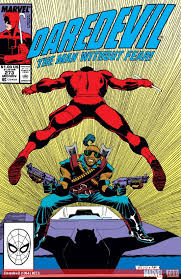 DAREDEVIL #272-273 (November 1989)
“Liberation” / “The Billion Dollar Ashtray”
Writer: Ann Nocenti
Penciller: John Romita Jr
Inker: Al Williamson
Colourist: Max Scheele
Letterer: Joe Rosen
Editor: Ralph Macchio
There’s still a way to go in the Ann Nocenti run after these issues, but this is where we leave it. While she created a string of new characters in the early part of her run, the later issues feature longer storylines and returning or guest villains, with a couple of one-off stories about everyday bad people along the way.
So, to be specific, issue #274 has Skip Ash as the villain. Issues #275-276 are an Acts of Vengeance tie-in, with guest villain Ultron. Issue #277 is a one-off story about a manipulative psychiatrist. Issues #278-282 feature Mephisto and Blackheart. Issue #283 guest stars Captain America, and the villains are assorted corporations. Issues #284-290 are a Bullseye storyline. And her final issue, issue #291, has Bullet.
Which means that for us, Ann Nocenti’s run draws to a close with the entirely unrepresentative figure of Shotgun. These two issues are part of the Number Nine storyline, which we’ve already looked at in the context of Skip Ash. As you’ll remember, Skip is a factory farmer who’s doing illegal operations for the CIA on the side. But he’s also got a laboratory which is altering women to make them “perfect”, and one of them, Number Nine, has been freed by his semi-estranged daughter Brandy. Since this is still a superhero comic, Skip calls in some favours from his government contacts to try and get Number Nine back. And so they send Shotgun to help out.
He’s a guy in spiky leathers, laden in ammo belts. Despite his name, he carries an insanely over-elaborate techno-gun. His CIA handler tells us that it costs “ten thousand dollars”, which “merely reflects the years of R&D work.” Even Skip is sceptical. Not only does it seem like total overkill just to deal with a few animal rights protestors, but Shotgun’s reliance on technology strikes Skip as unmanly. Still, Shotgun is insistent. He likes his gun. He also has some other guns. He likes those guns too. But he especially likes this one, because it’s new and shiny and cool.
Shotgun duly shows up at Brandy’s home and gets into a fight with Daredevil, who instantly identifies him as a “Rambo-type”. Although he seems like a more or less competent fighter, Shotgun’s basic strategy seems to be to fire massively overpowered guns in Daredevil’s general direction and to hope for the best. Daredevil naturally wins, and Shotgun simply runs away, promising to come back if Number Nine isn’t returned.
In the next issue, Shotgun does indeed return. He’s now armed to the teeth with even more hi-tech ordnance, and he’s got a vehicle not wholly dissimilar to a Cybertruck. Frankly, he seems to have a lot more interest in shooting his exciting guns than he does in actually completing his mission. Daredevil beats him again, and his truck explodes, though the dialogue assures us that he’s still alive. And then everybody moves on to talk about something else.
The rest of the Number Nine storyline is mostly about programming and conditioning. Shotgun is a somewhat awkward fit in that theme. Given the Rambo reference, he may have been intended as a hyper-masculine counterpart to Number Nine’s hyper-femininity, with his framing set by society rather than by Skip’s lab. But the art plays him more as a triggerhappy psycho, and Skip seems to view Shotgun as not manly enough. Shotgun borders on being a parody villain – when everyone else wants to discuss big issues, he’s here to fulfil genre expectations and blow things up for the fun of it.
Then again, if he is meant to be a parody, the art may play him a little too straight. In concept, he’s crying out to be a proto-Image character, but Romita makes him look somewhat cool. And that’s basically how he’s been treated by later writers, who have played the character more or less straight.
His next appearance was in the opening arc of 1992’s Punisher: War Zone, still drawn by Romita, but now with Chuck Dixon writing. This version does retain his childlike enthusiasm for guns, but otherwise he’s a highly competent one-man killing machine and an ally of the Punisher. Shotgun went on to show up as a, well, a hired gun in a bunch of Punisher and Spider-Man stories. Technically, he makes a single further appearance in Daredevil, but it’s as a generic sniper in the “Nuff Said” silent issue. If it wasn’t for the script that was printed at the back of the issue, you wouldn’t know it was meant to be him.
Of more interest is the 2017 Bullseye miniseries by Ed Brisson and Guillermo Sanna Bauza. Brisson has a down-on-their-luck Shotgun and Bullet reduced to working as mercenaries for Columbian drug cartels and limited to ordinary weapons. Shotgun keeps some of his childlike excitement about what he’s doing, but seems to have already come to terms with his reduced circumstances before the story even starts, and mainly just wants to get back in the CIA’s good graces. Brisson’s Shotgun doesn’t seem like such a bad guy – he doesn’t have to fight Bullseye, but puts himself in harm’s way so that he can help Bullet try to get home and see his son again. Brisson follows up the pairing in Old Man Logan #44-45, where Shotgun and Bullet actually get to defeat Bullseye. This is the most rounded version of Shotgun, but he’s basically a sounding board for Bullet. It’s a million miles removed from his genesis as a superficial explosion merchant.
In his original form as a gleefully one-dimensional shoot-em-up villain, Shotgun is an unlikely candidate to be brought back at all, let alone played straight. Presumably Romita had some affection for the guy. He certainly makes a strange final instalment in writing about Ann Nocenti’s run, especially as it has a year left to run. But perhaps he isn’t such a bad segue for us, as the book will tack back in a more conventional direction after this.

A strong candidate for most by-the-numbers, most disposable antagonist in the Nocenti run.
And delightfully, even he showcases self-delusion themes with his very name, which plainly misrepresents both his tools and his goals.
His firearms are interesting, though. In #272 his main gun can only be described as something of a combination sniper/assault rifle in drag to look like a shortgun for some reason. Then in #273 Skip Ash, of all people, finds his drool-like fascination with Shotgun’s new toy repulsive.
And it is quite the ridiculous gun, which we are told from the outset to have cost millions (to develop, presumably). Ann Nocenti is cunning and skillful, but she doesn’t particularly insist on subtle.
That gun is a perfect fit for Shotgun: both are very busy trying at great expense to be mutually excluding things with a very broad and shallow theme, and failing utterly from the get go. It says something that Skip Ash, who has very similar flaws, still finds the time and the drive to point out Shotgun’s and his handler’s on sight.
That second weapon is marvelously shown by John Romita Jr.; I wish I knew what exactly Nocenti oriented him to draw. It looks like a tragically overgrown and mishappen tommy gun that apparently fires 12-gauge shotgun shells while _also_ having a scope that runs through half its full length. It is big enough to put Shotgun under risk of a hunchback, and the final touch is a shoulder lanyard that is barely visible and plainly can’t possibly serve any useful purpose.
As for ammo, it is a combination grenade launcher / exotic ordnance dispenser that somehow uses slightly oversized 12-gauge shell casings. Which, naturally enough, Shotgun fires from an equally unlikely and contradictory vehicle – a slick convertible cybertruck-styled piece that of course acknowledges his unquestioned protagonism by having a front row with no passenger seat (the driver seat is centralized), looks like an expensive sports car, and behaves like a tank. Not even the weapons and vehicles are spared from severe identity crises in this run.
#272-273 may be the strongest – or at least most representative and plot-forwarding – issues of Nocenti’s run. It is delightful how the delusional statements come fast and strong from the first panel of #273.
Shotgun himself is plainly a mercenary – and one with very rebel-like presentation at that – yet he seems to have half convinced himself that he represents the Army. Presumably he has been hired for that specific black-ops task and he is leaning on that feeble pretext to think of himself as an Army man. Yet at the same time his handler, possibly the least deluded person in the whole issue, does not even attempt to hide that the concerns about the secrecy of Skip Ash’s “farm” (quotes included in his speech), which he plainly also calls an illegal lab, are overriding and will decide who is in danger and to which extent.
Masterful economy of exposition. We are told outright that this is part of an attempt of covering up illegal activities with military and CIA backing, and we see even more clearly that the people involved are not being misled; instead, the gleefully embrace the joys of self-delusion.
The good guys are perhaps slightly less deluded, but their confused goals and roles are closer to the surface. Brandy, Daredevil and Number Nine have the hardest of times deciding who they are, which goals they have, how they relate to each other or even how they individually feel at any given moment. While they have been drawn together by accident and circunstance, their interplay in this issue feel a lot like an attempt at (rather violent) therapeutic social dynamics roleplay.
It is quite something to see freaking Skip Ash – who is not necessarily more psychologically put together than Typhoid Mary herself – take the role of voice of reason and denouncer of hipocrisy and excess in #273 and deliver several rather strong points while at it.
And then the handler – who seems to be Ash’s as much as it is Shotgun’s – simply turns his face towards Ash and tells him that he has had enough of that talk and Ash will behave now and let the grown-ups do what must be done.
Nocenti is just great at showing good examples of people who are so deeply insecure that they can’t afford to let go of the “alpha male” mode, even when literally no one is fooled.
Oh dear…we’re about to enter the Chichester era–some good ideas, an obsession with Hydra, one genuinely great one-off (“A Day In Rhe Life”) qnd three of the worst, drawn out storylines in the title’s history back-to-back.
90’s editorial interference is a powerful drug
If I remember correctly, Shotgun was created by Romita Jr. and included in both Daredevil and Punisher War Zone as courtesy by Nocenti and Dixon to their artist. Maybe the hope was that Shotgun would break out in popularity like Venom and Romita would have a marquee character all his own?
I’m not doubting it, @Chris M, but I want to point out that it took well over two years for Shotgun to appear again (in Punisher War Zone #1) after Daredevil #272-273.
It’s too bad that these skipped both “Inferno” and the Ultron “Acts of Vengeance” arc. A reader of these who is not familiar with the source material is getting an incomplete picture of Nocenti’s run. The entire run simply must be read to understand the full nature of Nocenti’s DD.
The cost of Shotgun’s gun seems to be a joke on Nocenti’s part about the cost that the military is willing to spend on contracts and the overkill of the US military with the amount of tax payer’s money spent on such.
I don’t know how much I’ll have to comment upon the Chichester run. It’s my least favourite period of the DD comic until this point. I found something worthwhile in each writer’s oeuvre until that point. I thought DD had a long string of superior writing from Miller to O’Neil and (especially) Nocenti, then it all came crashing down as Chichester’s attempt to be a poor man’s Frank Miller. I bought and read the early-‘90s DD because after the market crash, all these once popular early-‘90s “extreme” Marvel comics were readily available in 50 cent boxes as stores madly tried to unload their overstocked inventory. Hot books that had been selling for $20 a few years earlier, and surely can only keep inflating until they’re close to X-Men (1963) #1 on value were now cheap enough that they were worth picking up, even if they were terrible.
@Thomas Deja everything you said is true, but the Chichester era does have some Villains. I’m looking forward to seeing what Paul makes of them.
Ultron doesn’t count, though? This is Mr. Hyde all over again.
I don’t remember a lot of new villains being introduced by Chichester. It seemed to be the Kingpin, Hydra, and the Hand for most stories (none of them would be eligible). Otherwise, I remember someone like Tombstone showing up, but that would count as a guest villain and not be covered. There was the return of voodoo to DD’s life. If two things can be counted on for Matt Murdoch comics, it’s his mental breakdown and voodoo. I try not to think about the Chichester run a great deal though.
Back in the day I liked the Chichester run better than the Nocenti run. It had clearer themes and at least _tried_ to give some resolution to the Kingpin.
At the time,Ijust couldn’t get past the stupidity of the suit to read it regularly, although I prob at least flipped thru it at the comic shop.
It’s hilarious that Romita set out to draw a ridiculously overpriced vehicle that looks like a giant toy, and he drew a cybertruck. Decades before the real thing.
Shotgun is ANOTHER soldier Frank Castle knew in Vietnam who became a villain. Did ANYONE Frank knew in Vietnam follow a normal career path?
Brisson seemed to like pairing Shotgun and Bullet together. I guess he thought it fitting, considering their names.
Shotgun’s appearance in the Gang War story in the Spider-Books was not his finest hour. He was hired to kill Madame Masque by the CIA but instead failed and was mystically enslaved by her. Then he wound up telling her about Hammerhead’s plan to kill her, which enabled her to thwart Hammerhead’s assassination attempt. That’s one EPIC fail of an assassination.
@Skippy- Ultron is definitely an Avengers villain and not a Daredevil villain.
@Chris V- During the Chichester run, there was the Surgeon General and the daughter of one of the Mister Fears.
I think that the next new villain showing up is Sathan, who appeared in Daredevil Annual 7 and was the result of an experiment by, um, Hydra.
Very true about Ultron, but this version was created by Dr. Doom specifically to defeat DD during AoV and was different than other versions of Ultron. Plus, it was another great story. Nocenti was one of those authors who had sheer ability to take an editorially mandated crossover and turn it into quality, adding to her overall arc rather than interrupting it. She did it multiple times (Fall of the Mutants, Inferno, Acts of Vengeance). You used to see that with crossover events, some author using it as an opportunity to go insane and turn out a must-read story, while nowadays, it seems that never happens, and authors just glumly interrupt their stories to tell some random story that has nothing to do with their own plots. Not that every author could step up to the plate in the past, of course, as there were a lot of mediocre “this was forced on me by an editor this month” stories too, but Nocenti was one of the authors who could excel. “I have to use some random villain from another franchise in my DD story? Here’s an Ultron having an existential crisis.”
Ah yes, how could I ever forget Surgeon General? heh
Chichester gave us the Snakeroot, right? And those hilariously lame computers themed villains? I can’t wait for Paul to tackle those guys.
Shotgun is definitely a JR Jr character more than a Incentive character. IIRC, there were talks of a Shotgun series happening in the ’90s. Wizard had its “Buried Treasure” picks for cheap back issues that might rise in value, and DD 272 was singled out for that reason.
@Chris V, agreed, too bad we’re leaving Nocenti’s run now, as it deserves all the love and attention it can get. The Upfront & Memphis to issues blew my mind lo those many years ago.
That Ultron vs Daredevil issue sort of sets up a fun bit with Vance Astrovik in the Avengers.