Daredevil Villains #88: Lifeform
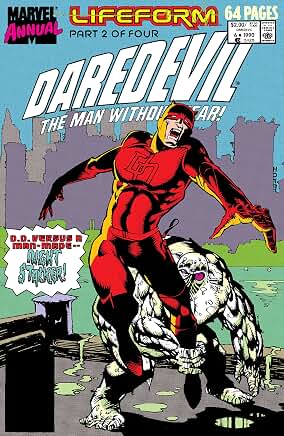 DAREDEVIL ANNUAL #6 (1990)
“Predator”
Writer, colourist: Gregory Wright
Artist: Cam Kennedy
Letterer: Richard Starkings
Editor: Ralph Macchio
We may have finished Ann Nocenti’s run, but we aren’t moving on to DG Chichester just yet. It’s time to check in on Daredevil Annual.
The last character that we covered from a Daredevil Annual was the Mind-Master, who debuted in Annual #4, way back in 1976. After that, Daredevil didn’t get another annual for over a decade. But in 1989, the book got another annual. Daredevil Annual #5 was a tie-in to the line-wide “Atlantis Attacks” event, with Tyrannus and Viper as the guest villains, and as such, it doesn’t concern us. It may be most notable for being misnumbered as a second Daredevil Annual #4. (The version on Marvel Unlimited has corrected the number.) But it must have done okay, since further Daredevil Annuals continued to appear through to 1994, all of them written by Gregory Wright.
For 1990, instead of a single line-wide event across the annuals, Marvel opted for crossovers among smaller groups of titles. Most of those groupings made sense. “Days of Futures Present” had the X-Men, the New Mutants, X-Factor and the Fantastic Four, in a story about Franklin Richards from the Days of Future Past timeline. “Terminus Factor” had Iron Man, Captain America, Thor, Avengers and West Coast Avengers. The three Spider-Man annuals did their own story. And that left…
Um. Well, it left Daredevil, Punisher, Incredible Hulk and Silver Surfer. Natural bedfellows, I think you’ll agree.
These four unfortunate titles hooked up for a mini-event called “Lifeform”. Lifeform himself is a marginal inclusion in this feature. But he never appears anywhere else, so I suppose he’s a Daredevil villain as much as anyone’s. And besides, he’s the only new villain to show up in Daredevil in 1990.
As you might imagine, “Lifeform” is an odd story. Reasonably enough, it doesn’t attempt to get the Punisher and the Silver Surfer involved in a single narrative. Instead, it follows the same basic structure as “Evolutionary War” and “Atlantis Attacks”, where for the most part each annual told a self-contained story with a throughline building in the background. In “Lifeform”, the throughline is simply that each time the hero thinks Lifeform has been destroyed, only for it to come back stronger than before, and ready to face an even more powerful hero. Or at least, that’s how the back end of the story scales up – there isn’t really that sort of escalation between the Punisher in chapter 1 and Daredevil in chapter 2. If anything, surely Daredevil and his stick are a step down from the skull-themed munitions enthusiast.
Since he’s really just here to pass the parcel, Daredevil’s contribution to the story feels nailed on. He’s back in Hell’s Kitchen by this point, which is where Ann Nocenti leaves him at the end of her run. There’s a monstrous shambling thing in the city alleyways, and that’s Lifeform. We’ve already established in the Punisher annual that he’s a guy called George Prufrock, and that he’s been transformed into a monster by a virus commissioned by his father, a wealthy and paranoid libertarian extremist who wanted it as a biological weapon. There’s a B-plot in which Ben Urich is investigating this story and, uncharacteristically, seems to be more interested in his career advancement than he is in the story itself.
Lifeform himself isn’t much of a character. He stumbles around the alleys in pain. He gets into a fight with the Wildboys. He seems to want to eat him. There’s a voice in his head telling him what to do, and that voice seems to be something to do with his father. At one point, Daredevil detects that the creature has two heartbeats. Eventually the police gun Lifeform down, despite Daredevil’s attempts to stop them, and that’s basically it.
A feature of Wright’s annuals is back-up strips that loosely tie-in with the main story, and there are three of them here. One of them is a Fat Boys story where Lifeform just kind of passes through near the end. Another is about someone who gets infected by Lifeform’s virus (something which doesn’t otherwise seem to be much of a problem). The third is a Typhoid Mary story, which leans into the idea that Lifeform has two competing minds in his body, and plays it off against Typhoid’s own competing personas. He outpowers Typhoid, but leaves her alone in her innocent Mary persona. This is about as much character development as Lifeform gets in this annual.
None of this is very interesting. Do the other three annuals make a difference?
Not especially. Punisher Annual #3, by Mike Baron and Neil Hansen, shows George stealing the virus in the first place, and establishes that he’s hearing his father’s voice yelling at him. It seems to be just a hallucination. The Punisher gets involved because he’s investigating George’s father for “alleged massive credit card fraud”. Once George starts changing into a monster, he veers between wanting to please his father and wanting to kill him.
Incredible Hulk Annual #16, by Peter David and Angel Medina, is largely built around George narrating his back story while slowly changing back into the deformed Lifeform. This story presents George as a naive and complacent rich kid who views “the Lifeform” as some sort of parasite. We learn that he joined AIM on his father’s behalf (he talks about it as if it were a normal post-college career), and he still believes in his obvious social superiority even as a shambling monster. But he also asks to be killed before the Lifeform rages out of control.
In Silver Surfer Annual #3, by Jim Starlin, Ron Marz, Ron Lim and Tom Christopher, the Lifeform is just growing uncontrollably into a sort of fleshlike blob of eyes and mouths that just wants to eat all life. The Surfer dumps it on a dead alien world. George briefly manages to regain control and speak to the Surfer, and asks to be killed. But the Surfer refuses on principle to take a life. So he just abandons a suffering man on a dead planet, presumably to die slowly from starvation instead. And that’s how the story ends.
As you may have noticed, it doesn’t hang together at all well. The Punisher and Daredevil stories seem to think that they’re setting up a story in which George is driven by the voice of his father, but that just gets dropped, with Hulk and Surfer treating the virus as just a mindless infection. If you’re feeling very charitable, the unifying thread is that George is a harmless fool destroyed by his excessive faith in his right-wing-lunatic father. But in practice it’s just a story about a monster causing some trouble, getting killed, and coming back again until the Surfer exiles him.
It’s not much of a premise, and it doesn’t merit a four issue story. And it certainly doesn’t have anything to do with Daredevil. “Lifeform” is Marvel annual crossovers at their most landfill, unfortunately.

Be the first to comment.