Daredevil Villains #90: Izanami
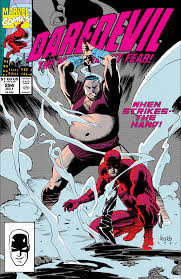 DAREDEVIL #294-296 (July to September 1991)
“The Infernal Mysteries” / “Through the Eyes of the Enemy” / “Balancing Act”
Writer: DG Chichester
Pencillers: Lee Weeks (#294-295) and Ron Garney (#296)
Inker: Al Williamson
Colourist: Max Scheele
Letterer: Jack Morellli
Editor: Ralph Macchio
After our detour into the annuals, we’re back with the main title, and we’ve reached DG Chichester’s run as writer. He takes over from Ann Nocenti with issue #292, and with a couple of exceptions, he’ll be with us all the way through to issue #342, although he took his name off the last few issues. He started his career as an editor on the Epic imprint before writing some of the largely-forgotten Shadowline books; by this point, he had been writing Nick Fury, Agent of SHIELD for a year or so.
Penciller Lee Weeks had y joined the book for Ann Nocenti’s final arc. This was his first regular assignment on a Marvel Universe title, following runs on the New Universe title Justice and the licensed book Destroyer. But he’ll only be around until issue #300 before moving on.
Nocenti ended her run by putting the toys back in the box, up to a point. She finished with Daredevil returning to New York and reclaiming his identity from the imposter Bullseye. This left the book ready to return to a more traditional status quo, and Chichester wasn’t going to follow in Nocenti’s more experimental footsteps. The first part of his run draws heavily on Frank Miller concepts, but stylistically it’s arguably more of a return to pre-Miller material (though he’ll have some format-breaking stories of his own in due course). It’s very dense and wordy, and more conventional in style than either Miller or Nocenti. And this was in the early 90s, when other books were leaning into the Image style.
Chichester seems to have taken the view that Daredevil had a mature rogue’s gallery, and he uses a lot of existing characters together with guests from other titles. But in the first phase of his run, he had little choice but to focus on existing villains. While Nocenti had obligingly returned Daredevil to Hell’s Kitchen, she hadn’t resolved the Kingpin/Typhoid storyline. Those villains were still out there, knowing his dual identity and aiming to destroy him. And since the book had already done two storylines in which Matt’s life was destroyed by the obsessive Kingpin, something had to be done to explain why it didn’t just happen again, particularly if the goal was to get back to a more traditional Daredevil status quo, with Matt and Foggy as lawyers again.
The book’s solution to that problem is basically to take Typhoid off the board, and then have Daredevil turns the tables on the Kingpin, destroying his empire and breaking his spirit. This doesn’t entirely solve the problem that they’re out there and know who Daredevil is, but it does stop them from being in a position to do anything about it for the moment.
With an anniversary issue on the horizon, Chichester takes a roundabout route to get to that point. Issues #292 and #293 involve Taskmaster and Tombstone competing to kill people at the behest of mysterious employers. Those employers turn out to be the Hand, and in issues #294 to #296, they get more directly involved. In plot terms, this is still Frank Miller’s version of the Hand: they’re hired mercenaries, and they’re also a mystical death cult. The identities of their targets aren’t particularly important – basically, they’ve been hired by HYDRA to cause terror in New York. Privately, the Hand hoping that this might also bring them closer to communion with the Beast, the demon that they worship.
The Hand set up their New York base in a disused church and cheerfully set about a bit of human sacrifice. The Hand group consists of a Jonin, a bunch of generic ninjas, and a hefty, androgynous woman who’s eventually named as Izanami. She has some sort of skin condition, for reasons that are never really explained. When the Hand ninja die and crumble to dust, she seems to absorb their souls if she’s nearby. Issue #295 has her releasing some of this soul mist to power up other Hand ninjas – described as “a token of the precious distillation you guard for all of us”. Her role is never very clearly explained, but basically she seems to be some sort of magical incubator and storehouse for the fallen ninjas’ life energy, and she serves as a sort of corrupted mother figure. The name “Izanami” comes from Japanese mythology, where she’s a primordial deity associated with both creation and death. That broadly fits with the role of the character in these stories, but it’s not information that adds much to our understanding of her.
Issue #296 sees Daredevil and the Chaste (Stick’s old outfit) teaming up against the Hand. When the Hand are clearly going to lose, the Jonin gets Izanami to behead him and absorb his own spirit. The newest member of the Chaste betrays them, apparently hoping to become the host for all the power that she’s observed. Instead, she decides that Daredevil would make an ideal host. There’s a suggestion that Stick had also picked up on his suitability, and mentored him so that he could be steered away from that fate. There’s also a suggestion that Izanami just thinks Daredevil would make a good host because he’s hot. Either way, Daredevil runs her through with a spear her, the absorbed souls escape, and she dies for good.
A second Izanami appears in the “Dead Man’s Hand” crossover in issues #307-309 (which also tied in to Nomad and Punisher War Journal). This version is a random Las Vegas tourist would gets transformed into the new Izanami, the implication being that the first one was also a transformed innocent. That adds something to her, but she’s still a dark mother figure, and the story doesn’t add much more to her than that – “Dead Man’s Hand” involves an absolute ton of villains fighting for page time, and Izanami is just one of them.
Izanami is prominent enough in these stories to merit an entry – she’s the final boss of the Hand story in issue #296, after all. But there’s not much to her as a character beyond the unsurprising fact that she’s a cultist, and some gestures in the direction of sexual interest in Daredevil. She’s clearly intended to be grotesque, although Weeks renders her more like a sumo wrestler. Ultimately, she exists to deal with the problem that the Hand are a bunch of interchangeable ninjas, and they need someone to serve as a representative in the field, in much the same way that Kirigi did in the Frank Miller issues.
In theory, as the host of the Hand’s fallen souls, she’s literally the embodiment of the Hand, and if that had been followed through more thoroughly, she might have been more interesting. But as it is, there’s not much to her beyond the character design.

Are the Hand supposed to be working for Strucker in these issues? There’s a scene where Ghost Rider uses his Penance Stare on members of the Hand and the mystical backlash causes a flashback where Matt witnesses Baron Strucker defeat a leader of the Hand. And Matt says he senses another malevolence at their roots. I can’t see what the point of that was unless the Hand are working for Strucker.
Later on, in Dead Man’s Hand, the Red Skull calls a group of crime lords together to divide the Kingpin’s empire. The Hand prepares a mystical ritual to kill them. Strucker says “The Hand shall serve its Beast, slaughtering these “leaders” for me.” The Hand definitely seemed to working for Strucker in those issues. But the plot of Dead Man’s Hand was completely incoherent. Was the idea that the Skull, Strucker and the Hand were all working together and the Skull lured the crime lords together so that the Strucker could have the Hand wipe them all out with the ritual?
“There’s also a suggestion that Izanami just thinks Daredevil would make a good host because he’s hot. Either way, Daredevil runs her through with a spear, the absorbed souls escape, and she dies for good.”
Matt should have just accepted the compliment and said “I’m flattered, but no thank you.”
Also, I bought the first issue of one of the Shadowline books because they had those great Sienkiewicz covers. I should have flipped through it first because what I found inside was not what I was expecting.
I’ve never read these issues, and they sound pretty lousy. I’m still tempted to track them down because Lee Weeks’s art is so good. Even in the early ‘90s, he had a good grasp on anatomy, lighting, mood, and storytelling.
D.G. Chichester had a decent run on Alien Legion, some of which was drawn by pre-X-Factor Larry Stroman. I liked “Last Rites,” and his guest writing on DD 380 wasn’t bad. Just about everything else I’ve read from him has been borderline incoherent. His plotting and dialogue are often opaque, leaving me wondering what is happening on the page. Lee Weeks gave his work some clarity, but artists whose storytelling chops aren’t as strong do his writing no favors.
@thom Matt should have just accepted the compliment and said “I’m flattered, but no thank you.”
He could have just been tired of using that line after all the times he’s had to use it after getting hit on my guys who didn’t clock that he was straight(ish. He’s probably explored more since)
But yeah Matt Murdock seems like that very specific kind of straight man whose gay vibes are just strong enough to combine with his handsomeness to create an aura of homoerotic attraction
@Jaymes: It doesn’t help that Matt keeps introducing Foggy as his long-term partner. Especially when they find out Matt calls him Foggy because he snores.
Yeah I was definitely thinking Foggy was the start of Matt’s gay journey too
It shows how much I was paying attention while reading most of Chichester’s run as I thought this was a male Sumo DD fought when I saw this cover. I was wondering why Chichester gave her a Japanese goddess name. Sure, it’s been close to three decades since I read these comics, but still, I remember the Nocenti issues very well and it was only a few years later that I read those back-issues (2005). Perhaps it was the famous Sin-Cong Sumo champion (Sumo is very popular in Sin-Cong also), Wong Chu’s brother from the nigh famous Iron Man issue. DD having a Sumo match with Wong Chu’s Japanese cousin, then deciding to go on a date with him after sounds like a better story.
Henching is a bad deal generally, but how does the Hand recruit exactly? Train for years, get killed as a minor obstacle to some antihero, and a woman will eat your soul and spray it on someone else for a boost. And your body will probably be made into a zombie. Sign up today!
Rumor has it that they were losing recruits to Hydra and AIM at an alarming rate.
Then they decided to give dental. It helped.
“D.G. Chichester had a decent run on Alien Legion, some of which was drawn by pre-X-Factor Larry Stroman”
Chichester wasn’t on Alien Legion. Alan Zelenetz did the first run and Chuck Dixon has written everything since.
I was wondering about that but couldn’t be bothered to check. I only read the first Epic published Alien Legion series, so I thought maybe he wrote a later volumn. Well, Chichester? Chuck? One poor writer with a “C” in his name or another.
Chichester is probably best known for creating Terror, Inc., but that is still a year in his future when he started on DD. Around these parts, he’s probably most famous for writing a fill-in two-parter on Wolverine (also about a year after this) which featured Wolverine shaving his head and beard, and guest-starred Terror as Chichester attempted to use his Wolverine fill-in story to help increase sales on his own character’s book.
Only thing I vaguely remember about this story is Chichester giving the murder victims horror director names (Cronenberg, Romero, etc.)
“Plus-size androgynous demon that wants to eat your soul” would have had way more of a fanbase in the DeviantArt era, although the character design would definitely be revised by the fanart.
@Chris V: Terror, Inc. was a retool ofChichester’s earlierShadowline villain Shreck. Editorial insisted they were different characters, but in more recent years Chichester has said he always considered them the same character.
@Michael:I think Chichester is the writer who introduced the idea that HYDRA and the Hand were once part of the same organization. I think it was all part of his efforts to make Baron Strucker a big-name villain.
Strucker seems to turn up as the bigger-picture villain in almost every MU book Chichester writes; even the Nightstalkers book, which was part of the “Midnight Sons” line, had Strucker in it, with supernatural HYDRA agents called the DOA as the main recurring villains.
To add to Omar’s observation, Chichester’s interest in Strucker has continued into the present. Strucker is the villain in the DAREDEVIL: BLACK ARMOR throwback mini (2023-2024). I suppose Chichester might have chosen him based on the remit, though.
Best part of this storyline was Ghost Rider showing up and DD getting a taste of the Penance Stare, which affected him even though he’s blind.
As for Chichester, he was the writer for the first year or so of Nightstalkers as well. His narration in that series was like a thesaurus threw up on a 90s Stallone film, but I still dug it for the most part.
Darkhold was the stand-out book of the Midnight Sons line. If only it was a different Marvel and every other issue didn’t have to have a “hot” guest-star (like Sabretooth or Punisher) who derailed the ongoing plots or a cross-over in order to try to increase sales, before cancelling it.
Also, Pat Mills wrote a fill-in issue of Morbius. No, it wasn’t the greatest story, but as I mentioned before, I do love Pat Mills.
Oh, also not Midnight Sons related, but Chichester’s terrible Nick Fury series did get interrupted for a fill-in issue by Alan Grant, the greatest story from that volumn of Nick Fury. One of the only comics Grant wrote for mainstream Marvel (very little at Epic either). Imagine that Marvel could get Alan Grant or Pat Mills to write a fill-in story for Morbius or Nick Fury, but decided not to offer than the assignment full-time. At least Mills had a few more writing credits at Marvel, but I want to imagine what an entire run by Grant on Nick Fury would have looked like, and would it have featured as much Scottish accent as the one issue. It was like feckin’ Irving Welsh wrote a Nick Fury story.
Sorry, nothing about Chichester. I have no positive comments to make about Chichester.
@David Phelps: aargh, Chichester worked as an editor @ Epic and edited one of the Alien Legion graphic novels. My aging brain mixed up the credits, and shunted him in subsequent credit boxes. Haven’t looked at those comics in awhile, my bad.
“@Michael:I think Chichester is the writer who introduced the idea that HYDRA and the Hand were once part of the same organization. I think it was all part of his efforts to make Baron Strucker a big-name villain.”
Wait, so these Daredevil issues came out before X-Men 268? I just assumed that Claremont was the one who created the Strucker/Hand alliance, for that X-Men story set in the ’40s, with Cap and little Natasha, et al.
The Uncanny X-Men issue came out before Chichester’s DD or Nick Fury.
The Uncanny X-Men features Baron Von Strucker attempting to form an alliance between his fledgling Hydra and the Hand in a secret meeting held in Madripoor. It’s obvious in that story that the two groups are independent. Strucker was going to sacrifice a Russian young girl captured by the Nazis to the Hand, who was to become their earlier version of “Elektra”. At the end of the story, Logan and Cap are able to save young Natalia Romanova from the Hand, and Strucker flees the battle when he sees his plan for an alliance has failed. The two organizations are never united, as per that story.
I’m sure there is now a ret-con that Romulus was secretly behind the formation of both groups, but I didn’t keep up on all the Romulus stupidity, so I may be making this up. Someone will probably come along to tell me this is true, much to my chagrin.
@Chris V- I think the major problem with the Big Reveal of Darkhold was that Victoria Montesi’s origin made no sense. Her family was chosen to guard the Darkhold because they could not be tempted to use the book under any circumstances but she was conceived when her father found out he was sterile and yielded to the temptation to use the book to have children. Huh?
“The Uncanny X-Men issue came out before Chichester’s DD or Nick Fury.
The Uncanny X-Men features Baron Von Strucker attempting to form an alliance between his fledgling Hydra and the Hand in a secret meeting held in Madripoor. It’s obvious in that story that the two groups are independent. Strucker was going to sacrifice a Russian young girl captured by the Nazis to the Hand, who was to become their earlier version of “Elektra”. At the end of the story, Logan and Cap are able to save young Natalia Romanova from the Hand, and Strucker flees the battle when he sees his plan for an alliance has failed. The two organizations are never united, as per that story.”
@Chris V: Makes sense. I thought Chichester was just rolling with the connection from that story, but you remember the details better than I do.
Still, the idea of having the Strucker family work with the Hand would still have originated with Claremont, yes? At the end of issue 268, Strucker’s kids (or grandkids or whatever those twins were) are linked up with the Hand.
The only reason I’m harping on it is that I remember reading these issues of DD and being confused as to why it was supposed to be a big shock that the Hand and Strucker were affiliated. Because we already saw the Hand linked up with Strucker and his Nazi-ilk in X-Men 268. And we saw them work together in the 1940s too, even if it was only once.
I don’t know, I just remember it being very un-impactful.
(That said, kudos to Chichester for finally coming up with a name for Stick and his bunch. Is it in one of these issues in the 290s, then, that we see the name “Chaste” for the first time? I couldn’t recall if it was here or if Chichester didn’t give them that handle until the “Fall From Grace” stuff later on down the line.)
Michael> I think the major problem with the Big Reveal of Darkhold was that Victoria Montesi’s origin made no sense. Her family was chosen to guard the Darkhold because they could not be tempted to use the book under any circumstances but she was conceived when her father found out he was sterile and yielded to the temptation to use the book to have children. Huh?
See, this is the thing about hereditary roles. Just because you picked the best guy ever at the start, doesn’t mean it’ll still hold ten generations later.
@SanityOrMadness- Yeah, but when Vicki uses a healing spell from the Darkhold, one of the Darkhold Redeemers acts like that’s impossible- a true Montesi should have never yielded to temptation.
I don’t care that the twist made no sense, Darkhold was an amazing series. Richard Case art on those early issues was beautiful, though it was a shame he wasn’t able to see on the series through its completion. As a kid, it was the Midnight Sons title that I liked the least, but as an adult I appreciate that it was operating at levels way above Mackie’s Ghost Rider (though I love, love, love that series) and Chichester’s Nightstalkers.
Wasn’t #294 the issue that brings back Karen Page?
This was one of the few issues of Daredevil I had prior to high school when I got into the Miller and Bendis runs. I did grow up in the 90s, so I couldn’t avoid Chichester completely.
I love that Weeks artwork and I enjoyed it when I read it back then because ninjas! But having read some of Chichester’s other work, including some of his other DD work, I don’t really want to revisit it (other than here) to have that childhood delight ruined.
I don’t know why I have that with this: there are plenty of other comics I read in as a kid that I knew was probably going to be bad on re-reading, and I still read them again anyway.
Does anyone else have this weird dichotomy of some childhood favorites being eligible for re-reads and some not? Or just other runs/titles/creators like this, where you liked it when you first read it but won’t read it again for various reasons?
I grew up in the ‘80s mostly reading Chris Claremont Uncanny X-Men comics. I still think the ‘80s were one of the best decades in comic books (I’d probably give the nod to the ‘70s at Marvel), so I don’t have that feeling about comic books I grew up reading (or saw on the stands, as I didn’t breach out a lot with comic books until high school which was the early-‘90s).
@Michael
So they believed the hype, not the reality.
@CJ “Does anyone else have this weird dichotomy of some childhood favorites being eligible for re-reads and some not? Or just other runs/titles/creators like this, where you liked it when you first read it but won’t read it again for various reasons?”
I think some stuff can hold your interest as a kid just because it hits certain generic tropes that you haven’t yet realized are formulaic/overused/problematic/boring. The material that I find I enjoy returning to does something else on top of hitting those basic notes – either in the art or the writing – that I can appreciate as interesting even as an adult. Nostalgia alone is not rarely enough to warrant a full re-read.
I actually kin of enjoyed Chichester’s Daredevil run up through the end of the Owl storyline. It wasn’t the most amazing thing, and it was a step down into somewhat more generic superhero storytelling than what went before, but it was entertaining enough.
Shadowline was more hit-and-miss for me, but Doctor Zero and Shreck/Terror, Inc.’s appearances in St. George were fun.
Doctor Zero was also a concept that genuinely couldn’t work in an established shared universe, and I enjoyed it as a warped take on Superman in which the protagonist really is a more powerful, other species who wants to manipulate humanity and has figured out that “colorful superhero” is the best way to do so in the present era.
I’ll add that the big element I think Chichester adds to the book is an emphasis on body horror, which is pretty consistent across his other work. He’s a big slasher and horror movie aficionado.
Consequently, in Daredevil, we’ve got clear examples such as the Owl’s grotesque mutations, Izanami’s grotesque bloating with life energy, and Taskmaster being written very out-of-character as a surgical addict. There’re smaller examples, too. Miller and Nocenti emphasized the Kingpin’s physical power and obsessive hatred, but they’d have been unlikely to have him gouge out someone’s eye.
It’s probably the most consistent element of his work. Shreck/Terror, Inc.’s whole gimmick is one big body horror trope, and many of his other co-creations, such as the HYDRA D.O.A. characters and the Shadowline villain Dirk Ravenscore have body horror gimmicks as well.
I think I’m somewhere in the middle of the ’80s re-reading spectrum. I sincerely like to revisit books like Uncanny X-Men and New Mutants from my youth, but I rarely actually read all of the text anymore. The overwriting! The accents! And I don’t need to read it to get that hit of nostalgia. Honestly, I’ve probably got some of it half-memorized at this point.
And it’s not just Claremont. Alan Moore is the same way for me, some Grant Morrison books, too. I realize this is ’90s, but I can get through a Morrison Doom Patrol issue just fine by reading only word balloons and looking at the art. I suppose I’m more of a nostalgia skimmer than a re-reader.
Omar-That is what I enjoyed about Mantlo’s Alpha Flight, when most people seem to hate it (hey, if they miss Byrne, the book isn’t getting any better from that point), there were a lot of body horror motifs, plus some examination of gender fluidity. The best aspect to Mantlo’s AF though was that it was all weird. It tended to stand out at Marvel for that time. That’s what’s lacking from Chichester’s usage here is that it never comes across as weird, it comes across as early-‘90s gratuitous. I didn’t get the feeling that Mantlo was particularly influenced by horror movies when he was introducing the concept of the weakness and fluidity of the human body (from both a positive and negative view). Maybe it shows influence of Harlan Ellison or some JG Ballard, as we know Mantlo read Ellison. Of course, the less said about Puck’s demon, the better.
Peter B. Gillis would add a lot of the same body horror elements and weirdness to his Micronauts after Mantlo too. That series is a really good run of comics too, for its own reasons (as is Mantlo’s lengthy run on Micronauts), if you enjoy science fictional exploration stories. Sort of Star Trek if done in the style of weird fiction. I think Gillis’ Micronauts was better received than Mantlo’s Alpha.
Omar: “I actually kin of enjoyed Chichester’s Daredevil run up through the end of the Owl storyline. It wasn’t the most amazing thing, and it was a step down into somewhat more generic superhero storytelling than what went before, but it was entertaining enough.”
@Omar: That’s where I fall too. Everything up to issue 300 is both decent and has some pretty solid artwork from Lee Weeks.
Issues 301-303, the Owl two-parter, lacking Lee Weeks, are … less than thrilling visually. But as a story it’s a pretty decent DD vs. Owl pot-boiler.
Issue 304 is really where the wheels fall off for me. After that, the Chichester years are rough going.