Daredevil Villains #92: Hellspawn
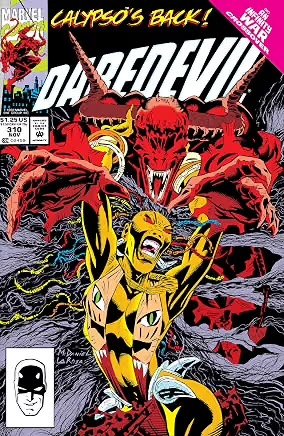 DAREDEVIL #310 (November 1992)
“Devil Ge Rouge”
Writer: Glenn Herdling
Penciller: Scott McDaniel
Inker: Bud LaRosa
Letterer: Bill Oakley
Colourist; Max Scheele
Editor: Ralph Macchio
We’ve skipped issues #307-309, which are part of the “Dead Man’s Hand” crossover with Nomad and Punisher War Journal. It involves a whole bunch of pre-existing villains squabbling over the Kingpin’s former assets. We’ve also passed over Daredevil Annual #8, which is part of the “System Bytes” crossover along with the 1992 annual for Punisher, Wonder Man and Guardians of the Galaxy. The overall plot involves a computer virus, but the main villain of the Daredevil chapter is Bushwacker.
That brings us to issue #310, which is the first half of a two-part story by guest writer Glenn Herdling and regular artist Scott McDaniel. He’s still working mostly in the Marvel house style at this point, but Calypso’s hair is already doing some remarkable things.
The two-parter as a whole is a sequel to issues #243-244, Ann Nocenti’s story about the Nameless One, the undead voodoo warrior. This time around, the Nameless One is under the control of Calypso, a previously obscure Spider-Man villain whose stock had recently been raised significantly by getting a prominent role in the first arc of Todd Macfarlane’s Spider-Man series. She only makes one further appearance in Daredevil, in a back-up strip in the 1993 annual, where Daredevil himself doesn’t appear. After that, she goes back to Spider-Man, so for our purposes she’s a guest villain here.
But in addition to being the first half of the Calypso story, issue #310 is also a tie-in to the sprawling Infinity War crossover. It’s the one where the Magus, the evil version of Adam Warlock, creates a bunch of distorted evil duplicates of superheroes. At the very start of Infinity War, some of those duplicates are sent to kill and replace the originals. Nothing else in the crossover concerns us at all. What’s important for our purposes is that there are some evil duplicates of superheroes around, because of reasons. They were all meant to be throwaway cannon fodder. Technically they have a back story, which involves Magus getting them from the Dimension of Manifestations, but none of that matters to Daredevil.
The Daredevil copy, who eventually gets called “Hellspawn”, is a demonic-looking version of the hero, with big horns and no eyes. He shows up outside Matt’s office at night, intending to kill him. Matt can’t detect him, and they have the same scent. All this sounds as though Hellspawn ought to be a serious enough threat – the villain that Daredevil has a blind spot for.
But that fight doesn’t happen, because before Hellspawn can even get near, he gets attacked by Calypso. The high concept is that even though Calypso has also come here planning to fight Daredevil, she’s never seen a photo of him, and she’s working off descriptions alone. So she assumes that this monster is in fact Daredevil. She defeats him, he vanishes, and she concludes that he is actually the “devil ge-rouge – the evil spirit of my true foe – sent by the loa to help me study my prey in action”. As for Daredevil, he’s preoccupied with another plotline, he can’t sense Hellspawn’s presence, and he completely fails to notice that any of this is happening.
Poor Hellspawn. It’s not an edifying debut.
If that was his only appearance then he wouldn’t merit an entry here. He’d be just another random duplicate in a crossover full of them, with Herdling doing his best to shoehorn him into a voodoo story. But some of the duplicates did survive the crossover to appear again. The best known is the Spider-Man duplicate, who hung around for a good few years under the name Doppelganger. But there’s also this guy.
He returns in a back-up strip in Daredevil Annual #9, the one already mentioned above. Calypso summons him up again; this time, he fights her off and escapes. Then he returns more prominently in the “Fall From Grace” arc in issues #319-325. This is a storyline that we’ll be coming back to in more detail in a future instalment, but for the moment, suffice to say that Hellspawn is summoned again by a second houngan, and again escapes (so it’s not really clear what the point of the annual was). This version of Hellspawn behaves like an actual character. He can speak, albeit in a cod Creole accent, and he has a coherent motivation. He seems to believe that he’s a magical being – perhaps he is, after the way he was brought back – and he believes that he can escape his susceptibility to being controlled by voodoo magicians if only he can turn himself into a regular, non-magical creature. So that’s his goal for the story.
Luckily for Hellspawn, the plot of “Fall From Grace” involves a virus which can reshape a person’s body according to their wishes. It even works on magical doppelgangers. It’s amazing what they can do with lab-engineered viruses these days. Hellspawn shows up from time to time across the “Fall From Grace” as one of the many characters chasing after the virus, and he has a few encounters with Daredevil which play off the idea that Matt can only sense him directly when he speaks.
Ultimately, this leads to Hellspawn getting the virus and using it to turn himself into a real second Matt Murdock – only to be promptly killed by the Hand. So he gets his wish, but in ironic form. His dead body then serves an important plot function: Matt uses it to fake his death and start a new life as “Jack Batlin”.
That mechanical function aside, Hellspawn works fairly well in “Fall From Grace”. He’s a villain because of the violence with which he’s pursuing his goals, but his actual agenda is reasonable. He was created to be a mindless puppet and his primary motivation is to gain control of his life. His secondary goal is to become a real boy. That’s all quite sympathetic, and there’s a sense that even his final fate – to get his wish and be killed moments later – is not such a bad ending from him, because it at least he succeeded in escaping control. In an odd way, his back story as a cannon fodder from an event crossover only makes it all the more reasonable that he wants to be something else.
I suppose you could have made him a long-term villain, and have him try to take over Matt’s life altogether. But the Kingpin is already the Daredevil villain who messes with Matt’s life, and ultimately the book probably makes the best use of Hellspawn that it could: he develops into a fuller character, and he does so in a way that allows something more important to happen.

Was that supposed to read Diable Rouge and someone made a misprint?
Anyway, of course Hellspawn would eventually return as one of the hottest characters in comics for a time in the ‘90s published by Image.
I’m really surprised some speculators haven’t tried to claim that this is an incredibly valuable comic featuring the first appearance of The “Hellspawn”. I guess no one buying comics as an investment is desperate enough to get fooled by that scam yet.
I remember when speculators were trying to pass off Bull’s Eye from the old Nick Fury series as the first appearance of hot DD villain Bullseye, around the time of the movie. The two characters don’t even spell their name the same way. That was a low point for collectors.
Apparently “Ge-Rouge” is an aspect of Erzulie who takes revenge on faithless lovers. Which does seem like something Calypso should be worried about.
https://en.wikipedia.org/wiki/Erzulie
Oh wait, this is November 1992. McFarlane’s Spawn already existed. This can’t be the ultra-valuable first appearance. How about 1st appearance of Hellspawn in the Marvel Universe? Surely someone will fall for that when a speculator marks their valued at a $1 comic up to $100.
Ah, good work, Dave White. It apparently does translate as “red eyes”. Still, I don’t think Calypso should be referring to Ezili Dantor in any aspect as “a devil”.
Matt fakes his death because an intern at the Daily Bugle broke into Ben Urich’s files and publicly claimed Matt was Daredevil. You’d think people would be suspicious when Matt turns up alive again and wonder if maybe he really WAS Daredevil but everyone was so desperate to put the “Jack Batlin” mess behind them that we all agreed to ignore it.
Although it was annoying when during Bendis’s Pulse series, Ben Urich revealed he knew that Peter was Spider-Man. Urich explained that one of the clues was that Peter knew Matt was Daredevil. That was annoying because you’d think everyone at the Bugle had heard the “intern broke into Ben’s files and claimed Matt was Daredevil”. so Peter figuring out Matt was Daredevil was not really a clue that he was a superhero. And, of course, everyone collectively agreed to ignore the fact that the entire Bugle staff should suspect Matt is Daredevil.
@Chris V- Marvel writers are often confused about the difference between loas in Voodoo and evil spirits in other religions. The worst example has to be Damballah. In Brother Voodoo’s origin story, the villain was a human called Damballah using a Wangal from his namesake. It’s not clear if Len Wein, who wrote the story, understood the Damballah was not supposed to be villainous in Voodoo. But in Avengers 152, the Black Talon summons Damballah, and Damballah is clearly evil. And for years after that, every writer that used Damballah depicted him as evil, since they were referring back to Avengers 152 and not Voodoo mythology.
Finally, in 1990, Marvel decided there were two Damballahs- a loa and a spawn of Set, and the spawn of Set appeared in any story where Damballah was a villain.
I think Wein simply took it that Damballah is a giant serpent, so he expected he must be evil.