X-Men #37 annotations
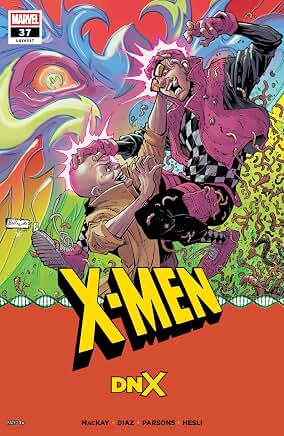 X-MEN vol 7 #37
“Psi-War”
Writer: Jed MacKay
Penciller: Netho Diaz
Inker: Sean Parsons
Colourist: Arthur Hesli
Letterer: Clayton Cowles
Editor: Tom Brevoort
COVER: Kid Omega and Cassandra Nova fight in the mindscape.
This is a DNX tie-in issue.
PAGE 1. Kid Omega prepares to fight Cassandra.
This is technically a flashback to “three minutes ago” – i.e., immediately before Kid Omega attacks Cassandra during the scene in pages 11-13 of DNX #1. Page 16 of DNX #1 (where Kid Omega confronts Cassandra in the mindscape) takes place between pages 1-2 of this story, and the rest of the issue picks up from there.
He’s speaking telepathically with someone who isn’t identified at this stage, but since she goes on to say that “you’ve got backup” at the start of page 2, we can take it that this is the character he calls in as back-up later in the issue.
PAGES 2-4. Kid Omega and Cassandra Nova begin fighting.
The lettering in these scenes reflects the way that similar mindscapes were depicted in issues #5 and #32-33. As Quentin points out, the deluge of worms and insects is the same thing that Cassandra planted as traps in the minds of Ben Liu and Schwarzchild in those issues, and is now familiar to him.
Cassandra refers to being “abandoned two billion years in the past, in the middle of a war, by another stupid child.” This is footnoted to Marauders vol 2 #10 (2023), where Kate Pryde stranded Cassandra in the distant past, apparently to be kept in the custody of the Threshold. Cassandra talks about living through “horrors” in returning to the present era, though she doesn’t directly say whether she found a time travel route back to the present, or just had to wait it out as an immortal psychic entity.
The “X-Men” that Quentin conjures up to fight for him are Rogue, Cyclops, Colossus, Storm and Wolverine, in early 90s costumes. The line “To me, my X-Men” has been a standard Professor X catchphrase since the Morrison era. Quentin has his X-Men refer to him as “Professor Q”, obviously positioning himself as a future Professor X figure. We saw something like that in the Omega Kids miniseries during “Age of Revelation”, mind you, and it hadn’t turned out well.
PAGES 5-6. Cassandra makes her case.
Cassandra refers to killing Genosha; she sent “Wild Sentinels” to wipe the place out in New X-Men #115, killing millions. The multiple-headed Sentinel and ruined buildings seen on these pages are references to that story.
Cassandra claims, however, to have changed sides and joined the fight for mutant survival, through the supposedly necessary expedient of human extinction. Quentin seems to think that this is merely a pretext to carry out a different genocide. It’s not entirely clear when Cassandra considers herself to have changed, but it’s probably the end of X-Men: Red and the start of the Krakoan era, where Jean Grey gave her a capacity for empathy and she started being vaguely co-operative with the Krakoan authorities.
PAGES 7-9. Kid Omega makes his rebuttal.
Quentin claims to have been inspired by Magneto’s change of heart, and specifically endorses embrace of all oppressed people (not just mutants) in Resurrection of Magneto. Quentin is completely on side with this and claims to have changed in similar ways himself.
Quentin says that “Magneto’s not interested in collective punishment, and neither am I any more.” This references their argument about how to respond to Glob Herman’s shooting in the “Danger Room” arc (issues #26-30), so it’s a very recent change of position on Quentin’s part.
PAGES 10-14. Cassandra seemingly defeats Quentin.
Cassandra regards the Chairman as morally detached, focussing entirely on taking steps that will bring about what he regards as a better world, and convinced that the ends justify the means. Cassandra, in contrast, embraces the mass slaughter that 3K’s virus will cause as an end in itself – though she claims that this is more to do with the important symbolism of defeating mutantkind’s enemies.
Cassandra seems to have the upper hand, but it turns out the plan is not for Quentin to defeat her singlehandedly, but rather to distract her while he dismantles enough of her psychic defences to bring in his back-up.
PAGES 15-18. Phoenix defeats Cassandra Nova.
This is the first time we’ve seen Jean Grey in the X-books since her solo title ended. She’s still out in Shi’ar space, but at her power level that’s not a huge problem.
Jean refers to wanting to heal Cassandra and “show you my vision”; that’s X-Men: Red #11, where she tried to give Cassandra empathy. In Marauders, Cassandra essentially claimed that this had worked, but merely gave her a greater enjoyment of other people’s pain.
(One of these pages is a double page spread, but it appears as a single page in the digital edition.)
PAGE 19. Kid Omega wakes.
He says that he has huge memory gaps and worries that he might have perception changes, but seems clear enough about where he is and what he’s meant to be doing.
In his absence, things have been going badly for the X-Men, which is presumably going to be the plot of DNX #2.

Oh, Cassandra Nova…her history is really so humorous. Everyone seemed to miss the glaring hint that Cassandra Nova had been stuck in the form of Jean Grey School pupil Ernst during the Morrison run. Morrison spells it out clearly in “Here Comes Tomorrow” where Nova is one of the future X-Men and Cassandra explicitly states, “You can still call me Ernst if you want.” I know everyone at Marvel immediately wanted to ignore Morrison’s run after he left, but what did future writers think that line meant? The idea was that being a pupil at the Jean Grey School had changed Cassandra Nova.
OK, that future got erased. Sure. Still (the Ernst thing wasn’t ret-conned)… Then, X-Men: Red has Jean implanting empathy in Cassandra Nova’s mind, making her want to protect mutants. Except, now this back-fired on Jean.
Cassandra Nova seems to be facing a temporal loop from being shunted back in time, as she is reliving the exact same character arc over and over again.
Alternatively, just let the woman be evil. It’s clearly what she wants. I’m not sure why we’re in such a rush to redeem X-Men villains all the time.
Chris V> The idea was that being a pupil at the Jean Grey School had changed Cassandra Nova.
Talking about people missing stuff, it wasn’t the JG School until the Aaron run :p
Funny, I remember Scott and Emma renaming the school as the Jean Grey Institute for Higher Learning after Phoenix resets the timeline so that Scott can move on with his life and become the co-leader of the next generation of mutants with Emma, post-Xavier. I think it’s the Mandela Effect.
“she doesn’t directly say whether she found a time travel route back to the present, or just had to wait it out as an immortal psychic entity”
Since she talks about being “much older” and having lived “countless years”, I think we’re supposed to assume its the latter.
The problem with bringing Jean in this early is that she’s just too powerful- there’s nothing that the Chairman, Astra, Wyre and Joseph 2.0 can do to stop her. Of course, we don’t see what happened between Cassandra and Jean- it’s possible Casandra did something to delay Jean.
Let’s face it, it’s not like 3K is a collection of powerhouses apart from Cassandra Nova. Joseph shows little sign of being in the real Magneto’s league, Wyre is just a souped-up super-soldier, Astra has never been a contender, and Chairman is the stupidest smart guy in the room. They don’t like each other, trust each other, or even want to work together.
Jean being used as the deus ex machina to take out Cassandra is a nice touch, but it really does spotlight how this X-Men team has two powerful telepaths and still needs the Phoenix-empowered Jean to stop Cassandra. I expect there will be some reason why she can’t finish the job on the others, beyond “she would break the plot by showing up in person.”
If you told me there were multiple iterations of Cassandra Nova running around, I’d believe it, just to reconcile things.
@TheOtherMichael
I always (since the 2000s) No-Prize headcanon rationalized Cassandra Nova and Ernst X-plainable using Konami’s OG Silent Hill lore as an analogy : OG Cassandra Nova is Alessa Gillespie , PTSD-insane Omega-level psychic mutant , and Ernst is Cheryl Mason , her split-soul “innocent” inner-child placed in a separate younger physical body in order to be given a second chance to start all over again from childhood. I’m surprised nobody else in the global internet (or at least the English-speaking parts) has realized this all these years , I guess there’s no crossover between X-Fans and Silent Hill fans LOL
So Cassandra Nova hung around for 2 billion years, and she did nothing at all until 2026, when she decided that now that her enemies are all adults and in a position to foil her, it would be a good time to start plotting genocide again?
Yep, that’s why no one should trust Kate Pryde to make decisions. Leaving an immortal being who can recreate any atom in her body at will before life existed on the planet seems like the worst decision anyone could make. She could have easily crushed the first lifeform to crawl out of the sea, among a million other changes that would have completely destroyed the world as we know it. Luckily for the X-Men, Nova decided to just hang around in the background and accomplish exactly nothing.
*before oxygen existed on the planet, not all life. I wanted my comment to be more scientifically accurate.
@Chirs V- It was also Emma Frost’s idea. So Emma also bears some of the blame.
Making Jean so powerful that she can remote in from another galaxy to take out the team’s enemies is such a disaster from the standpoint of dramatic tension. Why not just give one of them the power to call on the artist to erase the villain from the panel?
“Why not just give one of them the power to call on the artist to erase the villain from the panel?”
Lee & Kirby were smart enough to make the character with that power into a villain. Living Eraser reference.
Regarding Cassandra being trapped in the past- one of Orlando’s flaws as a writer is that he likes to have his heroes impose cruel and unusual punishments on his villains, no matter how little sense it makes and later writers have to deal with it. So he had Kitty and Emma trap Cassandra in the past, with Kwannon going along. This was hypocritical because Emma expects Firestar to respect the amnesty with respect to her and Kwannon expects the Morlocks to respect Thea amnesty with respect to Greycrow. Plus, trapping a villain in the past without considering the possibiltity that they might survive to the present is idiotic. So MacKay explained that Cassandra DID survive to the present.
Similarly, Orlando had the Scarlet Witch trap the Grim Reaper I a bottle. And Duggan had Wonder Man explain that he freed him because the Reaper is his brother and he couldn’t allow him to endure such cruel and unusual punishment no matter what he’d done.
I don’t think the Phoenix’s presence here is quite as damaging to the story as people seem to think: Quentin had to dismantle Cassandra’s defenses before Jean could step in, which rather suggests she wouldn’t have been able to do the job on her own (presumably *because* she’s still physically in Shi’ar space). I don’t think she’ll be showing up to throw 3K’s base into the sun
I’m unconvinced that it is Jean at all.
We see very little of her and nearly all of it is she playing scary boogeyman to Cassandra. At the very least, she seems to be uncharacteristically aggressive. I would readily believe that this is some sort of illusion or psychic construct trap instead. Earlier in this issue we saw Quentin build a Magneto construct, I expect this to be similar.
I had forgotten all about Ernst – and I don’t even remember who they are right now – but I feel that I saw Cassandra mention them in either DNX #1 or X-Men #37. Seems that I can’t locate the reference now, though.
Ernst was a member of the “special class” during Morrison’s run. She presented as having progeria and became close friends with No-Girl. She had similar powers to an adult Cassandra Nova. There’s nothing unusual about her until the end of Morrison’s run. Apparently, she was originally a replacement body created by Nova that her consciousness could flee in case her adult form is ever destroyed, and she could then reform her originally created physical form. What no one realizes until the end of Morrison’s run is that Jean and Emma trapped Nova’s consciousness in the body of Ernst.
In “Here Comes Tomorrow”, Cassandra Nova is shown as a member of the future X-Men. The revelation comes when Cassandra says, “You can still call me Ernst if you want.” The implication being that the student Ernst was always Cassandra Nova, and that her time as a student at the school had changed her.
Then, after Morrison, of course later writers brought back Ernst as an independent character. I’m guessing later editors and writers didn’t bother to actually read New X-Men. They didn’t even have an excuse like the mix-up with Xorn, as Marvel wanted an out for the fact that Magneto had become a drug-addicted psycho guilty of genocide. The fact that Kick was secretly Sublime was already Morrison’s out for Marvel, but apparently the drug Kick being Sublime was too subtle for Marvel, so they needed to give Magneto an alibi by saying Xorn was secretly pretending to be Magneto.
@Chris V,: The original idea was was that Ernst was Cassandra’s mind in the body of Stuff, the Proty expy from Morrison’s version of the Shi’ar Imperial Guard/Superguardians.
The end of “Imperial” shows Cassandra’s mind in Stuff’s body, experiencing the mental plane as a literal classroom where she’s being retaught from scratch, her mind now close to a tabula rasa.
So Ernst’s “progeria”-like appearance is supposed to reflect Cassandra-as-pseudo-child expressed through the body of a smaller, shapeshifting organism she’s inhabiting. This is also why Ernst is in the “Special Class” with the other rebellious and academically challenged students at the school.
This is reinforced in Whedon’s and Cassaday’s Astonishing X-Men, wherein Cassandra is explicitly shown as still inside escaping Stuff’s body while attacking the X-Men with mental projections of people based on Emma Frost’s guilt about her past. At the end of that series, Cassandra is strongly implied to have gotten loose and made it into Armor’s mind and body.
But this was essentially ignored by later writers who used Armor. Cassandra then duly shows up in the pre-Krakoa volume of X-Men: Red as if she’d gotten loose and hopped through a series of bodies, remaining just as evil as ever. Ernst, in turn, was used by other writers as if she had no connection to Cassandra at all.
Ah, that’s right, re: “Imperial”. I kept wondering why Morrison didn’t show the scene where Emma and Jean trapped Nova in Ernst’s body. The good reason for that lapse was that it was (singly) Emma who trapped Nova’s consciousness in Stuff’s body.
Bleeding Cool, for what it’s worth, is reporting that both Brevoort and Nick Lowe are both continuing with Marvel and going to California. Not great news from my perspective.
Brevoort:He’s 59 years old. He has a cushy job. He doesn’t want to give this up and have to start over again somewhere, probably for less money, and not having the connections he’s made at Disney/Marvel. At DC, he wasn’t guaranteed the same privileges he’d have at Marvel after all these years. He’s not leaving that easily.
Besides, it is not like there is some obvious better person for the job. None that I know of, at least.
I won’t pretend that I am not hoping for less symbiotes less of the time, though. So I guess I wonder if Jordan White will be at the new company that inherited the Marvel name.
@Luis
White was essentially demoted after Krakos ended and the X-line was handed to Brevoort. He’s Lowe’s subordinate now.
[…] #37. (Annotations here.) We seem to be doing the format where the core miniseries has the main plot and the home title is […]
Regarding Brevoort, Bleeding Cool said that Marvel was surprised that most of the employees agreed to move to the West Coast. There were aggressive moves to keep some people and some people they wish retired. I wonder which category Brevoort falls in.
I do wonder if they will move Brevoort off the X-Books at some point. White was effectively demoted when the X-Books were doing much better.
@Omar- Chuck Austen implied that Cassandra Nova was inside of Nurse Annie’s son Carter at the end of his run. That was published before Whedon implied that Cassandra Nova was inside Armor but it was unclear if it took place before or after. And Carter never appeared again.
@ChrisV
And Brian Bendis later implied in his New Avengers run that Planet X Xorneto was a gestalt fusion of both Xorn (now Zorn) & Magneto (as the Collective (“Kwan-Yin Xorn/Zorn” in energy form) tried to possess a depowered Magneto post-Decimation as his former perfect host/partner , and this revelation was later followed-up on/supported by Mike Carey in his Endangered Species back-ups and Dennis Hopeless in his All-New X-Men and Jean Grey runs , even arguably Chris Claremont in his Excalibur: Genosha run
@Michael
I do not doubt that the X-books sold better overall under White.
But the line was doing awfully from a creative standpoint. The whole Krakoa era was quite a disappointment. It is no accident that White was removed from the line – and it is no accident that the Symbiotes franchise is repeating the same mistakes either.
The funniest thing about everyone ignoring “You can still call me Ernst if you want” is that this is also the scene where Martha gets called No-Girl for the only time in Morrison’s run, and the same writers who ignored the Ernst thing immediately jumped on “Oh, that means she was always No-Girl, let’s ignore that previous stories clearly had her just called Martha, and No-Girl as an entirely seperate character who didn’t exactly exist.”
Luis-Now, you are just trolling. The Krakoa era fell apart after Hickman left, true, but the X-Men line was doing the best it had in decades under Hickman. Sales were up. Interest in the line was up. The X-Men had a purpose and creative vision again, arguably everything it lacked since Morrison left. By your logic, Brevoort should be removed immediately as all markers are down: sales are dwindling, there’s no excitement for anything in the line, the line is being allowed to flail aimlessly with no direction or aim. If creative began a downward trend after Hickman left under White, under Brevoort it never even started out creatively viable. “Publish some comics with X-Men characters” is not any sort of creative direction, and after three years of this malaise, Brevoort has shown he has no ideas for this line and sales are reflecting this fact. Instead of removing Brevoort, Marvel is giving up on the X-Men again and moving on to the Avengers with Miracleman, X-Men meet Star Wars by Kevin Smith, and the “Midnight Universe” all of which except the latter are, undeniably, short-term gimmick solution to Marvel’s problems (Midnight Universe may or may not be too).
I am definitely not trolling, and I resent the gratuitous insult.
Krakoa was a sensation, but ultimately it was also a series of failures, excesses, unaddressed important questions and eventually an unending series of unreadable books and feeble, overlong “resolutions”. Even early on it had a very flawed crossover in “X of Swords” and a not very wise choice to favor books such as Wolverine and X-Force above more promising material such as X-Factor – the best Rachel book ever IMO.
Hickman is an overambitious designer of plots and has some responsibility on that disaster. But it seems to me that he realized that the managing (under Jordan White) was going towards truly unsustainable spaces real quick and decided to disconnect from the wreck before final impact.
Blaming Brevoort for being assigned to damage control duties is quite pointless by my perspective. He _is_ having major trouble with writer retention, but Marvel-wide factors and the Krakoa fallout are each at least as much to blame here as Brevoort personally. Marvel lost brilliant writers such as Si Spurrier during the Krakoa Era and we can’t really blame Brevoort for that.
In essence, I see the Krakoa Era as poorly executed canibalism of the franchise by the franchise itself, and Brevoort as the recovery efforts manager.
I _do_ believe that the X-books need a period of laying low for reinvention and recovery, but I am fully aware of how hard a sell the idea will be in this site.
Brevoort was assigned to the X-books after the decision had already been taken to end the Krakoan era (and the last year or so of that period had a lot of very shaky elements – I’ll take MacKay and Simone over the last year or so of Gerry Duggan any day). I’ve always assumed that a major reason for assigning him to the line was that it was an obvious nightmare assignment where a senior editor had to take the hit.
I don’t think the current line is particularly meant to have a line-wide direction, any more than the Avengers books do. Generally, it’s been the attempts to shoehorn forced interaction into a line intended to consist of standalone books that have been most prone to falling flat.
The obvious reason why Wolverine and X-Force lasted while X-Factor did not was simply sales. Wolverine and X-Force were selling very well, the far superior (creatively) X-Factor wasn’t selling well. That’s just the dictates of the market, as should be well understood now. It’s why Eve L. Ewing’s Exceptional X-Men was cancelled too.
No. Spurrier leaving was the fault of Marvel Comics (not Krakoa, not White, not Brevoort). DC was willing to pay Spurrier more to sign with them. Marvel has huge problems that go well beyond one editor or one franchise.
———————————————————
I have no problem with Krakoa ending. It was time for that direction to end. I wish it would have ended a lot better than it did (ruining Moira, ruining Orchis, making it about the extraneous Essex clones, bad decisions with Xavier).
I disagree that the X-Men franchise doesn’t need a direction. It has always done best when there is a clear direction, even if the direction is subtle or in the background. During the Claremont years, it was about “fighting for a world that fears and hates them”, with Claremont’s run playing up the fact that the government was the main enemy, positioning the X-Men more as revolutionaries, but they still fought to protect humanity as much as they fought to protect their fellow mutants.
The 1990s had the clear direction that it was Xavier’s dream that motivated the X-Men, regardless of the quality of writing. Even the big crossovers dealt with that theme: “Age of Apocalypse” was about a world without Xavier’s dream and how that led to tragedy. “Onslaught” was about what happens when Xavier’s dream goes wrong (Xavier’s mind polluted by Magneto’s methods)…no matter how muddled it ended up on the page.
Morrison’s run was about evolution. What does evolution mean? What is it saying that mutants are the next stage in human evolution? How does, and should, society change?
“From the Ashes” couldn’t decide if mutants were “more hated than ever” or if things are going pretty well for mutants after “Fall of X”. There was an incompetent podcaster running an internment camp for mutants, and…?
The big, line-wide crossover was “Age of Revelation”. It was meant to bring back memories of AOA, but as pointed out, AOA worked with the direction of the line in the ‘90s, the very importance of Xavier’s dream, as the world goes to hell without Xavier’s dream. It wasn’t just an excuse to have a big, line-wide crossover event (although, I’m sure all that extra money at a time when the market was shaking was a nice incentive). It felt like someone thought the idea through. AoR was about a fellow mutant the X-Men thought they could trust who proved to be the greatest threat…which speaks to.,.? Especially in 2025-2026, what does that have to say about anything?
I understand that Disney probably wants to try to avoid politics (even though I’m pretty sure that 95% of the fans who support Trump turned on Marvel years and years ago). I’m not asking for political commentary about current events. It’s be nice if the X-line (supposedly about minorities in society) had something to say. Even in the ‘90s, with all the bombast, the line still had something to say about tolerance.
It doesn’t need to be a glaring obvious throughline for every book being published. The current Fantastic Four run works because North understands the purpose of the FF. It’s a fairly simple premise, but North is doing it better than the majority of writers who have worked on the book. Right now, the purpose of the X-Men feels like it’s the same as it was a decade ago: “we need to publish X-Men comics because they sell too well to just outright cancel them”. That’s not what Marvel expected coming out of Krakoa when they wanted the X-franchise to be the flagship book for Marvel again.
As far as the X-books needing to lay low, why? “Teen Tony” was the worst story I have ever read in comics. By all rights, Iron Man should have been ruined. It should have taken decades for Tony Stark to recover from that debacle. Marvel used “Heroes Reborn” to make everyone forget about that disastrous period of Iron Man history, the book was relaunched after one year being written by Kurt Busiek, and Iron Man was recovered. Comic fans memories are very short. The next interesting thing that a comic book does, the fans move on. It’s when publishers, editors, and writers dwell on something after the events that the fans begin to equate a character with the poor decisions instead of moving on. By telling us that the X-Men are a “failed franchise” again, Marvel are hurting their sales, instead of moving on and telling us who and what the X-Men represent post-Krakoa and for the mid-2020s.
During the American Civil War, experts agreed that General McClellan’s performance as a general was subpar and he was replaced with General Burnside. He proceeded to launch a series of futile attacks against General Lee’s men in the battle of Fredericksburg that got thousands of his men killed. Historians have condemned him for this. Just because you’ve been given a nightmare assignment is no excuse for idiotic decisions.
And many of Brevoort’s decisions have been a disaster. By most accounts, the Age of Revelation sold so poorly that Marvel instituted a policy of doing smaller crossovers. (Armageddon is just the limited series and Captain America, DNX is just the limited series, and the X-Men and FF titles. Queen in Black is just the limited series and one-shots, Venom and one issue of Black Cat.) His decision to flood the market with X-Men solo series resulted in most of them failing and trying to turn Storm into Marvel’s Wonder Woman just didn’t work.
FWIW any “brilliance” Si Spurrier had in the X-books got squandered by his non-stop rabid hate boner for “worst dad ever” Charles , his Gary Stu treatment of did-no-wrong-ever David , and his cringey convoluted over-the-top out-of-left-field retcon of Kurt’s conception in XMen: Blue * which also had a Mary Sue treatment of Mystique and a rabid hate boner for Azazel (while paradoxically making him Serious Business than even his own creator Chuck Austen ever dared dream) while creating new giant gaping plotholes such as the sheer impossibility of sanely reconciling Irene’s and Raven’s physical states/ages at the time when they supposedly conceived Kurt , with existing canon lore of Charles’ age and Rogue’s age and Destiny’s physical state in 616 .
* the only thing worse than this from Marvel in the 2020’s is the whole Paul storyline in SpiderMan where Zeb Wells went from proverbially walking on water with X-fans because of Helions to becoming the literal Anti-Christ for Spider-fans
Kurt’s conception ret-con was Claremont’s original plan for Mystique, Destiny, and Nightcrawler. Claremont wasn’t allowed to do it in his original run because Marvel editorial at the time wouldn’t even let him be overt that Mystique and Destiny were lesbian lovers.
Besides, it’s no great loss changing Kurt’s origin. Most readers agree that the issue of X-Men Unlimited which revealed that Mystique was actually Nightcrawler’s mother was one of the most rushed, slap-dash X-comics of the ‘90s.
Then, Austen’s ret-con about Azazel was one of the worst X-Men stories of all time.
Although, I agree that Spurrier keeping Azazel in the picture with the new birth story was stupid. It was the perfect place to get rid of Azazel’s role altogether as a LSD-flashback by Mystique.
Also, Spurrier was working with what he was given by Hickman for Xavier as Legion’s father. Xavier, basically, raped his patient Gabrielle Haller due to Moira telling him to so that he could breed a realty-warping mutant. When Moira’s plan to do the same with her conceiving the child Proteus succeeded, Xavier didn’t really care about having a child anymore, so he abandoned David who was no longer necessary to their plan. I blame that one on Hickman, and Spurrier was just trying to make the ret-con realistic.
@Chris V- Spurrier also suggested that Xavier was a bad father in his original Legion series.
Even if he was working with he was given by Hickman for Xavier, that doesn’t change the fact that he portrayed Mystique sympathetically despite the fact that she was a horrible mother to Graydon and tried to kill Rogue and seduce her boyfriend. He was willing to show Mystique grace he wouldn’t Xavier.
Regarding Hickman’s retcon- it’s not really possible. Xavier was clearly surprised when he first learned Legion was his son. I agree that the idea that Moira and Xavier both planned their pregnancies was horrific but in Xavier’s case we have no evidence that Xavier actually went through with it except for a data page in which Gaby is not mentioned by name.
(By the way, if entry 17 (which describes the plan) takes place before Legion and Proteus were conceived and entry 29 takes place after X-Factor’s first encounter with Apocalypse- how infrequently was Moria writing in her journal?)
If you want proof of how Spurrier favored Mystique, when he was writing the Black Knight, he had Dane say that Arthur “made a monster of” Mordred. If Arthur made a monster of Mordred. then how didn’t Mystique make a monster of Mordred?
Spurrier even tried to reframe Mystique murdering her husband who she was robbing as an act of lesbian liberation. He was basically like “But Mystique’s a lesbian.She can’t be a bad person.”
That should be “Mystique make a monster of Graydon”.
We also learned that Xavier at least once (maybe more than once?) erased part of his memories at one point as he couldn’t deal with what he was doing. Hickman never got around to revealing when this occurred. I’m guessing one of the events had something to do with his reason for procreating his son Legion.
Yeah, Moira was really lazy with her journals.
@ChrisV,
We’ll have to agree to disagree LOL 616 Azazel is unironically one of my favorite characters and the 2nd best part of Chuck Austen’s run for me , he’s what 616 Kurt would be if he was born and raised in the Bronze Age , he’s a fun guy because he’s an entertainingly amoral unapologetic hedonist narcissist (like DC’s OG Lobo or Vertigo’s Fables’ Jack Horner) minus any cringey awkwardly out-of-character hypocritically self-serving self-righteousness (usually of the emo edgelord ideologies) without devolving into being too stupidly over-the-top 1000% pure evil for the LOLSZ (Fall of X’s Dark XMen showed it it is possible to actually do a nuanced take on him) like what almost always happens with Joker-style trickster-archetypes/stereotypes (which is why both the far-left “Woke” revolutionaries and alt-right MAGA reactionaries just cannot stand him)
No. I think people hate him because suddenly there was an entire population of mutants who looked like demons existing in the far past who got banished to a “Brimstone dimension” by another entire population of mutants who looked like angels existing in the far past.
Trickster characters are interesting. Hickman’s Sinister took on the role of the trickster archetype, and he was interesting and fun (playing the fool on the Quiet Council while secretly being two-steps ahead of everyone else and working to upend the Krakoa project for the sake of chaos). Azazel isn’t interesting and was totally unnecessary in the mutant’s pantheon. I blame Chuck Austen for the similarly uninteresting and unnecessary Arakko backstory from “X of Swords”. When it comes to mutants, keeping things simple is for the best.
But X-lore has now overtaken more and more of three Marvel multiverse, especially 616 LOL that’s why the X-Books are the only Marvel IP that manages to keep on having new animated series every decade that manage to crossover to the mainstream audience , because they’re the only ones that have both the Science and the the Symbolism (which is why since the turn of the century/millenium Marvel has actually managed to publish or license to publish hardbound coffee-table-books compilations of serious essays about both) that ultimately can attract to and appeal to other global socioeconomic sociopolitical demographics in the long run of the picture aside from the now-vanished/vanishing Middle USAmerica hehehe
Looking back years later, I’ll accept that there was a lot of dross in the Krakoa era. What I regret with it finishing off when it did was that Immortal X-Men seemed to be building up to giving the world a valid reason to hate the X-Men for the bullheaded way they had behaved since House/Powers. The compromised Colossus having the casting vote in telling everyone about the Sins of Sinister-verse. I expected a revisit of Lifedeath now that Reed Richards had recovered his ability to create a mutant nullifier. Alas…