DNX #2 annotations
 DNX #2
Writer: Jed MacKay
Artist: Federico Vicentini
Colour artist: David Curiel
Letterer: Clayton Cowles
Editor: Tom Brevoort
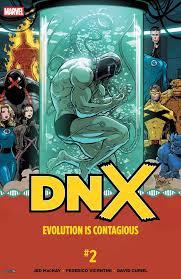
COVER: The X-Men and the Fantastic Four, gathered around Magneto in his floatation tank. This is all pretty much symbolic – Magneto is in a floatation tank in issues #1-2 of this series, but most of the characters shown are in Philadelphia.
There are two other DNX tie-ins out this week. X-Men #38 will get its own entry, but it’s basically an issue of Magneto either dreaming or being telepathically contacted by Professor X – the story is deliberately ambiguous. It might as well happen alongside this issue. Fantastic Four #17 is the first half of a two-parter about the FF’s attempts to cure Magneto, and it takes place after this issue.
PAGE 1. Agent Lundqvist returns to Juniper.
This is the statue of Bolivar Trask, creator of the Sentinels, which previously appeared in X-Men #34. It appeared overnight in the small town of Juniper, and was mysteriously protected by a force field that stopped the Juggernaut destroying it. Agent Lundqvist was sent along to go through the motions of keeping an eye on it in that story. This issue reveals that it was a creation of 3K.
In the earlier story, Lundqvist said that he had been sent to monitor the statue as a punishment for letting the X-Men get away with too much. Juggernaut told him that he was someone who needed a “good boss” to point him in the right direction, and Lundqvist seemed to think that there was something to that. Despite it all, Lundqvist seems genuinely curious about this statue, and has come back to look at it again in his spare time.
“Coleman” is Chris Coleman, the spokesman for the Juniper anti-statue campaigners in X-Men #34.
PAGES 2-4. The X-Men fight 3K’s X-Men.
This straddles the credits.
Galatea refers to getting a rematch against the Juggernaut; they’re the powerhouses of the respective teams, and did pair off once before in X-Men #16.
Psychovore refers to Kid Omega’s absence; he’s off dealing with Cassandra Nova in X-Men #37, which takes place alongside this story (despite coming out earlier). Psychovore used his “thought-eating” powers on Kid Omega in X-Men #36. Quite what being a “thought eater” actually means remains a little unclear, but Psylocke describes him as a “living telepathic countermeasure”, and he doesn’t actually seem to do permanent damage.
PAGES 5-6. Hank, Reed, Sue and Ben continue to discuss Magneto.
The “radical procedure” which Reed proposes to try on Magneto is for the Fantastic Four to collectively enter his body Fantastic Voyage style, as seen in Fantastic Four #17 (though that story picks up after it’s already gone wrong).
Again, Beast refers to Kid Omega’s solo story fighting Cassandra in X-Men #37.
PAGES 7-11. The fight on the 3K Mothership continues.
Joseph insists on proclaiming himself the “true Magneto”, as he did in X-Men #24 and #36. Predictably, he’s put out by the fact that the Human Torch and the Thing immediately dismiss him as “a Magneto”, without even appearing to consider the possibility that he might be the original – possibly they know that the original is in the Baxter Building, depending on what Sue told them when she despatched them last issue. There’s a parallel here with this week’s X-Men #38, much of which consists of Magneto lamenting that he isn’t truly Magneto without his powers.
The Chairman belatedly figures out that Schwarzchild didn’t die when he was booted off the 3K Mothership in X-Men #24, and that the X-Men have retrieved him and learned some of 3K’s security secrets from his mind. That’s certainly what the X-Men were planning to do in X-Men #33 and presumably it’s what Cyclops was alluding to last issue when he referred to them having an inside man. Quite how 3K failed to spot that Schwarzchild was not merely alive but causing major gravitational anomalies that attracted the attention of both the X-Men and Department H- as seen in X-Men #31-33 – is unclear, but perhaps the Chairman assumed that Schwarzchild’s powers could be expected to go out of control when he died. That might explain why they dumped his body in the middle of nowhere in the first place.
Wyre says that the Chairman has “certainly made things interesting”; that references his comments in the previous issue and X-Men #24 that he wants a “more interesting future”. That motivation may explain why he seems to be the 3K member most superficially loyal to the Chairman, at least in the narrow sense of doing what he’s told – whether he has any interest in the Chairman’s political agenda is another matter entirely.
Juice remains mobile when frozen or boiled, but for some reason he can apparently be incapacitated by freezing him and then shattering him.
Animalia debuts a new elephantine form.
Galatea is dismissed as a “hillbilly” by Magik, and refuses to surrender even when being directly threatened with Magik’s sword.
PAGES 12-14. The X-Men and FF finish taking care of 3K.
Wyre is, if anything, pleased that the plan is going wrong because it gives him an excuse to escalate matters. Again, you might wonder how far he really wants to help the Chairman in the first place.
The Chairman takes offence at being described as a “knockoff Beast”, but the irony of this character is that, while he may be the original Beast in strict continuity terms, we’re clearly invited to view the clone on the X-Men team as the authentic classic version of the character.
I’m sure we all know this, but the Torch and the Thing are discussing Jim Hammond, the Golden Age Human Torch from Marvel Comics #1 (1939); Johnny Storm was effectively a re-use of the name and character design. The Golden Age Human Torch was an android, despite the name, and various 1970s stories establish a link between him and the Vision, hence the reference to him here as a “synthezoid” (which is the term normally used for Vision).
Astra and Joseph escape to fight another day. Joseph is reluctant to leave, not because he cares about the 3K mission as such, but simply because he sees retreating as un-Magnetolike behaviour. At the same time, he continues to defer to his “mother” Astra, apparently oblivious to the tension there.
PAGES 15-18. Cyclops confronts the Chairman.
With 3K basically dismantled, the Chairman makes a bid to appeal to what he sees as Cyclops’ better nature. How far he really means it, and how far this is an attempt at manipulation, is open to interpretation. But he starts off by talking about how much he enjoyed being reunited with Cyclops when they were both transported to the future in the “Age of Revelation” event, and that seems plausible enough; he said something very similar in X-Men #35. On some level he does seem to want to be reunited with the X-Men, which fits with him talking in that issue about his feelings of nostalgia.
By implication, the Chairman thinks that Cyclops might somehow be open to persuasion about the whole X-virus thing. He seems to think that on some level Cyclops will view this as a potentially glorious mutant future as long as they leave Revelation out of the picture, perhaps because he sees Cyclops as fundamentally a soldier for whom the ends justify the means. Certainly MacKay’s Cyclops tends to justify decisions on pragmatic rather than principled grounds.
PAGES 19-20. The Chairman releases his back-up virus in Juniper.
I did raise the question last issue of why the Chairman was insisting on doing his virus test in Philadelphia, just because it happened to be where the virus started in “Age of Revelation”. Possibly he was trying to stick as closely as possible to the original timeline. But evidently he does have a back-up, and that was the purpose of the Bolivar Trask statue.
Note that the people immediately affected by the release of the Chairman’s version of the X-Virus include Agent Lundqvist.
X-Men #37 ended with Kid Omega getting in touch with his teammates after emerging from his fight with Cassandra Nova, and being told that “We may lose Philadelphia.” It’s not clear from this issue what that referred to, since Philadelphia doesn’t seem to be the problem.

” It’s not clear from this issue what that referred to, since Philadelphia doesn’t seem to be the problem.”
I think the idea is that the winds will carry the virus to Philadelphia or something.
What happened to Myriad? She’s nowhere to be seen in DNX.
Oh, Wyre. If only the Chairman could have made the X-Men comics more interesting.
So, the Bolivar Trask statue is, basically, the ending of AE Van Vogt’s novel Slan. Got it.
“Quite what being a ‘thought eater’ actually means remains a little unclear,”-I assumed it is like the Vertigo Comic Mnemovore. A much better comic which I would rather read than any of these X-comics. Seriously, it’s a great comic. Read it if you haven’t already, everyone.