X-Men #38 annotations
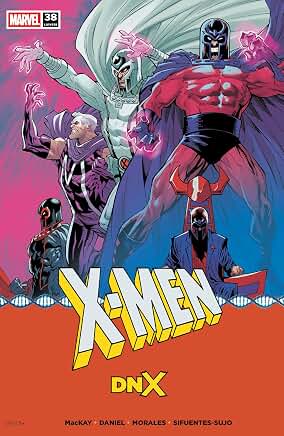 X-MEN vol 7 #38
“Magneto”
Writer: Jed MacKay
Penciller: Tony S Daniel
Inker: Mark Morales
Colourist: Fer Sifuentes-Sujo
Letterer: Clayton Cowles
Editor: Tom Brevoort
COVER: A montage of images of Magneto in various costumes from the course of his career. From left to right, the black and red costume is from Uncanny X-Men vol 4 (the Cullen Bunn run where Sabretooth was on the team); the purple costume is from when he first joined the X-Men; the white costume is from Uncanny X-Men vol 3 (the Brian Bendis “Mutant Revolution” run), although it also cropped up a lot in the Krakoa era; and the red and purple one is Silver Age Magneto. The present day Magneto is seated in front of them.
PAGE 1. Magneto remembers being attacked by the Chairman.
This is from the end of issue #36. The dialogue in the first two flashback panels is from that issue, but the final line – “There. I understand that I am doing you a terrible indignity, so please let it all out” – is original.
The other panels show Magneto in a blank landscape which is apparently the interior of his own mind. Note that in his own mind, he still presents in the classic Magneto costume.
PAGES 2-6. Magneto is approached by Professor X.
The story deliberately doesn’t clarify whether this is a hallucination, or the real Professor X contacting Magneto. It seems much more likely to be the former, simply on the plot level that it’s unlikely that Professor X would be aware of Magneto’s current condition from across the galaxy.
Professor X is wearing his Krakoan-era black costume, without the Cerebro helmet. Magneto refers to him being in “Shi’ar space, or wherever it is you’ve been”. Professor X was last seen in the X-books in the “X-Manhunt” crossover, which for this series was issue #13. After that, he appeared in last year’s Imperial War: Exiles one-shot, which was supposed to lead into an Exiles ongoing about him and Lilandra in exile from the Shi’ar Empire. That book never happened, and so their storyline remains in limbo.
The flashback on page 3 which shows Magneto crying blood and feeling stone tablets is from Resurrection of Magneto #2; the tables show the names of people who died as a result of Magneto’s actions in life. As Magneto points out, he’s already come to terms with all this when he returned to life – that was the whole point of Resurrection of Magneto. Nonetheless, he jumps straight to talking about this without Professor X even raising the topic, which seems overly defensive if he’s quite as comfortable with it as he says.
Magneto’s death at the hands of Uranos took place in X-Men: Red #5-7, and led to Resurrection.
Magneto feels humiliated by his defeat at the hands of the Chairman – echoing the Chairman’s own dialogue on page 1 – and suggests that his powers are so central to his sense of identity that without them he isn’t really Magneto. This has parallels with the way Joseph is written in elsewhere in the crossover, insisting that because he has the powers, he is the real Magneto. (It seems fairly likely that Joseph is here so that Magneto can defeat him as the climax to his arc, and reassert his identity.)
Magneto references the line “I am power.” MacKay is probably thinking of this line cropping up at several points in Resurrection of Magneto #3, which ends with Magneto saying “Who am I? I am power. Men call me Magneto.” That book in turn got it from the end of X-Men #17 (1966), where Magneto answers the door to Angel’s understandably confused parents.
PAGE 7. Magneto views an alternative Iron Night.
Welcome to the It’s a Wonderful Life section of the issue, where Professor X makes the case that the events of this series would have played out differently in Magneto’s absence, despite his lack of powers.
This, specifically, is the “Iron Night” seen in flashback in issue #7, where Cyclops and Magneto save Merle from a Sentinel. In that issue, Magneto shows up with his powers fully functioning, and tries to persuade Cyclops to re-form the X-Men. After the Sentinel is defeated, Magneto loses control of his powers. We were told (but didn’t see) that Cyclops had to knock Magneto out in order to get him under control; in this version of events, Magneto dies as a result. Magneto doesn’t see this as a particularly bad outcome, since Cyclops goes on to re-form the X-Men anyway.
PAGE 8. A montage of how the series would have played out without Magneto.
In Magneto’s version of events – and we have to assume that this is him talking to himself – most people are largely unaffected by his absence, or even better off. He envisages the Beast being able to spend his time on something more productive, instead of researching Magneto’s condition. Interestingly, Magneto sees himself as one of the reasons why Temper hasn’t been able to move on from her feelings of bitterness at being imprisoned in the Pit on Krakoa, presumably because he was one of the Quiet Council and directly implicated in the decision.
It’s only with Ben Liu that Magneto struggles to rationalise how his absence wouldn’t make a difference, given the way Ben has clearly viewed him as a mentor.
PAGES 9-12. An alternate version of the second Iron Night.
This is the mutant now known as Myriad attacking Merle in issues #14-18, where Magneto piloted a Sentinel to fight her. Magneto clearly does take an active line in this story, but ultimately rationalises that if he hadn’t been taking up Beast’s time, somebody else would have dealt with the problem. None of this really addresses the point that Magneto was still making a contribution, of course.
Note also that Magneto’s concerns about Myriad’s rampage are framed less in terms of how many humans she might have killed in his absence, and more in terms of how much guilt she would have carried for killing them.
PAGES 13-15. An alternate version of Danger Room.
This is a version of the “Danger Room” storyline from issues #26-30 in which Kid Omega and Temper take the bait after Glob Herman is shot, and go on a rampage against the entire population of Merle. In issue #30, Magneto manages to talk them down at the very last minute; in his absence, they undoubtedly would have crossed the line.
PAGES 16-20. Magneto and Professor X discuss why he was the target of the DNA message.
Again, faced with a clear example of him contributing to the plot, Magneto ducks the question on the next page, and instead starts complaining about being lectured to by Professor X, who he sees as a moral scold (although in this context he probably represents that side of Magneto’s mind).
Magneto confirms that their understanding of the plot is that the message written onto his DNA, which caused him to lose his powers, was the one sent back by the Age of Revelation Beast in the closing moments of X-Men: Age of Revelation Finale. Ultimately, while none of the examples of him contributing to the plot of the series seems to have changed his mind much, Magneto is swayed by the argument that he was only chosen for this affliction because of his ability to endure it. This seems to recast the situation in his mind as one of dignity.
Professor X directly refuses to confirm whether he’s real or not, the suggestion perhaps being that if this is the real Professor X, he thinks the message will have more weight if Magneto believes he came up with it himself.

An interesting inversion of Uncanny 309 from back in the day – I don’t necessarily think it would be a problem for Xavier to know Magneto’s condition, considering Jean’s taking an active part in this story from all the way in Shi’ar space.
That said, it’s not the best dialogue these two have had in similar situations.
I’m not sure where the error lies, but it was Warren’s parents who arrive at the X-mansion, not Jean Grey’s parents.
There needs to be more references to 1960s X-Men #17 and 18. Magneto answering the door like that (talk about dignity). Using his magnetic hypnotism powers on Warren’s parents. Putting the captured X-Men members in a hot air balloon trap. Magneto is suffering under wonderful delirium.
I see we’re basically fully into the idea of Magneto as a tired old man wallowing in insecurity and self-pity. This dovetails into the idea that with Xavier and Apocalypse off-planet and the great Krakoan experiment failed, Magneto’s run the entire course of his mutant superiority philosophy. (Especially when you count the OTHER mutant homelands he’s lost, including Genosha…)
Marvel has spent ages moving Scott into the forefront as a mutant leader and inheritor of Xavier’s legacy, but we’ve never really gotten a good Magneto/mutant supremacist successor even though he’s been allied with the X-Men/off-and-on sympathetic since the ’80s.
It’s a shame that Chairman has taken that role because he’s far more mad scientist than revolutionary, and not in the least inspirational, charismatic, or visionary.
I’d like to see someone actually able to become Scott’s counterpart/opposite self but with that ability to inspire followers like Magneto had. Sinister is a mad scientist, Apocalypse always inspired through fear and strength…
@Chris V: I’ve fixed that, thanks.
@Michael: I thought Cyclops was the Magneto successor.
Note that Xavier refers to Robin Carr as Myriad. Magneto never heard her referred to by that name. That suggests this is the real Xavier.
@The Other Michael: It should be Emma as the next mutant supremacist standard bearer. Less of Magneto’s overt militant separatism and more ruthless manipulation of existing power structures from within.
More importantly, with Cyclops as Xavier’s successor this would mean the two main leaders of mutantkind once again have a whole lot of simmering sexual tension between them.
Taibak-Until he says, “Who am I? Awesome and terrible power. Men call me Cyclops!”, Scott can’t be Magneto’s successor.
That original Magneto scene in the 60s X-Men was incredible, in that the artist made a man with a helmet and cape in a suburban setting look not just natural, but intimidating as hell. I think about that a lot.
@The Other Michael: I don’t know, Hank *could* have been Scott’s Magneto. He’s managed to keep an alliance of nutters together and he has a vision of mutant domination.
The Chairman’s main problem is the same one that he had in Krakoa – that he makes dumb, predictable mistakes.
This issue directly referencing the far superior Resurrection of Magneto story does it no favors whatsoever. While I appreciate the story slowing down for a character study, it all reads as very superficial. I just don’t think MacKay puts in enough character work amidst his plotting, he’s like Hickman but without the intricate world building. “Shallow” is the first word I would use when describing his run, actually.
One of these days I will try to understand what Al Ewing’s plots look like.
He had some interesting ideas in Immortal Hulk, but even there his plots seemed to take weird turns.
There was probably some reason for publishing his X-Men Red and Resurrection of Magneto, but I sure failed to notice it. Together, those two series were just expensive journeys to claim that Storm and Magneto are Very Badass People while not actually showing anything to back that up.
I’m probably in the minority here, but I think that this story lessens itself by referencing Ewing’s. Not because that one was so good, but because it was so frustratingly pointless.
Cyclops is supposed to be the heir to both Xavier and Magneto, that has been the point since Utopia, that he learnt form both to take the dream of Co-existence but us the Militancy of Magneto to bring it about.
It’s like Nightwing being product of Batman and Superman, Dick is Bruce with the Hope Clark, Scott is Charles with the practicality of Eric.
Which means he does not need his Magneto, the needs his own nemesis. Hank can not be that one because marvel did not commit toe evil Beast, and 2 because there is already an evil beast and he has never really amounted to much.
I would just make clear the Sinister is Scotts Nemesis as he is also the only big bad to not to turn in Krakoa, or beef up the ONE.
@Luis, I appreciate your opinion on Ewing’s work, I felt like his Immortal Hulk completely lost focus by the end and I couldn’t engage with his work on Venom at ALL. However, I thought his Krakoa era titles, From SWORD through X-Men Red and Resurrection of Magneto, was one of the highlights of that period. Yes, his Storm and Magneto were lifted up quite a bit, but I felt like he did back up the reverence with plenty of evidence. I certainly appreciated his work with Storm more than how she was written in her solo series that came after.
To each their own, though!
The idea that Charles and Magneto could potentially have a shared ideological legacy probably has some real-world proposed parallel (MLK Jr. and Malcolm X, I assume), but in comics AFAIK it was first clearly stated in 1993’s “X-Men 2099 #1”, some sixteen years before Utopia. Of course, that was an alternate timeline several decades in the future, so not very relevant.
Whether it makes sense in the main continuity and when it became so is probably an arbitrary call reliant on the reader’s interpretation. Some will say that Xavier recognized that in Uncanny #200 back in the 1980s. Others might point towards Utopia (which I am only peripherically aware of), Schism or Krakoa.
Myself, I’m not a great fan of Magneto hagiography, so I suppose I am just not part of the target readership.
It’s really right there in the first issue of X-Men (1963). Professor X believes that the stronger have a responsibility to protect the weaker from others who are stronger and would prey on the weak, while waiting for humanity to come around to accepting those who are different. Magneto believes that the strong should conquer the weak. Both beliefs come from the similar ideology that mutants are superior to humans and simply break over what being “the strong” should mean.
Outside of Scott deciding to embrace a half-way point between Xavier’s peaceful coexistence and Magneto’s use of force to achieve rights for mutants; which can be seen as later writer’s attempt to flesh out Scott becoming the leader for the next generation who embrace new ideas proposed at the end of Morrison’s run, there was never a point where Xavier’s and Magneto’s ideologies are conflated in the comics-outside of perhaps in the alternate year 2099 after Xavier’s dream has long since died out anyway.
It was shown in the comics as Cyclops losing faith in his earlier blind trust of Xavier.
Claremont has Magneto admit that he tried to do things Xavier’s way, and he failed.
Utopia was Scott’s idea for the future of mutantkind, not Xavier’s.
Krakoa was Moira’s idea, and Xavier eventually admits that he compromised his dream to embrace an ideology that was far more compatible with Magneto than with his own ideology.
Wasn’t that position of Scott kinda what Cable was all about in the 90s?
No. I think Cable’s ideology was more strike first to take out the enemies of both mutants and humans. Xavier thought it was better to wait for “evil mutants” to strike, then send the X-Men to stop them from hurting humans. Cable’s idea was that if they knew of a threat, they should neutralize the threat before the threat has a chance to “radicalize” others. Basically, Xavier is sitting around, thinking that humans will come around to accepting mutants if they see “good mutants” fighting the “evil mutants”. Cable’s view was that it was only by eliminating the “evil mutants” before they could act that humans will stop seeing all mutants as a threat. Like, if Xavier would have just maimed Magneto before the events of X-Men #1, maybe the fear and hatred of humans for mutants wouldn’t have even happened.
Because as we all know, bigotry is an inherently rational mindset based entirely on what people do, rather than what they are.
Scott does have to have a new approach because this is not the world of Xavier and magneto from the 60s 70s 80s or the 90s think todays radicalism being from the right is why the focus has been on the O.N.E and department H as has institutionalised bigotry seems to be making a come back either as a political platform in the UK and Western Europe or actual policy in the US. So it makes sense the Marvels most fascist coded country Canada has been a big bad for while in this era.
I would also bring back a Grayson creed type coming from a city in the UK that recently saw a standoff between masked bigots and the police and coast guard it would be good to see those people sent through a portal to limbo like we did with racists in the 80’s
Scots approach of winning hearts and minds and showing the people of Mearle the benefits of have mutants is a good approach for winning over the open minded similar to the let’s be heros approach of astonishing. And temper and quire’s storyline about not raising to bait are all good in theory , but it’s a bit ‘when they go low we go high’ so maybe also need an team to take less respectable approach.
I don’t know if X-Force was the first team to sport the “heroes strike first” remit, but it’s the earliest one I remember.
And I’m ashamed to say I completely bought into it (I mean, I was a kid). Cable was gonna be a different type of leader than Xavier/Magneto, the X-Men were at the top of his “potential enemies” list because his team was gonna be so out-there and controversial, blah blah blah.
And it was complete bullcrap, like every other hero team with the “strike first” policy. X-Force didn’t strike first ONCE. They either reacted to the bad guys doing stuff (the MLF, Juggernaut) or got attacked themselves (the Brotherhood, the Six Pack). And then Cable left and any pretension of X-Force being the “strike first” team left with him.
The post-Siege Perilous X-men were the first “we’re going to be proactive” team that I ran into, and it lasted for the Reavers, the Brood, and the Marauders, but Inferno put an end to any pretense of it.
Stryfe is probably as close to an inheritor of Magneto’s mutant supremacy, but he was mostly an X-Force character and the quality of those was not great. Similarly, Exodus in the 90s might have been Magneto’s heir, but I think he’s only been written interestingly in Age of Apocalypse and Krakoa.
I think it’s notable that he hasn’t been seen since Krakoa; really all the Omega-levels have made themselves scarce, have issues with their powers (Magneto), or have incomprehensible/poor solo books (Ororo and Jean). Though if Ororo is the Omega-level weather manipulator and Omega-level hippo rider, then I will tip my hat to that series.
@Diana: The problem with that take is that exposes the limits of mutants as metaphor. When someone like Xavier or Magneto can kill you just by thinking in your general direction, fear becomes a very rational response.
I really wish we could have seen more of the “mutants trying to help the world” part of Krakoa, like when they introduced the first responders team made up of assorted characters from all corners of the mutant sphere. Why not have those with special powers respond in a helpful, beneficial manner? But that lasted for all of one issue.
Point is, we see “good” mutants fighting “evil” mutants, or fighting vampires, aliens, demons. We see “good” mutants fighting mutant supremacists, battling attempted genocide, trying to save the world. But what we don’t see are the more mundane acts.
What if mutants could be synonymous with healing, helping, building, terraforming, reconstruction, saving lives, instead of laser eyes and death touches?
Of course, you still have to watch that line between helping people and controlling them– we’ve seen what happens whenever superhumans go too far in trying to change the world. So no more miracle drugs or terraforming Mars as a mutant world or resurrecting the dead. But working in conjunction with human agencies and organizations to feed the hungry, house the homeless, battle and recover from natural disasters, heal the sick…
Ooops, sorry, it’s time to go fight genocide robots.
@The Other Michael: One truth Krakoa inadvertently drove home is that a persecuted minority can never be “good enough” for the rest of the world. Jean’s Phoenix Foundation was literally resurrecting murdered or terminally ill human children, it changed exactly nothing when the world had to choose between believing Charles Xavier or believing MODOK. There is no threshold of helpfulness, charity or assistance that will suddenly make bigots *not* want that minority to disappear from the world.
@Luis- in X-Men Red and Resurrection of Magneto, Storm’s and Magneto’s victories were sometimes a little contrived but mostly felt earned. It isn’t like Sleeper in Queen of Black, where it reads less like Sleeper usurped Knull’s throne by outwitting him and more like Ewing told Sleeper how the plot would go before the story started. (There’s no way Sleeper could have known about Venomworld in advance.)
@Chris V, Diana- In his first decade or so as a character, Cable wasn’t primarily concerned with humans fearing mutants. He was worried more about the harm that evil mutants could do. Most of the tragedies in Cable’s life were caused by other mutants- he was infected with the virus by Apocalypse, he grew up in a future that had been conquered by Apocalypse, his wife was killed and his son was corrupted by Stryfe.
in a two-parter in X-Force that featured Nimrod. Cable told Forge that although he respects humans’ rights to defend themselves against evil mutants, the Sentinels are just too dangerous. He ends the story compromising with a human scientist.
Notably. CANNONBALL was the character who in early X-Froce was depicted as a potential synthesis of Xavier’s and Magenta’s ideas/
@Sam- Even the Reavers. the Brood and the Marauders don’t really count. The Reavers had kidnapped Tyger Tiger., the Brood were infecting mutants. and Malice was possessing Lorna so they had to go after the Marauders to free her.
Of course, when the New Warriors tried to arrest four supervillains who had escaped jail, everyone acted like they were being completely reckless when things went wrong.
@Taibak: Sounds like you’ve rather missed the point of the whole story. Prejudicial hatred will find any reason, invent any justification to take root. The people who murdered Rahne Sinclair and chased the Morlocks underground and hung mutant children from swing sets and cheered when Genosha was destroyed weren’t doing it because they have a “legitimate” fear of Xavier being a telepath – that didn’t even save Xavier himself from being victimized by his human students back in the Claremont days.
Just because racists and misogynists and antisemites and transphobes can make up any excuse as to why a category of people is “dangerous” doesn’t mean they actually are. And it *certainly* doesn’t legitimize what they do with those excuses.
It fits as a metaphor for minorities in the established wider Marvel Universe anyway. You can have super-genius Tony Stark wearing advanced military grade tech flying around the city and getting cheered, with the common folk simply trusting that he’s going to use it to defeat supervillains. How is Tony Stark being allowed to do whatever he wants with his armour any different than Xavier having powerful telepathy? In the real world, a large segment of the population would be afraid that Elon Musk would use his weaponized military grade armour suit to put an end to “Wokeness”, but in the Marvel Universe Iron Man is simply accepted as a hero. In the real world, a lot of people would be upset the first time he used his repulsors and ended up blowing up millions of dollars in city property and saying he’s not liable, while the people he’s paid off in Congress vote to give him immunity.
You can say, “Oh, Iron Man’s proven himself by defeating so many dangerous criminals who have their own advanced tech.” Isn’t that the same as Xavier’s “dream” that we readers so often (understandably) mock though? If the “good mutants” protect baseline humans from the “evil mutants”, eventually humanity will come to accept that mutants should be judged by their deeds, and realize there are plenty of “good mutants” too. Except, it never happens as all mutants are still feared and hated.
Hickman even attempted to explain that humanity is encoded with the instinctive knowledge that mutants are the “next stage in evolution” and are fighting against their eventual extinction. Meanwhile, superhumans are the next stage on the eventual path to post-humanity which will outcompete the mutants and allow Homo Sapiens to survive in some form, so humanity will naturally see the two as different.
Sure, that messes with the metaphor, but I think it’s the first time that the contradiction has been blatantly pointed out in the comics, which does reject the argument that the metaphor of mutants for minorities in society is too muddled because “mutants can have world-shattering abilities”. Mutants don’t exist in our world, they exist in a world where any human could randomly find themselves with great powers that could kill millions of people, yet those superhumans are beloved. Yet, those born with their powers are hated. Not just Magneto when he was sitting in Asteroid M threatening to destroy human civilization, but all mutants, regardless of their powers or how they use their powers, including those also-powerful mutants who travelled to Asteroid M in order to stop Magneto.
This does fit with real-world examples, like the issue of rape, where you have racist and misogynist people arguing that “rape is just natural” when a white man is accused of rape, but that Black men are a danger to white women when a Black man is accused of raping a white woman. It’s always that Black men are a danger to women by these types, not the individual rapist is a dangerous person, but potentially any Black man. How about the recent argument that trans people are inherently violent because an individual who is trans was responsible for gun violence. Would that action have mattered? Was it really this one incident which suddenly made these types decide that trans people are a threat to society or were these types always scapegoating and vilifying trans people, and this one incident allowed them to attempt to justify their earlier messages of fear and hatred?
@Chris V: Hickman’s attempts falls short in exactly the same way – saying humanity is “encoded with instinctive knowledge” gives them an out for acting the way they do. It would be like saying the people vilifying and attacking trans people can’t help it because it’s an instinct and there really *is* something “Other” about trans people (and it’s not much of a stretch to go from that to “well, then trans people are asking for it”).
Kieron Gillen had Xavier articulate it so simply and clearly in three words: “Mutants *are* humans.”
Right. That’s why I say that Hickman did mess up the metaphor, as he was using mutants as a separate species to tell his story. Although, he did include some info to undermine his own narrative also, such as Nimrod the Greater seeing Homo Sapiens and mutants as the exact same, while apparently portraying post-humanity as something “other”.
I was just pointing out that, as far as I’m aware, Hickman was the first writer to actually address the contradiction of why “mutants as metaphor for minorities in society” does work within the rules of the Marvel Universe, regardless of Magneto having actual potentially civilization-destroying powers. The different reaction of Marvel’s humans to those who are superhuman versus the fear and hatred reaction to those born with mutant abilities. A lot of readers seem to miss that when they claim that the mutant metaphor is too muddled to work.
I think the homo superior label and the species idea which keeps being used by lauded writers like Morrison and Hickman is wrong and breaks the metaphor.
Despite there appearances a pug, a collie a labrador, a chihuahua and a great Dane are all the same species. There closest relatives wolves and foxes are both different species. So either or mutants are humans or there are 1000s of new species where feral mutants are as separate from telepaths as wolves and foxes
If mutation is random and different it can’t create a single new species
Yeah, if mutants are a separate species, you couldn’t have two mutants be the parents of a human like Mystique and Sabretooth are the parents of Grayson Creed.
The homo superior label goes back to the early issues of the book but the usual explanation before Morrison was that mutants are a SUBSPECIES. not a species.
Mutancy in Marvel stories was never remotely similar to anything that happens in real world biology, though. Claremont and later Morrison and others may have balloned the differences, but there isn’t a point to trying to find parallels to real life.
We will have to agree to disagree about Al Ewing’s takes on Storm and Magneto, Michael.
@Michael: They pretty much do count. The X-Men didn’t know who Jessan Hoan was, just a prisoner the Reaves were holding when they took over their base. She wasn’t even Tyger Tiger yet. The Brood is a case of eliminating a threat to mutants before it attacks the X-Men themselves. Even before they were attacking mutants, Havok and Polaris had discovered their spaceship.
Just to be pedantic
While the term “homo superior” was used by Silver Age Marvel (but coined somewhere else) the use of “homo sapiens superior”, implying a subspecies, not a separate species, has been play long before contemporary Marvel Comics, but Google was no help in pegging exactly where and when Marvel first used it.
As for why a given minority is othered, this isn’t exactly a chicken or the egg thing. In the real world there are REASONS, cause and effect, behind a given prejudice and/or bigotry. That fact doesn’t make it right but generalizing a given injustice or hatred is as silly as the hatred itself and undercuts any attempt at correcting a given injustice.
I first remember seeing “homo sapiens superior” during Claremont’s run during Genosha. He was always a proponent of mutants being human.
As for reason for humans to be afraid of mutants, it was there from the beginning. The X-Men didn’t fight sapiens bigots, they fought Magneto, an obvious Hitler analogue. Bolivar Trask was portrayed as a misguided but good man who saw the truth and tried to stop his creations. Chris Claremont created Senator Kelly, modeled after Sen. Ted Kennedy, as a mutant antagonist, and had everyone call him a good man.