X-Men #18 annotations
As always, this post contains spoilers, and page numbers go by the digital edition.
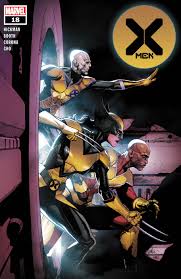 X-MEN vol 5 #18
“Inside the Vault”
by Jonathan Hickman, Mahmud Asrar & Sunny Gho
COVER / PAGE 1: Darwin, Wolverine (Laura) and Synch enter the Vault.
PAGE 2. The exterior of the Vault.
This is recapping issue #5. In that issue, the X-Men decided to infiltrate the Vault, home of the post-human Children of the Vault. Technologically-enhanced post-humans are supposed to be the biggest threat to mutantkind, according to everything we discovered in Power of X; and besides, the Children of the Vault really are planning to take over the world once they’re ready. The Vault is a sealed chamber where time moves at a different rate, the idea being that eventually they will emerge in a hyper-advanced state, ready to take over the world. From time to time the Children come out to have a look around and decide that they need a bit more time in the oven.
Wolverine, Darwin and Synch were selected for the mission on the basis that their powers ought to allow them to deal with the time dilation. They entered the Vault in issue #5 and we haven’t heard from them since. That’s bad, because if all had gone to plan, they would have completed their mission and (thanks to the Vault’s accelerated time) returned to the outside world mere second after they left. If they’re still in there then it’s been a very long time from their point of view.
The ruined Sentinel seen here is the one that Cassandra Nova was using in New X-Men #114. The Children relocated the Vault here in X-Men vol 2 #193.
PAGE 3. The team look out over the Vault city.
This calls back to a series of splash pages with similar layout in issue #5. That issue presented the alarms as going off pretty much immediately, so presumably this scene has to be slotted in between the pages of issue #5.
PAGES 4-6. The team advance into the city.
For reasons which are not wholly apparent, the Children of the Vault have built an enormous city with almost nobody in it. Darwin voices a theory that the Children engage in population control. There’s a certain logic to this: if the Children were breeding over a period of millennia from their point of view, you’d have expected their population to increase exponentially. So presumably either they’ve consciously chosen not to expand their numbers or there’s a sterility issue. Neither really explains the need for the city, though. Issue #5 strongly hinted at a connection between the Children’s computer, and the City of the Children of Tomorrow from Hickman’s Ultimates run. The X-Men would have no way of knowing about that.
Darwin’s powers are described here in terms of “rapid evolutionary adaptation”. Traditionally he’s been presented as adapting to his environment without having any conscious control over the process, which basically means that he gets useful powers, and especially powers that will keep him alive, according to the scenario. Sprouting a bunch of sensors isn’t exactly typical, but he does kind of need them to stay safe. None of this, of course, has the slightest thing to do with evolution, which is a population-level concept, but shhh.
The rainbow effect around Synch in the final panel of page 5 is the traditional visual representation of his energy field that lets him synch up with the powers of other characters.
PAGE 7. Data page. Basically, Dr Reyes claims that Synch’s powers are more powerful than they were the first time round (as we’ll see, she’s right), and she theorises that this is something to do with the resurrection process (in which case it should apply to others too).
There was a medical report page about Synch in issue #5 too, which is why this is identified as an addendum. In that version, Reyes also picked up on Synch’s increased powers, but theorised that it was due to the Five. We know that the Five can revise people’s bodies, but her current theory is that the power increase is due to something else.
PAGE 8. Recap and credits.
PAGES 9-11. Serafina reports back to the computer.
We saw several such scenes in issue #5, but this one doesn’t follow the splash page layouts from that issue. Basically, the computer concludes that they’re only at level 2 and they need to be at level 3 before they can take on the mutants.
PAGES 12-13. The Children are despatched to protect the City.
The other four children seen here are (all as foreshadowed in the computer listings in issue #5):
- Sangre, the guy with the circles. He can make water bubbles to suffocate people with (which is maybe not as prominently conveyed in the later fight scene as it could have been). He used to be the team leader.
- Perro, the big guy. He affects gravity.
- Aguja, the woman in green. She has vaguely-defined energy powers.
- Fuego, the one with his head on fire.
Sangre, Aguja and Fuego all supposedly died in X-Men vol 2 #193, but evidently the Children of the Vault have their own resurrection procedures. All this was indicated in issue #5, though we didn’t see the other Children in that story.
PAGES 14-23. Fight scene.
Accompanying all this is a narrative from Synch to the effect that memory doesn’t work in literal terms, and that the way you remember things looking back is framed by what connections your mind made between different things.
Synch’s powers used to be confined to copying mutants. Apparently he can now copy superhuman powers generally.
PAGE 24. A data page confirming that the “Murder No Man” law does not apply for the purposes of this mission, though the reasoning wavers over whether that’s because the rule has been suspended, or because it doesn’t apply to the Children of the Vault in the first place (since they aren’t human). In fact, since the Children have access to resurrection technology, it’s arguably in line with Krakoan principle to treat them differently. Nonetheless, it’s unusual to see Synch, of all people, using lethal force in the way he does here, even allowing for the fact that he’s (literally) fighting fire with fire. He’s normally quite a laid back type, who might perhaps be driven to use this level of force in self-defence, but would normally be a bit more conflicted about it.
PAGE 25. Trailers. The Krakoan reads NEXT: IT STARTS.

This was a very nothing issue.
It’s shocking how decompressed most of this is.
Agreed. I was looking forward to this issue, but it seems that Hickman has his “each issue will tell a different story “ writing philosophy on this X-Men book for a reason.
He gives himself a two-part story and it tempts him toward decompression.
Granted, none of his X-Men issues actually tell a complete story, so they can’t be considered self-contained plots either.
It’s hard to believe how little happens in each issue of Hickman’s post-House/Powers X-comics.
It does make it read as if he’s just killing time, waiting to tell the Moira story someday.
Meanwhile, he allows the other writers to play in the sandbox, while he has nothing he wants to say with the franchise.
I may be alone in this, but I always cringe when I see Laura be called “Wolverine”. X-23 at least had a hint of individuality.
12 issues between installments of this mission is a bit much, even allowing for crossovers that might not have been expected (I don’t think that the pandemic changed their plans, although it delayed the publications). I suppose that it somewhat emulates the uncertainty that those on the outside feel about these three’s fate.
Yeah, I don’t think there should be two people called Wolverine at the same time. Only Hawkeye can pull that off successfully. It’s done for commercial reasons no doubt.
But X-23 is a terrible name in my opinion. In-story it’s not even a name, it’s a designation given to her by her abusers. In real life, it’s far too generic to be catchy. There’s hundreds of things called X-numbernumber, or at least Q-38 or whatever. There’s another character in Marvel comics called X-51 for goodness sake.
She shall from this day forward be known as…Carcajou!
This book is just endlessly spinning its wheels. It’s very lucky to have such pretty art (Brett Booth’s issue was whatever). HoX/PoX brought me back to the X-Men and bought Hickman a lot of goodwill in my book, but sometimes I ask myself why. He is very clearly not interested in actually getting on with telling a story.
Issues #1-12 were all set dressing, and you can forgive Hickman for wanting to get his pieces into place and set the mood, but that’s after 12 issues of HoX/Pox supposedly doing just that. The New Mutants issues he wrote to position even more pieces were just not very funny and those plot threads that were brought over into the main book are at this rate going to take forever to go anywhere.
The Giant-Size one shots still kind of mystify me. I’ve read them multiple times, together in order of their release and when interspersed between the main title’s issues based on publication date. Either way they all feel like disjointed false starts. I know these were supposed to be showcases for the artists, and the art is beautiful in each issue; but there is very little story over 5 issues, 2 of which (the Nightcrawler and Magneto issues) have absolutely nothing to do with the other 3.
I enjoyed X of Swords overall but that really feels like an Excalibur story with Hickman’s Arakko stuff tacked on. Ineffectively. And now we’ve come out of that 22 issue crossover and are being fed abortive stories in slow, vacuous 1 issue installments that so far show no connective tissue. Just like all those early issues of set up. This title might work better if it were released biweekly but instead it’s taking a month off in April.
I didn’t mean to go on a rant! I just don’t know what any of this is for anymore. Every issue feels like a down payment on a future story that won’t arrive for years… but I guess I’ll keep buying because of the great art and the sunk cost fallacy.
This is a two-parter in which the first part might as well not exist. I’m guessing the second issue will have some payoff, hopefully. But this is… ‘Remember what happened a dozen issues ago? Well, let me remind you. Right. So that’s what happened. And… Yeah. Well. Have a fight scene. See you in a month!’
Marvel seemed to be on an IP expansion kick a few years back. Steve Rogers and Sam Wilson were both Captain America, Amadeus Cho and Jennifer Walters were both Hulk, Dr. Doom and Riri Williams were both Iron Man, Thor was Thor and so was Jane Foster, and so on.
Some of these worked better than others. Having two Spider-Men has been a smash success for Marvel, two Hawkeyes is working well, and Jane Foster’s getting to be Thor in the MCU.
Does the name work for Laura? Not in my mind. She’s always been notable for her lack of relationship with Logan. X-23, meanwhile, is basically just calling her “Girl”. I’d rather she picked up her own name. Maybe Gabby can go back to Honey Badger and let Laura have Scout?
I was taken aback by Booth being credited as the artist on the cover, but fortunately this was just an error.
Scout’s a terrible name, though. I can sort of see it working for Gabby (though Honey Badger was much better), but it doesn’t fit Laura in any way whatsoever.
Kyle and Yost (and, weirdly, Claremont in X-Men The End) put forward ‘Talon’ as a codename Laura will adopt in the future, but that was completely forgotten. And DC published a ‘Talon’ book in the meantime which rules it out completely.
Well. There’s always Sniktbubette if nothing else works out.
this issue was boring. nothing happened.
i am a huge generation x fan as it came out just as i started reading x-men comics, so i was excited to have an issue of Synch.
But then… nothing happened.
Any review for X-Men Legends #1 coming?
HoXPoX must have been more successful than Marvel anticipated because they expanded their subsequent X-plans at least a couple of times (more spin-offs, larger crossover). But that means Hickman has to wait even longer to follow up on the HoXPoX set-up. So we get wheel-spinning from a writer already notorious for gratuitous amounts of set-up.
The smart thing for Marvel to do financially is to wait until the X-books dip in sales, then wrap up Hickman’s uberplot in another can’t-miss miniseries. Unfortunately(?), readers seem to enjoy many of the spin-off titles, so the resolution to HoXPoX that we’re all craving keeps getting putting off longer and longer. In this instance, we’re getting a two-part story that explicitly doesn’t “start” until part two. That’s just rude.
It’s cynical, but I do believe this is all about the money. The X-books must not have sold this well in years. And we’re getting some good stories out of it — I know I’m buying more X-books than I have in a long time. But the central narrative is suffering quite a bit from the success of the line in general.
I’ll review the X-Men Legends arc once it’s complete.
Quickhatch!
Synch!
Darwin!
So are we meant to think that the Children of the Vault are the same posthumans as the ones from Moira VI’s timeline? Because they don’t seem to be spending the time until their ascension creating and refining Sentinels/Nimrods, and there’s been no mention of the Phalanx…
No. The Children of the Vault are not the same post-humans.
They are post-humans with a plan to conquer the world.
Any post-humans could accelerate technological change and lead to the extinction of mutants.
The post-humans in Life Six were explicitly being genetically engineered by Nimrod.
Thom-I’m not sure that is accurate.
Hickman signed on for a three year deal with Marvel.
As far as I am aware, the contract has not been extended.
So, what was Hickman’s original plan for taking over the X-line for three years? What was he going to be doing differently with the books over three years that has been changed?
As far as I’m aware, the better sales than expected only convinced Marvel to allow the line to become more bloated.
The effect has been felt mainly by spin-off books, rather than Hickman’s stories.
The original pitch was that the first line of books would last for roughly twelve issues and then be canceled, in order to make space for the next wave of new titles.
Instead, books like New Mutants and X-Force are continuing, as Marvel slowly rolls out new titles to join the line.
So, it may have changed a few small ideas from Hickman; but overall, I think we are seeing Hickman’s original vision.
I thought Synch could copy beyond just mutants. Also Hickman writing style of leaving characters into cliffhangers and returning to them MONTHS later must be something new.
On prolonging stories due to promising sales figures… Do we even have access to sales data? Do companies release information on electronic sales? I used to enjoy the comic chart rundown on this website, though sometimes with gloom as even the top books were in steady decline. I’d appreciate the latest take on this. Especially through a HOXPOX prism.
@Chris V: Where does it say Nimrod genetically engineered them? The Librarian just said Nimrods bought them decades.
@sagatwarrior: In Amazing Spiderman #437, he was able to Synch with Spider-Man. Does he now have to touch people to synch with them, like with Wolverine and Fuego? Before, it was being in their vicinity.
@Evilgus: There’s the Comichron sales charts. https://www.comichron.com/index.php
Since DC left Diamond, sales are given in a range. Even with the X of Swords crossover, sales aren’t particularly high. X-Men #13 barely broke the top ten. X of Swords: Stasis was 19, Excalibur #13 was 34.
How and why did the Children move from their last location in the Corridor in X-Men: Legacy back to the Vault?
Nope, Synch was always limited to fellow mutants.
And once Spider-Man when they’d both been transformed into monsters by Plantman spore. Look, it was a weird issue.
No, this is just Hickman’s writing style that he always uses, fully on display. He has a gangbusters opening planned out, filled with intrigue. He opens up a bunch of cans of worms, and it looks like there are going to be lots of stories he could tell with them. He seems to have themes he intends to flesh out. He never does character stuff, and those of us who complain about that are generally brushed aside at first, because Hickman’s bold ideas are on display, and the establishing material looks really promising.
But Hickman has very little else in his writing quiver besides introductory material. Every subsequent issue he writes feels like another restart in a way. He does not develop stories; he just keeps starting new ones. And when it comes time to deal with the story threads he’s set up in those exciting early issues, what he ends up doing with those story threads is never as interesting as what was promised. He is the comic equivalent of that recent collection of movie directors that shoot their films “for the trailer”––filling their preview content with intrigue and exciting images, but then delivering only the disconnected, partially-assembled elements of an actual story when the time comes.
This issue needed to open with the story that takes place after the events we saw in the issue. We’ve actually seen this Children of the Vault scene in one way or another twice prior during Mike Carey’s run. Nothing about our knowledge of the Children of the Vault is enlarged upon here. They are nasty characters, and it’s fun to watch them get their asses handed to them by the X-men a third time, but it would be more ideal perhaps to begin on the X-men’s little kill crew polishing off the Children of the Vault as they do, and then moving on to whatever story Hickman eventually intends to tell…if he in fact has a story he intends to tell here. And I’m doubtful of that.
The first Children of the Vault story taught us all we needed to know about them. And in the process, Rogue formed an X-men team. They came together to fight the Children of the Vault, and that coming together of that team was at least half of what we saw during that storyline––making it pretty entertaining. The second Children of the Vault story was framed around the rekindling of the romance between Magneto and Rogue, and Magneto’s general pivot to being a member of the X-men. So it was cool to watch Magneto and Rogue essentially outwit the Children of the Vault, and out-fight them. It demonstrated Magneto as a resourceful hero––really kind of fulfilling the promise Claremont had written in to the character, but had never been able to see through. That’s what made that second story fun. I don’t recall any other Children of the Vault stories before now.
In this story, we have 3 X-men who have never worked together, who have no relationship between them that means anything. The mission is characterized as a fact-finding one, but Laura seems to think the mission is to kill the Children of the Vault; neither of the others disagree with her. They don’t appear to be trying to do much else––they aren’t gathering readings, they aren’t proceeding with any clear fact-finding goal in mind. I mean, these Children of the Vault have a nominally cool idea behind them, but their creator even treated them as villains of the week (like the Reavers, say––formed with a philosophy behind their creation, but not a story, and present only to prove the X-men’s prowess in battle). This X-men hit squad, who barely know each other and have never worked together before, went through them like hot knife through butter. So what are we talking about, here? Hickman kills the urgency by giving Synch a narration, instead of letting any suspense play out in real time. We know they survive the vault, because Synch tells us at the end of the issue––when it looks like they’re all getting blown up. Hard to take that cliffhanger seriously. Nothing about the city the X-men enter means anything. We never knew if they expected to find something there. The city seems to have no purpose, as people have remarked, and what purpose there could be is not properly foreshadowed here.
A skilled writer would build this story first by getting some character to suggest what they expect to find in the vault. That way, when they get inside, each encounter in the vault could play against that first prediction of what t would be like. Another kind of skilled writer would realize that we’ve seen the Children of the Vault twice already, and that we can kind of surmise how X-23 and Darwin especially will make out in that environment (and Synch too, since he can match each of them move for move). That writer would begin the story with the three of them on the run, hunted through the city, with a goal in mind, but with odds against them achieving that goal, because the city itself, and it’s allegedly advanced inhabitants, are each constant threats against them. In that story, mileage could be had if their retreat through the city constantly greeted them with new discoveries of the horror of what the city in the vault was like––new trials and visions of terror around every corner. You know; a story with some kind of stakes. Something to be discovered; some small ambiguity about whether the characters will make it out alive. One could argue that Hickman is holding out on that for the second issue, but I have my doubts the second issue will deliver, and on top of that, this issue has to be worth something, too, for the story to be any good. And this issue ain’t good.
In a side note here, when Laura divebombs Serafina, she seems to deliver a killing blow. Certainly, I can believe it. But I have to recall that when Kyle and Yost wrote the character, Laura’s prodigious kill streaks were all very visually inventive and visceral. The idea was that she was an accomplished killer from a very young age. Target X shows her figuring a way to kill Wolverine on the fly, as they fight. Since the character ended up out of the hands of her original creators, her fiendish inventiveness in the art of slaughter has been downplayed to the point of non-existence. Making her into Wolverine seems to have been the final nail in the coffin of that particular character; as Wolverine she just charges into the fray, like Logan does. She doesn’t even seem to remember that she has claws on her feet–or, more likely, the writers and illustrators who handle her later on just don’t know it? Because it never comes into play in these boring scenes. I feel like it would have been cooler to see Laura do something more inventive to wipe out these Children of the Vault. She doesn’t have the beserker instinct that makes Wolverine charge head-first into fights. But the writers don’t seem to be able to come up with anything more interesting for her to do. If Hickman refuses to write foreshadowing or development of a plot, or of characters, you’d think he could at least devote some of the violence in this primarily violent issue to showing Laura Kinney at her best.
Heh. I was following on what Thom and Chris and Evilgus were saying. I guess I was writing for a while, and more comments were made. But that’s the context for the post.
@neutrino : this is actually the highest sales the X-books have enjoyed in years. Going by the September figures (since the October ones are inflated by the crossover), flagship X-Men is selling in the 75k-90k range, which hasn’t been the case since the start of the Bendis run. Wolverine sells over 60k, which is much better than it’s been doing its sales got more than halved by the botched Dark Wolverine relaunch. Most of the first wave books have settled to around 30k, which isn’t great but solidly in Marvel’s midrange (it’s similar to what Daredevil sells).
Aside from maybe X-Men itself, none of the line is near the level of Marvel’s star books (such as Venom, Thor or Amazing Spider-Man), but it certainly seems to perform well enough to justify itself. And the crossover did its job by lifting every book by at least 15-20k.
Wow, I never expected to see a day where Thor and Venom were two of Marvel’s best-selling titles and both were selling better than the X-titles.
Oh, brave new world!
Yeah, I see that Hickman is being Hickman in this instance. He just seems extra Hickman-y on X-Men, if that makes sense.
I don’t remember him dropping subplots for 12 issues and then playing catch up. Or reusing exactly the same scene in multiple issues of the same title.
To be fair, I haven’t read everything he’s ever written. I think Manhattan Projects and Secret Wars are the only titles I’ve read from beginning to end. But if these writing “techniques” were the plan all along — and not an attempt to play for time — then I’m a little surprised and a lot disappointed.
For a series full of data pages, I could really have done with more information from this issue. I don’t remember any of the Children’s names bar Serafina, or their powers. What happened to intro boxes?I
Not a fan of mutant powers changing, same as I never liked second mutations.
Gosh. I’m so disappointed to read how even the top selling x-books have such low circulation 🙁
Marvel really tried it’s hardest to run the franchise into the ground, and succeeded. Such strange business decisions over the last decade.
Alan said: In this story, we have 3 X-men who have never worked together, who have no relationship between them that means anything.
And that hits the nail on the head. Hickman’s (and by extension the whole X-Office’s) big ideas lately seems to be about mutant synergy– connecting characters together for no reason other than that their powers work together. It’s little more than a 8-year old taking his action figures and bashing them together. It’s literally objectifying– by reducing characters into interlocking objects.
The whole point of the X-Men, of comics, heck, of *stories*, is character and personalities learning how to deal with life. This simple point is always lost in Hickman’s pursuit of some larger cosmic philosophy.
To prove the point, look at Ewing’s SWORD. The same premise, about mutant synergy and about some vague cosmic existential reality, but it has characters with personality interacting with each other and commenting on their place in it all. And so much better for it.
These are such low sales numbers that it is probably wise to accept that the comics themselves have lost their relevance for good.
Marvel probably makes more money now selling graphic novels, trade paperbacks and high end collections than the monthlies themselves.
Marvel Unlimited may well be more of a money maker by itself than the whole monthly printed line.
Still, it must be that the true money comes from other media using the same IP.
Once upon a time, in the late 1970s, DC’s Robin could not change his costume because it was feared that the sales of related merchandise could suffer from it. But sales of the comics are so low now that I don’t think that brand consistency is much of a concern anymore, and if anything comics must be the branch given the least oversight and the most creative freedom, since there is so little shareholders money at stake.
This Hickman period seems to be a result of that. X-Men comics were finally allowed to take some risks and eventually that paid off somewhat. For all my disappointment with many aspects of the Krakoa era, it is certainly trying something new and bringing a measure of reader interest that had been eluding X-Men comics for a long time.
If only it had better pacing, more focus on the characters and better acknowledgement of the logical implications of the setup. X-Men could become as worthy of attention now as they were back in the early 1980s.
But that just doesn’t seem to be the way Hickman writes his stories. He is high concept all the way, and there seems to be a lack of people with both the power and the proper motivation to reign his excesses.
It makes sense for Disney to leave him be. The risk/benefit analysis must be very attractive. The worst case scenario is that he loses a little bit of their money while creating more ideas that may well become lucrative visuals and derivative merchandise further down the line. Then there is the variety of other books and creators trying their wings and gaining further market attention during this period. It is a somewhat lucrative way of recruiting and trying out talent while keeping the brand alive, visible and perhaps a bit more relevant than it used to be not long ago. Talent and IP farming without the controversy and public image harm that DC has been suffering.
We just should not hope for the comics to be the trendsetters anymore.
“Marvel probably makes more money now selling graphic novels, trade paperbacks and high end collections than the monthlies themselves.”
This makes sense to me, especially since more than one comic shop has decided to stop selling monthly comics altogether in favor of a more “book shop” model of trades and related items.
Individual comics have simply outpriced most of the market, except for older readers who have enough cash and are addicted to collecting comics after sticking with them since they were children.
When comics were a dollar or less, a kid could get a $5 allowance from their parents and buy a number of titles every month.
Now, give a kid $5 and they can buy one comic. So, that leaves most kids out of the market.
People in college would have extra income to be able buy some Trades every few months.
They probably aren’t going to invest in purchasing one comic for $4 or $5 every month though.
So, the average comic reader today is mid-30s to early-50s, which isn’t a healthy sign for an industry.
The point where product changes – largely paper and printing quality – began to contribute to price increases above and beyond simple inflation was also right about the point where the direct market became the only market. It really is a wonder the whole industry didn’t go under after the various catastrophes of the mid-90s.
You know, the first time I read this, it seemed pretty insubstantial to me. The second time, it hit me hard–there’s a lot of space in here for Asrar and Gho to do their stuff (it’s a visually gorgeous issue), and having Synch narrate and talk about how memory works, from a vantage point that we understand is much, MUCH later, reminded me of some of the Hickman-written issues of Fantastic Four/FF where it seemed, at the time, like not a lot was happening, and in retrospect there was a huge shift going on that we were only seeing from the edges. Love the connection to the Ultimates, too…
Incidentally, my LCS’s owner tells me that the Dawn of X collections are selling better there than any other Big Two trades right now!