New Mutants #23 annotations
As always, this post contains spoilers, and page numbers go by the digital edition.
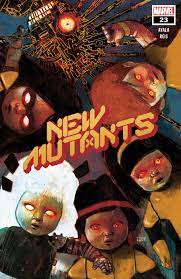 NEW MUTANTS vol 4 #23
“The Truth Shall Set Them Free”
by Vita Ayala & Rod Reis
COVER / PAGE 1. The New Mutants looking down on us as scary dolls.
PAGES 2-3. Lost Club enter the Shadow King’s mind.
The previous issue ended with Lost Club arriving at the Shadow King’s home to find him standing over the unconscious New Mutants. We’re not told how the Shadow King wound up unconscious, though the art seems to suggest that Cosmar zapped him.
Once they enter the Shadow King’s mind, the art goes crazy, and stays that way for much of the issue. Rob Reis’s art on New Mutants is clearly influenced by Bill Sienkiewicz’s seminal run on the original title in the early 1980s, and that’s particularly clear here. The general thrust of the story (enter a mindscape and rescue the lost-child core persona) also seems like a homage to the first Legion arc from New Mutants vol 1 #26.
No-Girl, normally a disembodied brain in a jar, manifests on the astral plane with a body (albeit with a visible brain). Her psychic form is wearing a standard X-Men uniform, which presumably means she sees that as an important part of her persona despite the criticisms she’s made of Krakoa in this arc. Rain Boy and Cosmar also both look more human here, though not entirely so.
PAGE 4. Data page – an exchange between Amahl Farouk and the Shadow King persona, written as a play. The “Act 2, Scene 3452” presumably indicates that they’ve been playing out this routine many, many times. I’m not sure if the play title has any particular significance – The Boy and the Beast was the name of a Japanese animated film from 2016 about an orphan boy who winds up under the tutelage of a mythical beast, which seems at least tangentially connected to Amahl’s story here.
The Shadow King is described here as “an echo of the beast”. Later references in the issue also seem to confirm that we’re not dealing here with the psychic entity normally known as the Shadow King; rather, this is the impression that the Shadow King has left behind in the mind of his long-time host. This would explain why the Shadow King was accepted onto Krakoa. I can kind of see why they didn’t want to explain this too directly at the outset, but I think it would have been better to clarify somewhere that we’re meant to be dealing with the former host rather than the Shadow King himself, if only to make sense of the way other characters reacted to him.
PAGE 5. Recap and credits.
PAGES 6-7. Lost Club make contact with the New Mutants.
Last issue, the Shadow King was putting the New Mutants through repeated illusions of the destruction of Krakoa by invaders (here, the Brood), ostensibly to make a point that Krakoa was bound to fall in the end, and that its inhabitants needed to be trained and ready for it. That process continues here, though the New Mutants are only hazily aware of things not being quite right.
Lost Club are apparently able to contact them in some form resembling Rain Boy’s water droplet. The snatches of dialogue come from Lost Club’s dialogue on the next page – other than names, which are presumably Lost Club calling out to the New Mutants just before we join their scene. The other words that get carried over are all words describing Amahl Farouk’s emotional state.
PAGES 8-9. The New Mutants and Lost Club are drawn together.
A bit of Dali, a bit of Escher. Very pretty.
The portrait on the wall of the Escher castle shows young Amahl with his father (who we previously saw in a flashback in issue #14).
“This feels so much like my nightmare sphere.” Cosmar is referring to the reality-distortion area that she was creating around her in her sleep in issues #10-11.
PAGE 10. Data page. The New Mutants and Lost Club engage in expository dialogue. Normally I’d query doing an essential scene in this form, but given the dreamlike tone of this issue I think it works, since it avoids putting a very prosaic piece of plot in the middle of the issue (and it gives it a bit more distance). I’m not sure “Heroes & Shadows” references anything in particular. It seems to suggest that Lost Club are serving as a mirror to the New Mutants, though they don’t seem to map on to one another as individuals. The low scene number would also imply that they’re at a relatively early stage in this relationship.
Broadly, Lost Club take the line that Farouk was genuinely trying on some level to help them (by taking them under his wing in earlier issues), and therefore isn’t all bad (even if his approach is warped). Magik very firmly rejects that; the other New Mutants seem to be more pragmatic, arguing that it’s an issue they can worry about later. The Lost Club are taking the more traditionally heroic role here.
“As someone who has a lot of experience being trapped in a liminal space being tortured and manipulated by its ruler…” Magik is referring to her backstory, most fully shown in the first Magik miniseries, where she grew up in Limbo after being abducted by Belasco.
I’m not entirely sure what Magik means by “liminal” here (which is to say, I’m not sure if she’s using the word wrongly or if I just don’t quite get what she’s saying about this landscape). The word “liminal” basically means “threshold-like”. In a literal sense, a “liminal space” is just a location whose defining feature is that it provides a transition between two other places – a doorway or a corridor, say. In a figurative sense, it’s more like a place of transition between two states. Being “in limbo”, in the sense of stuck without resolution between two possible states, is a liminal state in a sense. Magik’s dimension of Limbo isn’t all that liminal in itself, though it was the location of Magik’s personal coming of age story. Calling Amahl Farouk’s own mindscape “liminal” seems a bit of a stretch to me. I do kind of wonder if the word is just being misused to mean “dreamy and non-linear”, since she later refers to herself as an “expert in navigating liminal spaces”.
Despite loudly asserting her expertise throughout this issue, Magik is the member of the team who is most emphatically and comprehensively wrong. Presumably it reflects her own refusal to accept that she too might have an uncontaminated core personality within.
“[S]omeone who knows what it is like to be trapped in her own mind and manipulated to do horrible things…” No-Girl is referring to her first appearances as a prisoner of John Sublime in New X-Men vol 1 #118, when she was being forced to work for him.
“[W]hat the Shadow King did … to Karma, and Rahne, and [Scout]”. The Shadow King possessed Karma for an extended period in the original New Mutants (mostly off-panel). He manipulated Rahne over several issues of this series, and he killed Scout in issue #19.
PAGES 11-14. Rahne is separated from the group.
At least some of the echoing dialogue comes from the Amahl/Shadow King data page earlier in the issue; some comes from page 15.
There’s a little Magik doll sitting on one of the Escher steps, which seems to be the basis for the cover.
Wolfsbane’s “Five-into-One secondary mutation”, believe it or not, is a real thing. It was a power she picked up while working for the government of the mutant enclave of New Tian in X-Men Blue #7, and I don’t think it’s been mentioned since. In issue #14, Magik and Wolfsbane were shown combining their powers so that one Wolfsbane went into a portal and five came out, but the implication there seemed to be that Magik was using the weird time physics of Limbo to produce five Wolfsbanes from slightly different points in her timeline. (If it was just Wolfsbane’s secondary mutation, what was Magik contributing?) But… yes, it is canon that Wolfsbane can turn into a pack of wolves, and apparently we are no longer politely pretending that never happened.
I have some difficulty with the idea that you can just “form a mutant circuit” with any old mutants regardless of powers, as opposed to using powers synergistically, but I guess it’s the astral plane and everything’s symbolic.
Dani and Rahne’s psychic connection is an idea that goes back to the earliest days of New Mutants.
PAGES 15-21. The New Mutants and Lost Club reach Amahl.
The New Mutants attack on sight, Lost Club want to rescue Amahl. The Shadow King persona takes the opportunity to seize control and fight back, and we get the old standard of the New Mutants being confronted by frightening things from their past (all of which they brush aside). In Dani’s case, it’s the Demon Bear which was her arch-enemy in early New Mutants; Warpath is presumably meant to be reminded of his brother’s death; Illyana sees herself as a demon. I’m not entirely sure what the art is meant to be showing for Karma, but I suppose it’s probably her brother.
The art is absolutely bananas in the sequences shown from Wolfsbane’s viewpoint, which I’m all in favour of.
The Shadow King is trying to manipulate Wolfsbane by reminding her of the subplot about her missing son Tier. Tier was supposed to have died in X-Factor #256; Rahne didn’t “let” anyone kill him, but it’s a generic guilt trip.
I would never have picked this up without a steer from the discussion of this issue at ComicsXF.com, but No-Girl’s enhanced “Giga” form is the temporary body that she had in Generation Hope #14.
PAGES 22-23. Amahl Farouk rejects the Shadow King.
It’s a fairly standard moral about Farouk accepting that he can be the master of his own destiny, but the art’s spectacular. I like the fact that we’re apparently left with an arrested-child Amahl persona in the body of the Shadow King.
PAGE 24. Trailers. The Krakoan reads NEXT: WHAT IS DESERVED.

The mutant circuits as shown in New Mutants seem to be weird new powers not particularly related to the power sets of any of the participants. In other comics the circuits tend to be more straightforward, like Magik redirecting Cyclops’ eye beam through her teleport discs. Then you have The Five, who seem to be forming an ever-tightening bond that makes them a gestalt, beyond the power stunts.
I’d say the whole concept has been pinched from the comic The 99, which came out in the 00s. In that there were 99 people with magic gems that gave them super powers, assembled under a Xavier-figure and looking for new 99ers and generally being helpful heroes. The people could be assembled in groups of three, and with the right combination they’d get extra powers and stuff. But there were also bad circuits where the gems aren’t compatible and things go wrong. Clashing personalities, or powers going wonky, or toxic relationships like Nature Girl and Curse are meant to be.
It’s been years since I read the comics, so I don’t remember the exact details. And from memory some of the concepts were based on Islamic mysticism, which I don’t know much about. But it does strike me as a heavy influence.
Wolfsbane being able to turn into a whole pack of wolves is just weird, and entering into Madrox territory, and raising all sorts of questions. Can she turn into five people? Are they a hive mind? What happens if one dies?
Didn’t they explain the original episode away as something boosting their powers artificially? They should have stuck to that. If you want to give Wolfsbane a power boost, let her turn into different animals. Or make her turn into a big giant werewolf like she did in X-Tinction Agenda. Or you know, just find interesting things to do with the character as it is.
For Hickman’s influence, I would guess Theodore Sturgeon’s More Than Human.
The Five, specifically, seem to be based on Sturgeon.
The mutant power combinations was based on life nine, where Sinister created Chimera mutants for Krakoa.
It seemed as if the Chimeras would turn the war in the mutants’ favour, until Sinister betrayed Krakoa.
Moira wanted Krakoa to experiment with combining their powers in combinations similar to the Chimera mutants, developing closer to a gestalt, instead of allowing Sinister to control the creation of hybrid mutants.
I intensely dislike this “five wolves” secondary mutation of Rahne’s, as it’s something which just doesn’t make any sense for her as a person, a wolf, or a mutant. If anything, her secondary mutation (itself such an annoying concept) should relate to her transitional werewolf form somehow, or else she should be able to become like, a giant dire wolf out of prehistory. Just straight up multiplying herself doesn’t work for me.
(Really though, why is a Scottish person becoming a wolf in the first place, when they’ve been extinct there for centuries and so there’s no real good explanation for why that form… yes, mutant powers are weird, but why become a creature not even present in your particular area of the world? Claremont has much to answer for…)
I think Claremont came across the legend of the Wulver for creating Rahne.
Sure, the Wulver is supposedly native to the Shetland Islands rather than the mainland, but still…
My headcanon is that Rahne became a werewolf via epigenetics. She had it ingrained in her that she was wicked and wild, and she’d read about werewolves in the witch trials and soforth because that’s the kind of thing her guardian would have kept around the house, she identified her supposed wickedness with the wickedness of werewolves, and so that’s how her mutation expressed. Maybe if she’d been raised differently, she’d be more like Mystique or Meggan or something.
Rahne Sinclair premiered in 1982. “An American Werewolf in London” came out in 1981. I wouldn’t be surprised if Claremont took direct inspiration.
@Si: Wolfsbane’s wolf pack mutation was meant by Cullen Bunn to be a Mothervine power-up. I’m not sure whether his wrap-up of that story took those power-ups away or not. Toad’s flaming tongue sure went the way of hot claws.
I loved the art on this issue. I basically like Reis in every issue, but this was special.
The story was alright – I like the Lost Club kids, I like how they underline that the ‘New’ Mutants are all twenty-somethings who are pretty set in their ways.
No-Girl and Cosmar looking the way they did on the astral plane – so, presumably, the way they see themselves – is a huge sign that they probably should go through resurrection. Considering Cosmar’s plotline so far, we’ll definitely be going back to that at some point.
Also, as much as I loved the art, something tells me Reis didn’t bother to check what a honey badger actually looks like, since Gabby’s giga-form is just plain badger.
My best guess is that Claremont created Rahne to fill the role of team innocent, and made her a wolven shape-shifter in order to make use of some of the Wolverine plot ideas that would not fit the character anymore.
That may be a biased view of mine. While I knew of Rahne before, I first learned her name in Uncanny X-Men #169 (first appearance of the Morlocks), which would turn out to be the first issue of the storyline where Storm lost her own innocence and became the angry, ruthless version of herself.
That issue included what I perceive as a meta scene. In it Storm requests Rahne’s help to track a kidnapped Angel since Wolverine was unavailable due to his first miniseries (by Chris Claremont and Frank Miller). Xavier replied that she would not put Rahne in harm’s way no matter what.
A single short scene that foretells several trends coming in short order.
But I also have that perception because early Rahne strikes me as a bit of a Claremont afterthought. She has a ready-made connection with Xavier by way of Moira, but not a lot ever comes from that. Most of her role and characterization comes from her many insecurities and her relationship with Dany. She does not have a particularly deep characterization, nor do we delve into what there is of it for very long.
Plots also tend not to make much use of her background either. Mostly she is just there because she has no better place to go – and in retrospect, it is a bit telling that Moira claims to think of her as a daughter and very recently (#165) admitted to Xavier that she thinks of herself as a decent if unproven mentor for new, young mutants, yet ends up leaving Rahne with Xavier for a long time and making little effort towards seeing her again with any regularity. Rahne was created with most of the required character boxes dutifully filled, but both in universe and outside of it she just wasn’t a priority even for her own self-designated guardians.
All in all, 1982 was an interesting year for Claremont and the X-Men. An early creative crossroads for the line, as it first expands (New Mutants, solo Wolverine) and has to deal with the resulting demands, not always gracefully.
Claremont was IMO clearly uncertain about where to go with the plot in those days, and at that point in time he often put his doubts plain on panel for readers to comment on and suggest ways to follow ahead. Hence scenes such as a recently limbo-grown Illyana telling Xavier outright that she has powers of her own and neither one elaborating on that right away, or the dialogue between Moira and Xavier in #165 where Moira reveals that she would be willing to send Karma to Magneto or Emma if Charles won’t have her.
There is a clear non-commited quality to those scenes, which strike me as necessary exploratory pieces that are meant to operate in more than one level at once. Xavier is meant to reflect on whether Magneto or Emma could ever replace him if it comes to it, but at the same time so are readers, editorial, and Claremont himself.
I don’t think that it _worked_ – it is very hard to reconcile Xavier’s stances in #165 and #200, which I would guess to be three months apart at most from his perspective – but Claremont tried, and the questions themselves are logical enough even if I happen to find the eventual answers underdeveloped and unconvincing.
“Wolfsbane’s “Five-into-One secondary mutation”, believe it or not, is a real thing. It was a power she picked up while working for the government of the mutant enclave of New Tian in X-Men Blue #7, and I don’t think it’s been mentioned since.”
Oh, wow. I read that and thought James was just making a lame joke about the Stepford Cuckoos in response to Farouk powering Rahne up on the astral plane. That’s, uh… that’s way worse. Yikes.
“I’m not entirely sure what the art is meant to be showing for Karma, but I suppose it’s probably her brother.”
I interpreted it as her crimelord uncle (General Coy Manh?), because he’s ultimately the one who manipulated her and Tran..
I don’t know if I’d call Rahne a shallow character, especially in the early years. In contrast to some of the later additions to the team (Amara, Doug, Warlock), Rahne was a fairly complex character.
— She wanted to be like other girls and to be liked by boys (especially Sam), but was unsure how to do those things.
— She was the youngest of the new crop of students and got scared easily, but also had a quick temper if crossed.
— She felt conflicted about her power set because it felt great, but she was taught feeling good was a sign that you were doing something wrong.
— She was deeply religious, so had problems with other characters like Nightcrawler and Illyana.
— She was adopted, so she wasn’t sure of her relationship with Moira (which was admittedly tenuous) or Charles (ditto).
Claremont hit some of those notes pretty hard, but he tended to focus on one or two features of any character repeatedly for long stretches of time, even when they had more complexity.
But Rahne actually had a broad web of connections to other characters, was a clear asset to the team, and was basically the physical manifestation of the whole mutant-powers-as-metaphor-for-growing-up idea that was at the heart of the New Mutants book.
What happened to her after Claremont left the book and then the franchise, I don’t know. I have a feeling her characterization suffered, but I stopped reading at that point.
Back in original New Mutants, when Rahne and Bobby got Cloak and Dagger’s powers, Rahne was shifting into an adult form. IIRC Professor X said that part of her doing that was Dagger’s powers bringing out Rahne’s own potential as a metamorph. I’ve always been sad that they never followed up with that as far as I can remember. Not for that glamour form itself, but it would be fun to see her play with variations on herself and wolf form.
Rahne as a pack of wolves reminds me a lot of Vernor Vinge’s Tines, a species of alien canines that combine into ever-shifting hiveminds. Nothing that could ever be applied to Rahne, but A Fire Upon the Deep is a great novel.
As much as I don’t like “mutant who turns into actual wolf” as a power, I’m totally on board for Pack of Wolves.
Reminds me of my beloved Malazan Book of the Fallen.
This book has really lost me, it’s so meandering and slow paced.
Is it confirmed to be ending?
Nope, it’s not ending. It’s one of the X-books that will be continuing on, with its current numbering and creative team (Ayala/Reis). Next arc is Magik-centric. Not a big favourite of mine, but it does suggest that Ayala can further pursue plotlines introduced in this arc like Tier and Tran.
Huh, that’s surprising.
I’m not sure if I’m going to continue on.
Maybe I’ll hold on until the big shakeup just to see how it plays out.
The only plausible explanation for Rahne’s mutation is that she doesn’t turn into a wolf, or 5 wolves. Her actual power is that her body is a portal to a dimension filled with telepathic wolves. Originally, one of the telepathic wolves would merge with Rahne, and her transitional forms were part of the merge. She could speak to Dani mentally using the wolf’s powers. Now, after growing up and gaining greater control of her powers, she can let 5 telepathic wolves through and control them through a telepathic link.
The telepathic wolf dimension is located next to the dimension that Cyclops’s brain connects to so the force that his optic blasts generate don’t blow his head off. It’s 2 dimensions to the left of the place Hank Pym gains or loses mass, and across from the hell dimension Nightcrawler goes through when he teleports.
(Handbook to the Marvel Universe people, call me.)
New Mutants has been one of my favorite titles since Ayala took over, but I suspect the Shadow King story was stretched out when Hickman and co. changed direction during and after 2020. This story was about 2-3 issues too long. That said, I liked this issue a lot. Reis went all out, and the characters’ interactions felt right.
For the benefit of those who don’t follow comics news, Marvel announced the Destiny of X roster of books today along with a promo image.
CONTINUING WITH THE SAME WRITERS: X-Men (Duggan), New Mutants (Ayala/Reis), X-Force (Percy), Wolverine (Percy)
REVAMPS: Marauders (new roster, Orlando writing), Way of X turns into Legion of X with Spurrier returning
DEAD SERIES: WAY OF X (see above), X-Corp, Hellions, Excalibur, SWORD
“NEW” SERIES: Legion of X, Immortal X-Men, X-Men Red, Knights of X
I’m betting X-Men Red is set on Mars, presumably with Storm as the lead, unknown if Ewing will write. The Excalibur team’s on the promo image, with Rictor still in his druid outfit, so I suspect Knights of X is a relaunch for Excalibur.
Characters from the promo image without a known “home book”: Xavier, Magneto, Omega Red, Destiny, Mr. Sinister, Rachel, Sunspot, Hope, Bei, Shatterstar, Cable, Iceman, Magneto. The Quiet Council will probably be around in general as now, but Rachel, Sunspot, Cable, Iceman and Shatterstar seem to be at loose ends unless Cable follows Storm to Red. They really crunched the end of X-Factor to get Shatterstar back so I assume they have plans for him.