X-Men Red #10 annotations
As always, this post contains spoilers, and page numbers go by the digital edition.
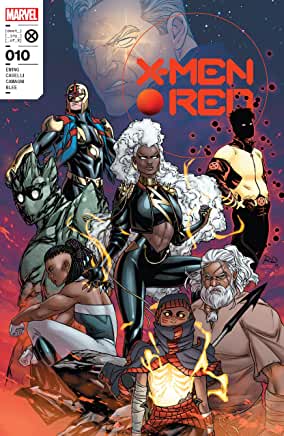 X-MEN RED vol 2 #10
“The New Age”
Writer: Al Ewing
Artists: Stefano Caselli & Jacopo Camagni
Colourist: Federico Blee
Letterer: Ariana Maher
Design: Tom Muller
Editor: Jordan D White
COVER / PAGE 1. The cast pose. Of some interest, Nova is positioned as equal to the rest of the cast.
PAGE 2. Text page – a poem by Lodus Logos about the battle between Storm and Vulcan that we’re about to read. If you need to be told that the Storm is Storm, the Summer is Vulcan (Gabriel Summers), the Earth is Wrongslide, and the Sea is Sobunar… well, this issue may not be the ideal jumping on point for you.
Lodus Logos’ verses are written in a 6-4-5 syllable pattern (and the final verse is a modified version of the first). It’s obviously reminiscent of haiku, but as far as I can see it’s not a specific real-world verse form. His dialogue is also written in this style, but this is more obviously verse.
He also repeat the “I was there” mantra which has come up throughout Ewing’s Arakko stories, with the Arakkii continually claiming authority from personal experience.
As a rule, it can be risky for writers to say “This man is the greatest poet in the world” and then actually show his poems, but I think Ewing gets away with it here, since this does work as a pastiche of epic poetry (plus, you do wonder how hotly contested the “best poet on Arakko” position actually is).
PAGE 3. Vulcan destroys the Autumn Palace.
“The shell is broken and the fire inside is free.” This refers to the flashback in X-Men #10 (2020) where the three aliens alter Vulcan’s mind: “They will see you as changed – reborn, healthy and whole. But that is just a shell. Underneath it, buried alive in a shallow grave, is the real you. You can lie to yourself, pretend to be better, to be unbroken. But we know what’s waiting there inside you, waiting to get out.” (The last line is accompanied by an image of a mushroom cloud.)
PAGE 4. Recap and credits.
PAGES 5-7. Cable’s team at the World Farm.
The three weird-looking aliens are the unnamed characters from X-Men #10, who Orbis Stellaris described in the previous issue as his heralds. It seems pretty clear, though, that he’s not in proper control of them, and he’s deeply disturbed by the possibility that they could do damage to someone with cosmic significance like Manifold.
Khora has come round to the idea of using her powers as teamwork (which fits with the general theme of the Great Ring members coming round to the importance of co-operation too). Back in Cable: Reloaded #1, she was very averse to this.
Cable. The gunk in the tube was bred by Orbis Stellaris using the sample of Cable’s techno-organic virus that the Progenitors took from his body in issue #2. (Cable explained this in issue #8.) The plan backfires since Cable is able to control the virus with his powers, and he uses it make himself armour that intentionally echoes the designs of his creator Rob Liefeld from 1990 or so. I think there may well be a specific splash page from early X-Force in mind, but I’m not sure.
PAGE 8. Vulcan confronts Storm.
Vulcan has spent much of this series loudly insisting that he never died and thus never truly lost the Shi’ar throne (which isn’t entirely wrong). He’s now claiming to be better because he died – and in fact, last issue he also tacitly accepted that he was no longer the Emperor, referring to his upcoming “second reign”. In part, he’s referring to the way his resurrection restored him to this personality. He’s also alluding to the fact that Storm doesn’t have this option, having pledged herself to mortality in order to win over the Arakkii in issue #4.
On a purely practical level, Vulcan has a point that if he and Storm are “evenly matched” as she says, but he can be resurrected and she can’t, then logically he has the upper hand.
PAGES 9-10. Abigail realises that Mentallo has betrayed her.
This isn’t entirely surprising, since Mentallo has seemed as sceptical as anyone else about Abigail’s plans – and for all his mercenary tendencies, he’s liable to switch to a higher bidder, especially if he can see everyone else drifting away from Abigail. Whatever else Mentallo may be, he’s not someone likely to go down with the ship if he can avoid it.
A.I.M. Mentallo was part of the A.I.M.-installed government of Barbuda in Secret Avengers vol 2. Sunspot led a version of AIM in Ewing’s New Avengers vol 4.
PAGE 11. Cable punches Orbis Stellaris.
Orbis really does collapse into cowering when things go wrong.
The three “heralds” appear to be connected to the Phalanx, given their own ability to control the techno-organic virus, and their reference to the “glory of the Phalanx Contagion”. However, there’s no apparent indication that these characters are themselves infected.
PAGE 12. Manifold banishes the heralds.
Lactuca is one of the Great Ring, with the power to know the location of everything. It’s not clear how he makes contact with Manifold here – some sort of telepathy, presumably, but he also suggests that he and Manifold are somehow linked; perhaps Lactuca is Manifold’s counterpart from the dimension of Amenth where the Arakkii came from. It’s unlikely that he literally means they share a parent. But for what it’s worth, we don’t know anything about Manifold’s mother, as far as I’m aware.
Evidently contact with Lactuca’s powers gives Manifold the orientation he would normally have from being able to see the sky, which makes sense.
PAGE 13. Cable’s team set off home.
The Progenitors come after them and blast the ship, but evidently Manifold teleports the actual crew away. This has the happy side effect that Orbis presumably assumes the crew have died. The Progenitors, it seems genuinely are under Orbis’s control.
When Manifold says he sent the heralds “all the way outside”, he presumably means he’s expelled them from the universe – and he’s pointing out that they can probably get back again.
PAGE 14. Abigail escapes from Xandra.
Abigail justifies herself by pointing to the danger posed by strong neighbours and, like the Arakkii, appealing to her own personal experience. This is doubtless intentional on her part, attempting to shore up her legitimacy with the people she’s addressing. But given her persistent disdain for Arakkii culture throughout this series, it’s doubtful that it’s anything more than an appeal to the audience’s known sympathies.
She escapes using Cable’s signature “bodyslide” teleportation technology, which she copies from “kid” Cable when he was her security officer in S.W.O.R.D. vol 2.
PAGE 15. The Fisher King confronts Abigail Brand.
It’s not clear where this is, but evidently the Fisher King was anticipating it. By talking about the destruction of all that she is, leading to “what comes next”, he seems to be foreshadowing some sort of transformation.
Axus. Abigail previously mentioned Axus as her homeworld in S.W.O.R.D. vol 2 #11, where she also repeated the previous information that “Brand” is a codename referring to her mutant power. This is the first time we’ve had her actual surname. The name Axus probably comes from S.W.O.R.D. vol 1 #1 (2009), where her half-brother Lothithanriaxiaxus appears.
PAGES 16-18. Storm and her allies defeat Vulcan.
Despite Storm surrendering the chair of the Great Ring (and the casting vote) to Lodus Logos, she’s still clearly portrayed as a “queen” figure here. She takes the line that they have learned to work as a team of equals, while Vulcan takes the traditional Arakki line of seing that as weakness.
PAGE 19. Data page: Cable’s report back.
Sunspot. Cable wasn’t exactly Roberto’s headmaster, since the school was out of the picture for a while, but he did lead the New Mutants for a short period while Sunspot was still on the team.
Agent of S.W.O.R.D.. Cable is comparing himself to Nick Fury, Agent of S.H.I.E.L.D., though it doesn’t really make sense in-universe.
Orbis Stellaris. Zsen’s portrait of him apparently shows him as an elderly steampunk figure with playing card motifs, because…
PAGES 20-21. The identity of Orbis Stellaris is revealed.
Like Mr Sinister and Dr Stasis, this is another of the four clones seen in the flashback story in Immortal X-Men #8, who have apparently gone their separate ways and all believe themselves to be the original. We’ve yet to see the “heart” Sinister, but the theory that it’s Mother Righteous seems pretty plausible.
PAGE 22. Trailers. Next month’s issue is part of the “Sins of Sinister” crossover, titled as Storm & The Brotherhood of Mutants #1.

Cable’s ‘Let’s talk man to man and quite literally face to face’ directed to Orbis Stellaris is originally said by Cable to Stryfe, or about Stryfe, in… X-Cutioner’s Song?
I’ve really enjoyed how Lodus Logos’ poetry High Prophet Idyll’s amazing and cryptic wordplay (“an empty heart beats hardest”) have cleverly foreshadowed events to come in this book.
For transparency’s sake I didn’t realize that Lodus’ earth and sea references were alluding to Wrongslide or Subunar until Storm played her trap card and those two emerged.
Speaking of which: I was quite into the fact that Ewing leaned into a combination of Muhammad Ali’s rope-a-dope tactic (i.e., turtle on defense while resting on thr ropes while opponent wears themselves out) and the Arakkis warming up to teamwork to plausibly demonstrate how Storm could best Vulcan yet again.
Another great issue X-Men: Red, which is still tops for me in the Krakoa era.
Bleeding Cool has the page that the silly Cable design is referencing, but doesn’t note the issue. It’s from Greg Capullo’s X-Force run.
https://bleedingcool.com/comics/cable-makes-his-biggest-nineties-reference-ever/
The page is from X-FORCE #16.
“he did lead the New Mutants for a short period while Sunspot was still on the team.”
He also led X-Force when Sunspot was on the team.
Can someone explain to me why they didn’t at least TRY to take Orbis Stellaris prisoner? His armor was damaged. Maybe Manifold was to weak to teleport Stellaris inside his armor but you’d think they’d at least try to open the armor. Admittedly, he orders his servants to prepare his other armor at the end, so his servants had to be relatively close by but none of Cable’s team seems worried about the servants.
Ewing seemed to be misinterpreting how Vulcan’s powers work. He’s supposed to be capable of projecting not just heat, but anything along the electromagnetic spectrum, right? Yet Ewing has Storm defeat him by summoning rain to extinguish his powers then trapping him in Mysterium, which absorbs heat.
It’s weird that Stellaris isn’t actually immune to aging like Sinister and Stasis but is dependent on life support machinery.
OT: does anyone know whether there’s been any clear reference during the Krakoan era to Theodore Sturgeon’s 1953 novel More Than Human? In that book, a collection of a half-dozen misfit mutants are brought together to form a new species, homo gestalt. It reminds me of some of these themes we’re seeing during the Krakoan era.
Regarding those three ‘heralds’ (for the lack of a better name), their mysterious overlord is most likely the Dominion (the giant crown structure seen at the end of Ewing’s Defenders Beyond). When Manifold said he sent them ‘outside’, he means The Outside (the white space outside the multiverse). We know from Hickman’s Powers of X that the Dominion is a collection of Titans, which themselves are a collection of Phalanxes, which themselves are a collection of Technarchy.
Putting the pieces together, the Vulcan’s pre-Krakoa story looks something like this:
During the War of Kings, the T-Bomb explosion rips a hole through the fabric of the Multiverse. The two kings, Black Bolt and Vulcan, fall in and are stranded on the other side. (War of Kings)
Black Bolt and Vulcan are noticed by agents of the Dominion lurking in the Outside. With the aid of his loyal pet Lockjaw, Black Bolt is rescued and returns to Earth-616, to the City of the Universal Inhumans. (FF)
Vulcan is captured by the heralds, who experiment on him and bury his real personality under a more amicable shell. The ultimate purpose of these experiments is currently unknown. (X-Men)
Right before the Krakoa era, Abigail Brand hires Orbis Stellaris to retrieve Vulcan from the Outside. OS takes over a World Farm and then captures Vulcan and the heralds from The Outside. Brand hatches a scheme and Vulcan is released somewhere close enough to Earth that the mutants find him. (X-Men Red)
Once Vulcan is found by the Krakoans, his docile personality reassures them and Scott, Jean and Logan take him into their house on the Moon.
Nu-D-Hickman was influenced by a number of science fiction works as well as some more esoteric concepts (Russian cosmism in particular) for his creation of Krakoa/House/Powers. There’s been no direct reference to Sturgeon, but it’s pretty obvious that his concept of The Five was based on More Than Human.
Some other clear influences for Hickman are Arthur C. Clarke’s Childhood’s End and the works of Olaf Stapledon.
GN-Not exactly. A Titan is a society which has become so advanced that it has collapsed into a Singularity. A Dominion is a collection of Titans, yes. The Phalanx were created as the servants of the Dominion in order to find and judge other societies in order to decide if their knowledge is worth assimilating into the Dominion. Those judged worthy are granted Ascension to become part of the Phalanx hivemind. Their sum total of knowledge is then downloaded to that sector’s Dominion, where it will become immortal outside of space and time as part of a Dominion’s intelligence. The Technarchy were secretly created by the Phalanx as cosmic “janitors”. Those societies judged as being unworthy by the Phalanx are marked to be consumed by the Technarchy.
Regarding Lactuca and Manifold, I believe this is payoff for a thread Ewing opened in the early issues of S.W.O.R.D. During the King in Black crossover, Knull mocked Manifold by saying he wasn’t an Omega mutant. This was because Manifold’s space bending had two limitations:
a) the need to be able to see the stars to orient himself,
b) abilities limited to Universe-616, doesn’t work beyond that
Some time later, we were introduced to Lactuca, who is the Omega Space Manipulator without those limitations. I don’t think Lactuca was speaking telepathically to Eden. I think the idea is that Manifold’s power (as envisioned by Ewing) is to speak to space and since Lactuca is the embodiment of space, he has a direct line of contact with her.
I expect Manifold’s power to evolve in X-Men Red going forward – with Lactuca’s help, he can overcome his limitations and accomplish crazier feats.
By the way, Lactuca identifies as female. I believe someone, either Jean Grey or Storm, referred to her as such.
Lettuce
Wise words, Chris.
@Michael: re: Vulcan’s powers, just because he’s an Omega doesn’t mean he knows all the ins and outs of his abilities. He generally seems like he has one setting–aggro–and then goes all in on the tactic. It’s precisely his penchant for over-extension and his lack of adaptability that were exploited by Storm not once but now twice (and by Tarn as well). Storm even trolls Vulcan on this point: He more than likely has he capacity to escape his mysterium prison if he ever decides to develop a more nuanced approach to deploying his powers.
As always, a great issue. I still have one quibble: Arakki not valuing teamwork in battle. I get that showing them engage in teamwork to defeat a common foe is meant to show that they can adapt and change but there’s no way they could have fought for centuries without fighting together. Ewing has done the lion’s share of fleshing out their society, and I hope the non-cooperation gets explored or justified at some point.
Is Sunspot the only character still wearing the old Grant Morrison era costume?
@MikeLoughlin: Where I’d take it is that they’re used to fighting *together*, but not directly helping one another. Like in a big battle, they know to line up and attack together and not try to turn a war into a set of 1v1s. They probably also know to not mess up the others on their side — Water Guy won’t flood an area Fire Guy is standing in just because it takes out a bunch of mooks they’re both fighting. What they don’t do is take it to the next level and have Water Guy and Fire Guy both combine their powers to blast people with steam.
I *think* that’s generally consistent with what we’ve seen. We’ve seen a training camp in Legion of X which even before new attitudes is probably going to end up teaching some bits of indirect teamwork. And while it’s been a while, I don’t remember the final battle in Swords to have been crippled by them getting in each others’ way.
(But definitely agreed, someone should put this on page.)
@Michael: re: Cable’s strategy, I assume he didn’t want to take the risk since they were working in unknown territory and just putting Zsen in contact with Orbis was enough to get the truth and plan the next steps.
@Mike Loughlin: I feel like the reader supposed to interpret their resistance to “help” as a matter of framing/getting into a certain mindset: think how the NASA guy explains to the Arakkii kid they have to make a *tactical* retreat, the fisher king mobilizing a group of Arakkii to join the fight against the progenitors, how they always understood an aggression on one of them as an aggression to all.
So you don’t have a society that’s highly individualistic, but considering all the conflict they’ve been through over the course of their story, there are matters of personal pride and not wanting to be a burden/doing the most you can do alone. And that in a way goes tback to Storm’s arc in this book – Ororo is also someone taking a lot on her shoulders until she realizes she’s better sharing the burden by passing her previous seat to Lodus Logos.
And I guess this is what really gets me about SWORD/X-Men Red: it’s a book about community and mutants with different walks of life making each other stronger, but it’s all also very empathetic to the ways in which we often take too much on our shoulders because we assume this is going to be the best for everyone.
Ewing’s work in this book was sensational and with Brand’s arc already wrapped up I feel even SWORD might age better for many fans. I’m gonna miss this guy a lot when he’s done telling the x-men stories he wants to, this might be one of my favorite x-men books ever.
@Jon R & @Miyamoris:
I appreciate the thoughtful responses to my one gripe with the series. Your explanations make sense, and I hope Ewing includes similar reasoning in future issues.
I’m going to read and (barring bad stories or character beats) enjoy this series until it ends. My hope is that X-Men Red & Immortal X-Men inspire future creators to push the envelope for X-comics.
@Michael
Vulcan is supposed to control all energy, even psionic and magical. He beat Adam Warlock. A mysterium prison shouldn’t hold him.
@Chris,
Thanks.