Storm and the Brotherhood of Mutants #2 annotations
As always, this post contains spoilers, and page numbers go by the digital edition.
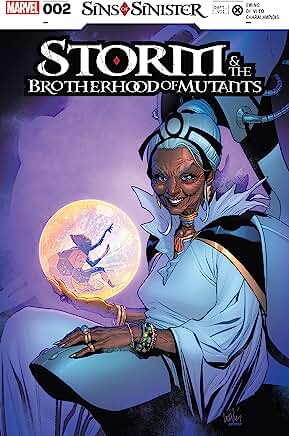 STORM & THE BROTHERHOOD OF MUTANTS #2
“Sins of Sinister, part 7: No Hope”
Writer: Al Ewing
Artist: Andrea Di Vito
Colourists: Jim Charalampidis & Rachelle Rosenberg
Letterer: Ariana Maher
Design: Jay Bowen
Editor: Jordan D White
COVER / PAGE 1. A very elderly Storm, holding a miniature Destiny in an energy ball reminiscent of Orbis Stellaris’ sphere. Make of that what you will.
PAGE 2. Data page. The mock-3D effect was also used on the data pages in the previous issue; this one seems to be echoing Star Wars.
The Interstellar Compact. The Compact was mentioned by Hope in Immoral X-Men #2, where it was described as simply an alliance of alien races which the mutants were cheerfully destroying. Hope’s account suggested it was on its last legs. The information that Orbis Stellaris is behind it is new, I think.
Planet Arakko was destroyed in Sins of Sinister #1.
Varon appears to be new, as far as I can see.
Freedom Force were mentioned in a data page in Immoral X-Men #2: “We still can’t get ahold of Storm, but I hear we cornered Freedom Force. We finally got Mystique, the little traitor.” Originally, Freedom Force was the name used by Mystique’s Brotherhood of Evil Mutants when they worked for the US government in the late 1980s; the name was ironic there, but it’s played (more) straight here.
PAGES 3-4. Destiny arrives at Starship Ananke.
Starship Ananke. Ananke is the ancient Greek personification of fate, necessity and so forth. The logo on the ship, shown on its side here but seen more clearly later on, is Storm’s headdress in a circle.
Mandragora autumnalis, also known as Devil’s Candle, is a flower. The nickname is due to a myth that its flowers shine at night. (They don’t, but they do have some reflective properties.) The more prosaic name is autumn mandrake.
Noh-Varr is an elderly Marvel Boy, evidently long lived enough to still be around this far into the future.
Amaranthus caudatus, also called Love-Lies-Bleeding, is another flower, whose traditional symbolism is fairly self-explanatory. Clearly, all this fits in with Destiny’s despair at losing Mystique.
PAGE 5. Destiny and the Brotherhood.
The three Brotherhood members seen here are
- Khora from S.W.O.R.D. and X-Men Red – evidently very long-lived and so still alive and well;
- Ironfire, the vaguely mysterious guy introduced last issue, who also apparently lives a long time; and
- Cable, as merged with the Arakki living history depository Xilo, perhaps kept alive this long through that merger. He’s now going by X-Man, the name used by his counterpart Nate Grey (or rather, originally the name of his series – but it crept into the actual stories in the end).
It must be well over a century since Destiny’s last resurrection, but her back story already had her being around as an adult in the days of Sherlock Holmes, and (per the sliding timeline) still alive into the early 21st century – so apparently she ages very slowly too. She’s now back at the age that she was in the Claremont run.
“Exodus … left his messiah to be eaten alive by Chitauri.” In Immoral X-Men #2.
“Too worm-ridden now to give a damn about your own daughter’s death?” Destiny is referring to Cable’s merger with Xilo. Her question also presupposes that Hope won’t be resurrected, but then again, there wouldn’t have been much point in Exodus killing her if he was planning to bring her straight back.
PAGE 6. Flashback: Mystique sets out to fight.
“We’re the reason this timeline’s still ticking, remember?” In issue #1, Mystique and Destiny stole Mr Sinister’s Moira clone and prevented him from rebooting history. For Destiny, the only point of this exercise is to keep Mystique with her; that’s consistent with Immortal X-Men #3, where she was horrified by the thought that Mystique didn’t feature in any of the futures that she could see. Mystique has more of a strand of political rebellion in her, and is less inclined to tolerate an awful universe just so that she and Destiny can be in it.
Freedom Force. Aside from Mystique, the group consists of an unnamed Nova (in a version of Sam Alexander’s costume), Sevyr Blackmore (the Wolverine villain), and the immortal Hercules. Blackmore’s inclusion here is a bit odd, but presumably he’s the sort of villain who figures that some degree of functioning society is a prerequisite for anything else that he wants to do.
PAGES 7-8. Destiny and Mystique.
“A golden ball on the flag.” Presumably the logo of Orbis Stellaris, based on the sphere he lives inside. Destiny is displacing the blame onto Storm, but tacitly accepts the point that her schemes have resulted in a timeline based on a futile interstellar war, and that this is not a worthwhile outcome. Hence Destiny’s basic agenda in this issue, which is to enlist Storm’s aid in destroying the Moira clone and rebooting the timeline. Mainly, though, Destiny just doesn’t see the point in any world without Mystique in it – as she said in Immortal X-Men #3.
The clone has been in the possession on Orbis Stellaris since last issue, when Destiny and Mystique were still allied with him.
Ganna is a new character; her codename is given later in the issue as Shockjock, which seems an odd reference point for this far into the future.
PAGE 9. Recap and credits. The story title, “No Hope”, seems like it alludes to the death of Hope in the previous chapter, but the more immediate issue is the collapse of Destiny’s belief in this timeline being worthwhile.
PAGES 10-11. The X-Fighters approach the Death Sphere.
The Accuser giving the instructions is presumably Noh-Varr, the only Kree in the cast – the Accusers are Kree officials.
The three X-Fighters are “gold”, “blue” and “red”, after the three colours that have been used in the names of ongoing series.
PAGE 12. Data page. We saw the World Farm and the Progenitors in recent issues of X-Men Red. The distortion pattern redacts out (kind of) the word “Dominion”; like the other Sinisters, Stellaris is trying to bring about a Dominion under his control and ascend to the next level, and like the others, he doesn’t want to disclose to his allies that this is the end game.
PAGE 13. Orbit Stellaris responds to the attack.
He doesn’t want to tear the Progenitors away from his Dominion research, so he just hurls a ton of conventional fighters at the attackers.
PAGES 14-15. Destiny synchs her powers with Khora and X-Man.
The good old mutant circuit concept, a staple of the Krakoan era. Destiny foresees the Brotherhood pulling off a freak victory thanks to Cable’s tactical skills and her ability to see the future, but she also sees Storm giving the order to destroy the Moira, and then the timeline rebooting. This isn’t what happens, but as we see on page 18, her powers are working just fine – she’s just misinterpreting what happens. Storm actually gives an order to kill Destiny, and Destiny assumes that the immediately following blackness is due to the end of the timeline, when in fact it’s due to her own death. Apparently Destiny can’t see past the end of her own life. This is a little odd, since the Mystique/Destiny plot of the Hickman run hinges on the fact that Destiny foresaw Krakoa even though it happened long after she died. But perhaps the fact that Destiny was in fact resurrected on Krakoa makes all the difference there.
PAGE 16. Mother Righteous and Ironfire.
Righteous claims to be a “daydream”, but presumably she’s able to contact Ironfire thanks to his mental state.
Ironside mentioned the Genesis War last issue too; it was apparently an event where he and Storm fought alongside one another.
PAGES 17-19. The X-Fighters make it into the Death Sphere, and Destiny is killed.
Storm, acting as the traditional hero, does not see rebooting the timeline and wiping out its entirely population as terribly heroic. Part of the angle of this arc, I think, is that Sinister sees this entire universe as simply a diversion and a means to an end, which is logically horrific, but a standpoint that we as readers are likely to identify with – because it is a self-cancelling divergent timeline, and we all know that. Storm, however, is not so meta.
PAGES 20-21. Storm uses magic to steal the Moira Lab and the Worldfarm.
Basically, she opens up a wormhole which takes all Orbis Stellaris’ key belongings and transports them to the other side of the universe. At least, I assume they get the Moira Lab too – Orbis only actually mentions them getting the Progenitors and the World Farm, because he’s mainly concerned about their work on creating a Dominion. Orbis seems to react to this setback by throwing in the towel and committing suicide.
Storm’s magical lineage. There are indeed some scattered references to Storm having a magical lineage. Uncanny X-Men Annual #1 (2006), a Chris Claremont story, claims that Storm is “descend[ed] from a royal lineage reaching back to the dawn of humanity” and that “[t]he power in our family passes from mother to daughter”, though it doesn’t explicitly say that it’s magical power. Storm vol 2 #2, published at around the same time, could be read to suggest that N’Dare somehow uses magic to push Ororo to safety as her final act before dying.
In New Mutants vol 1 #32 (1985), Magik and Mirage travel back to the time of the pharaohs and meet a sorceress ancestor of Storm, Ashake. The Handbook-style Marvel Tarot (2007) also claims that Storm is descended from Ayesha, a sorceress from the Hyborian era (i.e., the time of Conan the Barbarian). The link with Ayesha also gets a passing mention in the recent Scarlet Witch #2. Both sorceresses get namechecked here.
Amun and Hauhet are simply major Egyptian deities.
“I offer you fire! And a life incarnate!” Referencing Jean Grey’s proclamation “I am fire! And life incarnate!” when she debuts as Phoenix in X-Men #101.
PAGES 22-23. Khora reports that Storm has died.
Well, she’s over a century old. But presumably she was the “life incarnate” that she offered for the spell.
PAGE 24. Trailers.

Other than the names of the x-books, Blue, Gold and Red are codenames for starfighter squadrons in Star Wars movies (Blue doesn’t fight against the Death Star, but it appered in Rogue One).
I read Stellaris’s order to shut down life support not as him committing suicide, but murdering his underlings after a setback, like Darth Vader often does.
If the Compact is run by Stellaris, then why did Mother Righteous tell Sinister “you don’t know him” in Immoral X-Men 2? Sinister might not have realized that Stellaris is the spades Sinister or that he stole his lab, but he should definitely know who Stellaris is.
Destiny’s prophecy that she would lose Mystique turned out to be a self-fulfilling prophecy- if she hadn’t stopped Sinister from rebooting the timeline, she wouldn’t have lost Mystique.
I guess neither Destiny not Stellaris realized in 90 years that the gizmo to destroy the Sinisters was in Sinister’s lab.
Agreed that the way Storm killed Destiny made no sense. First, Destiny was shown to make predictions past her death in many stories, not just Hickman’s X-Men. Second, the story assumes that Destiny can only “see” what’s in front of her face and not anywhere else- that’s not how Destiny’s powers usually work- she can “see” events she’s not present for. Third, how would Storm know that Destiny’s powers work this was? Ewing seems to be limiting Destiny’s powers so Storm can score a win, just like with Vulcan.
Another enjoyable issue. I liked the “twist” that Storm (of course!) would fight to keep the universe alive. Through the reader’s narrow aperture, we want and expect a reset… But there’s a whole world out there that might want to continue, when Krakoa is but a distant past.
I kind of assumed that Khora’s power maybe also interfered with Destiny seeing her own death? It was a little odd but then, otherwise Destiny becomes unbeatable.
A bit like Storm. I’d like more of Ororo’s inner monologue. She’s become even more goddess regal than in the past. Surely that can’t hold? Narratively there needs to be some kind of gotcha!
Dark Beast was in Sinister’s lab when it was stolen. I wonder if he’s still there and still alive when Storm stole the lab. One of the promos seemed to show Beast alongside Cable.
@Krysziek- No Stellaris really killed himself. Note that Mother Righteous said that what will happen will prove her right and Stellaris was upset that Storm won by using magic. Stellaris committed suicide in part because Storm’s victory demonstrated the superiority of magic over science.
So I guess that means that Mother Righteous will be the Final Boss of Sins of Sinister and the one that nearly succeeds in becoming a Dominion.
Paul > The story title, “No Hope”, seems like it alludes to the death of Hope in the previous chapter, but the more immediate issue is the collapse of Destiny’s belief in this timeline being worthwhile.
It’s also a reference to ‘(A) New Hope’ since this issue is largely a homage to that movie. Freedom Force is Rogue One, who sacrifice themselves to transmit the coordinates of the superweapon to the Brotherhood. The Brotherhood of Arakko is the Rebel Alliance, working against the Empire of the Red Diamond and the Interstellar Compact. The Death Sphere is the Death Star, with the X-fighters (X-wings) doing a trench run against the Stellaris drones (TIE fighters).
Michael > I guess neither Destiny not Stellaris realized in 90 years that the gizmo to destroy the Sinisters was in Sinister’s lab.
Even if they did know about it (and they probably did due to Destiny), that lab is sealed inside a Chimera force field that they cannot breach. Only Mr Sinister had the code to get in. Mother Righteous has seemingly been hammering at the force field with her Nightkin sacrifices for a century, but it hasn’t broken yet.
Michael > One of the promos seemed to show Beast alongside Cable.
If you’re talking about the initial concept art released for SoS, I’m pretty sure that blue figure was the original Nightcrawler in the Year 100 era.
Wasn’t Cable/Xilo meant to be called “Xible”, ala Bible? What happened to that?
As with the other series, the second issue strengthened the first. As long as they stick the landing I expect this to be a crossover that will benefit from re-reading, and work best as a whole.
Ananke was a key character in Gillen and Mckelvie’s The Wicked + The Divine, so I wouldn’t doubt that Ewing is winking in that direction.
The Arraki have been depicted as functionally immortal, short of being killed. After all, Genesis and the original horsemen were in the broken lands for many millennia. So none of those long-lived characters stikes me as too surprising.
Hope as a martyr also makes a nice parallel with what Mother Righteous seems to be up to over in Nightcrawlers with the dead child (and Storm’s death here), so I wouldn’t be surprised if we see three cults competing in the X^3 timeline.
The little window into Freedom Force is nice enough, I presume Sevyr Blackmore is there partly as a Blob analogue, with Nova as a kind of Avalanche (a helmet wearing character, at least), leaving Hercules as… well.
“gold”, “blue” and “red”, keeping with the Star Wars references, also calls to mind the color starfighter squadrons, as pointed out in the comments above.
As far as no-prizing Destiny’s death here I concur with Evilgus that the mutant circuit allowed for her blindspot.
@SanityOrMadness Kate Pryde and Rachel Grey Summers have had about a dozen monikers a piece, so it stands to reason that Cable would re-brand a few times over the course of 90 years
Oh and I think it’s been mentioned in the comments here before, but I presume the Genesis War is a reference to the upcoming Apocalypse storyline in the main books.
Regarding Storm’s sorcerous potential, the Magik and Storm limited series seems relevant. Granted, it’s an alternate version, timey-wimey Storm in that book, but she does become a powerful sorceress in her old age. At the very least, this shows precedent that Storm *can* develop in such a direction.
And hey, maybe Storm used magic to interfere with what Destiny perceived. Does Destiny have any known past interactions with powerful magic users?
Destiny already died once in the main timeline though. She was killed by Legion. Although she must have foreseen her death (why else would she need to be resurrected), she wasn’t able to stop her death at that time either. I don’t think there is any discrepancy there.
The idea that she was able to foresee the future in Hickman’s plot could certainly be congruent with the fact that she was eventually going to be resurrected. It can be read that Destiny doesn’t know exactly how her power works, hence why she told Mystique that if they refused to resurrect her, to burn the island. If she realized that her power was only able to foresee the future until the time of her death, she’d have realized that she must get resurrected on Krakoa, thereby making her warning to Mystique pointless.
For the record, I initially read shutting off life support as referring to Orbis killing off most or all of his crew, Vader-style. But on second read, the point is ambiguous. It certainly *can* be read as a suicide, even though that doesn’t feel right to me.
SanityOrMadness> Wasn’t Cable/Xilo meant to be called “Xible”, ala Bible? What happened to that?
Xible was certainly a name Ewing threw around in interviews, but it never materialized in the books, in place of ‘Cable’ and ‘X-Man’. So Ewing must have changed his mind at some point. Which is a shame, since I thought Xible was a great name.
Joseph S. > I presume the Genesis War is a reference to the upcoming Apocalypse storyline in the main books.
I agree, the Genesis War is probably the ‘Fall of X’ storyline for X-Men Red. From the looks of it, Apocalypse, Genesis and the Four Horsemen return from Amenth to Arakko and they are not happy with what they find. This conflict has been hinted at before – Isca has said that she was a placeholder holding the Seat of Victory for her sister Genesis, whom Isca believed would someday return.
The 616 version of Jon Ironfire will probably be introduced here as well.
Ayesha is the titular character from H Ridder Haggard’s She.
The art completely fails to convey how large a system enclosing sphere would be. Just compare the number of hexagons in the establishing shot with the brotherhood ships as they enter through the open hex, they shouldn’t even be a pixel in size.
Anyway, I didn’t particularly like this issue, just felt like more moving pieces around without much character beats. Who gets to hold the Moira potato now?!
Both this and last week’s Immoral X-Men set-up the idea that various Sinisters are going to take 900 years to get to the next stage in their plan, it’ll take Orb boy that long to redo all his calculations again and Sinister that long to fly across the universe. I don’t think Nightcrawlers #2 explicitly says Mother Righteous will need 900 years to do her magic spell but maybe what looks like a possible Nightcrawler holy Army might slow her down somewhat.
@Alexx Kay Destiny was on the team with magical Spiral, and from memory they really disliked eachother.
I think it’s just the purple and yellow, and Storm looking at the viewer, but I’m getting strong CBeebies Book at Bedtime vibes from that cover.
Nice to see a non-Avenger doing it. 😉
Destiny’s powers obviously allow her to see past her death, otherwise the many years and multiple plotlines in multiple books centered on her Diaries would be pointless.
I mean. Some of them were pointless anyway, but you get my meaning.
So let’s go with magic interference on top of mutant circuit interference. It works for this story, let’s not overthink it.
“she’d have realized that she must get resurrected on Krakoa, thereby making her warning to Mystique pointless.”
Not necessarily, because it may be that Destiny needed to give Mystique this warning in order to be resurrected. Remember Mystique impersonated Magneto and Xavier and others to get Hope to it after realizing she was being lead on.
Yes the Diaries seem to present a problem, but the Krakoa/Moira/resurrection plot points are retcons that are bound to create some dissonance at points in the past con.
And the fact that she was resting the universe would obviously allow for an opportunity here, so let’s just agree to read that she allowed herself after all these years to misread a vision. Besides, the timeline /will/ eventually reset and so she’s not really wrong. Mystique is gone and she didn’t want to live without her. I don’t think we need to pick at it too hard, especially as magic and a mutant circuit were in play as well.
I think HoX/PoX worked so well because there were so many different writers with so many different plot points post-Claremont that almost anything could make sense. Like Destiny being killed by Legion in 1989 and Mystique killing Moira in 2003, it almost leads to an unwritten story that could be expanded upon. Having Warlock be a baby alien AI that wants to take over every planet they find, an idea to be expounded upon. So many X-Men have literally died in canon- Jean, Doug, Illyana, Logan, Scott vs Apocalypse, Collossus, Nightcrawler, Cable, etc etc the resurrection angle kind of makes sense as a meta commentary. I think there was a way to bring it all together for some kind of era-ending new status quo, but kind of hard to do it without Hickman in charge.
My hot take is that Destiny’s shortcomings here are not about whatever power technicalities or interferences but 100% about her mental state.
Destiny sounds delusional if not borderline unhinged when she approaches the Ananke crew. Between taking an entirely cheap shot at Cable and scapegoating Storm for the choice her wife made out of her own free will, not only she’s desperate but she’s unable to accept the failure she brought on herself.
As a side-note: Love-Lies-Bleeding is symbolism for Noh Varr as well, considering his relationship with Hercules.
This event got substantially better after the second issues. Even if everything is highly compressing there are a few character beats working pretty well.
Storm having predisposition to be a sorcerer goes back all the way to Uncanny X-Men #160, back in 1982 (also S’ym’s first appearance).
Claremont revisited the idea sporadically and gave strong hints that several of her ancestrals were powerful at magic, but seems to have decided to transfer that trait to Forge later on. There may be a connection to a character named Ashake that played a role in Claremont’s work with Marada the She-Wolf.
“Destiny arrives at Starship Ananke.”
I’m pretty sure Ananke is Destiny’s shape (hence the name). What she’s arriving at gets referred to as Arakko Base.
Er, ship, not shape.
Given that (IIRC) Sevyr Blackmore is a pirate, I suspect the Freedom Force characters are analogous to Star Wars characters. The Nova Corp member could be the Luke of the group. Blackmore could be the Han (smuggler, sort of like a pirate), and Hercules could be the Chewbacca (big guy with a gun/gun-like weapon).
I had fun with this issue, and the twists were well-done. The Star Wars homage was noticeable, but didn’t overwhelm to the story. This issue was much better than the first.
@Luis Dantas – Claremont revisited the idea sporadically and still hasn’t let it go. It only just came up in his Gambit miniseries. A knocked out / otherwise unconscious Storm receives training from her mystical ancestor, later even pulling another, completely unrelated unconscious character into the training sequence.
(So it’s clearly not just a dream, but at the the very least a shared dream. And probably just what it appears, that is: mystical training from beyond the grave).
In Gillen’s Young Avengers (and possibly elsewhere, I recall a scene with Kate Bishop), Noh Varr is depicted as a collector of vinyl records, so I assumed that “Love Lies Bleeding” is also a reference to the opening tracks on Elton John’s Goodbye Yellow Brick Road (“Funeral for a Friend/Love Lies Bleeding”, which fits thematically with this issue on multiple levels).
@Joseph S., that’s a great catch.
I have to disagree with Storm. It wasn’t just one planet, the Empire is wiping out entire civilizations like Xandar and the Shi’ar.
Small detail, Noh-Varr being called the Accuser is a reference to Ewing’s Royals, wherein he takes up the position of an Accuser in a different dysopian future (another one where he interacts with a precognitive, though Maximus is in a bit of a different position to Destiny). That’s also where his bulkier look comes from, it’s the same design as Royals