X-Men #21 annotations
As always, this post contains spoilers, and page numbers go by the digital edition.
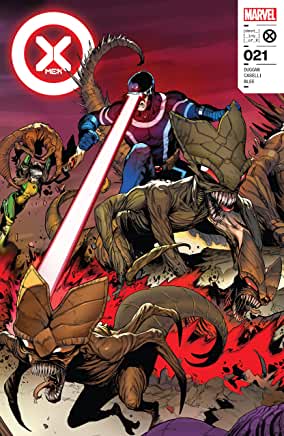 X-MEN vol 6 #21
“Lord of the Brood, part three”
Writer: Gerry Duggan
Artist: Stefano Caselli
Colourist: Federico Blee
Letterer: Clayton Cowles
Design: Tom Muller with Jay Bowen
Editor: Jordan D White
COVER / PAGE 1. Cyclops and Rogue fight the Brood. This continues the fight scene which has been shown over the covers of recent issues of X-Men and Captain Marvel (which is where Rogue has been appearing).
In Captain Marvel #47, Captain Marvel’s team defeat a bunch of Brood and rescue Rogue. Binary is found hooked up to some sort of organic machinery. In what might politely be termed a high degree of plot convenience, it turns out that Binary can only be freed if someone else takes her place, and Captain Marvel duly makes the required heroic sacrifice. Rogue explains that the Brood faction in the Captain Marvel arc are led by a Brood Empress who resents Broo’s control over them and took the opportunity to break free of him when it arose. (X-Men has established that this was brought about by Nightmare, but the Captain Marvel cast don’t know this yet.) The Empress blames the Kree for creating the King Egg that gave Broo control over her race in X-Men vol 5 #9, and has a convoluted scheme to convert superheroes into Brood in order to use them as an army against the Kree; the part-Kree Captain Marvel is particularly key to this plot. The issue ends with the heroes largely defeated and a groggy Captain Marvel apparently unable to register the giant Brood Empress looming over her.
None of this really matters to the X-Men issues, but both threads are meant to come together in Captain Marvel #48 for the finale.
PAGE 2. Opening quote: Cyclops argues that the Brood ought to be wiped out. The previous issue opened with a line to similar effect.
The quote is attributed to “an early meeting of the Krakoan War Captains”. There’s a data page later on where Bishop, Cyclops, Magik and Psylocke discuss this issue in their capacity as Captains, but that line-up would be post-Inferno and surely wouldn’t be an “early” meeting. So perhaps Cyclops has been banging on about this for a while now.
PAGE 3. Forge and M bring Knowhere to the solar system.
This doesn’t flow very well from the previous issue, which already had a scene that ended with Forge and Monet transporting themselves and Knowhere back to their own dimension. So apparently this overlaps with that scene, which is a bit clunky. (Page 17 seems to confirm that this is them returning to the mainstream universe.)
M is indeed meant to be a technical genius, though it’s not exactly something that comes up very often.
PAGES 4-7. Jean fights Nightmare.
“[Nightmare] was seeking revenge for [Jean] laying her hands on him in a previous adventure.” In issue #4.
“Release your grip on the Brood…” Jean hasn’t taken on board the plot – which was explained fairly clearly last issue, and Nightmare explains it again on the next page. Nightmare isn’t directly controlling the Brood, he’s simply broken Broo’s control over them (or many of them) and attempted to take advantage of them just doing what they do when left to their own devices. Clearly it’s intentional that Jean gets it wrong; she’s firmly in the pure-and-heroic camp in this issue and she’s firmly giving the Brood the benefit of the doubt. Note also that she takes it as read on page 7 that this will be an uncontroversial view among the X-Men. (“The X-Men will save as many as we can. Even the Brood.”)
“I try never to kill, because I can do so without effort…” Given Jean’s powers, this is probably true even without resorting to Phoenix-level effects – after all, most people have no possible defence against her breaking their neck or dropping them from a height. I’m not at all convinced about the wisdom of having her casually despatch magical threats, though; everyone needs some weak spots, and B-tier Dr Strange villains should surely be more of a challenge for Jean.
“What is one will be two by the end of your day…” Nightmare is presumably alluding to the argument that Scott and Jean are about to have about the ethics of Brood slaughter.
“And then you’ll still have the fall of your kind to witness.” Nightmare is advertising… sorry, foreshadowing “Fall of X”.
PAGE 8. Recap and credits.
PAGES 9-15. Talon and Synch deal with the Brood-infected refugees.
Well, so much for Nightmare’s plan. The whole idea of this was for the X-Men to take the infected refugees to other worlds and trick them into spreading the Brood. But since the infection becomes apparent while they’re still in transit, the X-Men never get a chance to do that, so the plan just fails. Huh.
If Nightmare’s fallback plan was for the Brood to just kill the X-Men, then that doesn’t work either – Synch boots everyone into space, apparently reasoning that they’re all functionally dead anyway. The narrator is very keen to stress this for us: “Synch didn’t kill those folks, but he couldn’t save them either.” In the case of infectees who hadn’t yet turned into Brood, it’s far from clear that this is true. If you take someone with terminal cancer and chuck them off a cliff, you have killed them, and the fact that they were going to die anyway in the near future doesn’t change that fact.
At any rate, implicit in the narrator’s reasoning is that killing the Brood is just fine and doesn’t count. Cyclops, Synch and Talon all seem to be basically on board with this view.
“I wish I’d pushed harder for the Atlantic archipelago of Krakoa to become a safe haven for refugees.” Cyclops would like to remind us that it is just the Brood that he wants to kill. He is, of course, correct that Krakoa’s “no humans allowed (unless you’re an established supporting character)” policy results in practice in a very, very right-wing stance on refugees; generally, writers in this period have tried to rationalise that sort of thing away with an “oh well, they’ll let them stay the night in an emergency, that’s fine, right?” approach.
“The Vault mission was hell, but at least there was nobody else to fail.” In other words, during the centuries they spent trapped in the Vault (subjectively), at least nobody else was depending on them. I suppose that’s true once they give up hope of saving Darwin.
PAGE 16. Data page: the War Council discuss what to do with the Brood. Basically, Cyclops and Bishop both view them as something to be wiped out. Bishop’s rationale, explicitly, is that while the Brood are basically just animals and since they’re a danger to others, they’re fair game to be wiped out. Of course, the Brood are absolutely not animals in any standard sense – they’re not just sentient, they’re capable of reasoned thought and speech. Hence Bishop’s focus on them lacking a “culture” – which, as far as we know, is true, in the sense that they’re just queens and drones. There’s no such thing as Brood art.
The claim that they’re an existential threat to all life is… questionable. They’ve been around as a space faring race for a long time and they’ve never posed an uncontainable threat. There’s some difficulty in containing the spread of the infection during the period when they can pose as human, but at the end of a day, individual Brood are fairly easy to kill. Still, they’re undoubtedly a race of predators who target other sentient races.
“Specialised hybrids of several mutants…” Bishop is contemplating chimera, which is one of Mr Sinister’s experimental themes (as seen in particular in “Sins of Sinister”, but it’s come up before, particularly in Hellions).
“No more Brood.” Somewhat bizarrely, Bishop’s big idea is to clone a Scarlet Witch and use its powers to alter reality so as to wipe out the Brood, just as the Witch did with “No more mutants” at the end of House of M. It’s not at all clear that this would work, given the ambiguity about how far Wanda’s powers are magical rather than biological, and at any rate, it’s a wildly reckless proposal to create a reality-altering weapon based on a national hate figure (even if she’s been forgiven in Trial of Magneto) and use it to commit genocide. Wanda, bear in mind, didn’t actually kill mutants, she just depowered them and turned them into normal humans. Cyclops is actually up for this; Magik and Psylocke are not, though Psylocke seems to have been at least open to hearing about a pre-emptive strike more generally.
PAGE 17. Magik, Jean and Broo pick up Forge and M.
“A decapitated Celestial head” is exactly what Knowhere is. Apparently Forge had no particular agenda in retrieving Knowhere beyond curiosity and appropriating the well-known space station for Krakoan use (which, to be fair, does sound potentially useful).
PAGES 18-21. Cyclops and Jean argue about the Brood.
Psylocke presumably sends this distress call somewhere during Captain Marvel #47.
Cordyceps Jones. Despite what Cyclops implies here – and perhaps what he believes – Jean did not kill the fungal parasite Cordyceps Jones when he fought the female X-Men in issue #12. Instead, and Polaris contained him in a metal sphere. Cyclops stops short of invoking Dark Phoenix, doubtless because it wouldn’t be a very good parallel – but you have to suspect that it plays a part in Jean’s determination not to participate in a wholesale slaughter of any species, even the Brood. Moreover, as she mentions in the last panel, Jean’s connection with Dark Phoenix gives her a pressing need to believe in the possibility of redemption for monsters.
Obviously, Cyclops and Jean’s argument about the Brood is the crux of this issue. Cyclops is really taking a traditional X-Men approach to the Brood, but what’s unusual is that he’s doing it to Broo’s face, and in circumstances where an opportunity to get the Brood back under control is at least on offer. And even Jean only makes the case that “some” Brood can be saved. At any rate, the story puts Jean in the position of saving some of the Brood from the X-Men themselves.
Forge is privately on Jean’s side here, or at least willing to go behind Cyclops’ back to make resources available to her – that may feed into the trend of his moral standards getting rather higher now that he’s away from X-Force and hanging around with more traditional superheroes.
PAGES 22-24. Jean takes Broo and some of his followers to Knowhere.
Jean is very explicitly positioning the Brood as the victims and the X-Men as the oppressors here.
PAGE 25. Trailers. The story continues in Captain Marvel #48, also out this week, where Binary dies in freeing Captain Marvel from the Brood.

Cyclops: “Let’s do a genocide.”
Bishop: “I got a wacky idea.”
Everyone else: “Holy -shit- dude, wtf? You can’t just do a magical Wanda clone genocide of the Brood!”
Cyclops: “Wellllllll….”
Everyone else: “Jesus Christ, man, who do you think you are, the Beast???”
Bishop: *awkward cough*
Cyclops: “So are we genociding or what?”
Broo: “I’m right here in the room.”
To say that this is one of the more ludicrous things to come out of contemporary X-Men comics is… well, it says something about the current status quo, for sure.
But then again, Bishop -did- mass murder entire future timelines to kill Hope, so we shouldn’t be surprised that Mr. Ends-Justify-The-Means is back at it again.
Also, using a brain-dead Wanda to wipe out the Brood is a bad precedent because then it’s “No more Orchis” and “No more mutantphobes” and “No more …” every time there’s even a remote threat to Krakoa. I mean, how soon before someone “No More Avengers” the next time there’s a small disagreement? Assuming, of course, that you can even -do- that with Wanda’s powers anymore.
(I bet Thanos would LOVE a “no more …” weapon of mass extinction!)
Big yikes.
Agreed that Nightmare should be a threat to Jean- he’s supposed to be Strange’s deadliest foe other than Dormammu and Mordo- and INSANELY powerful.
I’m not sure that I like the idea of this being the start of some big rift between Scott and Jean. It really hasn’t been foreshadowed well- and arguably, neither has Scott’s narrowmindedness. Admittedly, Scott helped provoke Alex into punching him and losing his visor in the Children of the Vault arc and in Dark Web, Alex and Jean favored reasoning with Maddie while Scott was opposed but he didn’t come across as unreasonable in those arcs as he did here. It just seems a little odd that this is the start of some big rift between Scott and Jean when they’ve gotten past Scott being abusive to Jean before (more on that below).
Re:the infectees- it’s been established in previous issues that the X-Men don’t consider killing Brood infectees murder if they’ve already started showing symptoms- for example, Uncanny 232-234. Of course, in those issues, the X-Men didn’t have access to a surgery that could save the infectees.
Haven’t we been here before? I seem to recall the X-Men having this same argument about the Brood in a 1990s comic book, and Bishop (yes, Bishop) stated that in the future, the Brood had evolved and many of them were no longer a parasitic species, although some of them were still predators. I want to say it was in that John Ostrander X-Men vs. Brood two-part series, but I might be misremembering.
I’m surprised that they had Bishop support genociding the Brood- Marvel seems to be trying to forget all the crimes he committed trying to kill Hope.
I’m not sure Wanda’s powers could wipe out the Brood unenhanced- she supposedly was enhanced by the Life Force when she did the “No More Mutants”.
Jean’s removing Scott’s visor MIGHT be a call back to X-Factor 18.The idea was that normally Jean’s powers can’t block Scott’s optic beams- only the Phoenix power can block the optic beams. Cameron Hodge tricked Jean into thinking that Jean was Phoenix. Scott reacted by shooting his blasts at Jean with enough force to blow a hole in a wall. And he did this in front of Skids, who saw her dad beat her mom to death. Jean was saved by Leech. Apparently her TK is strong enough now to block Scott’s powers. And Jean forgave Scott and moved on. But it’s possible Scott’s willingness to kill the Brood reminded her of how Scott reacted when he thought she was the Phoenix.
Duggan is really bad at trying to depict morally ambiguous situations; he can only do the extremes of high or low morality, and it gets cheap anytime he tries to do shades of grey. It’s the same thing with the initial X-Men Green stuff; him trying to make Nature Girl sympathetic even though she murders someone only tangentially connected to what set her off.
The Wanda thing was really silly and reckless. On the humorous side…
Xavier again tries to recruit Namor to the Quiet Council, showing a tour to him and some of his people.
“Charles, what’s behind this door?”
“Ah yes, it’s our ultimate weapon.” He opens the door. “Namor, honored guests–”
The Wanda clone’s eyes open. “No more honored guests.”
“That’s not what I– oh bother.”
“Charles… I am going to have to hit you very, very hard now.”
Sounds like the setup for one of those “X-plain the X-Men” openings:
“Bishop wants to exterminate the Brood.”
“Wow, he’s really gone down a dark path. How will he do it? Assemble a coalition of all the space empires?”
“Nope.”
“A biological weapon?”
“Not that either.”
“Well, how does he want to do it?”
“Clone the Scarlet Witch and get her to say ‘No more Brood’.”
“WHAT?”
Remember all the action movies (and, by extension, comics) where the heroes have to race against time before the indifferent military men drop bombs on everyone?
When did we decide that the indifferent military men should be the heroes.
“When did we decide that the indifferent military men should be the heroes.”
I think it stems from the director’s cut of Aliens, where Ripley says, “I say we take off and nuke the entire site from orbit,” and everyone agrees and they just do that. Significantly shorter movie!
Is there any actual difference in sentience and general essence between the Brood and the Annihilation Wave? They’re both invading insect hordes who don’t really have any purpose beyond predatory expansionism. I don’t remember how the X-Men handled the Annihilation Wave, but I recall them having a run-in somewhere in this series, and I don’t remember Jean raising any concerns about Annihilation Wave’s capacity for moral redemption.
Misspelled my handle above. But the Wave is definitely smarter, now that I think about it, since they have their own weapons and warships. If anything their greater intelligence should make the argument for their redemption more plausible, but whenever they show up they’re just wiped out mercilessly. The Brood are just rabid animals, by comparison.
It’s very funny to remember that the writer who’s been the biggest proponent of “no, it’s okay, refugees can just stay temporarily before they’re forced to move onto another country, it’s heroic of the mutants to allow them this respite on sacred soil!” is also Gerry Duggan.
I think someone pointed out to him how that parallels real life a little too well, similar to X-men Green.
I usually take it as a given that the X-Men are against genocide. Are the Brood dangerous? Oh, absolutely. And so are mutants. Moira’s power was to uncontrollably destroy and recreate the universe. Mad Jim Jaspers was such a powerful reality warper he was a threat to the multiverse. Sins of Sinister is showing right how dangerous mutantkind can be.
If it’s okay to commit genocide because a group is an existential threat, then the X-Men’s enemies are right.
Though the story would work better if Broo’s Broods showed any signs of independence. As presented they’re silent meat puppets, which doesn’t seem like much of an alternative.
While the X Of Swords event was going on, I thought it was notable that nobody from Krakoa tried to persuade Mad Jim Jaspers to leave Otherworld and come to Krakoa, which was perhaps a sign that there was still some shred of sanity at play amidst all the “nooo, mutant psychopaths are actually just misjudged by humanity, everyone is welcome on Krakoa”. But now I think they just forgot and would have given it a go if they had remembered.
More shallow writing from Duggan. Nightmare shows up, and Jean just beats him again. The refugees are *all* infected by the Brood, so shoot them into space! The Forge & Penance plot just sort of happened. I agree with Jenny, Duggan can’t seem to write with shades of gray.
As for the refugees thing: the more super-hero comics reference the real world, the more they point out how much the narrative can’t support the weight of real issues. Super-heroes can’t be depicted solving actual issues. Professor X wiping out prejudice while Mr. Fantastic solves world hunger and Iron Man gives the world free, non-polluting energy… it doesn’t make for good storytelling, and it could come off as dumb and offensive. Duggan’s awkward handling of the idea of Krakoa’s refugee policy underlines how much super-hero comics should avoid most real problems.
In their original appearance, the brood were very intelligent. They had tools and energy weapons, an engineered virus that targeted the higher brain function of those whale things, and of course the scientific knowledge to experiment on Carol Danvers until she became Binary. I think they’re often portrayed as more like Aliens, but they can be more than a mindless horde.
I know it’s only a data-page conversation, so the writer probably gave it little thought and readers will probably give it even less…
…but it’s still funny to try and reconcile this Bishop and his “Let’s do the Thor clone thing from Civil War, only a million times worse” with the Marauders Bishop and his “Let’s risk the time/space continuum to go back in time and save some people from millions of years ago because Captain Kitty Pryde is the sole arbiter of everything that is good and righteous.”
Wasn’t there a storyline somewhere in the last decade that showed a council of representatives of different space civilizations, that had a Brood diplomat on it? That seemed wrong at the time but it makes this “let’s genocide” idea even worse.
See also, vampires in the MU, who are often treated as obviously OK to destroy, despite being, you know, sentient and able to create societies.
(I’m halfway thinking that space council scene was in one of Duggan’s own space titles…)
I think the galactic council with the Brood queen was in a Bendis book. His Guardians of the Galaxy, maybe?
@Sean Whitmore: Well, Threshold attempted genocide. Bishop probably felt a kinship.
It’s Hickman’s Avengers run, there’s a Brood Queen in the Shi-ar’s council of alien races.
@Chris V:
It was indeed 1996’s “The X-Men vs the Brood” two-parter by John Ostrander. Which, btw, may have been the first time Iceman met the Brood as well.
There, Cyclops asked Bishop about the status of the Brood in his future. That doesn’t necessarily mean much – Bishop’s future was never predetermined to be more probably than any other, after all – but the answer was along the lines that the Brood had never been a runaway major threat, and indeed might have developed a benevolent branch perhaps due to Hannah Conover’s influence.
I don’t really think that made any sense even under its own terms, however – at that point the Brood was shown to reproduce by consuming sentient hosts, after all.
In any case, that was some fifteen years before Broo, and the status quo is not nearly the same now. We never heard of either Hannah Conover nor of the unique Brood of that series since, while Broo is now a significant factor in their collective behavior. Also, there is another bening Brood around from what I read, one “No-Name” from Hulk and Warbound stories.