Immortal X-Men #13 annotations
As always, this post contains spoilers, and page numbers go by the digital edition.
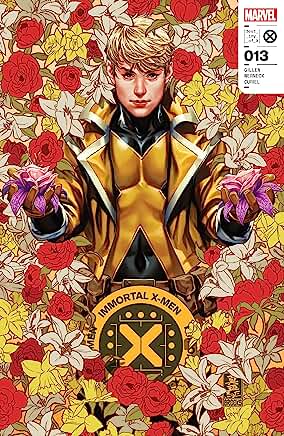 IMMORTAL X-MEN #13
“Part 13: Deadlocked”
Writer: Kieron Gillen
Artist: Lucas Werneck
Colour artist: David Curiel
Letterer: Clayton Cowles
Design: Tom Muller with Jay Bowen
Editor: Jordan D White
COVER / PAGE 1. Cypher, with Krakoan flowers. We’ve been through all the official members of the Quiet Council (except for new member Selene), and so we reach the spotlight issue of Cypher and, through him, Krakoa itself. Cypher, of course, has been a non-voting observer and presence at the Quiet Council all along, and offers an example of how that can be a more significant role than it first appears.
PAGE 2. Opening quote. This is indeed a quote from the post and cleric John Donne (1571/2-1631), from one of his prose works. The passage is famous as the origin of the phrases “no man is an island’ and “Ask not for whom the bell tolls”, probably his best known coinages today. Donne’s original point is that because we are all part of society, every death is a loss to everyone; here, the island is Krakoa itself, suffering because the mutant society it sustains is suffering.
The version here is in modernised spelling. Donne actually wrote “as well as if a Manor of thy friends or of thine own were”, which makes rather more sense. (Different modernisations also disagree about whether “Manor” should be “manor” or “manner” – “manner” seems to be more common online, as in “as if all manner of your friends were [lost]”, but “manor” seems to fit better with the following words “or of thine own”.)
PAGES 3-4. Cypher asks Krakoa about the leaves.
Cypher is apparently watching the debate on Colossus’s proposal to reveal the Sins of Sinister timeline to the world, which would place this scene between pages 21-22 of the previous issue.
“[Krakoa’s] biotech that filled the space Warlock left.” Cypher’s techno-organic arm used to be Warlock, until they were separated in Legion of X – Cypher believes Warlock is dead. The “biotech” arm doesn’t look much like any other tech that Krakoa has produced, and this may be an attempt to cover for a continuity problem. At any rate, Cypher has apparently chosen to make Krakoa’s gift look like Warlock, his earlier partner.
PAGE 5. Recap and credits. Cypher and Krakoa don’t normally appear in the headshots here, but they get a listing in this issue for obvious reasons.
PAGES 6-7. Emma addresses the Quiet Council.
Since the previous issue, the Krakoans have indeed made the world aware of the Sins of Sinister timeline, and of the possibility of resurrected people being compromised by Sinister.
“I didn’t think Colossus could be so naive.” Despite his mastery of body language, Cypher hasn’t picked up on the fact that Colossus is being controlled by Scrivener.
The Phoenix Foundation was formed at the end of AXE: Judgment Day as a charity project to offer resurrection to a small number of the deserving poor.
The Krakoan economy. Understandably, the disclosure of Sins of Sinister has seriously undermined public trust in Krakoan drugs. Emma claims here that this is a catastrophe because Krakoa needs its drug exports in order to pay for imports. The claim that Krakoa isn’t self-sufficient seems a bit odd – pretty much everything seems to be supplied by the island itself. Nonetheless, the Krakoans do depend on the demand for mutant drugs to have economic leverage over the rest of the world. A collapse in demand is a catastrophe for that reason.
Emma apparently uses telepathy to fend off the protestors in a way that seems likely to be counterproductive, but can’t bring herself to lie to the mother of the Phoenix Foundation girl. She realises that Sebastian Shaw ought to have foreseen the consequences of making Sins of Sinister public, but doesn’t (at least openly) draw the obvious conclusion that he must have an ulterior motive which benefits from undermining Krakoa. However, she takes Colossus himself at face value, viewing him and Nightcrawler are moralistic simpletons.
“If Kurt hadn’t gone off to have a little cry…” In X-Men: Before the Fall – Sons of X #1.
PAGE 8. Emma and Xavier argue.
“Kurt has suffered almost unimaginable trauma…” Professor X is summarising the plot of Before the Fall – Sons of X and the last few issues of Legion of X. The part about Nightcrawler having “the very concept of hope torn from him” is literal, and refers to Margali conjuring the Hopesword from him in Legion of X #10.
“During Judgment Day, he resurrected himself over twenty times, choosing to remember each death.” Issue #7.
“Me, who pretends not to care…” A rare example of Emma explicitly acknowledging that her schtick is an act in front of a hostile audience.
“I wish Hope had acted earlier…” In the previous issue. Xavier responds making the same argument as he did in that issue regarding the importance of sticking to the rules.
“Destiny speaks, and everyone is suspicious. No one trusts her any more.” Partly because of her role in Sins of Sinister, partly because her accusation of Sebastian Shaw last issue didn’t stand up, and partly because she was resurrected by the potentially tainted Five process in the same issue. Ironically, Destiny is one of the only members of the Council left who does basically want to promote Krakoa’s interests.
“However, if she’s speaking, she’s saying things that she thinks can make a difference.” Destiny’s powers ought to tell her what the consequences of making a statement will be, but of course that also just reinforces the suspicion that she says things to achieve a result rather than because they’re necessarily true. Here, as we’ll see in a couple of pages, Destiny knows she’s not going to get her way, but she’s trying to drop hints to put an idea in Exodus’s mind – so that Selene gets killed and she can deny responsibility.
Note the fingerprints in the background throughout this page, particularly around Destiny in the final panel.
PAGES 9-10. Selene annoys everyone.
“Selene attacked Krakoa…” In issues #1-2.
“We sent one Council member to the Pit.” Mr Sinister, in Sins of Sinister: Dominion.
“Do you want me to shoot you through the head again?” Hope shot Selene in issue #2.
PAGES 11-15. Exodus tries to kill Selene.
He picks up on Destiny’s hint – even if he doesn’t realise it was a hint – that Selene can be denied a vote by killing her and then making sure the Five resurrect her this time.
“I don’t see any magic metal to help you here.” Hope used a mysterium bullet to kill Selene in issue #2, specifically because its effects counter magic. However… in issue #2, Selene was resurrected by the Five, and then Exodus then just mentally commandeered her and broke her neck. He didn’t seem to have any trouble with her there, but perhaps it made a difference that she was fresh out of the cocoon.
Storm steps in to defend Selene, essentially arguing that Exodus has crossed a line. But she also makes the point that a direct conflict between the more powerful members of the Quiet Council would destroy the island. On backing down, Exodus makes the reasonable observation that the more powerful mutants can only be governed by consent, and that Krakoa is only sustainable as a society for as long as that continues. He has been willing to sign up to this arrangement in pursuit of a common purpose but has now decided that the whole thing is collapsing. Despite his religious framing, his basic point is that of course the likes of Mr Sinister were not on board with any sort of idealistic cause.
Hope intervenes to calm Exodus down, despite having been fighting with him last issue after learning about how he killed her in the Sins of Sinister timeline.
PAGES 16-18. Cypher tells Professor X to quit.
“I let Moira go when Destiny and Mystique schemed to kill her.” Inferno #4.
“You, Emma, Exodus, Hope and Sinister were the only people who actually got the ‘trapped feeling nothing’ thing [from the Pit].” In issue #11.
“Everyone else, I gave them a psychic place to be. Sabretooth used that…” In the Sabretooth miniseries.
“[T]he Pit is actually empty bar Sinister and the Struckers.” Sinister has been there since Sins of Sinister: Dominion. Fenris were stuck there – without any involvement by the Quiet Council – in Bishop: War College #5.
“Sabretooth getting out changed things. Everyone realised what the Pit was – and what you’d done.” Again, the first Sabretooth miniseries. A key theme of that story is that the underclass of bit part character at least learned about the existence of the Pit and Xavier’s reputation was badly damaged among the public as a result. That hasn’t shown up anywhere else until now, but Gillen is tying it in to Krakoa’s wider rot.
“Beast going completely out of control…” In current issues of Wolverine and X-Force.
“Krakoa – the island – feeds off us all.” This has come up repeatedly in the Krakoan era but hasn’t really mattered until now.
“Moira’s experience showed purity failed.” Referring to the various past lives depicted in House of X #2; the lesson Moira gains from all that, and shares with Xavier, is that the mutants need to work together as a whole in order to survive, even at the cost of serious moral compromise. Xavier spells out directly that he does still believe in the classic version of his dream, which is one of mutants and humans living together as a single people – something that the Sinisterised Xavier also stressed in “Sins of Sinister”. The mutant separatism of Krakoa is, for Xavier, a serious moral compromise and an admission of defeat.
“Eri… Max.” Professor X starts off referring to Magneto by the name he knew him by, then corrects to his actual real name. Storm laid some stress in issue #11 on the fact that Professor X never really knew the real Magneto, using that name as a symbol.
PAGES 19-21. Professor X announces the Quiet Council’s disbandment.
Professor X, Emma, Kate and Hope clearly discuss this in advance. Exodus, Mystique, Selene and Shaw clearly don’t. Nobody directly indicates whether Colossus was told, but presumably he’d have sold them out if he had, so let’s assume not. Similarly, it’s not clear whether anyone asked Storm. Destiny warns against the plan, so presumably she wasn’t in on it – of course, she’s Cassandra now, so everyone ignores her.
The proposal is apparently for the new ruling body to be appointed by consensus through the psychic voting procedure using for the X-Men roster over the last two years. Professor X’s commitment to not voting on the Quiet Council apparently doesn’t prevent this, perhaps because he’s persuaded that the Council really has failed, and it’s not like he’s proposing to re-take power himself. Besides, it ought to have been obvious that “twelve people make it up as they go along” is not a long-term governance plan.
Cypher, who never was a voting member, formally proposes the resolution and nobody challenges him. Either the villains figure that the Council is unsustainable as a vehicle for their plans without the assent of the other members, or they already know that this suits their personal agenda – after all, Destiny did warn against it.
Note that Cypher is surrounded by falling leaves as he proposes his resolution, and while they’re coloured in the lush green that’s normally a positive on Krakoa, Cypher went out of his way earlier in the issue to tell us that this is a symptom of rot.
PAGES 22-24. Krakoa sucks Cypher into the Pit.
Cypher told us back on page 13 that he knew Krakoa would look after him if things got bad. This is it happening.
Krakoa’s dialogue has never taken the form of a consistent substitution cypher, so it can’t be translated.
PAGE 25. Trailers. The story title of this issue is repeated, which is probably a mistake.

Destiny votes against Cypher’s motion – she’s the only one with her hand raised.
Remember how mutants crashed the Eternals’ psychic voting?
Are they about to experience that from the receiving end?
The threat that the Five would go on strike – everyone seems to be taking industrial action these days.
Gillen continues to excel at bringing disparate storytelling threads together. I didn’t think the events of the Sabretooth comics would be referenced, but he wove them into the story and made them consequential to the main books. I like that almost every character involved in this issue made a choice, and the choices will have consequences. I was shocked that Krakoa’s ineffective government was dissolved,even if there’s nothing to fill that void. Cypher being sucked into Krakoa was chilling. Werneck and Curiel did a great job with characters’ nobody language, expressions, and displays of power.
My only minor quibble was the discussion about the economy, but if the island itself is sick it might not be able to provide for its inhabitants.
I was surprised that we had everything dissolve here. I expected it wouldn’t completely fall apart until the Gala itself. I’m very glad though, because this way it happens on its own terms rather than Orchis shouting out some bombshell at the Gala.
On the same page, I didn’t think that the revelation of the Sinister stuff would happen mostly off panel but also approve of that. The public reaction to that is so dead simple that doing it as its own scene would have been a waste. My own minor quibble was having a lot of things that were off-panel in this book suddenly come up as reasons for the council’s problems. Sabretooth and the Pit, Beast, the public reveals… I’m glad we got some acknowledgement of the first two, but I wish it could have come sooner.
Aside from that giving me a mildly rushed feel, this was an excellent culmination of things for the Council, and I want to see what comes next.
A few typos above, some significant:
> We’ve been through all the official members of the Quiet Council (except for new reader Selene),
New member Selene
> The version here is in modernised spelling. Donne actually wrote was
Missing a “What”, as in “What Donne actually…”
> The “biotech” arm doesn’t look much like any other tech that Cypher has produced
That Kraoka has produced
> “Destiny speaks, and everyone is suspicious. No one trusts her any more.” Partly…because she was resurrected by the potentially tainted Five process in the same issue. Ironically, Destiny is one of the only voting members of the Council left who does basically want to promote Krakoa’s interests.
Destiny is non-voting, for the reason you give in the same paragraph!
Exodus suggests that they take Sinister out of the pit and read his mind to find out if he can control people. Kate objects that Sinister might take control of Xavier, Emma, Exodus and Hope. Ok, so why not just sedate them and have Jean, Rachel, Betsy and Synch read Sinister’s mind? Or, since Exodus, Emma and Xavier have no defense against power dampeners and Hope’s powers only work in proximity to other mutants, they could chain Exodus, Emma and Xavier up near Leech and imprison Hope away from other mutants. The idea that it’s impossible to imprison Exodus, Emma, Xavier and Hope temporarily is ludicrous. (Especially since we know that the villains will be doing it all the time once Krakoa ends.)
Similarly, Exodus claims that the Pit isn’t powerful enough to hold him or Storm unless they wish it. It would be nice if this had been mentioned sooner. (Storm? Plenty of villains have had no problem holding Storm whenever they capture her,)The idea that the pit can’t hold powerful mutants should have been mentioned sooner.
It’s nice to see that Hope’s and Exodus’s friendship seems to be healing and that Hope is the last person in the world who should be condemning people for what they did in a possible future.
It’s also nice that Gillen is acknowledging that mutants aren’t a people in the same way that, say. Jews and Armenians are a people.
@Mike Loughlin- the problem is the way that Gillen wrote it- Emma complains that the loss of the money from the medicines means Krakoa won’t have enough revenue BEFORE she realizes that the island is sick.
Michael> It’s nice to see that Hope’s and Exodus’s friendship seems to be healing and that Hope is the last person in the world who should be condemning people for what they did in a possible future.
Last person? I think you’re thinking of Bishop :p
“It’s also nice that Gillen is acknowledging that mutants aren’t a people in the same way that, say. Jews and Armenians are a people.”
This and Xavier’s bit about mutants being humans who are othered by bigots were great to see after four years of these key philosophical questions being largely ignored. Gillen’s taking core premises at face value that Hickman seemed to have no interest in ever addressing, and it’s adding so much.
Interesting in that same scene, Xavier pointedly uses Magneto’s preferred name, but not Apocalypse’s.
Immortal is consistently the best read of any X-Men comic, just because of the way it pulls in all the little bits and pieces from the other titles, and gives us real drama in what’s essentially a book of committee minutes and talking heads. I really hope Gillen continues to do this kind of thing ‘after the fall’…
I have lived to see a Xavier speech baloon where he claims that Magneto was “always” the idealist and Xavier himself was not.
Or have I? I sincerely have to wonder. I generally like Gillen’s writing, but this issue was weird in at least two very wrong ways. There is no way in heck Xavier could say that about Magneto and himself with a straight face. And there is no way Storm, forceful depictions to the contrary not standing, is quite powerful enough to match Exodus like that.
Despite those two major flaws, this was an exciting issue. It was about time someone said out loud that the Quiet Council has already overlasted its usefulness, and it was very proper that Cypher ended up being the mover and shaker given recent trends and lampshades. Other than the weird and glaring fantasizing about Magneto, Xavier’s speech was welcome and even felt justified and natural. It is a shame that it ended up tainted like that.
Someone must realize that Magneto and Storm are not nearly as pure as they have convinced themselves to believe to be. They are not Reed Richards, to tap into a recent weirdness. It is off-putting to see the plot apparently condone such forceful reinventions.
“Despite his mastery of body language, Cypher hasn’t picked up on the fact that Colossus is being controlled by Scrivener.”
Which tracks for me. Scrivener’s power isn’t mind control; it’s reality-warping. And the specific change to reality that he is enforcing is that “Colossus is an undetectable sleeper agent.”
Storm and Exodus don’t need to be equals in that fight, Storm just needs to be credible enough to not be easily defeated and have the idea of a fight between them being one that would cause much collateral damage, for her move to succeed. I buy it.
Also, Xavier is in grief, it’s not weird to say things that might overstate the positive aspects of a recently dead friend.
I believe Xavier’s speech about Magneto’s idealism should be read in the context of Hickman’s retcon about Xavier with Moira.
He is saying that Magneto never betrayed his ideals. Krakoa is built on a solid foundation of what Magneto represents and believes rather than Xavier. Xavier tried to remain true to his dream, yet he found himself always ready to accept the necessity of Moira’s revelations and Magneto’s ideals. As we know from Hickman, the three of them were plotting the creation of Krakoa for years. Xavier kept fighting what he felt was reality (if mutants didn’t unite and separate from humans they were doomed) in the name of his own ideals, yet he compromised his dream many times by agreeing to go along with Moira and Magneto. Magneto never had to compromise his own ideals.
This is an important course-correction from Hickman’s legacy. Krakoa was meant to be a compromise, combining the ideologies of Xavier, Magneto, and Apocalypse. As Moira said in House/Powers, there would be no more conflicting ideologies keeping mutants fighting against each other. Xavier also claimed throughout the Krakoan era that he had never given up on his dream, that his dream had just changed.
However, the reality of Krakoa was always very different than what Hickman put on the page. Krakoa is clearly most comfortably read as based in Magneto’s ideology. Xavier’s dream was based in gradualism; while Krakoa said that humans and mutants may be able to coexist, but only if they are kept separate.
Most of all, as Xavier finally admits in this issue, his vision was always based in humans and mutants being the same. Yet, Krakoa is based in mutant separatism and superiority. It is Magneto (as well as Moira and Apocalypse) who believe that humans and mutants are fundamentally different. Xavier abandoned his ideals to say that he would go along with Magneto and Moira.
This isn’t the first time Charles has spoken about himself and Erik that way – I recall another scene where he said something to the effect of Xavier always being characterized as the idealist to Magneto’s pessimism, but in fact Charles sees himself as a pessimist as well: he doesn’t advocate for mutant integration out of naïveté but because he believes the alternative is so horrific there is literally no other choice
Emma’s statement about the Krakoan economy is what I found to be the most glaring flaw of this issue. I realize I’m not alone.
Also, Selene is a new reader. Due to complications of being dead, Selene was only able to begin reading Immortal X-Men recently.
I don’t see Magneto as a pessimist. He may be pessimistic about humanity, but he believes he (or mutants, in general) can create a utopia world, if they are allowed to rule. His belief is that humans are flawed, while mutants are a superior race which can overcome the errors of humanity.
K > Remember how mutants crashed the Eternals’ psychic voting? Are they about to experience that from the receiving end?
Probably not given that Zuras declared any further Eternal attacks on mutants will result in Exclusion. However, I do think the Eternals Uni-Mind was foreshadowing the eventual creation of a Krakoan Uni-Mind for communal decision-making. Jean & Scott intended for their telepathic X-Men elections to be a model for the eventual QC elections they were pushing to introduce. Jean was already creating a Mutant Uni-Mind prototype during the HGs.
I’ve theorized before that when Fall of X is over and a New Krakoa is formed by mutants (and humans?), Nightcrawler will be elected as its first mutant president/premier/leader. This will be the logical expansion of Kurt’s arc in WoX/LoX. Xavier even talked at length about Kurt’s sacrifices in this issue. The writers have removed Nightcrawler from Krakoa post-SoS. This way, Kurt is not involved in or associated with the decline of the QC before it was dissolved. When Kurt returns, he’ll still be seen as a trustworthy candidate by the Krakoan populace.
Krakoa may provide the essentials, some unusual building materials and apparently some weird form of biotechnology, but we have had to gloss over a lot of its everyday existence in order to keep the appearance of sustainability. At the very least, being apart from other communities would be a major and sudden cultural change for most residents.
Fixed various errors pointed out in the comments. (Not bad for something I wrote while heavily jetlagged on two hours sleep, I think.)
I think the chances of the Eternals having anything to do with future storylines are negligible given that their book has been cancelled and their movie was perceived as underperforming.
I haven’t been reading all the X-men Red, is “Max”, Eric? Found that a little confusing, but maybe I just missed something.
Max Eisenhardt is Magneto’s real name, per the 2008 origin miniseries X-Men: Magneto – Testament, which retconned “Erik Lehnsherr” into being another alias. Magneto has been going mainly by “Max” in X-Men Red. But the point is that if Xavier had been as close to Magneto as he would like to believe, he wouldn’t have to make a conscious effort to remember to call him by his real name.
ah, got it. Thanks Paul.
I thought it was a good issue, Immortal is only only thing that really feels like it remembers the framing of HOX/POX as a larger narrative, which is what brought me back into the book, this issue was satisfying on that account.
I think Lensherr was revealed to be a forgery in the Joe Kelly run way back in 1998, no? It just never really stuck.
@Rob: yes, but the movies use of the “Erik Lensherr” name overwrote the forgery story in peoples’ minds. I skipped a lot of the late-2000s & 2010s X-books, but I don’t recall seeing Magneto called “Max” on a regular basis until the recent X-Men Red series.
Wasn’t the Lensherr name — or the forgery story — tied to Marvel’s brief effort to suggest that Magneto might have been Sinte Romani rather than Jewish in the late 1990s? I recall Paty Cockrum objecting fiercely to that idea.
Or am I conflating two separate things?
Wasn’t it the Classic X-Men #12 backup story by Claremont that introduced Magneto’s name as Erik Lehnsherr? I have to assume that Claremont always meant for there to be a forgery story involved with Magneto’s name. Claremont would realize that “Erik Lehnsherr” was not a Jewish name. I don’t believe “Lehnsherr” is even used as a name. It translates as “feudal lord”, which seems to imply Claremont meant it as a pseudonym created by Magneto.
Apparently not. I did some digging online and what I found says that he received the name Erik Lehnsheer in X-Men Unlimited #2, and according to the article, it was an attempt to establish that Magneto was of the Roma.
I must have been the one conflating the Joe Kelly retcon story which was based around the Classic X-Men story. Unless the internet information I read is wrong. Either way.
I was a bit surprised that Mystique voted against Destiny. While Gillen did admittedly plant the seed for that, I wouldn’t have minded a quick moment here that showed where she was coming from.
If you want to No-Prize it, you could say that Krakoa tried to be self-sufficient, but it failed. At the start we were seeing characters complain about the coffee or the egg plants. Logan needed Kate to ship booze in for him. There were twice daily EMP blasts and plant-based messaging systems.
Later on, they stop mentioning the food plants, have no trouble getting alcohol in glass bottles, and can access the internet. Presumably this was part of making Krakoa seem less like an isolationist cult, but you could argue Krakoans just weren’t that interested in it. Self-sufficiency flopped the way actually speaking Krakoan did.
[…] X-MEN #13. (Annotations here.) There are only twelve members of the Quiet Council, so with issue #13 we move on to Cypher, the low […]
What am I missing about the significance of the fingerprints?
I was also wondering about the prevalence of the finger prints. Perhaps this comes up again in another issue?