X-Men Red #17 annotations
As always, this post contains spoilers, and page numbers go by the digital edition.
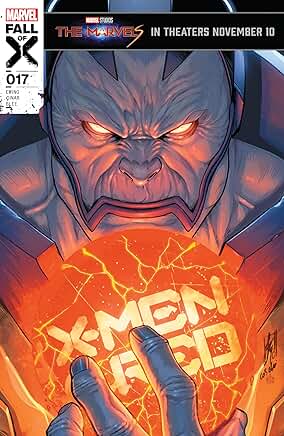 X-MEN RED vol 2 #17
“The Avatar of Life”
Writer: Al Ewing
Artist: Yildiray Çinar
Colour artist: Federico Blee
Letterer: Ariana Maher
Design: Tom Muller & Jay Bowen
Editor: Jordan D White
COVER / PAGE 1. Apocalypse holds… well, some sort of energy ball with the logo.
PAGES 2-4. Apocalypse and Vulcan.
Last issue ended with Apocalypse, the hooded guy and his sidekick demon – named later in the issue as “Orc” – arriving in the Autumn Lands and declaring that he would “remake the world” there. He specifically mentioned a “sun caged below”, referring to Vulcan, who was imprisoned there in issue #10. Evidently Apocalypse has just freed Vulcan between issues.
Vulcan assumes that Apocalypse is (as usual) recruiting a new Horsemen of the Apocalypse, and asks whether he’s going to be Death – though with an obvious double meaning, threatening Apocalypse. Apocalypse acknowledges that he’s formed plenty of Horsemen groups in the past, all named after the four children who he lost when Arakko was severed from Earth, and he claims to have had a hand in adding their names to “the sacred texts of humankind” – i.e., the Book of Revelation.
In this case, as we’ll see, Apocalypse is really more interested in his mutant magic idea from Excalibur, and he wants to do something with the ideas of the four elements (earth, air, fire and water). Obviously, Vulcan will do nicely for fire, and Apocalypse is going to be “water” on shape-changing grounds.
Apocalypse is rather vague about how he freed Vulcan from the prison. He describes it as an “oubliette you strained against for months”, and indeed we can see some bits of it lying on the ground on page 2. In issue #10, it was said to be lined with mysterium, the cosmic material introduced in SWORD. Apocalypse seems to suggest that this has something to do with his ability to break the oubliette, and attaches significance to the fact that Abigail Brand chose to use it for economic leverage rather than exploiting its mystical potential. He may be saying that Abigail’s approach weakened mysterium by tying it to the mundane world, making it more vulnerable to his magic.
We’ll see who the hooded character is later in the issue.
PAGE 5. Recap and credits.
PAGES 6-9. Storm destroys the Uranos trigger and argues with Jon Ironfire.
This is the refugee camp after Storm’s forces were driven into retreat by the Brotherhood last issue.
Craig Marshall and Peter Corbeau were seen arriving at Arakko last issue, and have departed off panel with some refugees.
The Uranos trigger was recovered from the Red Lagoon bar last issue. As we covered last time, it’s the device that the Eternals gave to Arakko at the end of A.X.E.: Judgment Day to allow them to unleash Uranos on their enemies for an hour. Much of the previous issue was given over to the dilemma of whether to use him, and Jon Ironfire clearly wants to go for it. More fundamentally, he doesn’t see any prospect of the people under Genesis’s influence being freed from it. Interestingly, when he says “they cannot be saved”, we get a panel of the Annihilation staff’s face, which has nothing to do with the scene itself. The obvious reading is that it’s referencing the reason why they can’t be saved, but you could read it as suggesting some sort of influence over Jon.
“Ask Doug Ramsey if the White Sword needed to be worshipped.” During “X of Swords”, White Sword used his powers to save Cypher’s life when he was dishonourably poisoned before the tournament properly began. Unusually, this actually gets a footnote, presumably because somebody figured it was such an obscure reference that people needed a pointer. Unfortunately, the footnote has the wrong issue – it ought to point to Marauders #15. In that scene, the White Sword specifically says “I release you from any obligation to me” after curing Cypher.
“And when the mission was done, he gave me an honourable discharge. He ended my service.” This is not what we saw in issue #12. In the flashbacks in that issue, White Sword releases Jon from his service because Jon simply won’t leave and warn Arakko otherwise. Jon reacts as if he’s “waking from a dream”, and was clearly under White Sword’s mental influence throughout his time with the Hundred, despite what he says here. Jon is trying to portray the White Sword in the most favourable light, but Storm has a point that the White Sword’s influence over his followers is similar to Genesis’s. That said, the White Sword does seem to have limited it to volunteers.
PAGE 10. Storm and Sunspot discuss Nova.
Nova was infected by Pestilence last issue.
PAGES 11-12. Apocalypse arrives.
Death is the only Horseman to switch sides last issue, regarding Storm’s forces as more in accordance with his notions of honour. He’s clearly looking for approval from Apocalypse and gets it in a vague way, with at least an indication that Apocalypse thinks he’s on the right track. Apocalypse is rather more approving of Death later in the issue when he isn’t around.
PAGES 13-14. Jon Ironfire and the White Sword.
The Morrowlands is the artist district first seen in issue #2.
The White Sword gave his eponymous sword to Jon in the flashbacks in issue #12, and Jon brought it to Arakko in issues #11-12. Genesis stole it in issue #13. Since the White Sword has been under her influence since issue #12, he doesn’t particularly care, or at least rationalises the sword’s absence away. With Jon gone, he now refers to the group as “my Ninety-Nine”.
PAGES 15-17. Apocalypse prepares for his ritual.
Storm gives Apocalypse her reasons for not using Uranos, basically claiming that she has the power to do this herself, and needs to take personal responsibility for it, not least because she believes she would know when to stop. Apocalypse clearly signals that he thinks she’s fooling herself on that point.
Apocalypse explains that he wanted to do this ritual with the Four Horsemen, but none of them have yet achieved anything approaching the level of enlightenment that he needs for this (and when you bear in mind that Vulcan meets the cut, albeit under magical duress, that’s really quite damning). As already noted, Apocalypse is water and Vulcan is fire. Orc is tenuously rationalised as air – as even the characters recognise. The hooded character representing Earth is…
Sunfire, who has just returned from his arc in X-Men Unlimited Infinity Comic #112-117, newly bonded to Redroot, the plant spirit mutant who used to serve as Arakko’s interpreter. (She’s analogous to Cypher’s role with Krakoa.) We saw Apocalypse rescuing Sunfire from Otherworld in X-Men #28.
“When I came here, I took land for myself – and killed to keep it.” In X-Men #9.
“Rictor was my original choice.” A nod to the Rictor storyline from Excalibur.
PAGE 18. A montage of mostly reprinted panels, somewhat similar to the one in issue #11, though this one also has plants.
- The image of Apocalypse yelling is from the cover of X-Factor #6, his first full appearance (after being shown unrecognisably at the end of issue #5). The line “Be grateful that the centuries have taught me not to waste what might prove useful” comes from page 13 of the same issue.
- The picture in the bottom left of someone saying “But I do not know why you wish me to take this burnt, barren soil into my hands!” is from Sunfire’s origin flashback in his debut in X-Men #64 (1970). It’s the site of the Hiroshima nuclear bomb, and touching the soil is going to trigger his dormant mutant powers. (Sunfire’s origin story was originally tied to his mother suffering radiation poisoning as a result of Hiroshima, which obviously can’t be valid any more due to the sliding timeline.)
- The panel of Vulcan with eyes glowing is from page 21 of X-Men #10 (2020), the issue with the flashback to Vulcan being resurrected by sinister aliens. The caption “He has fire within him” comes from elsewhere in the same issue.
- The panel of Apocalypse saying “In what other realms could we build a home? And what would it cost?” is from Excalibur #1 (2019).
- The panel of Orc asking “How do I survive? What is strength?” is from his first appearance, X-Men: Before the Fall – Heralds of Apocalypse #1. It’s page 3 panel 9.
- The panel of Storm thinking “I must work with the forces of nature, not ride roughshod over them, and gently shape them to my will” is from Uncanny X-Men #147. It’s the scene where she nearly loses self-control and a “Dark Phoenix” style turn is teased.
- The large figure of Storm at the top of the page with hands outstretched is from a flashback in Uncanny X-Men #226, where it’s actually the Bright Lady appearing in a vision to a young Ororo. The dialogue reprinted at the bottom of the page – “Great mother – bright lady of the earth and air – hear thy daughter’s call!” – is the prayer that she’s responding to.
- Superimposed on that figure is a nearly naked Ororo with a scarf thing around her. That’s another panel from Uncanny X-Men #147 – she’s just escaped Dr Doom’s control, and in the original, she’s yelling “I am a goddess!”
PAGE 19. Sobunar warns Genesis.
The Ten Towers were originally built in Amenth as a defence against the demons. Genesis has apparently decided to finish wiping out the opposition on Arakko but then just sit there and wait for “the humans” – possibly meaning specifically Orchis. Annihilation seems to be encouraging her to attack the humans first.
PAGES 20-21. Kaorak attacks.
Kaorak is, of course, another anagram of Krakoa, Okkara and Arakko. Since Genesis is on the original Arakko, Apocalypse’s magic has apparently raised a whole new living landmass. Its face is probably based on the original Krakoa from Giant-Size X-Men #1, even though it might bring the Man-Thing to mind.
PAGE 22. Trailers. The Krakoan reads LAST STAND.

I’m not liking the idea of Apocalypse being able to control Vulcan with a spell of obligation. The dialogue implies that he’s known about this spell all along. Then why didn’t he ever USE it in his battles with the X-Men? The attempt in recent years to convince us that Apocalypse has been a master sorcerer all along and we never noticed just doesn’t work.
I’m also not liking the idea that Apocalypse could easily damage Mysterium. We saw in the last issue of Iron Man and the last issue of Dr. Strange that STRANGE’S magic was useless against Mysterium. And we saw a few issues ago in Dr. Strange that DORMAMMU’s magics couldn’t protect him from Mysterium. Even the power of the Trinity of Ashes, who fought the Vishanti to a stand still for FIVE THOUSAND YEARS, was in vain against Mysterium. But Apocalypse can easily break it? Yeah, right.
The story seems to suggest that Genesis is a coward. The caption describes Genesis as “safe again on Arakko-Prime” and her plan involves hiding in the Ten Towers.
He says “I tore it easily, with bare hands.” so I thought he just smashed the mysterium confining Vulcan. Apocalypse is supposed to be close to the Hulk in super strength so that doesn’t seem implausible.
Mysterium is meant to be nearly as strong as secondary adamantium, Hulk himself should have trouble damaging it. Maybe it was corrupted and weakened by being used as a common building material, while it is strongest when dealing with magic.
The biggest problem with Apocalypse’s magic retcon is it makes him less special. There are other immortal warlords, granted, but there are so many more immortal wizards. Hell, Selene is right there.
Symbolically, Mysterium is Earth. Earth can contain the power of Fire. (As also demonstrated by the way that Sunfire/Redroot are Earth, NOT Fire, whereas Sunfire alone clearly would be Fire.) Apocalypse, however, is Water, and Water erodes Earth.
Or if you want a more physics-based explanation, maybe the Mysterium was formed into something that had similar properties to a Prince Rupert’s Drop (https://en.m.wikipedia.org/wiki/Prince_Rupert%27s_drop); astonishingly strong in many ways, but when struck at the right spot, the entire structure instantly disintegrates.
I liked this issue – I like the presentation of Apocalypse, and the collage of old art was very nicely done.
But I thought the Uranos Trigger plotline would last longer – Storm could be just a little bit tempted, maybe? And I’m not too hot on the finale of this dialogue-heavy series being a… big kaiju fight?
Like, I’m definitely surprised, this is a resolution I did not see coming, but… really?
Huh.
I’m irrationally annoyed that the guy whos name has the name “fire” in it symbolises earth, while the guy named after the god who lives in a mountain and shapes metal, doesn’t.
While Apocalypse’s spell was obviously based on the elements, the way it was portrayed reminded me a lot of his plan in ‘The Twelve’ story line and how he had a backup for every character whose powers he wanted to steal. His horseman picks always mostly seemed random, but his plans here seemed to have some level of planning or at least he’s intent on convincing the others it did (same as in ‘The Twelve’). I wonder if it was intentional or if I’m just overthinking it since that story line is not fondly remembered (though most of those deck clearing stories before a new writer takes over aren’t well-liked. Nate Grey’s weird sexless reality, for instance). But hey they still bring up the Draco for some reason so who can say.
Well, viewed through the lens of the Krakoan Age, in The Twelve Apocalypse was trying to create a mutant circuit, utilising for that purpose mutant technology/magic. (Both terms have been applied to mutant circuits, making them both meaningless, at least to me).
Storm’s line about knowing when to stop was chilling. How can anyone know exactly how much is enough in war? How can anyone stay on the side of good? Uranus’s mass slaughter is clearly wrong, morally, it what if it’s the only way to prevent the innocents Storm is protecting from dying? As with last issue, this comic cut too close to current events (no one’s fault), but I care more about the implications and consequences of characters’ decisions than I do about the more fantastic elements or continuity.
For once I see Ororo’s point and agree with it.
She saw the danger of third-partying the fighting to Uranos. To be fair, it was obvious even without Uranos’ teasing.
Uranos wants to kill as many people as he can and expects that to be appealling for Ororo and her allies so that they can distance themselves from the slaughter.
For better or worse, Ororo is aware enough that it would be hypocrisy and also be perceived (correctly) as cowardice by her Arakki allies, so she resists the temptation.
That is the correct call. It will fall to them to be better than psychotic mass murderers, to whatever extent they succeed to.
There’s nothing really stopping Uranos from turning around and killing Storm and her army too, is there? They’re not Eternals, and therefore only fit for extermination under Uranos’s code. The whole idea of unleashing Uranos against your enemies only makes sense if the Eternals are unleashing him.
The Krakoa age has introduced two of the biggest retcons-that-don’t-hold-up-when-reading-old-stories, “Moira was always a crazy mutant-hating mutant” and “Apocalypse was always a master sorcerer.” I’d argue that those are harder to rationalize than classics like “Dark Phoenix wasn’t Jean,” “Xavier was Changeling for a while up until he died,” and “Bobby has always been gay.”
Am I missing any other big ones?
@Karl
The Psylocke/Kwannon one comes to mind.
The Moira ret-con works if you figure in two key details.
She was working in secret with Xavier and Magneto to eventually establish Krakoa. Hence, she’d keep her mutant-hating views to herself.
Also, she replaced herself with a Shi’ar golem along the way, one without memories of being a mutant or her past lives. So, that version of Moira (the one we saw in Ellis’ Excalibur) is who Moira could have been had she not went through her prior nine lifetimes.
The whole “she’s so crazy” thing only happened after they kicked her off of Krakoa. Before that point, she was only coldly manipulative and amoral, which would make sense if you had her mutant power, lived for over a thousand cumulative years, and felt you were the sole individual who could shape the world into something approaching an utopia.
There’s still a huge amount that the Moira retcon doesn’t explain. One I haven’t heard mentioned is Wolfsbane. Rahne’s at best a B lister, who has had nothing to do with Krakoa. She wasn’t needed for any reason. So why did Moira bother to nurture her? Adopt her? Letting someone so young and fundamentalist so close is basically asking to be exposed. It makes sense (assuming Scotland is ten people who all know each other) for her traditional nurturer role, but try to imagine Doctor Doom adopting some waif without ulterior motives. It’s nuts.
I always felt that Doom was pretty altruistic for adopting Kristoff. Sure, it may be because of Doom’s ego in that Kristoff’s mother was one of “his” people, but for a Marvel supervillain, that’s practically worth canonization (and not by the Kurt anti-Pope). I always liked Byrne’s idea that Doom would be horrified that his Doombots did this and he’d need to build a completely new batch of them by the time he was through.
My personal headcanon is that the Moira that we first meet and know is the Shi’ar golem. One of the previous lives had knowledge that let her build it. That lets Rahne and Sean’s interactions with Moira be real, and it’s the Krakoa-Moira that’s fake.
Let’s just admit it, no matter how compelling HoX/PoX were, retconning 40 years of Moira being a scientist human ally to Xavier into her being an immortal reset button mutant with designs on meeting a dominion on their level…. it was always going to have a TON of plot holes.
At least it was ambitious. Too bad Hickman didn’t stick around to finish it, I doubt a lot of the current plots were meant to be there originally. Maybe the OG mini could have set up magic Apocalypse or the Sinister variants or the Moira heel turn
Hickman wasn’t interested in any of those ideas.
Magic Apocalypse was a Tini Howard concept.
The current incarnation of Essex is nothing like Hickman’s interpretation of Sinister. In Moira’s Life Nine, Sinister betrayed Krakoa and sided with the Man-Machine Supremacy because he thought they would win.
I think Gillen is the one with a softspot for Sinister.
Hickman’s Moira was based in shades of gray. She was amoral, not immoral. She thought it would be a kindness to create a “cure” for mutants and put an end to the cycles she had witnessed. That’s why I liked Hickman’s Moira…the reader could understand each side in the conflict and disagree with every side, but there was no outright good versus evil.
Orchis were villains but only due to the current circumstances. Hickman showed the other side in the alternate Life Ten, where the mutants showed under different circumstances, they could be the villains.
It is a shame Hickman didn’t flesh out Moira’s decision better, as her taking the side of humanity, who seemed to be the true losers in every life, would have fit nicely, especially after Moira’s interaction with the Librarian in Life Six.
@Chris: Hickman was pretty clearly modeling his interpretation of Sinister on Gillen’s, considering the whole clone show he puts on for Xavier and Magneto in HoXPoX and his general behavior in Inferno. Gillen’s just better at it because he originated that take.
I’m also not sure how the “10A” timeline depicts mutants as villains – setting aside the obvious bias of Omega’s perspective, that same story has Moira unequivocally saying that the machines can’t be reasoned with, have never been open to peace overtures, and will exterminate mutants in every timeline. Omega comes from a timeline that had Nimrod in it, which means there were Sentinels, which means they started a war with the mutants again and lost decisively.
Honestly, the biggest problem with Inferno is that Hickman completely undermines his own writing – if the original outcome of Krakoa is mutant victory, then Moira’s wrong about the cure being the only way out. And if she was planning the cure route all along, what was the point of establishing Krakoa? Why help cure the Legacy Virus, for that matter?
Hickman’s characterization is based on Gillen’s Sinister from his prior run, but this idea that Essex had seen that AI was an existential threat to non-mechanical life and he created four clones to attempt to pursue a path to dominionhood in order to stop the machines is outside of Hickman’s interpretation of Sinister.
Humanity is also extinct in the future 10A timeline. Sure, you could argue it was inevitable, that nature left to its own devices is going to leave mutantkind to replace humanity.
That’s why Orchis isn’t a bunch of evil supervillains under Hickman though. Omega Sentinel showed Devo a future where Krakoa conquered the world and ruled over humankind, patiently waiting for them to go extinct.
We see it in “Inferno” where Xavier tells Magneto that he believes that mutants can be benevolent rulers over humanity.
A better future, even by the standards of Professor X’ dream, wouldn’t require anyone to rule over anyone else.
Life 10A didn’t have an operational Nimrod. It had the Nimrod AI, but he wasn’t functional yet. Hickman’s timeline explained what happened. The Children of the Vault emerged and declared war. Humanity united to fight the Children, but they were still losing. Humanity reached out to mutantkind for help, and Krakoa agreed to an alliance. Apocalypse returned and helped the human-mutant alliance defeat the Children. Shortly afterward, Krakoa discovered that humanity was still building a Nimrod, so mutants went to war with humanity and the mutants conquered the humans.
As far as the Legacy Virus…well, the point is to cure mutancy. That’s why Moira was characterized as shades of gray under Hickman. She didn’t want to kill mutants. She gave them an island and immortality, and would create a cure so there were never any further mutants born. The Legacy Virus would lead to suffering and pain for mutants.
Also, If Moira’s cure was the Krakoan drugs, it made sense that Moira would need to use Krakoa to distribute her cure.
Krakoa is the biggest flaw in Hickman’s grand design, true. However, what I like about Hickman’s run are the parallels he sets up between the different sides.
Krakoa is a mutant paradise. Moira helped them found Krakoa (by showing Xavier and Magneto her truth), but they discover that Moira was using Krakoa to undermine the mutant cause.
Orchis is a human haven. Omega Sentinel helped found Orchis (by showing the scientists her truth), but we know that Nimrod and Omega Sentinel are using Orchis to do their bidding (eliminating the mutants who would stand in their way) so that Nimrod and Omega Sentinel can go on to betray the humans.
So, the best idea behind Krakoa is that Moira was creating a simulation for mutants, just as the Dominion was a simulation being offered to post-humanity by the Phalanx. Post-humanity would become immortal within a machine god. The Librarian questions if such a fate can be considered real. It would be living in a simulation.
So, once again, using the parallels between post-humanity and mutants, Moira sets up Krakoa and Cerebro as a mutant version of the Phalanx and Dominion. Mutants could have immortality and live out their lives isolated on an island, content, but it would be as unto a simulation, it wouldn’t be a real life.
Hickman never fleshed out his intent for Krakoa as a trap in light of the revelations by Moira.
Whatever everyone feels about the Moira retcon itself, I think it’s clear that Moira’s story arc wasn’t allowed to play out the way Hickman intended. It’s the biggest casualty of his leaving the franchise. Inferno is kind of my jumping off point.
I’m pretty certain the intention was never for her to be a moustache twirling robot villain who skins faces while cackling. I mean… The writing just got really infantile with none of Hickman’s subtlety.
On X Men Red, I really like Ewing and his grand space opera stuff. But it’s very far away from core concepts at this point? But still, love the art and Ororo’s journey. She’s still too perfect, though
@Chris V When you say Hickman showed something about Life 10A, you mean something mentioned only in a data page, right? We haven’t actually seen any of it – or am I forgetting something?
@Diana- Yes, Moira says the machines can’t be reasoned with but she also “forgets” to mention that she’s secretly plotting to get rid of mutants so Moira isn’t exactly the most reliable narrator in that sequence.
Hickman seemed to say in this interview that he didn’t originally intend for Moira to be evil (around 20:30):
https://www.youtube.com/watch?v=uWZuAQdF_fg
@Chris V- Hickman was clear that Moira was only replaced with a Sh’iar golem AFTER she got the Legacy Virus- it was the real Moira who got the virus:
https://bleedingcool.com/comics/al-ewing-was-originally-going-to-write-moria-mactaggert-x-men-comic/
The problem with Karima’s claim that mutants always win is that Moira’s plan was thwarted in part because of the existence of Orchis. So if Orchis didn’t exist, shouldn’t mutants have lost?
Aside from that. we have Moira claiming that mutants always lose despite the fact that (a) Cable’s entire backstory is that he comes from a. future where mutants conquered the world and became a dictatorship and (b) in Karima’s future, mutants won. I’m not sure what Hickman originally intended but Inferno was a mess.
@Chris V- Based on what Duggan wrote, I assumed that Moira’s original plan was for the Eternals to kill Hope and end the resurrection process. But again, it’s not explained very clearly.
Ceran-Yes. I am referring to the timeline data page that Hickman included in Inferno #3.
Michael-Yes, Hickman ignored Cable’s future, but he had been ignoring it since HoX/PoX.
Moira isn’t aware of the fact that there was a Life 10A. It was split off from the current Marvel 616-Life 10 by Omega Sentinel’s messing with time travel. She has no idea that Krakoa went on to succeed before the founding of Orchis by Omega Sentinel’s interference.
Hot take- The best X-Men stories have almost always been when the X-Men step away from their ‘core concept’. Living in a world that hates and fears them is fine for a basis for stories but is hamstrung by the fact that they don’t do anything about it. Stepping away from that allows them to do stories on an exciting ‘splodey level.
@Loz- God Loves, Man Kills is one of the best X-Men stories, and it’s all about prejudice. It benefits from being a stand-alone story, however, and has an end which indicates there’s hope for the future. Also, Days of Future Past is very much about the outcome of prejudice being fascism. It’s another story that gets to have an ending.
That being said, most of the other great X-Men stories I could think focus on other themes, with mutant/ human relations being an undercurrent rather than the main plot. You might have a good point.
@Chris V- I’m fine with other writers stepping away from Hickman’s original plans, but boy howdy did they screw up Moira. That said, I thought her heel turn in Inferno should have resulted in her being taken off the board until someone like Gillen or Ewing had a good idea of how to wrap up her story. Just have her escape the mutants (possibly using the techno-organic arm) and have her continue her research underground. At the climax of the Krakoan era, she returns and has to be defeated or bargained with or even saved to prevent another hellish future.
Re: Cable’s future: aren’t Cable, Bishop, and Rachel from alternate universes? Moira never saw a positive future in 616, but she couldn’t see outside of lifetimes lived in 616. Or maybe she has, and the period of mutant supremacy in Cable’s time gives way to mutant extinction later.
@Mike- Good call, I dropped off reading X-Men for a number of years so I might be missing others but I also thought of Onslaught and Operation: Zero Tolerance.
It’s weird that so many of Captain America’s rogues gallery are Nazis but they concentrate on him rather than moving over to the X-Men where they’d have more fertile ground for stoking race hate in the U.S.A.
Also, re-reading the end of Inferno there’s enough room for a writer to say the Moira who is working with Orchis now is just another Moira golem and not the real deal. It doesn’t solve the betrayal thing, though I suspect post-Krakoa that won’t matter as much, but it would give an excuse as to why she’s been written as so painfully thick now.
Loz said: It’s weird that so many of Captain America’s rogues gallery are Nazis but they concentrate on him rather than moving over to the X-Men where they’d have more fertile ground for stoking race hate in the U.S.A.
There have been a few stories that had the Red Skull go after mutants: the weird effort to spin off a bunch of tech-based heroes in the late 1990s and, most prominently, the first volume of Rick Remender’s Uncanny Avengers. And we did see Strucker and later characters like Geist in a few flashback and time-travel stories.
I think part of the issue is that most of the MU Nazi villains don’t stack up very well against the X-Men. Most of them are one telepath away from a swift defeat, and the Skull only managed by stealing Xavier’s brain and becoming a new version of Onslaught.
The other issue is that most of the MU Nazi villains do things that are already covered by existing X-villains.
Arnim Zola doesn’t bring anything to the table when Sinister is right there; HYDRA is covered pretty well by Fenris; and lesser lights like Master Man, Baron Blood, and so forth either don;’t do much distinctive stuff or don’t fit that well.
The one I think might interesting is Dr. Faustus, a guy who uses mind control that’s more in the vein of brainwashing and hypnotism, and might be a good metaphor for racist propaganda and so forth.
“As far as the Legacy Virus…well, the point is to cure mutancy. That’s why Moira was characterized as shades of gray under Hickman. She didn’t want to kill mutants. She gave them an island and immortality, and would create a cure so there were never any further mutants born.”
This is one of the places where the Moira story goes off the rails for me. Did she really think the mutants would never figure that out? Or never respond to that once they knew? It seems like that’s a deception that’s just kicking the ball the down the road rather than definitively solving anything. That she spent nine lifetimes with these people and still understood them so poorly… well, you could make a story out of that, but that doesn’t seem to be the story anyone was aiming for.
“The Krakoa age has introduced two of the biggest retcons-that-don’t-hold-up-when-reading-old-stories, “Moira was always a crazy mutant-hating mutant”…”
I don’t mind that it doesn’t fit VERY well with old stories, but it does bother me that it doesn’t even fit with HoXPoX!
I’ve always felt that GENERALLY the ‘hated and feared’ thing should be more in the background while the X-Men do SUPERHERO-ing.
The problem with that is , if the X-Men become just mere generic superheroes , then what’s the point of having the Avengers & Defenders etcetera ?
The best way to split the difference between “hated and feared” and superheroing, in my opinion, is to have the X-Men fight other mutants. That way, they’re saving the world while also worrying about salvaging mutantkind’s general reputation. This setup worked pretty well in the ’80s, for example.
The in-story problem with that setup is that the best mutant villains keep getting converted into mutant heroes. Once Magneto, Emma Frost, and Mystique are convinced of Xavier’s dream (at least temporarily), then whole groups of evil mutants are basically useless because they’re missing their leaders. Who wants to read the adventures of The Blob outside of his affiliation with the Brotherhood? Not me. Krakoa just compounded this problem.
The real world problem with the old ’80s setup is that policing the public image of your minority group has become less and less fashionable over time. “Respectability” isn’t really a universal goal anymore (if it ever was) and that kind of undermines the relatability of Xavier’s whole enterprise. He ends up looking like a gatekeeper instead of a visionary leader.
For my part, I liked the way Claremont toed the line between superhero adventure and mutant rights. I think it would take some creative thinking to return to that kind of tension today.
@Person of Con If mutants continued to give birth to mutants, but the general population didn’t, mutants would become like the Inhumans. A superpowered race with a stable population that wouldn’t threaten to dominate the world.