Daredevil Villains #14: The Leap-Frog
We jump forward quite a few issues here. So, just for the record: Issue #19 is more of the Gladiator and the Masked Marauder. Issues #20-21 are an Owl story, in which he kidnaps the judge who sentenced him to jail and forces Matt to defend him in a mock trial before a jury of criminals. It’s a lovely idea, but Stan couldn’t figure out a clever solution, so Daredevil just hits everyone with a stick. Issue #22 is the Tri-Man, but that’s just a robot built by the Masked Marauder. Issue #23 is another Gladiator / Masked Marauder story. Issue #24 is the Plunderer again. And that brings us to…
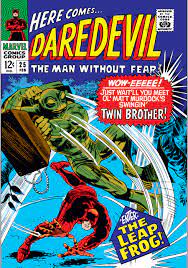 DAREDEVIL #25 (December 1966)
Writer, editor: Stan Lee
Penciller: Gene Colan
Inker: Frank Giacoia
Letterer: Art Simek
Colourist: Not credited
The most significant thing in this issue is the new storyline advertised on the cover. “Wow-eeeee!”, Stan proclaims. “Just wait’ll you meet ol’ Matt Murdock’s swingin’ twin brother!” Yes, it’s Mike Murdock, a notorious piece of Silver Age silliness.
Foggy and Karen find a letter which reveals that Matt is Daredevil. When Matt shows up a few minutes later, he improvises wildly, and claims that Daredevil is actually his twin brother Mike. Foggy can’t help remembering that he and Matt lived together for years with no mention of a twin brother. But Matt keeps digging – complete with thought balloons of the “what the hell am I doing” variety – and winds up promising that Karen and Foggy can meet brother Mike.
Since Matt wants to discourage Foggy and Karen from asking to meet brother Mike again, he’s an irritating halfwit in an obnoxiously loud suit who says things like “Ol’ Matt’s the one with the brains, but I’m the family pussycat!” Naturally, this backfires. Foggy can’t stand the guy. But Mike is supposedly Daredevil, so Karen thinks he’s kind of cool.
During the issues we skipped, Gene Colan has come aboard as regular penciller. He injects a ton of life into the book’s romantic triangle. Nothing has changed in the way that Karen Page is written, but she has vastly more charisma than before, and she suddenly looks modern. If any artist can sell a ridiculous plot about Matt pretending to be his own obnoxious brother, it’s Gene Colan, and sell it he does. Draw the main character with completely different body language and acting like a clown? Colan is absolutely up for that.
The entire thing is absolutely absurd, which is precisely how it’s designed. In one sense, this storyline’s reputation is a little unfair. Much like the Coffee-a-Go-Go in X-Men, it’s ridiculous, but that’s obviously the idea. Then again, the Coffee-a-Go-Go was just a running gag. Mike is a dominant storyline all the way through to issue #41, where Matt finally fakes his death in order to get rid of him. It turns the central Matt/Karen romance into a farce (literally), and “wacky comedy” is not the approach to Daredevil that finally clicked.
You might have noticed that we’re quite some way into this article and we haven’t yet mentioned the issue’s new villain. That’s because he’s the first in a series of questionable creations who show up around this time, before Stan just gives up for a while and starts recycling villains from other books.
We first meet the Leap-Frog as Matt arrives back at the airport from last issue’s story. He’s a man with spring loaded boots, but at this stage he’s still testing them out. He’s not wearing a costume yet. Instead, he’s just bouncing around the airport in a suit and tie, with a handkerchief tied over the lower half of his face. Why? Well, to see what he can get away with, apparently.
As so often in this phase, Colan gives the guy a lot of charm. He looks terribly smug about his creation, while everyone else seems unsure what to make of him. The airport cops can’t figure out whether to treat him as a harmless joker or a genuine threat. Nobody really feels like shooting him. Declaring his test a success, he decides to make his debut as the Leap-Frog. He gets a very, very token origin story: he invents novelty items for toy companies, he got bored of it, and he decided to invent something for himself. “Something to make me invincible”, he says. And then he dresses up as a frog.
The Leap-Frog isn’t intended as a proper threat. He’s a delusional guy who built a working bouncing device and thinks that that qualifies him as a supervillain. In fact, he’s just a high end nuisance. He breaks into a jewellery store and immediately sets off the alarm, something that he apparently didn’t see coming. Come to think of it, if his plan was just to burgle a jeweller and go home, I’m not sure how he thought that dressing up as a frog was supposed to help. Daredevil happens to be passing, but Leap-Frog bounces rings around him and escapes. A few pages later, after some more of the Brother Mike storyline, Daredevil catches up with the Leap-Frog again. This time, Daredevil tangles him up with a cable, and hands him over to the cops. Thanks for coming, Leap-Frog.
He shows up again briefly in the next issue. He escapes from his trial after the dimwitted prosecutor gets him to put on his boots in order to prove that they fit. Except the prosecutor isn’t quite that dim, so they aren’t strapped on properly, and the Leap-Frog breaks an ankle on the next page. Then a proper villain shows up to roll his eyes at the whole thing. And it’s Stilt-Man. Two issues in, the Leap-Frog is being condescended to by Stilt-Man.
He returns in Daredevil Annual #1, along with every available Daredevil villain up to that point. And then he wanders off to be a minor character in other books. He’s effectively a subplot in his own debut, and a pretty simplistic one at that.
What he has going for him is an enjoyable over-confidence – he’s a gimmick villain who thinks he’s an A-lister, and Colan makes that work. But there’s only so far you can go with that. It doesn’t help, too, that we’re only 25 issues into the book and this is our second villain dressed as a frog. Colan’s art makes him feel like more of a character, but the idea is half formed at best.

The highlight of Leap-Frog’s career is getting is joining Justin Hammer’s army of super-villains and getting his arse handed to him by Iron Man.
The highlight of the life of Leap-Frog is his son stealing his equipment and attacking the neophyte Defenders villain the Walrus as the Fabulous Frog-Man.
Leap-Frog and Frog-Man eventually teamed up in a Spider-Man story much to everyone’s embarrassment.
It was very funny when Charles Soule had an Inhuman randomly create a ‘real’ Mike Murdock (it’s The Reader! Whatever he reads, happens! Somehow that’s a power!), and then it was very surprising when Chip Zdarsky made Mike work as a character.
I remain confused about the Leap-Frogs and Frog-Men. One of them stars in the recent Murderworld miniseries (or, rather, a series of one-shots) and it presents him completely seriously, but for the life of me I can’t remember which one that was supposed to be. Maybe the original Leap-Frog?
Didn’t he get revealed as a violent abuser of his kids in the Bob Gale fill-in arc just before Bendis took over?
Daredevil Annual 1 shows the difference between Spider-Man’s villains and Daredevil’s villains. In Amazing Spider- Man Annual 1, Dr. Octopus recruits a team of Spider-Man villains- Electro, Sandman, Kraven, Mysterio and Vulture. In Daredevil Annual 1, Electro recruits a team of Daredevil villains- Matador, Stilt-Man, Gladiator and Leap Frog. Notice a difference in quality:)
Note that in Daredevil Annual 1, Matt defeats the Leap-Frog by tricking Matador into attacking him. So not only was Leap-Frog mocked by Stilt-Man, he was also defeated by Matador.
After Daredevil Annual 1, he disappeared for over a decade. Then he reappeared in Defenders 64 and Iron Man 126-127 among groups of villains and was easily defeated.
When he reappeared in Marvel Team-Up 121, he had retired from villainy. His son Eugene was introduced in that story. Eugene became Frog-Man, a bumbling joke hero. And Vinnie (Leap Frog’s real name) was trying to be a better man for his son.
During Bendis’s Daredevil, he had a storyline where Leap-Frog, who had a living wife and an autistic prepubescent son, was depicted as an active villain and an abusive father.
Since this was completely inconsistent with Leap-Frog’s established history, it was revealed to be a new Leap-Frog. This was an early example of Bendis’s disregard for continuity.
Zeb Wells wrote an issue of Tangled Web that retconned that Leap-Frog had fought Spider-Man a couple of times before Marvel Team-Up 121. This doesn’t actually contradict anything, though.
Probably the most significant issue in Vinnie and Eugene’s career was Marvel Team-Up 131, which introduced the White Rabbit, who was a joke villain. However, she eventually become Lonnie and Janice Lincoln’s factotum, and Spider-Man’s second most frequent female foe after Janice herself.
David Michelinie used Leap-Frog as a villain working for Justin Hammer in the Venom:Lethal Protector miniseries in 2022, which takes place after Eddie first fought Peter but before Justin Hammer died. Michelinie remembered that Leap-Frog was working for Justin Hammer in Iron Man 126-127. but forgot that Vinnie was reformed at this point. Micheline also had the Porcupine among Hammer’s villains- again, Michelinie remembered that the original Porcupine worked for Justin Hammer but forgot that the original was dead at this point and his successor got his suit from Roderick Kingsley, not Hammer.
In Jim Zub’s recent Murderworld series, Vinnie was revealed to have returned to villainy, been sentenced to life, agreed to compete in Murderworld in exchange for a chance at freedom and was killed by one of Arcade’s robots. A lot of readers didn’t like this ending for the character.
Zachary-No. That was a Bendis story-arc, and it was a different Frog-Man. This one had an autistic child, and he was killed at the end of the story.
The Bob Gale story-arc featured the Jester.
Since there’s no edit function, I am going to rewrite my last post, correcting the villain’s name. I wrote it too quickly. I meant the second Leap-Frog, not Frog Man.
Zachary-No. That was a Bendis story-arc, and it was a different Leap-Frog This one had an autistic child, and he was killed at the end of the story.
The Bob Gale story-arc featured the Jester
There was also a mecha-Leap Frog towards the end of Waid’s run. But yes, the guy is most interesting as Frog-Man’s long suffering father.
Mike Murdock, though! What a plotline. Establishes so much about Matt as a character. Time and again from here on out, he tries to solve his problems with a piece of elaborate theatre, inevitably poorly thought out, which generates even more problems in the long run. Which, to be clear, is a fantastic trait in a protagonist.
I also like that it all begins with Spider-Man trying to send a reassuring letter to a blind man. Who does he think opens the mail at Nelson and Murdock?
@Skippy- What everybody forgets. though, is that the reason why Matt caused the explosion that trapped Death-Stalker in another dimension is because he was trying to fake Mike Murdock’s death. In fairness to Matt, the device he destroyed was keeping Debbie Harris trapped in a ghostly state, so it had to be destroyed, but if he hadn’t been trying to fake Mike Murdock’s death. he would have probably destroyed it when nobody was around.So Death Stalker DID have a legitimate gripe against Matt, even if he was a monster long before Matt destroyed the device.
I had forgotten that, too! Man, Death-Stalker was such a prominent villain to be totally forgotten now. Paul will get to him, I’m sure.
(But will he get to Tenfingers?)
@Michael – The Death-Stalker thing is a bit of a tangled mess, since the Daredevil story that’s used for the villain’s eventual, retrofitted origin doesn’t quite fit.
Daredevil v.1 #41 has Foggy Nelson, who’s on the scene of the final battle, state, “The T-Ray is destroyed! They’re all unconscious…except…Daredevil! He’s…not here! The explosion…Oh, no!” So the Eliminator arc seems to end with the baddies KOed, andf soon to be arrested, and only Daredevil seemingly dead.
Indeed, the Unholy Three are right int he room when the machine blows up, and they eventually turn up later on in Marvel Team-Up v.1 #25, none the worse for wear.
It’s issue #42 that creates the problem, where Fogy Nelson says that he remembers seeing Daredevil kick the Eliminator into the machine, which then exploded. That doesn’ quite fit withissue #41, but it’s closer tot he Death-Stalker origin than the actual ending of the previous issue.
Of course, the origin Marv Wolfman came up with for the Death-Stalker, which Roger McKenzie eventually put on the page, doesn’t seem to have been the original concept for the character Steve Gerber co-created. And few details from McKenzie’s version don’t quite work either. But there’ll be time for that when we get to issue #39…or, depending on how Paul chooses to handle things, issue #113.
As to the Leap-Frog’s retroactive appearances as a villain, I’ve noticed that a number of the recent continuity backfill stories have significant continuity errors.
For example, the Joe Fixit miniseries has a Silver Age-style Whiplash long after the villain became Blacklash, has Count Nefaria alive and well (but oddly without his powers) even though he was thought to be dead at the time, and doesn’t quite fit into the original plotline Pater David is revisiting in terms of the Maggia being in or out in Las Vegas. And Peter David is revisiting his own story!
For Michelinie’s sake, I suppose we can No-Prize it as Hammer giving Porcupine and Leap-=Frog suits to new agents, since he did the same thing with the Blizzard suit and the Cyclone suit (which he shouldn’t have had to begin with, but, ah well).
@Omar- and then there’s PAD’s King In Black: Symbiote Spider-Man series, which features Peter wearing the symbiote but Alstaire Smythe already a villain and crippled- which is impossible since Smythe had his first battle with Spider-Man, in which he was crippled, after Peter stopped wearing the symbiote.
@Chris V: thanks for the correction. I haven’t read any of those stories since they were new and my memory for this shit isn’t what it was before I was old enough to drink.
As I understand it, Peter David has been struggling with significant heart health trouble in recent years and has had at least two strokes in the last ten years or so. It is perhaps understandable if his recollections of continuity aren’t pristine right now.
About Electro and his Emissaries of Evil,I have to assume that even Stan Lee himself was well aware that it was a lazy revisitation of the idea of the Sinister Six three years prior. It was so second-rate that it was led by a member of the Sinister Six who wasn’t even in a leading role in that other team.
Come to think of it, it is rather odd that Electro is such an early foe of both Spider-Man and DD and yet their respective stories against that criminal run so parallel with hardly any reference to each other. I may easily be mistaken, but I don’t think that either of the three ever even _mentions_ that Electro has fought both of them.
Once upon a time that might have been a good start for a “revelation” that there are two Electros somehow…
In fairness, Electro does mention in Daredevil 2 that he almost defeated Spider-Man. And when Daredevil and Spider-Man FINALLY team up against Electro in Marvel Team-Up 56, Electro says that they were the first two heroes to defeat him.
Thanks for the heads-up.
“The highlight of Leap-Frog’s career is getting is joining Justin Hammer’s army of super-villains and getting his arse handed to him by Iron Man.” In fact, this is more or less my only context for him. But that was like my third issue of Iron Man, purchased off the spinner rack when I was 8 years old, and so read many, many times. It wasn’t until years later I realized they were all second rate villains at best.
@ Sol — I have a similar affection for Frog-Man, as his early appearance in Marvel Team-Up was one of the first Marvel comics I ever read.
Love the MTU issue with Spidey and Frog Man when JM.dM introduces the White Rabbit.
@Sol- As has been pointed out before, it’s unfortunate that the Beetle was included among them, since prior to this issue he was someone who defeated Captain America and Daredevil and went one on one with Spider-Man. But this issue seemed to convince many readers that he was in the same category as Stiletto, Discus, Man-Killer and Leap-Frog. Which Stern and Byrne tried to fix by revamping his armor. But that only worked until the next time Layton and Michelinie got ahold of him.
BRRRRRRICK FROOOGGG!!!
Look, my only qualifications are brick-throwing and frog-being, I don’t exactly have a masters degree to rely on here
@Luis Dantas – My apologies if I seemed to be singling out Peter David. His continuity implant stories are the ones I’ve read most recently, so they’re nearest to mind. I’d say it’s not a problem specific to PAD’s work, but rather apathy on the part of editorial.
The absence of editorial attention tot he issue in these sorts of projects is odd to me, since continuity hounds and longtimers are the presumed audience for these projects.
@Ben – Learn The One Weird Trick that the Guild Doesn’t Want You to Know About (comment sponsored by ARCH)
It is ok, Omar. And you are of course right about editorial’s duty to check for continuity issues.
Brick FROGGGGGG
I’d recruit him for MY Revenge Society.
Also…
Whiplash, Blizzard, and Melter were in thatbsuper-villain army alongside… the Constrictor?.. yes… so to be absolutely fair they and the Beetle prove that a tech-based villain is only as weak or strong as their respective equipment’s most recent product update.
Blacklash went A-list for a couple appearances… I mean literally 2 give or take
@Chris: Wasn’t that Toad and Leapfrog?
@Chris: The complete army was: Melter, Blizzard, Whiplash (not yet Blacklash), Constrictor, Spymaster (coordinating the assault), Porcupine, Man-Killer, Leap-Frog, Beetle (Jenkins), Stiletto, Discus, and the Water Wizard (who bravely ran away).
Water Wizard didn’t really make much sense there, since he’s the only non-tech-based character in the bunch.
Oddly, it was also a minor plot resolution for Discus and Stiletto, who had been set up as haing a mysterious backer wayyyy back in the Power Man story that introduced Discus. Evidently that was Justin Hammer.
Michelinie and Layton did make Blacklash a badass when he changed his name and updated his arsenal in Iron Man v.1 #146-7, and Blacklash was played as a formidable oppnent when he turned up[ nce in Michelinie’s Amezing Spider-Man run.
But Michelinie and Layton also had Blacklash lose a fight to Jim Rhodes — not Jim Rhodes as Iron Man or Jim Rhodes as War Machine, but noncostumed Jim Rhodes.
@neutrino: It was Frog-Man (song of Leap-Frog), the Toad, and the Spider-Kid (later horribly reinvented as the grimdark Steel Spider, and then savagely dismantled as a concept and a physical being in Thunderbolts).
Here ends my copy of essential daredevil, which means from now I’ll be reading this very entertaining column blind until we get to the miller years. I’m sure it’ll continue being a blast.
Incidentally since this is where my direct knowledge of silver age daredevil stops I was very surprised to find out some time later that Mike Murdock was an ongoing and long running plot and not just a one off silly gag.
Omar:
Steel Spider was an upbeat sympathetic non-joke character in a SPIDER-MAN UNLIMITED back-up story. I rooted for him to not get a regular series because the next writer would likely do him dirty.
I was right.
My point being, of course, that MOST of the so-called “Super-Army” were at one point or another formidable villains and some of them returned to being formidable villains.
Water Wizard was kicking Ghost Rider’s arse briefly.
Many of IRON MAN’S most threatening villains became obsolete only because technobabble.
Water Wizard was a Ghost Rider villain in his first two appearances, before the Iron Man story.
After the Iron Man appearance, his next appearance involved narrowly avoiding being killed by Scourge in the pages of Captain America. He got a flat tire on the way to the bar. When he arrived, everyone had already been murdered, so he surrendered to Cap out of fear Scourge would come for him. He was, somewhat, rehabilitated by joining the Force of Nature eco-terrorist group in New Warriors.
I like the idea that Iron Man’s super-villains aren’t able to keep up with Tony Stark. Stark is a billionaire, genius inventor. He continually updates his armour. Melter might have been a deadly threat to IM in his first couple of appearances, but he doesn’t have the money or the ability to upgrade his armour at the rate of Tony.
Although, having a billionaire corporate CEO competitor, like Justin Hammer, to fund the villains’ use of technology should take away at least some of IM’s advantage.
When we were kids, my cousin loved Iron Man. He thought IM was the greatest superhero. Anytime I tried to argue this point, he’d pull out those issues of IM. Even as a kid, I thought it was ridiculous that one hero could defeat that many super-villains at once, but those comics also made it hard for me to tell my cousin he was wrong.
@Chris: My recollection is that the Steel Spider was played as a stock superhero, but with the added wrinkles that his motivation was that his romantic partner was left partially paralyzed after she was jumped by a bunch of punks, and that he initially wants to quit after he beats the crap out of the goons who maimed her.
He gets a second story about averting disaster at an amusement park, and that’s about it for the Steel Spider until post-Civil War.
The Ellisbolts bit, I thought, was kind of a nice play on his multiple prior characterizations: the obsessive, antisocial character he started as and the vigilante he later became.
As to the Water Wizard….He wasn’t really played as a guy who could trash Ghost Rider in his first appearance, but more as a directionless superhuman mutate who drifts into villainy for want of better ideas and gets his soul fried for it.
Like a lot of early Ghost Rider foes (who aren’t demons), he’s played as terrified of the Ghost Rider in his earlier appearances once he figures out what he’s really dealing with.
He’s an unusual character, in that he’s very powerful on paper, but until his reinvention as Aqueduct, he was usually played as a small-timer with a bit more fear about getting killed or…uh…”soulfired”…than most supervillains-of-the-month. (in sme ways, he was the “workaday, blue collar villain” type well before that became the Shocker’s consistent personality.)
@Chris V: I think there are two other elements to Iron Man’s villains becoming less threatening over time, one of the textual and one of them metatextual.
Textually, a lot of the classic baddies are also one-trick ponies. The Melter has his one weapon, the melting beam; Blizzard has his cryostat device; Whiplash has his electrically charged whip.
In contrast, Iron Man not only upgrades his weaponry and learns from experience, but also has a much more versatile technology to start with. From his very earliest stories, he’s the guy who has more than one weapon, or can create something on the fly as needed.
In fact, most fo the Iron man villains who were deprecated in later stories are kind of beaten by innovation their first time out. Jack Frost loses when Iron Man assembles a mini-furnace, and his first outing as Blizzard ends when Tony adapts to his gimmick and adds a supplemental power source to his armor to resists the cold better.
The Melter is beaten in his first appearance because Tony works around his ray’s limitation: it melts iron, so Tiny makes an aluminum suit, and the Melter’s beam no longer affects him. He becomes a threat again because Baron Zemo upgrades the beam to work on any metal, and later because he forces Tony to design him a new melting gun. But that make sit easy for Tony to sabotage the gun, and later makes it easy for Tony to protect himself from it.
And, of course, some of Iron Man’s old villains never did get treated as obsolete. They may have tried to kill off the Unicorn, but Michelinie and Layton played him as an immensely powerful living weapon when he finally showed up. Blacklash got a good showing when he diversified his arsenal, too.
Metatextually, many of the Iron Man villains of old became obsolete because Michelinie and Layton wanted to focus on mastermind-type villains and James Bond style plots, so the more minor villains — in terms o both motivation and modus operandi — become colorful henchmen, not significant, freestanding threats.
Michelinie and Layton are more interested in, say Justin Hammer’s scheming or Roxxon’s latest unethical ploy than they are on the Melter’s umpteenth “show up and melt stuff for revenge and profit” scheme. They liked villains who played off of Tony Stark’s vast resources and business skills, not just iron Man’s physical powers, and that became the template for later Iron Man writers.
That’s one thing I don’t like about Iron Man as a character. Every single threat can be defeated by him immediately inventing some nebulous gizmo. He out-sciences the skrulls, an eons-old galaxy-spanning civilisation. He out-magnets Magneto. Where are the stakes?
@Si: He’s become like Reed Richards, a character who loses — or at least can be threatened with loss — because of his own personal flaws. I’m not sure if that’s ultimately been good for the character.
Some writers do make the villains a threat to him, but most Iron Man stories seem to be about Tony falling into addiction, or screwing up out of arrogance and his control freak tendencies, or something else.
More broadly, I hate the whole “the character is smart, so they are ready for anything, engineering society and anticipating everyone and everything psychologically and technologically.”
Unfortunately, superhero comics tend to make any “genius” character into that.
It’s the 21st-century equivalent of the omnidisciplinary Silver Age scientist, like Don Blake building a robot in that old Thor story because he’s a Doctor! They understand Science!
I think having a “smart” and well-resourced character build countermeasures can work if we get the sense they had to put in the work to do it.
It can also work if it’s something that they’ve run into so many times they kind of have to anticipate dealing with it again and they’d look stupid for not trying.
A guy who’s fought the Melter a bunch of times and had a few billion-dollar warsuits turned to goop in the process is probably going to develop something to try to stop that.
You can save the villains by having them adapt between appearances, too. Remember the Vulture figuring out how to counter Spider-Man’s magnetic inverter in his second-eve appearance?
But they have to be villains who could do that credibly. A character like the Melter was written as a pretty dumb guy who lucked into a melting ray, so it’s harder to make him seem like he’s going to keep up with Iron Man. But Blizzard is supposed to be smarter, and a specialist in cryotech.
@Chris V- Water Wizard appeared in three more issues of Ghost Rider between the Hammer story and the Scourge story.
@Chris- Discus and Stiletto were always lame villains, like most of Luke Cage’s foes.
Porcupine is an interesting case. In his first two appearances, he took on Hank Pym and the Wasp by himself. But after those appearances, writers never let him take on a hero by himself. He was always used in groups of villains. The exception is Avengers 167, where Hank and Jan easily defeat him to show how much more capable heroes they were now than when they were starting out. After the Hammer story, he redesigned his armor and try to sell it but went out a loser. Of course, none of Hank and Jan’s villains except Whirlwind really worked.
@Michael: I kind of think Egghead worked, once writers leaned into the ida that he was a truly nasty piece of work.
He blew off his niece’s arm in an act of petty revenge, and made it clear he deliberately maimed her rather than killing her, all while pitying himself.
And then he tried pretty hard to take Hank at his lowest point and kick him around even more. If he’d left his successful frameup stand instead of organizing a new Masters of Evil, he’d have efficiently, totally ruined his nemesis.
@Michael Scurrilous Scarlet Beetle erasure.
As a kid, I like Iron Man’s Rogues Gallery because they seemed the closest to the Flash’s Rogues, in terms of power level and gimmicks.
I came here to say the same thing about the Flash Rogues. I love that they hang out primarily because each one has a different doodad…or is a gorilla.
Also, as someone who was unfamiliar with all of the D-list superheroes showing up in Ellis’ Thunderbolts, it was fun to see who died, who survived, and who got pulled apart. It was like a Marvel pastiche from Image or something. I see now how it would read differently if you were a fan of those characters.
Ribbit and rip it!
I started this thread in an attempt to get us to talk about the Super-Army.
I succeeded.
I am deeply pleased.
I love that Justin Hammer and Tony Stark were essentially in an arms race and that all of Iron Man’s bad guys’ respective threat levels were determined by the good guy’s level of innovation at any given moment and all the characters’ deliberate attempts at countermeasures.
I hate MCU Leap-Frog. I feel it misses the point of the pointlessness. Brick Frog captured the spirit of the character better.
Blacklash peaked in the 1980s and all attempts to improve the character made him worse.
Alone Against the Super-Army is one of my favorite IRON MAN issues EVER, right next to his battle against Titanium Man in… the ice rink… New York City… geography.
Crap. Madison Square Garden is a stadium. Times Square? Where is that effing tree?
@Chris: Rockefeller Center has the ice rink and the tree.