X Lives of Wolverine
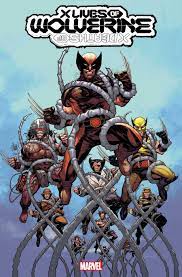 X LIVES OF WOLVERINE #1-5
Writer: Benjamin Percy
Artist: Joshua Cassara
Colourist: Frank Martin
Letterer: Cory Petit
Editor: Mark Basso
X Lives of Wolverine seems to be a book that Marvel had a lot of faith in. Together with its sister book X Deaths of Wolverine, it was billed as a ten-week event that would replace most of the X-books during the season break. The format harks back to House of X and Powers of X, the two linked Jonathan Hickman books that kicked off the Krakoan era, and in that sense perhaps the most important X-books in years. Marvel gave X Lives a same-day release on Marvel Unlimited, and they’ve just posted both miniseries there, without waiting the normal three months. It’s all promoted in such a way as to say it’s a big deal.
This may not have been to the book’s advantage. We’ll come to X Deaths of Wolverine separately, but it follows up directly on Moira’s story from Inferno, and advances some of the Krakoan themes about posthumanity. That book feels like it has implications for the line.
X Lives of Wolverine… not so much. Mikhail Rasputin sends Omega Red back in time in an attempt to alter history by removing Professor X from the picture before he can found the X-Men. Omega Red tries to do that either by killing the Professor himself at an earlier point in his life, or taking out one of his ancestors. His consciousness is projected, Days of Futures Past style, into the bodies of assorted randoms, who then get temporarily transformed into Omega Reds. Wolverine is sent back to possess his own past bodies and save the day, because he’s the X-Man who’s actually been around long enough to be present throughout this history.
Its links with X Deaths are mostly thematic – this book is about Wolverine going into the past to stop an attack on the timeline, while X Deaths is about a future Wolverine coming back to the present. Technically there’s a plot link – Wolverine retrieves the Cerebro Sword at the end of this series which happens to resolve the plot in X Deaths – but that’s pretty arbitrary stuff. One of the lesser glitches of both series is that the Cerebro Sword is presented as central to the plot , but we’ve never actually been given any coherent explanation of what it does or why it’s relevant. I realise these sort of plot mechanics are terribly dry and that there are good reasons for not wanting to spend too much time on them, but you can go too far in the other direction. Percy writes as if we all know what the Cerebro Sword does and (perhaps more fundamentally) what it’s supposed to signify. I’m still largely clueless on both counts. It’s an… icon of X-Men-ness? Or something? Is it just a macguffin that likes to dress up as a metaphor?
At any rate, the main feature of this story is revisiting the history of Wolverine. Despite the title referring to ten points in his life (the X is a Roman numeral, as it was in Powers of X), the story doesn’t actually have space for all of them, and focusses instead on a smaller number. There’s wilderness Logan from just after Origin, who meets Xavier’s sailor ancestor. There’s Wolverine from Jasmine Falls, the idyll where he married Itsu and fathered Daken. There’s Team X Wolverine, on a black ops team with Sabretooth. And given at least a decent chance to shine are the time of Charles Xavier’s birth, World War II, and good old Weapon X. Percy throws in some random stuff about the Venom symbiote there, drawing on material from a largely forgotten Venom one-shot, but fair enough, I guess. You can’t really ignore Weapon X in a series like this, but at the same time, who wants to see yet another straight re-tread of Barry Windsor-Smith’s floatation tank?
None of this really feels like it has much impact beyond Percy’s two books, Wolverine and X-Force, where Mikhail and Omega Red’s storylines had built up. Technically, I suppose anything that impacts Mikhail has an impact on Colossus, due to the mind-control arc, and that in turn has an impact on Immortal X-Men… but that doesn’t come up. So while X Lives has been promoted as if it were a line-wide event, it feels like just a Wolverine arc. And it would probably have read better if it had just been presented as a romp through Wolverine’s history, which is what it is, instead of something more important.
Cassara’s art leans a little towards the grotesque, and can feel a bit out of place where regular costumed superheroes are involved. Here, he gets to do old mansions, giant sea monsters, and horrific transformed Omega Reds with bone coils. He’s good at the straightforward violence. I’m not so sure about the cube visual he uses for Mikhail’s reality warping power, which feels banal. But ask him to draw a whaling expedition or a jungle bee nest and you’ll be fine. And the opening page of issue #5, with its backdrop of faces of Wolverine throughout his history, is excellent – it could easily have been tediously repetitive, but Cassara really does make all those panels different. I can’t shake the feeling that Cassara would be better off drawing a horror book, but there’s plenty here that plays to his strengths, and he takes advantage of that.
To give Percy his due, he steers clear of a simple rendition of the greatest hits. We don’t take up time here with Department H or Madripoor, or indeed any earlier times with the X-Men. And I like the fact that the book is non-linear, jumping between different points in time without worrying too much about their sequence or about Wolverine’s personal timeline. There’s a degree of confusion, in fact, about how that’s supposed to work – the first issue seems pretty clear that Logan jumps from one point in time to another after he’s finished his mission, but the final one seems to suggest that Logan is just generally lost in the timestream and is reliving all these past eras simultaneously, until he’s reassembled in the present. Those aren’t completely contradictory, though; perhaps the idea is that the order of it all is breaking down as Mikhail’s attack builds to a climax. I think Percy gets the balance right with this device – it’s disorienting rather than confusing, because the basic thrust of what’s happening remains pretty clear.
Is there a point to any of this, though? I think there is. From Wolverine’s narrated speech during the final battle with Omega Red, the big idea seems to have two elements. One is that revisiting his past has reminded Wolverine of who he is and of his sense of identity, which is fine, but ultimately a bit trite. The other is that the impressionistic history Wolverine sees through this fragmented journey – and which may have been altered by the story itself – is what he really needs, rather than a more rigorously coherent account of history. It’s the broad themes and the disparate angles that make up the character, rather than the details of how they all fit together.
Despite the fact that I’ve been re-reading Wolverine’s history in chronological order, I’d basically agree with Percy if that’s his general idea. From the standpoint of any normal reader, continuity is impressionistic; and even in the real world, memory is fragmentary. What matters about Wolverine’s history is not the precise details but the fact that there’s so very much of it. It’s an angle that maybe sits uncomfortable with the decision to accompany this series with Life of Wolverine Infinity Comic, which is indeed just a straightforward retelling of Wolverine’s history in chronological order. (I’ll come back to that book separately, though I may as well tell you now that I won’t be spending very long on it.)
Perhaps the most interesting creative decision in the book, viewed from that angle, is its treatment of Romulus. Daniel Way’s Wolverine: Origins devoted years to carefully setting out a detailed conspiracy history of Wolverine in which Romulus was weaved into everything. In theory, this should have cemented Romulus as an A-list Wolverine villain. In practice, he’s almost never been mentioned again – in fact, he’s only shown up once since Wolverine: Origins, and that was a story by his creator Jeph Loeb. Given the amount of Wolverine material that Marvel churn out, the fact that nobody else seems to have found him remotely inspiring speaks volumes.
The fundamental error in Wolverine: Origins is to think that Wolverine’s history is improved in any way by tying it all together. Quite the opposite: the strength of Wolverine’s history lies in its sprawling diversity, and the vast amount of things that are there to draw on. Ironically, the one part of Origins that has stuck is Jasmine Falls and its introduction of Daken, both of which were genuinely additive and more or less severable from Romulus. Romulus does show up here, only to be summarily despatched and treated as a minor nuisance, rather than the dominant threat he was designed to be. Maybe it’s just a grudgingly acknowledgement of the character and not a deliberate meta burial, but either way, Percy’s whole approach to Wolverine’s history and why it works seems to be the opposite of everything Romulus was designed to do. In fact, having one of the barely-seen “lives” be an Old West story from the turn of the 20th century feels like a way of saying, look, there’s still parts of this guy’s life that we’ve barely touched on.
As a romp through the character’s history, this is fun enough. But the plot that it’s tied to, with Mikhail and Professor X, feels sketchy and unsatisfying; obviously it’s just a device to do the time travel stuff, but the problem is that it feels like just a device to do the time travel stuff. I’ve never been sold on Omega Red as a character – he’s a nice enough visual, but there’s not much too him beyond being a serial killer with a hazy back story who happens to need a thingummy to keep his powers under control. You could make him an opposite number for Wolverine, I suppose, based on being somebody who willingly underwent experimentation to become a super-soldier weapon for his country. But it’s not really a theme in here, and Omega Red’s role ultimately comes to be as a visually memorable random footsoldier. He doesn’t have a particular connection with Professor X; and it’s certainly not as if we’re visiting parts in Omega Red’s past.
By the same token, what does Mikhail actually want? There’s not much depth to him in this incarnation beyond being a Russian nationalist, which may be topical, but it’s also quite shallow. We’re never really told what he’s actually trying to achieve by altering history in this way – presumably, without Professor X there are no X-Men and maybe no Krakoa, but surely the knock-on effects of taking the X-Men off the board are wildly unpredictable (and quite possibly result in the world ending). Is he meant to be reckless? Desperate? Dogmatically convinced that whatever world emerges will be better? Does he think he can shape it somehow? I don’t really know and I don’t get the impression that Percy is particularly bothered. But… that’s the central motivation for the main villain right there. So the final issue, where Wolverine actually defeats the bad guys, doesn’t land – because nothing very coherent was ever set up to be resolved.
Trying to press this jaunt into service as a line-wide event feels like a miscalculation. It’s just not that sort of story. But when it’s just being vaguely absurd and revelling in the character’s past – when it’s just enjoying the trip and not worrying too much about the destination – it’s entertaining enough.

I think using Xavier as the focal point was ultimately a waste. Logan and Xavier have a long and complicated history, but it didn’t really make any difference in this story, nor did Xavier’s complex (especially post-HOXPOX) personal history. Even Xavier’s ancestors seem to be essentially nice people. Xavier good, Omega Red bad, Wolverine fight Red, good guys win.
It seems like this could’ve been a more interesting story if it was Magneto as Red’s target. Co-leader of Krakoa so worth targeting. But Magneto’s backstory is a lot messier and Wolverine would’ve felt morally conflicted about having to protect Magneto when, say, he was planning to attack Cape Canaveral. There’s no decision to make with Xavier’s backstory, whereas Magneto would’ve presented ethical dilemmas – preserve the timeline or kill X amount of people. We’ve done “if Xavier dies, mutantkind’s history goes awry” before. Try something new.
That said, I laughed really hard at Romulus being trashed in one page flat. Does this canonically mean that Romulus’ whole elaborate scheme is retroactively because he feels humiliated that Logan kicked his ass so easily? I’d be okay with that. I don’t think it was worth derailing the X-line for two months, but making it canon that Romulus sucks earns a pass for me for X Lives. X Deaths, not so much.
I just could not possibly care less about any story that seeks to mine Wolverine’s history. I have enough trouble caring about a story that seeks to do anything interesting with Wolverine in the present. He seems like a dead-end concept that needs a drastic rethink. I’d say someone like 2011 Scott Snyder should take a crack at him, but I’m afraid of what 2022 Scott Snyder would come up with.
Rather pointless, no? I mean, other than Omega Red getting killed off (again), nothing in here really mattered with regards to the franchise as a whole (then again, considering how X Deaths turned out, that might be for the better).
@Josie What would a drastic Wolverine rethink even look like? I’m not asking for a full story synopsis, just… what can be done with him?
I agree something probably should be done – as it is, Wolverine has like three stories played again and again (old friend asks for help, it ends bloody; old enemy hunts Wolverine or his allies, it ends bloody; Wolverine stumbles randomly upon some evil person, creature or concept, it ends bloody). I just don’t see how you can do something drastically different that’s not trying to shove a completely different character into Wolverine’s skin.
Kinda like Moira slipping on Banshee’s skinsuit.
@Krzysiek Ceran: There was a period in the mid-to-late ’90s after Fatal Attraction where Wolverine suffered such extreme trauma that it actually changed his personality. Granted, the writers at the time ended up taking that to some really weird and off-putting places, and ultimately it didn’t stick, but the attempt was made
Logan should have been permanently retired as a character 15 years ago. Beginning in the mid-80’s, the X-Office should have remained committed to rotating old characters out, and promoting new ones. Cyclops should have stayed married in Alaska, only coming back as a reserve. Jean should have stayed dead. Bobby, Hank and Warren should have continued their lives on the periphery of the X-Men’s orbit.
By 1990, Sam and Dani should have been core players on the headline team. Logan the elder advisor in reserve. Kate the ideological and moral core, in Xavier’s role as an active leader but rarely in the field. Ororo, Kurt and Peter moved on to post-superhero life. Rogue the stalwart ally, doing her own thing as a solo hero, but ready to be called upon as needed.
By 2010, almost all of the Claremont era characters should have been phased out. Any character introduced between 1970 and 1991 still hanging around should have been strictly limited to cameos and guest appearances, with a small handful in post-superhero adulting roles.
Kate and Dani might be running the school, with Bobby as a financial backer, having taken over as trustee of the fortunes of Worthington and Xavier. Old Man Logan would be dead. Kurt, Peter, Ororo all long retired from the superhero life, now nearing retirement from politics or business or charity work or whatever they did after they were done being superheroes.
By 2010, the active team should have been entirely characters introduced later than 1995, and mostly later than 2000. Armor, X23, maybe some of the long underused second generation of New Mutants, Surge, Mercury.
Everyone always objects, “then we wouldn’t have had my favorite story from 2006 featuring so-and-so.” But the answer to that is that the writers would have told a great story with a new and fresher character. They’d be different stories, but there’d be just as many great ones that you love.
In my alternate universe, if someone proposed keeping all the old characters as headliners 40-years after their shelf life expired, you’d be objecting “if Logan was still around we would never have had my favorite story featuring my favorite new characters from 2003.”
And, of course, they never should have backtracked from Morrison’s revolution. Transitioning the X-Books from superhero genre to science fiction should have happened a bit more organically, but once done it should have stuck. By the time GM got his hands on the X-Men, the small band of super powered activists in the real world made no sense anymore. It was long past time to embrace the question, “what would the future world look like with super powered mutants as a burgeoning minority?” The concept of mutants demands that progression. Hopefully post-Hickman we’re finally committed to moving forward with that indefinitely.
I’ll die on this hill.
/rant
I was born in 1977. My mutant powers would have manifested around 1989. I would have graduated from the New Mutants to junior X-Man in 1995, and gone pro after graduating from X-Men U in 1999. I might have made a career change to go work for the Avengers around 2008. Or tried going solo for a few years.
Now, at age 45, my knees are creaky and my waistline a little thicker. I’d be applying my experience and wisdom as a trainer and educator, rarely in the field. I might be looking for a job in consulting, politics, or business, which draws on my powers and experience, but doesn’t require the physicality and risk. Especially since I have a family now.
I fully support that alternate timeline. And the X-Men franchise has introduced enough popular young characters to pull it off for quite a while. I’d love to see the Special Class from Morrison’s run eventually become the X-Men, for example.
It might be a little weird that characters are growing old and dying while Franklin Richards ages from 4 to 14 or whatever, but the X-Men should be shunted off into their own universe anyway.
It might be a little weird that characters are growing old and dying while Franklin Richards ages from 4 to 14 or whatever, but the X-Men should be shunted off into their own universe anyway.
If I ran the Marvel world, I’d have done the same with the whole universe. But failing that, breaking the X-Men out of the MU would also work.
By 2010, the O5 would all be in their 60’s, and thinking about retiring from their professional lives. The ANAD team (from Kitty to Kurt), Rogue, and a bunch of the New Mutants, would be 45-55 years old, entering or well into their senior professional careers.
The last young character introduced by Claremont was Jubilee. She was about 14 years old in 1990. That means she was 34 in 2010, and well into the age where adulting would be an attractive idea.
So the field teams would consist mostly of young characters born 1980-90, introduced as teens between 1992-2002, and who would be aged 20-30, or thereabouts. GenX, maybe some of the youngest New Mutants, and a few elder characters who are naturally durable or resistant to aging (Rogue, Sam).
It would be interesting to read that. It’s what they should have done with the rebooted movies (starting with First Class) – they had the timeskips, but the characters remained frozen in amber.
At the very least I hope Marvel publishes an X-Men Life Story mini like they did with Spider-Man and F4.
@Nu-D: Love those ideas, but let me push back just a bit – possibly the *only* advantage in having the same characters stick around for so long is that it lets us pick and choose our own canon.
So when someone like Chuck Austen or Peter Milligan comes around and makes a royal mess of things, we can just sweep it under the carpet and forget it ever happened. If characters aged and retired or stayed dead, the stories they were part of – however vile or awful or incoherent they might be – would be a lot harder to scrub out because there wouldn’t be a mountain of subsequent stories to bury them under.
Nu-D: I’d probably enjoy reading comics from that timeline, too. But, just to play devil’s advocate:
Most of the X-character designs post-‘80s suck.
Not all, but almost none have the visual flair of Cyclops, (blue furry) Beast, Wolverine, Nightcrawler, Colossus, Archangel, or Phoenix.
Most of the New Mutants look like regular people. Generation X has some good designs (Chamber, Penance) and some characters who look like… regular people. Forge? A dude with some metal parts. Liefeld’s X-Force characters had visual flair, which might be why Cable and Domino took off. Feral, however, was a generic cat-person and Shatterstar never found a good look. They could be written out or ignored for years at a time. I’m not super-familiar with the post-Morrison years, but the designs aren’t great. Grey Thing, metal Iceman, lizard boy, girl with blue hair… blah. The kid with no arms looks kind of cool. Hope? Yet another red-haired girl. Armor’s powers look cool when she uses them, but she hasn’t made much of a foothold post-Whedon.
The Morrison/Quitely special class is about the only visually-interesting characters post-2000. I like them a lot, but Morrison characters are usually ignored or underserved by subsequent creators.
Tl,dr: If you’re going to phase out the older characters, you need an artist with strong character-design sense to keep a franchise like X-Men going. Most newer characters have failed to make an impression equal to the cooler-looking older characters.
@Mike,
Most newer characters have failed to make an impression equal to the cooler-looking older characters.
It’s an interesting point, and I’ve been thinking about it. I think some of it is your personal preference, and you’re underestimating how many great designs have stuck from later eras. You dismiss Cable, but there’s no disputing the design has been lasting. Bishop, Gambit, Exodus, Cecelia Reyes, Xorn. And characters like Iceman, Emma, and Magneto have had compelling redesigns. I’m sure there are more modern examples too, I’m just not immersed enough to come up with some examples off the cuff.
But assuming your premise is generally accurate, it raises the question: “why was there such a surfeit of iconic designs in the silver and Bronze Age, and such a dearth in the modern age?”
I don’t for a second believe that there was some miraculous pool of talent and vision that modern creators don’t have. Kirby and Cockrum were marvelous designers, but there’s no compelling explanation for why later creators might have less talent and vision than their predecessors..
So I have two hypotheses which may be both true in part. The first is that the older designs are iconic simply because we’ve had more exposure to them. If Colossus was off the table, maybe Shatterstar would have had more exposure, and we’d think of the latter as iconic in the same way we think of the former. To the extent the original Shatterstar design was, shall we say, “of its time,” had it been used of necessity and revised by more artists during stories we came to love, we’d see it differently. To put it another way, Cyclops’ design is only iconic because Cockrum, Byrne and all the rest were stuck using it, so they put it to good use. The same could have been true of Shatterstar.
The second hypothesis is that he iconic designs have crowded out the space for creativity. You can’t do another guy with metal skin; that’s been done already. So now what? How about diamond skin! You can’t do another blue demon, so how about protruding bones?
But if the older characters rotated out, the compelling elements would be easier to recycle. There’s no good reason guy-with-wings has to be Warren, and maybe the Guthrie character could have soared if Warren was truly gone. You mentioned Jean Grey as a classic design, but then you dismissed Hope as “just another red head.” I’d postulate that if Jean wasn’t around, Hope would seem like a satisfactory design.
Some of the designs you mentioned already have been recycled. Wolverine has been recycled as Laura quite successfully. Blue and furry has been done to good effect on at least two characters, Hank and Kurt, and Hank has been redesigned several times. Eye beams are a dime a dozen.
Of the designs you mentioned, a few elements stick out as hard to replace. Scott’s visor. Peter’s metal form. Nightcrawler’s overall design. And one you didn’t mention: Ororo. But even those could be recycled in whole or in part.
Ultimately, I think we’d have no shortage of interesting character designs. Some would be recycled, but they wouldn’t feel derivative if the originals had been shuffled off fifteen years ago.
Nu-D: if the older characters had been shuffled off, would later characters stand out better? Good question! A few points first:
1) I wasn’t clear about it, but when I listed “Phoenix” among some character designs the I find distinctive, I was referring to the Phoenix costume Cockrum designed rather than Jean Grey’s overall look. I should have been more specific.
2) Storm’s main looks (original & punk) are definitely iconic.
3) “
(Sorry, accidentally posted before I was done)
3) “Kirby and Cockrum were marvelous designers, but there’s no compelling explanation for why later creators might have less talent and vision than their predecessors.”
Honestly, I think Kirby & Cockrum were leagues better than just about anyone else when it came to superhero costume design. Gil Kane, Alex Toth, John Buscema, and a few others I can think of who were great character designers didn’t do many X-comics.
Some later costumes stuck (notably the Jim Lee-designed outfits) but very few newer characters became mainstays. Gambit, Jubilee, Cable, & Bishop are possibly the last evergreen X-people.
Reading what you wrote, I wonder if the X-characters and super-hero comics in general have all but run out of distinctive character design elements. The recycling you mention is common, whereas more original designs don’t always hit. One of the problems I have with the Arakii is the way they look like either generic or overdesigned sci-fi & fantasy characters. Most of them don’t stick out in my mind.
I 100% agree that older characters crowd out newer characters. I think it’s easy for newer characters to get crowded out because they can rarely compete with the visor, blue demon, claws and pointy mask, metal skin, firebird, etc. I think I keep repeating myself, so I’ll stop typing now
One of the things most unsatisfying to me about this un-event was the ‘new rules’ of time travel. Jordan D White claims that time travel in Marvel comics doesn’t lead to divergent time lines but affects the time line of the time traveler.
Unfortunately, White and Percy couldn’t tell a coherent story with those rules. (Percy blocked me on twitter after I tweeted that ‘Terminator did it better’)
Paul does note that they did well to kind of show that all of Logan’s past exploits are experienced simultaneously as in the past even if he serially has to make a journey there.
As far as I’m concerned, anything under these rules that happens in the past has already happened, even if someone travels from my future to my past to kill someone. There’s only one timeline being affected, according to Jordan.
Don’t even try to explain why Logan was needed to jump into ‘his’ body but Arkady could jump into anyone (except Xavier? And then commit suicide?)
It was a very messy, not thought-through romp that I did not enjoy.
Mike: To be fair, Marrow could have become evergreen if editorial didn’t get in the way. Chamber could have too, if he didn’t keep getting redesigns that took away what made him distinctive.
And you could argue that Emma Frost and Northstar have become X-Men mainstays over the past 20 years, even though they long predate Bishop and Jubilee.
I spent the better part of seventh grade doodling Cockrum’s Phoenix emblem in he margins of my textbooks. Iconic.
Also a design that’s remarkably well suited to revision and recycling. The original on all its spandex glory doesn’t play well on the modern page. Too glossy, too skin tight.
But Quitely did a great reimagining, putting the emblem on a t-shirt and pairing it with black pants.
And there’s no reason it had to be on Jean Grey.
“What would a drastic Wolverine rethink even look like?”
If I knew the answer to that, I would’ve said what specifically should be done with Wolverine. Since I don’t have the answer to that, I said the character requires a major rethink, by which I mean those in charge of producing comics about Wolverine should indulge in such a rethink.
I once thought of a concept, “What if Wolverine was raised by Ben and May Parker?”, where he has Spider-Man’s personality, never kills, and has special retractable “climbing claws” that let him wallcrawl. I don’t know what the hell you’d do with that, but hey it would be different.
This seemed a nothing story for a big event, and it did not make much sense from the get go. But the biggest issue is how old is Xavier? Even with out the sliding time scale Charles server in Korea shortly after finishing University, so he in his early 20’s (he can’t be much older has he did not serve in WW2 5 years earlier.) so he was born in the mid to late 20’s. So why does his birth look like he was born in the 1870’s other then to look like Origin.
“What would a drastic Wolverine rethink even look like?”
Well, there’s the Ultimate version. A nihilistic asshole sent to murder Xavier but changes his mind and sticks around to fuck* teenage girls.
Real charmer, that one.
*(Coarse language selected deliberately to reflect the coarse character).
Taibak: absolutely agree about Marrow & Chamber. Marrow was an abrasive character, but her relationships w/ Callisto & Cannonball gave her a bit of depth. I would have liked seeing this less attractive, less socially-acceptable person being on the team for longer. Chamber had a great design, but almost nobody outside of Chris Bachalo drew it well.
Emma is definitely a major X-character, but Northstar has been in and out of the X-books too frequently for me to consider him an all-timer. Other than the Austen run & his wedding, I can’t think of a notable Northstar appearance before the recent X-Factor.
Nu-D: I dug the Quitely designs quite a bit. It’s too bad they were dropped so quickly. Xorn (pre-reveal) was one of my favorite characters after, like, two appearances. Oh well…
For a while, it seemed like the MCU would be forced to evolve forward like that. Steve Rogers the character you can keep using forever. Steve Rogers played by Chris Evans is only available until Evans wants to stop, and convincing audiences to accept replacements for Evans, Robert Downey Jr., or Chadwick Boseman would be a hard sell.
Then Marvel used Loki and No Way Home to establish that alternate universe versions of characters are generally played by different actors. Which is convenient.
MasterMahan: Except there’s no evidence Marvel Studios is going to use the multiverse that way. The Falcon and the Winter Soldier made it perfectly clear that Sam Wilson is the New Captain America. For Black Panther, Marvel has made it clear that they’re not going to attempt to replace Chadwick Boseman. We haven’t even heard rumors about a potential replacement being cast for Black Panther: Wakanda Forever. For Black Widow, Marvel is really pushing Yelena Belova. And for Iron Man, we’ve got a Riri Williams series coming up, Ty Simpkins still has a movie left on his contract, and it’d be really easy to use Kang to introduce Iron Lad.
I mean, it’s not out of the question for Marvel to bring in alternate universe versions of their characters, but there’s no evidence they’re going to do that.
“Marvel used Loki and No Way Home to establish that alternate universe versions of characters are generally played by different actors.”
I mean we already see multiple Doctors Strange in the Dr. Strange 2 preview all played by BC, and at least one other Wanda played by EO. I would not try to pin down a trend from Marvel (studios or comics) and expect consistency.
The most recent episode of Gillen’s Decompressed podcast with Ben Percy was a fairy weird experience as it was mostly him re-stating THE basic premises of Wolverine over and over and OVER again. Yes, he’s a violent loner with convoluted past and memory problems.
Me, after ten minutes: “I’ll try to be generous and ignore my anti-Percy biases.”
Me, after half-episode: “He really just… doesn’t have anything else, does he?”
In extremely hilarious reveal he was taught that approach (pair down main character to their most recognizable features and stories) by Geoff Johns.
I think the point MasterMahan was making is just that the MCU has intentionally put in place the necessary narrative pieces to recast headline characters.
That doesn’t mean every headline character who shuffles off will be recast immediately, or that every alt-version will be a different actor. Only that it’s clear they’ll never let Steve Rogers be out of circulation long enough to become public domain.
Or, to put it another way, I will bet $100 with everyone on this board that within 20 years there will be a new actor playing Steve Rogers as Captain America in a lead role in a feature film in the MCU, assuming (a) there’s still a line of MCU feature films, and (b) they haven’t figured out a cost-effective way to do a Peter Cushing/Carrie Fisher on Chris Evans’ for a whole feature film.
It may be by then that the MCU has several parallel lines of films, and the re-cast Steve is in The Ultimates, or whatever. But I am entirely sure that if the MCU is ongoing, then Steve Rogers will be back as Captain America not just as a cameo or supporting role, but as a lead character. If they can’t get Evans or CGI him into it, they’ve built in a storyline to cast someone else.
That’s a firm guarantee.
While I’m in the business of making bold predictions (or maybe not-so-bold):
I think Endgame/Infinity War was peak superhero, and I think Feige knows that. Ater 10+ years, Marvel had the biggest most unified audience it was ever going to get. Lots of people were watching more obscure or less interesting content just because it was a chapter in the larger story. Now that the story is over, those fans are going to be less willing to pay for content that’s not directly in their lane. I know my wife is done with it all. She sat through WandaVision and a few chapters of Loki, but that’s the only post-Endgame MCU she’s been willing to watch. If she comes back, it’ll only be for discrete stories that appeal to her specific tastes. She’s never going to watch another Iron Man movie.
Since audience engagement has peaked, now’s the moment to introduce a multiverse. At some point it’s no longer possible for Marvel to maintain a single, cohesive storyline which will draw casual fans in for the more obscure or minor chapters. But multiverses are complex and confusing and without a unified narrative lots of fans are going to be unwilling to do the work to keep up.
So the introduction of a multiverse and flooding the zone with Marvel content is going to accelerate the alienation of casual fans, but they were already going to leave anyhow. Anyone open to the complexity and confusion in a multiverse is already in the audience. So there’s nothing to lose.
Going forward, casual fans are going to be more a la carte when it comes to superhero content; fewer people are going to see a film or watch a show simply because it’s attached to the MCU. Indeed, I’ve begun to transition to the “watch it when it hits streaming” crowd for installments I’m less attracted to on their own merit, and I’m a pretty firm fan–I’ve watched The Dark World more than once in the last five years.
A fragmenting fan base is a blessing and a curse. Marvel is now free to incorporate the Netflix shows and Fox’s X-Men, to experiment with camp like Loki and Moon Knight, to recast star characters and to promote secondary characters. And doing so won’t corrupt or pollute the core story, because there isn’t really a single core story anymore. We’re never going to see Sony’s Spiderman vs. Netflix’ Punisher. Dafoe’s Osborn may be part of the MCU multiverse, but he’s not going to lead a Dark Avengers with Pugh’s Black Widow. We’re going to see a lot of content which is connected only by casual reference–like how the Netflix shows mentioned the battle of New York, but nothing else.
Sure, there will still be a prime storyline which is built through loosely connected cinematic episodes. But there are now going to be storylines which are much more tenuously connected, and perhaps some with no discernible connection at all. Though we sort-of already had that with Defenders, Agents of Shield and Inhumans and whatnot, it will be more formally recognized and promoted by Disney. We can see that happening already, since they waited until now to acknowledge Netflix in the MCU, and now the Netflix shows are available on Disney+.
Bringing it back to the topic at hand, yes, Mackie’s Sam Wilson is Captain America, and will be for as long as he wants the role and sells subscriptions/tickets. But that’s no longer an impediment to recasting Steve Rogers and bringing him back as Cap. Most fans will just pick and chose, and those of us who are game for alternate universes and parallel timelines will sit through it all.
[…] Paul O’Brien reviews the shallow romp of Benjamin Percy, Joshua Cassara, et al’s X Lives of Wolverine. […]
Nu-D: my impression of post-Endgame MCU content is that they’re marking time/trying out characters before the big X-Men & FF push. Some hit (Shang-Chi), some miss (Eternals), but most are given tryouts on Disney + because there’s less stakes than a bigger-budget movie. The pandemic has made most people more reticent to see movies in theaters, overall. The biggest exception was Spider-Man: No Way Home, which featured the multiverse gimmick. I think the multiverse is the equivallent of a “midseason replacement” show. It seems to be a hit, so far, so MCU content will use it until the next phase.
@Mike, I don’t think that’s inconsistent with what I wrote. They’ve got more flexibility and room to expand and experiment.
Nu-D picked up on exactly my thoughts. I don’t expect a new Steve Rogers in the near future. It’s too soon. I just notice that they’ve created the option for the future. Marvel Studios is generally big on long-term planning without committing to anything.
I’m in the “jumping off after Endgame” category. There’s honestly just too much to keep track of anymore. And I don’t need to pay for yet another streaming service.
Not to mention, Endgame is where Marvel jumped the shark for me. Bringing everyone back 5 years later seems incredibly cruel when you could just make the initial snap un-happen. But they couldn’t do that because then Iron Man would be sad? That’s some messed up moral calculus.
I keep thinking of all the people who came back to lives they didn’t recognize. And their loved ones who were seriously traumatized by their disappearance. How does every Marvel movie/show just handwave that away now?
Seriously off topic, I know. Play through.
“I keep thinking of all the people who came back to lives they didn’t recognize”
Oh, that’s nothing. You know what it made me wonder about? It made me wonder how both snaps affected pregnant women (assuming the infinity stones regarded mother and fetus as separate individuals) I can’t un-wonder about it.
But they couldn’t do that because then Iron Man would be sad?
Oh come on. Tony’s just one example of quintillions. What about all the people and aliens born during that five years? Should they just be erased?
There’s a genuine moral conundrum there. I don’t know if the Avengers got it right, but the argument in support isn’t the straw man you knocked down.
My question about the snap comes from the end of Infinity War. Nick Fury watches as planes crash because the pilot and half the people on board got snapped away; the other half of the people in those planes died when the plane crashed. When the pilot and those people get snapped back five years later, they’d be in mid-air and then fall to their deaths because they’re not in a plane. What about those poor bastards?
@Col Fury – Also, people who were on a cruise ship, people who were sitting in a vehicle on a busy highway/freeway and later rematerialized in heavy traffic, people who were inside a building that was demolished during the blip and ain’t there anymore, etc, etc.
There were countless ways to for people to die almost immediately upon being snapped back to life. And of course, as you mentioned, the people who didn’t disappear during the snap but died anyway as a result of it and therefore weren’t among the people who were brought back.
@Nu-D – Sorry, I don’t see any moral conundrum in what you’re saying. Either way, there’s going to be people who won’t be born. Some survivors of the initial snap who lost their partners went on to have children with new partners that they wouldn’t have otherwise had, true, but had the snap never happened– had Thor gone for the head, the children those people *would* have had with their still living-partners will go on to be born.
Like I said, either way, you’re going to have different people being born. Might as well roll back the clock five years and just allow things to play out the way they would’ve played out had Thanos not killed half the universe.
“Now that the story is over, those fans are going to be less willing to pay for content that’s not directly in their lane.”
It sure didn’t help things that Marvel had no films in 2020, and all four of their films in 2021 ranged from light garbage to complete and utter garbage.
“Endgame is where Marvel jumped the shark for me. Bringing everyone back 5 years later seems incredibly cruel when you could just make the initial snap un-happen.”
That’s not what jumping the shark means. Jumping the shark means something ongoing (a TV series, a comic series, a film series, etc.) takes a hit in quality and never recovered.
You just don’t like one plot point in one film.
“Jumping the shark means something ongoing (a TV series, a comic series, a film series, etc.) takes a hit in quality and never recovered.”
That’s not what it means either. It’s entirely possible for a show to take a hit in quality, never recover, but still not deliver a shark-jumping moment.
“Oh come on. Tony’s just one example of quintillions. What about all the people and aliens born during that five years? Should they just be erased?”
Yes. And the memory of them should be erased as well. Five years of events unhappen.
Our heroes, being part of the time shenanigans, most likely remember. But they are willing to carry that burden so that no one else has to.
That gives us a clean ending and pathos, not a second wave of suffering that never gets addressed.
The MCU will, most likely, never deal with the messy complications of the snap because the storytelling skews simplistic. I’ve noticed that whenever the movies and tv shows goes into a complicated topic or theme, they swerve. I like most of the content, but wince when Wanda is not held accountable for the events of Wandavision or the parts of F&tWS that deal with racism and symbolism just sort of resolve. The whole Ronin story in Hawkeye is emblematic of the approach – I’m not going to spoil it in case someone who wants to see it hasn’t done so, but I will say found the last scene to be an annoying handwave.
That said, I don’t view an out-there sci-fi/fantasy concept the same way. My head canon is as follows: everyone was brought back from the snap safely, that was part of the whole deal. Why? Because I don’t like super-hero stories with mass casualties. Super-heroes should PREVENT such events, not just avenge them. I don’t think the MCU gains anything by focusing on the horrors of people being killed twice, with the second time being even more awful and pointless.
Rewriting history so the Snap never happened was never an option anyway for the characters, anyway. The “rules” of time travel in that film are that the past can’t be changed. Granted, the way time travel works in that film doesn’t really make sense if you think about it for more than a few seconds but that’s a whole other thing…
“The “rules” of time travel in that film are that the past can’t be changed.”
That’s the rules of quantum time travel and time stone time travel. We never found out what the rules are for the combined infinity gems, because they were never used in an interesting way.
@Thom,
I think that the right of the people who were born during the interregnum not to be killed (and then forgotten!) arguably outweighs the suffering of those who missed five years. This way, they all get to live.
Cap was frozen for fifty years. He knows what it must feel like. But it should be easier for the returnees, since they’re not alone like he was, and it has only been five years.
I agree the MCU hasn’t really done a good job of fleshing out the real world logistics. Cap & WS made a gesture at it, but it was all abstract talk for the most past, and it wasn’t very compelling.
But these are comic books, so I don’t expect much.
The snap or blip or whatever wasn’t totally ignored. It was a central driver of Falcon and Winter Soldier (years later, but still). Actually it sounded like after people dealt with the trauma, a golden age was dawning. Thanos was right after all.
While we’re on the topic, how do people feel about Marvel Studios acting like snapping is the only way the combined gems can be used?
As far as I’m aware, snapping only occurred twice in the original Infinity Gauntlet story: when Thanos erased half the universe, and when Warlock restored it. The gauntlet and gems were used many other times in that one story, but no snapping or gesture was necessary.
Granted, snapping provides a visual cue to signal an important magical event. It would be kind of weird if Thanos just closed his eyes and furrowed his brow, and then people started disappearing.
But I also think it’s super corny that snapping in the films is treated like the crucial mechanism to activate the gems.
how do people feel about Marvel Studios acting like snapping is the only way the combined gems can be used?
In my head cannon, it’s not the stones which require snapping; it’s the limited imagination of the anthropomorphic mind.
To actualize the kind of instant mass effect intended, the human-like mind requires a gesture that simulates an instant as near as possible. Maybe the effort can only be sustained for a fraction of an instant, so simulating it with a gesture is necessary or else they’d be overwhelmed by the psychic effort to even ramp up.
Bipedal mammals with five-digit hands and opposable thumbs use a “snap” for a single-handed instant gesture. If there were ten gems on two gloves, it would be a clap. If it were a single gem, it would be a tap.
You could also imagine that it’s just Thanos’ limited imagination, and that Bruce and Tony used a snap simply because that’s what Thanos did and they didn’t have time or inclination to come up with some other method.