X-Men: Red #12 annotations
As always, this post contains spoilers, and page numbers go by the digital edition.
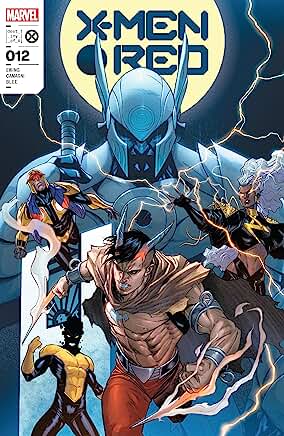 X-MEN: RED #12
“Storm Warning”
Writer: Al Ewing
Artist: Jacopo Camagni
Colour artist: Federico Blee
Letterer & production: Ariana Maher
Design: Tom Muller
Editor: Jordan D White.
COVER / PAGE 1. Jon Ironfire in the foreground, with Nova, Sunspot and Storm surrounding him, and an image of the White Sword in the background.
PAGES 2-6. Flashback: The White Sword frees Jon Ironfire and sends him to Arakko.
Essentially, the White Sword knows that Genesis’s forces are coming and that he’s going to wind up under her control. He sends Jon Ironfire away with his sword, partly to save Jon, partly to alert Arakko, and partly to keep the sword itself out of Genesis’s hands.
The White Sword and Genesis‘s back story was covered in “X of Swords”. Basically, the Sword and his personal army of 100 champions battled the enemy forces on Amenth for centuries, with the Sword using his omega healing powers to resurrect them all daily. On page 3, the White Sword refers to Genesis’s shifting alliances in the past. Originally, she led the forces of Arakko in their battle against the demons of Amenth – the Sword regards them as bringing up the rear. Later, she fell under the control of Annihilation, via its demonic helmet, and led the Amenth forces against the White Sword.
That was the position going into “X of Swords”. At the end of that crossover, in X of Swords: Destruction, Genesis’s estranged husband Apocalypse freed her from Annihilation by taking the helm himself, and then resisted Annihilation’s control long enough to surrender her forces. Saturnyne then turned the helm into a staff. Most of the population of Arakko were then transported to Earth along with Arakko itself, while Apocalypse and Genesis went back to Amenth to rule it. The White Sword and his champions also returned to Amenth.
The White Sword claims here that Saturnyne deliberately cursed the staff. Here’s what she actually said in Destruction:
“Nothing changes in regard to what’s required. Whoever wields the helm controls the world. And that world most certainly does need controlling. But this will make it more manageable. Still corrupting, of course – there’s no satisfying that appetite, but at least now it won’t have direct dominion over the wielder.”
Saturnyne offered to turn it into a sword, but Genesis rejected that. Saturnyne then chose the staff form herself, despite Annihilations’ protests. She did tell Annihilation that “This is a better look for you, and a deeper lure if you want it.” The White Sword seems to suggest here that in its staff form, Annihilation is actually able to influence more people than before.
Jon Ironfire. Apparently the first of the Sword’s 100 champions, but also a close friend before that; the Sword clearly indicates here that Ironfire, at least, was not viewed by him as cannon fodder, but as someone he was actively protecting. Jon refers to him with evident affection as “Blue”.
“Tell them all – but especially the Seat of Loss…” Right now, that would be Storm. The Seat of Loss is supposed to be consulted when battles are lost. White Sword probably doesn’t know who the current occupant is, and really does just want Jon to bring it to the attention of the appropriate Ring member.
PAGE 7. Recap and credits.
PAGES 8-15. Flashback: The White Sword’s champions fight Genesis’s army.
The First Horsemen of Apocalypse are back together, serving their mother Genesis again. Death, in particular, has been hanging around with the vampires of Otherworld over in Excalibur and Knights of X. The other three did return to Amenth after “X of Swords”; Pestilence and Famine were shown in Excalibur #22 acting as the regents of the Otherworld realm of Dryador (annexed by Amenth at the start of “X of Swords”).
Summoners are basically mutants who control monsters in Arakko. One of them showed up in X-Men #2 near the start of the Hickman run.
“Where is your husband?” The White Sword doesn’t get an answer to this question, but it’s a very good one. What did happen to Apocalypse? Presumably, he hasn’t fallen under the control of Annihilation and he’s been sidelined somewhere.
Purity was the White Sword’s sword as seen in “X of Swords”. Genesis is evidently very keen to get hold of it, which is presumably why she goes out of her way to suggest that it might be the White Sword’s only chance. He’s not falling for it.
Quite why Purity is so significant hasn’t previously been explained, but Jon tells us later on that it’s essentially an embodiment of the pure concept of cutting, and capable even of cutting a portal between realities. Which sounds quite useful in the wrong hands.
“Arakko calls you, General.” Genesis appears to be positioning herself as the representative of the true Arakko.
PAGES 16-18. The Brotherhood of Arakko listen to Jon’s story.
The Red Lagoon. Sunspot’s group are using his Red Lagoon bar as a temporary base because the Autumn Palace was destroyed by Vulcan in issue #10.
Dryador is the former water world that was turned into a desert wasteland by Arakkii/Amenthi invaders at the start of “X of Swords”.
Blightspoke is another of the Otherworld realms – basically a dumping ground for detritus from failed realities. Poor Jon seems to have taken the most uncomfortable route possibel through Otherworld.
Fisher King takes surprisingly badly to Jon Ironfire, and Storm makes sure to flag up that this is out of character for him. Fisher King is normally a wise elder figure, after all. But he’s also an embodiment of a less aggressive conception of Arakkii society compared to the White Sword’s champions, who are so extreme they didn’t even fit in regular Arakkii society in the first place. It’s maybe also significant that the champions have a history of routine resurrection – something which we’ve been told in no uncertain terms is generally frowned upon in Arakkii society. That was the whole point of Storm and Magneto giving up their ability to resurrect.
At the same time, Jon invokes the “Where were you?” mantra which was frequently directed at Storm by Arakkii characters in the early part of the series.
Nova, bless him, doesn’t seem to realise how traumatic his back story has become – despite it being central to Al Ewing’s take on him.
PAGES 19-21. Genesis arrives on Arakko.
Arakko Prime here apparently means the location of the original Arakko, i.e. the living island that was the counterpart to Krakoa. It was blasted into this state by Uranos during the A.X.E.: Judgment Day crossover.
The Okkara Gate is new, but it’s worth noting that “Okkara” was the name of the single island that split into Arakko and Krakoa aeons ago.
Genesis has evidently been led to believe that the destruction of Arakko during Judgment Day reflects the failure of its current rulers, which may have had something to do with her succumbing to Annihilation’s influence.
Marianna Stern is the High Priestess of Coven Akkaba from Excalibur and Betsy Braddock: Captain Britain – Reuben Brousseau gets used much more often as the Coven’s leader figure, but they seem in principle to be equals. She’s h Their association with Orchis is new, I think, though hardly a surprise.
PAGE 22. Data page: a memo from Marianna Stern to Orchis’s “Director” (presumably still Killian Devo).
Marianna was evidently hoping for an outright invasion or at least a larger force than just Genesis on her own.
PAGE 23. Data page: speaks for itself, really.
PAGE 24. Trailers.

@Another Sam: I’m reminded of a criticism that came up often during the Bendis era – that the whole O5 storyline was a misfire because it effectively pulled most of the focus away from the JGS/NXS teens who were the actual latest generation of mutants (and who weren’t really being spotlighted elsewhere).
By the same token, I think it’s perfectly fair to remind everyone that we started getting Arakko buildup in Hickman’s *second issue*, and that all this woo-woo magical sword demon nonsense has taken up substantial real estate that could’ve been used to explore Krakoa instead.
You know I’m sure i could make, oh I don’t know, the scene where Swamp Thing defeats Jason Woodrue with the question of “if you kill the humans and animals how will the trees get carbon dioxide” by describing it in the most trite way possible (“why didn’t woodrue think of that earlier”) and saying others defending are only doing it cause Moore is a popular writer and or acting like people are ascribing emotions to a scene the writer didn’t intend for.
Also acting like you can tell a story beat with data pages is one of the more ridiculous claims I’ve heard in a while. They’re just a form of text pages that have been used to do that for decades except these ones don’t have pictures. Also Ewing is one of two authors left using them for story purposes and not “Beast sends himself a memo about how evil he needs to be”
Another Sam –
“any new characters would naturally be terrestrial mutants from a wide range of cultures and backgrounds who might present differing perspectives on how Krakoa should be governed and what its purpose could be.”
I really did hope that in turning Krakoa into a home for all mutants, we’d actually get a more global approach to what has always been an Ameri/Eurocentric-dominated franchise. But then again, I’ve also frequented lamented how little of this era was given to attempting to establish Krakoa as a viable and plausible nation-state in a contemporary world.
I’m glad that a few writers -are- trying to create new terrestrial mutants who provide a more diverse perspective, or give new depths to long-underused and undeveloped characters, but it’s still just a drop compared to what it could have been with a change in focus.
Re:Arakko- I think one of the reasons why Arakko was created was to justify the idea of Krakoa. Krakoa was supposed to be a state for a people that was the victims of genocide like Israel or Armenia. The problem is that the reason why it makes sense to speak of Jewish culture or Armenian culture is that Jews and Armenians often lived in separate communities for centuries. Plenty of cities have a Jewish quarter or an Armenian quarter. That’s not the case for mutants. Krakoa would be like a state for LGBTQ people- they don’t share a common language, religion or culture. So Arakko was attempting to justify Krakoa by saying yes, there was a mutant state in the past. (Threshold was created for similar reasons.)
(Of course, the other reason Arakko was created was to try to make Apocalypse less of a monster by giving him a lost family he wanted to rescue.)
I think the problem with Orchis is the same problem with Arakko and X-Men Red- there’s just too many characters. If there were fewer Orchis members or Arakki, the writers could actually focus on developing their characters.
(That said, the X-books really don’t have any memorable human anti-mutant villains. The most frequently used is Donald Pierce and let’s be honest, few fans would name him as their favorite villain.)
“…..(“why didn’t woodrue think of that earlier”) and saying others defending are only doing it cause Moore is a popular writer…..”
Damn, you just reminded me of something I haven’t thought of in years. Miracleman vs Kid Miracleman, the second fight (when Kid Miracleman got loose and began slaughtering civilians in London).
Miracleman and a bunch of his allies fight Kid Miracleman and spend most of the fight getting their asses handed to them. They eventually pull out a win, but it’s a brutal fight and they suffer casualties along the way.
And the whole time I’m reading that fight scene, I’m thinking “Why doesn’t Miracleman just say the word “Abraxas” out loud so that Kid Miracleman can hear it?” It’s a trigger word that a bad guy used on Miracleman earlier in the series which automatically reverted him back into his mortal form and prevented him from changing back to Miracleman for a period of one hour. It would’ve worked on Kid Miracleman too.
Cool fight though.
I get the criticism that there has not been enough focus on the millions of unfamiliar mutants on Krakoa, and share it. X-Men Red, however, is not the book for that. It’s the X-Men on Mars/Arakki/cosmic politics & action book. Why this book and not a comic about terrestrial mutants who don’t get featured very often? No idea, but I can’t hold it against X-Men Red that Marvel hasn’t created the other comic.
I thought New Mutants under Vita Ayala and now Charlie Jane Anders has been the closest we’ve seen to a book about a subset of obscure and/or new characters. Way of X and Legion of X incorporated some lesser-known mutants and aspects of Krakoan politics and culture, but lost and found and lost its way several times. I don’t think Marvel is going to assign an A-list creative team to that kind of project.
@Michael: Donald Pierce is far from the only memorable human villain the X-Men have faced – there’s Graydon Creed, William Stryker, the Trask family, Senator Kelly was a problem for them for a good long while, etc. And since you’re counting Pierce despite him being a cyborg, that list should also include Cameron Hodge, the Leper Queen and Lady Deathstrike…
“I find Isca’s arc compelling.”
“Well, that makes no sense to me and you’re just being seduced by Ewing’s popularity.”
That’s seriously your counterargument?
Look, we get it: You don’t like Red. Cool. But this response moves us beyond simple, different strokes and into uncomfortably accusatory territory, where people who like his work *on this book* are sheep being blinded by the acclaim and goodwill he’s apparently earned on his other well-received works.
Here’s a plot twist: I quit comics during Chuck Austen’s run and only came back when HoXPoX started. I quite literally never read anything by Ewing (or even Hickman or Gillen, for that matter) until the Krokoa era. Therefore, the explanation is quite simple: I personally love Red because…I am reading the dialogue…and appreciating the art *on this book*…and am reaching the conclusion that, “Hey, this is really great.”
If there’s any projection of personal bias occurring, it’s whatever hang-up you have with Ewing in an attempt to discredit our opinions about his work on Red.
Well, I like Ewing because of his previous work (Immortal Hulk, but also the Mighty/New/USAvengers run), and if that informs my enjoyment of Red – so be it.
It’s easily my favourite book with ‘X-Men’ in the title published in the last 10 years. Basically since Carey’s run ended, so 12 years.
@Moonstar Dynasty: You really can’t talk about “uncomfortably accusatory territory” and then write off everything I’ve said as me “not liking Ewing/Red”, particularly when I’ve already clearly stated that I enjoyed the Brand/Vulcan/SWORD storyline. So let’s leave it at “agree to disagree”.
I’ll echo the praise for this series. The Arakki weren’t very compelling before but Ewing’s *made* them interesting.
Now there is something to be said for how already liking a writer makes you enjoy their work more — because you feel more anticipation as you read it — because accusing others of being sheep for a different opinion isn’t it.
“….accusing others of being sheep for a different opinion isn’t it.”
Well said, and I agree with you completely. However, I’m only agreeing with you because I’m anticipating in advance that many others here will agree with you and I want to be a part of what everyone else is doing.
Er, meant to write ‘BUT accusing others of being a sheep for having a different opinion isn’t it,’ not ‘BECAUSE accusing others…”
@Moo
Ha!
I just read through this thread and my initial observation stands: people are working hard at rationalizing why X-Men Red is bad in order to avoid laying the blame on Ewing.
It reminds me of every time we hear about a writer’s proposal getting rejected by editorial, there’s all this squawking about how the company is denying us the greatest book ever.
It’s like moving past fandom into religion.
@Moo: looks like you’re going to have to change your user name to Baa!
@Josie: you’re starting from the premise that “X-Men Red is bad.” I’m starting from the premise that “X-Men Red is good.” Difference of opinion? Fine, no one has to like the same things. I don’t see myself (or Moonstar Dynasty or ylu or anyone else who likes the comic) as “rationalizing” anything. The criticism that the art for issue 12 isn’t that good, and that it affects the story, is a legitimate criticism of the comic. I’m not saying Ewing’s script was so good that the *only* reason this issue isn’t great is because of the art.
Although:
“It’s like moving past fandom into religion.”
I think there’s something to the fact that fandom and it’s sense of belonging and being a part of an imagined inner circle because you like a thing and immerse yourself in that thing echoes religious devotion. Going against the sacred text (e.g. criticizing a Marvel movie, calling boy band’s music junk) or adding to it in ways that the adherents don’t like (e.g. in the worst corners of comics fandom, “being woke”) is seen as heresy.
@Mike: You don’t see rationalization in this thread? Because to use just one example, there’s a suggestion here that people who have a problem with Red’s current direction, Ewing’s writing or Krakoa as a whole aren’t actually reading the books, just Paul’s annotations. What would you call that if not rationalization?
@Diana: No suggestion is required when it was declared exactly as that in the second comment.
For the record: I thought your disagreements with the way Ewing’s handled certain plots were valid. You specifically called out my praise of the Isca/Wrongslide arcs, counterpoints were offered, and it became clear that this was simply a difference of taste and interpretation at that point.
Where you lost me was when you steered the conversation into–your words–the projection of Ewing’s popularity, as if it’s inconceivable for someone to simply enjoy a works of a creator on its own merit. (And as ylu pointed out–so what if you’re a fan of their previous works? We pick up and avoid books all the time based on previous experiences with them.)
That said I do recognize that the thread has gotten a little testy and acknowledge my part in it. It’s obvious we are all just fans seeking to share ideas and make connections, otherwise none of us would be here (and in apparently many cases for 20+ years).
@Diana: someone upthread who was complaining about X-Men Red said they did not read it. That particular comment may or may not apply to everyone else, but it was definitely true for at least one commenter.
as I see it, “rationalizing” can be coming up with a reason to like something when the quality isn’t there (and vice versa). I don’t see anybody doing that, although I’m not going to reread the whole thread so I could have missed something. Stating one like this comic because of the plot, dialogue, art, characterization, use of data pages, etc. is not, in my mind, “rationalizing.”
I also want to note that I’m putting quotes around the “rationalizing” to denote it’s role as the word being defined/argued, and am not being sarcastic or condescending. I’m trying to clarify my point of disagreement, not demean your position.
And for the record I do think the Arrako stuff has always sucked even in the portion of the book that I really liked, and I say that as someone who has enjoyed most of what Ewing has written. I just disagreed with the point of “this feels like editorial letting him do whatever he wants.”
1. And it came to pass in those days, that Geoff Boycott scored the hundredth of hundreds. And there was much rejoicing.
2. And on the next day, lo, a child was born in the land called Angle-land, and the name of the child was Al.
3. And Al was trained up in the way he should go; and he did not depart from it. For he had hair and beard as the hair and beards of the prophets of Israel, that was heavy upon his head. For it is written, “The hairy head is a crown of glory, if it be found in the way of righteousness.”
4. And Al did write stories, even for 2000 AD; and they were well-received.
5. And the fame of Al went out among all the provinces, even unto the States that are United, and Marvel did say unto him, “We treat creators better than the British comics industry, and given how crap our record is, that is saying something.”/
“I have not been sucked into some weird personality cult; I like this book for the reasons I’ve stated, which, having read your argument, I still think are valid” is exactly what someone who’d been sucked into some weird personality cult would say!
@Diana- when I said human anti-mutant villains, I was excluding Lady Deathstrike. She’s worked with bigots like Styker and Pierce in the past but she isn’t USUALLY motivated by anti-mutant hatred. As for the rest:
The Trasks and the Leper Queen had relatively few appearances. Senator Kelly was more of. a supporting character than a true villain, had his Heel-Face Turn and died.
Graydon Creed’s default status between 1996 and 2023 was dead.
Stryker was a one-and-done villain in his first appearance and didn’t appear again for 20 years, because he was used in a movie. (The movie Adapted Out his being a reverend.) He’s had a lot more appearances over the last 20 years but he still keeps getting killed off. It doesn’t help that writers can’t seem to keep a consistent hook for him- he’s infected by the Transmode Virus, no, he’s a cyborg. no, he’s a black magic user.
Hodge is an odd one. He’s killed Candy Southern and Warlock and is an Evil Former Friend of Warren, so in theory he should be an arch enemy for Warren and a major villain. But in practice, he’s had relatively few appearances since the Phalanx Covenant in 1994. He’s a lot like Namor’s foe Lllyra. She killed Dorma, Namora and helped kill Namor’s father and destroyed Atlantis twice in one crossover (the editors screwed up), so she should be Namor’s archenemy. But in practice, when the writers need Namor enemies, they usually use Attuma and Tiger Shark. Hodge and Llyra are examples of characters who on paper should be major players but in practice are usually neglected.
The X-Men’s top five villains are usually considered Magneto, Apocalypse, Sinister, Mystique and Shaw. Wolverine’s archenemy is Sabretooth. But none of the X-Men’s human villains compare to them or to lesser but still major villains like Dark Beast. The X-Men are in theory about conflict between humans and mutants, so you’d expect there to be a major anti-mutant human among their main adversaries. But there isn’t. Look at Spider- Man for a contrast. He often fights crime, so you’d expect there to be major crime lords among his major villains. His major crime lord foe was the Kingpin, who became Daredevil’s main enemy. But he also has lesser crime lord foes like Hammerrhead, Tombstone and Mr. Negative, who frequently appear in other heroes’ books. There’s nothing like that with the X-Men’s human mutant-hating foes.
“Hodge and Llyra are examples of characters who on paper should be major players but in practice are usually neglected.”
I think part of the reason for that might be branding. Attuma gets away with just being known as Attuma because he’s a (very) physically-imposing villain and since Namor is a physical superhero, he’s an obvious go-to baddie. Llyra, on the other hand, could probably do with a catchy moniker.
As for Hodge, probably the only thing more embarrassing than being known as the friggin’ Angel’s archnemesis is being the Angel and having an archenemy known as…. Cameron!
“Cameron” isn’t a villain name, sorry. You can’t call a bad guy simply “Cameron” and expect anyone to take him seriously. Cameron is Ferris Bueller’s best friend. Everybody knows that. There’s only one Cameron.
And “Hodge” being attached doesn’t help matters much. So, I would say Cameron Hodge could definitely do with a moniker as well. But not something stupid like “Mister Sinister” though. Something more contemporary. Like “Doctor Ominous”.
Outside of the small circle of comic readers, I would say that Senator Kelly and Rev. William Stryker are actually pretty well-known human antagonists because of the movies/other media, and also because Reverend Stryker shows up in a meme where he looks like Mike Pence. I literally was reading a joke from a non-comic-reading friend about Trump blaming his indictment on “mutants” yesterday where he said that “Trump has been endorsed by Senator Kelly.” So not low profile characters.
That said, the X-books really don’t have any memorable human anti-mutant villains.
I think the big problem is that the iconic anti-mutant villains were established early on as the Sentinels, and the Sentinels were always written as where anti-mutant hatred inevitably winds up.
As if to drive the point home, the Sentinels have a different human creator every time they turn up, which tend to make the “human anti-mutant villain” look rather interchangeable.
In this sense, the problem isn’t that this or that hateful fellow turns up, but that there’s always enough general ani-mutant sentiment that someone is willing to fund and build anti-mutant genocide machines.
Hodge and Llyra are examples of characters who on paper should be major players but in practice are usually neglected.
Llyra also has three notable problems:
1) She was a character that was pretty directly killed off when Bill Everett returned to Namor’s adventures in 1972 and stayed gone for nine years afterwards, which robbed her of a lot of momentum as a villain.
2) After she was brought back, she was used more and more as a schemer and a seductress, with her other powers being ignored.
3) Her motivations have kept shifting, from the split personality gimmick used only in her first appearance to her generic scheming to become queen to her becoming a worshipper of the serpentine Elder God Set, so she’s got less straightforward motives than, say, Attuma or Tiger Shark
Hodge is similar: he was used nicely in his original arc as a kind of Iago figure, betraying Warren out of a hatred and envy that eventually lead him to throw away his humanity out of sheer spite.
But then he goes from a guy who sells his soul to a demon to a cyborg/scorpion/disembodied head thing to a Phalanx and then to a techno-organic pseudo-zombie.
All of that takes him farther and farther away from being a “human” anti-mutant villain, but it also makes it harder and harder to explain who and what he is.
there’s always enough general ani-mutant sentiment that someone is willing to fund and build anti-mutant genocide machines
In fact, there’s a back-up in X-Men (v2) Annual #1 that says exactly this, by putting humans’ prejudice against mutants at the top of a list of the X-Men’s villains. (Sentinels get their own entry at #8.)
We must not ever blaspheme against his Holiness, Pope Ewing. He can do no wrong, and if he did wrong, it was editorial’s fault.
On a side note, I love how a few days ago, Marvel’s official Youtube channel posted a video interview with both Grant Morrison and Jonathan Hickmanm, and the host basically asked Grant, tell me about this story you wrote, tell me about how you used these characters, tell me about these themes you injected, tell me about your purpose.
And when he got to Hickman, he was like “tell me about the X-Men books you read growing up, tell me about Grant’s run, tell me about the history of the characters.”
Neither the host nor Grant seemed interested in even pretending Hickman wrote any stories. He just implemented status quos for existing characters. There were no stories. There was nothing to ask him about.
Perfect interview.
@Josie: After reading Claire North’s The First Fifteen Lives of Harry August, there’s no question in my mind whatsoever that Hickman’s a borderline-plagiarist. “Inspiration” nothing, he lifted whole passages and concepts from that book for HoXPoX.
“Cameron” isn’t a villain name, sorry.
Certain parts of the United Kingdom would disagree.
@Josie: “We must not ever blaspheme against his Holiness, Pope Ewing.”
Indeed, for those that do not keep his blessed scripture close to their hearts shall be X-communicated.
Someone read all the comments about the Krakoan era’s “AI godhood” and got the wrong end of the stick.
For the record, I don’t think Al Ewing is a bad writer. I just don’t think he’s a particular talented one either. Like a lot of writers at Marvel these days, he’s far more competent than a lot of the talent from 20 years ago, but competent doesn’t do a lot for me.
I just find it really funny and kind of sad how many people think he’s the second coming of Odin and get mad at editorial any time they don’t enjoy an Al Ewing comic.
I just really don’t get this idea that a particular writer can never do wrong.
I like Alan Moore. I recently read his Miracleman run for the first time. And by issue #14 or #15, I go, “Oh wow, rape as a plot device in an Alan Moore comic, I’m shocked.”
You should be critical of the writers you like, maybe more so than those you don’t, when you hold them to a higher standard.
For the record, I don’t think Al Ewing is a bad writer. I just don’t think he’s a particular talented one either. Like a lot of writers at Marvel these days, he’s far more competent than a lot of the talent from 20 years ago, but competent doesn’t do a lot for me.
My sense is that some of his other books — especially Immortal Hulk and The Ultimates — do a really good job of blending commentary, exciting narrative, interesting themes, and clever genre twists and turns, and, yes, character continuity.
Her’s not really reinventing the genre or changing how wee look at the medium, but I’d argue that he is a cut above most current writers at the Big Two.
That said, I’ve found his X-books underwhelming by comparison, and it’s hard yo tell how much of that is because the current direction doesn’t mesh well with Ewing’s style or because Ewing’s just in a slump.
(I haven’t been reading his Venom because Venom-as-antiheroic-lead just doesn’t appeal to me on a visceral level, and because I have zero interest in the “symbiotes as evil godspawn” idea.)
X-Men historically, I’ve noticed, seems to have had a fair number of decent-and-upwards writers come on board and then proceed to underwhelm readers. Ed Brubaker, Brian Bendis, Joe Casey, Matt Fraction, Peter Milligan, even Chris Claremont (the second time). Varying reasons here depending on which writer we’re talking about (didn’t get it, didn’t suit their particular writing style, etc.). Seems like it’s a bitch of a franchise to write. Probably best for everyone to lower expectations no matter who they announce as their next writer.
@Moo
X-Men writers often feel like they’re trying to fit their writing to a sort of X-Men mold rather than let their own freak flag fly. So that a Brubaker X-Men leans a lot more into ‘X-Men’ than into ‘Brubaker,’ etc. And that’s a problem.
I’d say that’s a huge part of how well HoX/PoX was received, now that I think about it. Love it or hate it, it reads like Hickman was doing exactly what he wanted to do. And that’s all too rare in this property.
(I should clarify I’m talking specifically about writing on THE main X-Men book(s), not spin-offs and peripheral titles.)
Who would go on the list of their tenure “worked” on the main books?
Morrison, Kelly, Seagle, and now Gillen?
Seagle definitely goes on the list of writers that underwhelmed. He wrote the “Rogue-leaves-Gambit-to-die-in Antarctica” sequence. When asked to justify it, he said that even though Remy was awake and protesting, it was the influence of his personality that Rogue absorbed earlier that caused Rogue to do this. Seagle apparently thought that Rogue could absorb a person subconscious desires while the person remained awake and protesting. For example, if Rogue touched a lesbian with rape fantasies, she might try to rape her while the victim would try to stop Rogue from raping her. While that’s an interesting idea for a character, it’s not how any other writer has interpreted Rogue’s powers.
@Mark Coale- Though I never read it, Mike Carey’s run seemed to be well-regarded.
@Michael – Okay, but you’re disqualifying Seagle on the basis of that one scene?
I’m of the view that Ewing’s a great writer, but he’s definitely failed to convince me that Arrako is interesting and worth telling stories about, and this particular issue was boring. I like the series despite the core premise. But on top of that, cast size and focus has been a problem.
Wrongslide’s the best example. He’s introduced into the book, has a heartfelt, poetic conversation with Sunspot that I think is the best scene in the series to date, is set up to move to Arrako…. and since then has three caption boxes during the Uranos fight, participates wordlessly in the fight with Vulcan, and says “Will it hold him?” afterwards. That’s it. One line of dialogue in eleven issues, counting Sins of Sinister. It’s not enough, in my book.
Re: Seagle/Kelly, I definitely file them under “underwhelming”. Seagle in particular has to ditch his entire cast midway short Rogue and every subplot he set up. Seagle and Brubaker are the two go-to examples of writers I otherwise love who tanked on the X-books.
I think I wrote seagle when I meant Carey. My bad.
Also, given his tenure, does Fabian go on either list?
Also, thought on Kyle and Yost, DePhillipis and Weir? Did Rucka ever write one of the main books?
Rucka wrote Wolverine after Tieri. It was a step up from Tieri (which wasn’t a high bar to clear) from what I understand but it didn’t set fandom on fire either. That’s only based on what I’ve gleaned from reviews.
DePhililipis and Weir, for me, right approach, wrong medium. What they wrote would’ve been far better suited for a live-action television drama about a mutant high school. In comics, though, you really need to pick up the pace.
My opinion of Kyle and Yost’s run. = see Paul’s reviews.
For a long time, the X-Men titles were under the thumb of Bob Harras, who was not an easy editor to work with. He chased Claremont off the series the first time. The Kelly & Seattle runs were heavily messed with by editorial. Alan Davis’s run was built on editors saying “do this” and him constructing the plots. Mark Waid’s tenure on the title was brief, and he reportedly didn’t get along with Lobdell or Harras. Nicieza expressed how much he didn’t enjoy working on X-Men in the ‘90s due to not being on the same wavelength as Harras. That’s not to say all the Good came from the writers and all the Bad came from editorial, but the pattern of working under Harras and not being named Scott Lobdell is obvious to me. See also: the Nu52
Things changed in the ‘00s. I haven’t heard Fraction, Bendis, Brubaker, etc. say they had conflicts with editorial. Honestly, I think Fraction and Bendis are very hit or miss in general. Brubaker’s considerable strengths do not seem to lie with big super-hero stories. Brian Wood, Kyle & Yost, Rosenberg, Soule, Guggenheim… none of those are favorite writers of mine, and their X-Men comics aren’t exactly loved.
Mike Carey and Kieron Gillen made it work. Jason Aaron got acclaim at the time. Bendis did, too, at first. People liked Whedon’s story, mostly. Marjorie Liu’s run seems to be decently-regarded. That’s a small amount of X-Men comics in the 15 or so years between Morrison & Hickman.
Why have so many writers produced subpar X-Men comics? The shadow of Claremont & co is hard to get out of. Thematic weight. Bob Harras. Miscast writers. Mediocre writers. The monthly grind. The huge cast. The abandonment of the Marvel Method of writing, so the artists had less input. Any number of reasons, but those are the ones I gravitate toward.
Why have so many writers produced subpar X-Men comics? The shadow of Claremont & co is hard to get out of. Thematic weight. Bob Harras. Miscast writers. Mediocre writers. The monthly grind. The huge cast. The abandonment of the Marvel Method of writing, so the artists had less input. Any number of reasons, but those are the ones I gravitate toward.
I think that the big vast fo the X-books and the editorial management converge to make it especially tough.
I think most writers would struggle to write as part of a large line of books — almost all of them team books — that frequently have to play off of each other’s plot points while simultaneously having to handle their own ensemble casts.
I’m hard-pressed to think of a “family” of superhero team books that produced strong work under those conditions. In retrospect, the later 1980s X-books look like an anomaly in this regard.
It’s happened to other franchises, too. We can look at 1990s explosion of Justice League titles in the years before the Morrison relaunch for another example. And there have been a few periods when the Avengers books get similarly overstretched and diluted, resulting in some mediocre-at-best comics.
At most, you get one really strong book that overshadows and ignores the others and/or a title a bit off to the side that does quirky, fun stuff with the characters the rest of the line isn’t using.
The X-books have the added disadvantage that they nominally share some common core concepts, settings, and themes with each other: any significant events in the status quo of mutants in one X-book logically has to affect the others, so they either get written by committee or some creators are asked to follow the ideas of others.
I’d say the Superman triangle books of the 90s had some very competent people making solid if not great books: Jurgens, Louise Simonson, Kesel, among others
I guess in an industry increasingly fraught with financial instability that is likely past its glory days, you take any chance at a well-paying gig you can get. The X-Men are far from their million selling days, but I understand the impulse to take the gig even if you aren’t very excited in the franchise. There’s not many other titles where you can safely imagine you might make a decent-ish living these days, so maybe that’s why the big names (or those on the ascent) inevitably end up doing an X-run.
@Allan M.
Re: Wrongslide. I don’t see it that way. The book has its set of main characters — the bunch in issue 1, though two of them have since moved off-stage by developments. And then, because it’s a story about a place, it has a large bunch of the residents of that place as recurring characters, who occasionally hop into the story when the plot needs them to but aren’t actually the protagonists. Wrongslide being one of them.
In Simpsons terms, the former’s the Simpson family, the latter’s Moe and Otto.