X-Men: Red #12 annotations
As always, this post contains spoilers, and page numbers go by the digital edition.
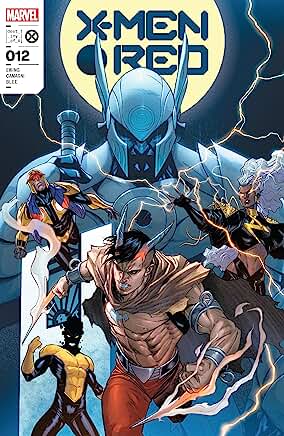 X-MEN: RED #12
“Storm Warning”
Writer: Al Ewing
Artist: Jacopo Camagni
Colour artist: Federico Blee
Letterer & production: Ariana Maher
Design: Tom Muller
Editor: Jordan D White.
COVER / PAGE 1. Jon Ironfire in the foreground, with Nova, Sunspot and Storm surrounding him, and an image of the White Sword in the background.
PAGES 2-6. Flashback: The White Sword frees Jon Ironfire and sends him to Arakko.
Essentially, the White Sword knows that Genesis’s forces are coming and that he’s going to wind up under her control. He sends Jon Ironfire away with his sword, partly to save Jon, partly to alert Arakko, and partly to keep the sword itself out of Genesis’s hands.
The White Sword and Genesis‘s back story was covered in “X of Swords”. Basically, the Sword and his personal army of 100 champions battled the enemy forces on Amenth for centuries, with the Sword using his omega healing powers to resurrect them all daily. On page 3, the White Sword refers to Genesis’s shifting alliances in the past. Originally, she led the forces of Arakko in their battle against the demons of Amenth – the Sword regards them as bringing up the rear. Later, she fell under the control of Annihilation, via its demonic helmet, and led the Amenth forces against the White Sword.
That was the position going into “X of Swords”. At the end of that crossover, in X of Swords: Destruction, Genesis’s estranged husband Apocalypse freed her from Annihilation by taking the helm himself, and then resisted Annihilation’s control long enough to surrender her forces. Saturnyne then turned the helm into a staff. Most of the population of Arakko were then transported to Earth along with Arakko itself, while Apocalypse and Genesis went back to Amenth to rule it. The White Sword and his champions also returned to Amenth.
The White Sword claims here that Saturnyne deliberately cursed the staff. Here’s what she actually said in Destruction:
“Nothing changes in regard to what’s required. Whoever wields the helm controls the world. And that world most certainly does need controlling. But this will make it more manageable. Still corrupting, of course – there’s no satisfying that appetite, but at least now it won’t have direct dominion over the wielder.”
Saturnyne offered to turn it into a sword, but Genesis rejected that. Saturnyne then chose the staff form herself, despite Annihilations’ protests. She did tell Annihilation that “This is a better look for you, and a deeper lure if you want it.” The White Sword seems to suggest here that in its staff form, Annihilation is actually able to influence more people than before.
Jon Ironfire. Apparently the first of the Sword’s 100 champions, but also a close friend before that; the Sword clearly indicates here that Ironfire, at least, was not viewed by him as cannon fodder, but as someone he was actively protecting. Jon refers to him with evident affection as “Blue”.
“Tell them all – but especially the Seat of Loss…” Right now, that would be Storm. The Seat of Loss is supposed to be consulted when battles are lost. White Sword probably doesn’t know who the current occupant is, and really does just want Jon to bring it to the attention of the appropriate Ring member.
PAGE 7. Recap and credits.
PAGES 8-15. Flashback: The White Sword’s champions fight Genesis’s army.
The First Horsemen of Apocalypse are back together, serving their mother Genesis again. Death, in particular, has been hanging around with the vampires of Otherworld over in Excalibur and Knights of X. The other three did return to Amenth after “X of Swords”; Pestilence and Famine were shown in Excalibur #22 acting as the regents of the Otherworld realm of Dryador (annexed by Amenth at the start of “X of Swords”).
Summoners are basically mutants who control monsters in Arakko. One of them showed up in X-Men #2 near the start of the Hickman run.
“Where is your husband?” The White Sword doesn’t get an answer to this question, but it’s a very good one. What did happen to Apocalypse? Presumably, he hasn’t fallen under the control of Annihilation and he’s been sidelined somewhere.
Purity was the White Sword’s sword as seen in “X of Swords”. Genesis is evidently very keen to get hold of it, which is presumably why she goes out of her way to suggest that it might be the White Sword’s only chance. He’s not falling for it.
Quite why Purity is so significant hasn’t previously been explained, but Jon tells us later on that it’s essentially an embodiment of the pure concept of cutting, and capable even of cutting a portal between realities. Which sounds quite useful in the wrong hands.
“Arakko calls you, General.” Genesis appears to be positioning herself as the representative of the true Arakko.
PAGES 16-18. The Brotherhood of Arakko listen to Jon’s story.
The Red Lagoon. Sunspot’s group are using his Red Lagoon bar as a temporary base because the Autumn Palace was destroyed by Vulcan in issue #10.
Dryador is the former water world that was turned into a desert wasteland by Arakkii/Amenthi invaders at the start of “X of Swords”.
Blightspoke is another of the Otherworld realms – basically a dumping ground for detritus from failed realities. Poor Jon seems to have taken the most uncomfortable route possibel through Otherworld.
Fisher King takes surprisingly badly to Jon Ironfire, and Storm makes sure to flag up that this is out of character for him. Fisher King is normally a wise elder figure, after all. But he’s also an embodiment of a less aggressive conception of Arakkii society compared to the White Sword’s champions, who are so extreme they didn’t even fit in regular Arakkii society in the first place. It’s maybe also significant that the champions have a history of routine resurrection – something which we’ve been told in no uncertain terms is generally frowned upon in Arakkii society. That was the whole point of Storm and Magneto giving up their ability to resurrect.
At the same time, Jon invokes the “Where were you?” mantra which was frequently directed at Storm by Arakkii characters in the early part of the series.
Nova, bless him, doesn’t seem to realise how traumatic his back story has become – despite it being central to Al Ewing’s take on him.
PAGES 19-21. Genesis arrives on Arakko.
Arakko Prime here apparently means the location of the original Arakko, i.e. the living island that was the counterpart to Krakoa. It was blasted into this state by Uranos during the A.X.E.: Judgment Day crossover.
The Okkara Gate is new, but it’s worth noting that “Okkara” was the name of the single island that split into Arakko and Krakoa aeons ago.
Genesis has evidently been led to believe that the destruction of Arakko during Judgment Day reflects the failure of its current rulers, which may have had something to do with her succumbing to Annihilation’s influence.
Marianna Stern is the High Priestess of Coven Akkaba from Excalibur and Betsy Braddock: Captain Britain – Reuben Brousseau gets used much more often as the Coven’s leader figure, but they seem in principle to be equals. She’s h Their association with Orchis is new, I think, though hardly a surprise.
PAGE 22. Data page: a memo from Marianna Stern to Orchis’s “Director” (presumably still Killian Devo).
Marianna was evidently hoping for an outright invasion or at least a larger force than just Genesis on her own.
PAGE 23. Data page: speaks for itself, really.
PAGE 24. Trailers.

I’d say the Superman triangle books of the 90s had some very competent people making solid if not great books: Jurgens, Louise Simonson, Kesel, among others.
Yes, and the 1990s Batman books — written by Moench, Dixon, and Grant — were at or a little above that level of quality.
They also both had big revamps with new suites of creators — Loeb, Kelly, Casey, and Schultz for the Superman books; Brubaker and Rucka for the Batman books — and, of the two, the Bat-book revamp was much more successful in creative terms.
In both cases, I think they had the advantage of having a single main character and setting to work with, not a set of overlapping ensemble casts.
And, in both cases, there was definitely a point where each suite of creators ran out of steam or fell into diminishing returns with “event” storylines.
It has to be easier when you’re given free rein on a book that exists on the edge of Marvel continuity and you have full editorial support to realize your vision a la Immortal Hulk.
In the X-office, that would be the equivalent of the Whedon/Cassaday Astonishing X-Men run, Hickman’s HoXPoX, and (to some extent) Morrison’s New X-Men.
And even if you acknowledge the exceptions above, editorial coordination can kill a potentially good run just as easily as editorial interference. Ewing’s S.W.O.R.D. is a good example. When your book is pulled into endless crossovers — or worse, when it exists in a perpetual state of crossover like X-Men: Red — what can you do but play along and hope you can get back to your cast/premise before people forget what you were doing in the first place?
@Thom H: I am curious whether the set-up for Apocalypse’s return is an editorial decision/suggestion, the story Ewing wants to tell, or both.
@Omar Karindu: I’ve been wracking my brain trying to find other examples of times when a franchise with multiple comics had good main series. The Superman and Batman eras cited above came to mind, even though I wasn’t a Superman reader and ignored the main Batbooks in the ‘90s. The JLI-era comics are the only ones I could come up with, but they had the same writers and editors for a good chunk of that run. I guess the Morrison Batman series was decent while the Dini-written Detective was also ok? Or Conan and Savage Sword of Conan in the ‘70s? There was also some overlap of Stern’s run on Avengers and Englehart’s run on West Coast Avengers, the latter of which was at least ok while the former was very good?
The Super and Bat office also had the advantage of strong editors, Carlin and Denny, Respectively
@Mark Coale: very true. When I think of the best editors in comics, I usually associate them with a line (Stan Lee and Marvel, Archie Goodwin and Epic, Karen Berger and the mature readers DC series that became Vertigo) or individual writers & artist. or series (Goodwin again with Legends of the Dark Knight and then Starman; Mike Gold with John Ostrander; Tim Truman, and Mike Grell) rather than multiple comics starring or revolving around a character or related group of characters. Carlin & O’Neil are exceptions.
@Mike Loughlin- Stern’s Avengers and Englehart’s West Coast Avengers didn’t really overlap more than any other Marvel books, though. There was issue 16 of the West Coast Avengers, which played off the Mansion Siege and that was pretty much it. (There were also two crossovers in the Annuals but Stern didn’t write the Avengers Annuals.) But it was basically two separate teams with separate characters. This is different from the X-Books with the constant crossovers and events in one book that are related to events in another. The only time the Avengers and West Coast Avengers were like that was when Byrne was writing both books.
@Michael – I can’t speak for Mike Loghlin, but by “overlap” I don’t think he meant “crossing-over”. I’m assuming he simply meant that a sizeable portion of Stern and Engelhart’s respective runs were published concurrently.
Moo is correct, but I can see how the phrasing could be read as meaning crossing over. Michael’s correct that they featured different characters, though. If West Coast Avengers had been called “Champions,” I wouldn’t put them on my list when main books in a franchise were good at the same time. Justice League America and Justice League Europe, on the other hand, had guest appearances, cameos, and crossovers between the two teams regularly.
@Moo, Mike Loughlin- But Omar’s original point was that the reason it’s difficult to write for the X-Books is how interconnected they are. If Stern was forced to turn Jan into a half-naked baby killing dominatrix to redeem Hank Pym in West Coast Avengers, his run might not be so fondly regarded.
@Michael – Yeah, Stern and Englelharts’s books weren’t all that interconnected. I think you, me, and Mike already agree on that, so I’m not sure what the argument is here.
Mike was trying to think of a time when a franchise’s main titles were written relatively decently, right? He brought up Stern and Engelhart’s runs during the bi-coastal Avengers period which did overlap (in terms of when their respective runs were published) but weren’t hideously interconnected. The two writers therefore had more creative freedom.
“(I haven’t been reading his Venom because Venom-as-antiheroic-lead just doesn’t appeal to me on a visceral level, and because I have zero interest in the “symbiotes as evil godspawn” idea.)”
I have zero interest in Venom, but I accidentally won an ebay auction of Donny Cates’s complete run on Venom, and of all the stuff I’ve picked up from ebay lately, it was some of the best stuff. Just completely nailed the tone of what I thought a Venom book could be in order to work. It flags a bit in the second half, but it’s very strong work, and has sold me on eventually trying Ewing’s Venom, if only to see if Ewing runs with the stuff Cates set up.
“And, in both cases, there was definitely a point where each suite of creators ran out of steam or fell into diminishing returns with “event” storylines.”
If you ignore the satellite books, despite the event numbering, I quite enjoyed Bruce Wayne: Murderer and Fugitive. I know that Rucka’s spoken ill of his work at that time (there’s a really poor birdman drug dealer story in there), although he claimed the editor (Bob Schreck?) kept switching artists on him, and that does not actually apply to that part of his run.
In any case, I like almost all of Rucka’s run except that birdman drug dealer story. I know he feels he didn’t get to resolve Sasha’s story arc as intended, but I think he did well with the choices left to him.
@Josie: I also dig Rucka’s Detective runs. I wishe they had stuck with the limited coloring palette and Shawn Martinbrough as line artist (although I thought Rick Burchett and the other artists did a good job as well). I got the feeling that “Bruce Wayne: Murderer” and “… Fugitive” were not well-liked, but I thought they were quite good. “Officer Down,” as well. I wish Rucka had written a Sasha Bordeaux mini-series, I really liked that character. Having her join Checkmate was ok, but I wish she had stayed human.
@Michael: there was some topic-drift, but I was trying to name runs of main franchise titles that were good, as Moo noted. I also agree that keeping the teams separate made things easier.
“I wishe they had stuck with the limited coloring palette and Shawn Martinbrough as line artist”
GOD YES. I really didn’t appreciate the art at all at the time. Coming off of No Man’s Land, I wanted more guys like Maleev and Eaglesham. I wanted Batman to be inked in blacks. The looser cartooning of Martinbrough and the two-tone color scheme didn’t make sense to me, but now I just can’t get enough of it.
““Officer Down,” as well.”
Officer Down is so good. I mean, that’s why I think the “events” of that era really work (if you ignore the superfluous tie-ins, anyway). The stories were about the human characters: Gordon, Sasha, Crispus, Renee, Alfred. The events capitalized on the drama those characters were undergoing. They could have made a big event out of what happened to Harvey Bullock. I wanted more.
“Having her join Checkmate was ok, but I wish she had stayed human.”
What happens to me almost every time is I try out a Rucka series, I give up on it after a couple issues, I come back after it wraps up and I’m blown away. I bailed on Checkmate after 6 or so issues (I didn’t appreciate the Suicide Squad issues, not having read Ostrander’s run at that point), and last year I got the two Checkmate collections, and aside from the Check-Out misfire of a crossover, it’s an incredibly strong series that sees Rucka doing things he rarely does – specifically, digging deep into the DC sandbox – and doing it really well.
Josie said: If you ignore the satellite books, despite the event numbering, I quite enjoyed Bruce Wayne: Murderer and Fugitive. I know that Rucka’s spoken ill of his work at that time (there’s a really poor birdman drug dealer story in there), although he claimed the editor (Bob Schreck?) kept switching artists on him, and that does not actually apply to that part of his run.
Yeah, if you only read the Brubaker and Rucka parts of “Fugitive/Murderer,” it’s a much stronger story overall, albeit that Brubaker’s Nicodemus story in the middle of “Fugitive” reads like a story he was going to tell anyway, refitted for the “Fugitive” status quo.
The mutated gangster element of Rucka’s run was a bit weak — it’s hard to see how that guy functioned as a gangster given how quickly he changed over what amounts to some traditional religious symbolism.
There’s an interesting idea in there, perhaps, about the fantastical aspects of the genre sort of breaking someone’s brain or being interpreted very differently by a specific character, but it needed more subtle characterization to work.
Overall, though, I think the sheer length of “Murderer/Fugitive” was the issue, plus the fact that the solution revolved around a couple of characters that hadn’t really mattered much in the Brubaker and Rucka runs before.
Both Brubaker and Rucka left the books when it concluded and moved over tot he more grounded and relatively self-contained Gothman Central right afterwards. I don’t know if that was always the plan or if it reflects a kind of exhaustion setting in.
Mike Loughlin said: I got the feeling that “Bruce Wayne: Murderer” and “… Fugitive” were not well-liked, but I thought they were quite good. “Officer Down,” as well. I wish Rucka had written a Sasha Bordeaux mini-series, I really liked that character. Having her join Checkmate was ok, but I wish she had stayed human.
I quite liked the stuff with Sasha in Rucka’s Detective Comics during the “Murderer” and “Fugitive” storylines.
I’m surprised Rucka was dissatisfied with that ending, since it struck me as offering superb and suitably tragic closure on the characters’ relationship.
Maybe that’s the other reason I wasn’t that into Sasha’s later appearances as an OMAC and then as part of Checkmate.
I read her arc as telling the story of someone who’s very normal and professional, almost from a more grounded genre, who gets pulled into Bruce Wayne’s emotional orbit and superhero-genre stuff, but ultimately understands that she has to walk away from it and especially from him.
So Sasha becoming an OMAC and then a member of a very superhuman-oriented version of Checkmate seemed to lose the way the character uneasily — and interestingly — ran up against the genre elements and stock character traits by bringing the perspectives of a very different kind of genre fiction into the mix.
Rucka’s Checkmate as a whole certainly did some of that, but moreso with some of the other characters than with Sasha.
@Omar Karindu: “Overall, though, I think the sheer length of “Murderer/Fugitive” was the issue, plus the fact that the solution revolved around a couple of characters that hadn’t really mattered much in the Brubaker and Rucka runs before.”
I don’t think you’re wrong, but Cassandra Cain is one of my favorite comics characters, I loved the Puckett/Scott series, and I liked her chapters of the crossover. I fully acknowledge that I am biased in that regard.
“I’m surprised Rucka was dissatisfied with that ending, since it struck me as offering superb and suitably tragic closure on the characters’ relationship.”
I don’t know exactly how he put it, all I can recall is that he meant to weave Sasha’s narrative through Murderer/Fugitive, and that didn’t end up happening. She remained in jail for a couple issues, and then her story gets resolved in the final three-parter.
Omac Project is a weird book. I can’t say it’s good, and probably for the reasons that none of it plays to Rucka’s strengths and all of it relies on concepts Rucka typically avoids. It’s effectively a JLI story with no central cast or protagonist, constantly reacting to a villain who, at the time of publishing, had no villainous backstory. Max Lord is suddenly outed as the surprise villain in Countdown to Infinite Crisis, and then Rucka just runs with it, unable to flesh anything out or tell the readers why we should care that Max is now evil. I don’t really blame Rucka; it sounds like a concept handed down from editorial, and it would’ve more or less been the same story under another writer, just without Sasha.