Daredevil Villains #50: The Mind-Master
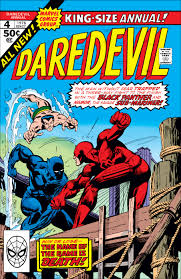 DAREDEVIL ANNUAL #4 (1976)
“The Name of the Game is… Death!”
Plotter, editor: Marv Wolfman
Scripter: Chris Claremont
Penciller: George Tuska
Inker: Frank Chiaramonte
Letterer: Anette Kawecki
Colourist: Bonnie Wilford
Once again, we’ve skipped a few issues. Issues #134-137 resolve a long running subplot about conspiracy theories being spread by deepfake TV broadcasts created by what sounds awfully like an LLM. It’s the highlight of Wolfman’s run, but the villain is the Jester, so it’s outside our remit here. Issue #138 is a crossover with Ghost Rider, with Death-Stalker as the villain.
That brings us to Daredevil Annual #4. The previous two annuals were reprint books (the first is Daredevil versus a team of established villains), but this one contains an original story. How successful was this issue? Put it this way: Marvel didn’t publish another Daredevil Annual for thirteen years. And when they did, they numbered it as a second Daredevil Annual #4, because they’d literally forgotten that this one existed.
This issue slots neatly into the ongoing storyline between issues #138-139, but it’s something of an afterthought. Wolfman only plotted it, leaving the script to Chris Claremont, and the whole thing is basically an excuse to have Namor and the Black Panther as guest stars. It does have a new villain, but he exists simply to drive the plot rather than to be a focal point of the story in his own right. And when he does get around to doing something, it’s… um… well, look, I’ll explain what happens.
The story involves Robert Trevanian Mallory, described by the narrator as a “crackpot inventor, maverick industrialist” and “multi-multi-millionaire”. Mallory has come up with a design for what he calls “the world’s first tidal power station, designed to exploit the vast energies contained in the deep ocean currents”. In fact, the French had had a working tidal power station for a decade by the time this story came out, but let’s be generous and assume that Mallory is planning the first deep ocean tidal power station.
But how is Mallory going to get the power from his underwater installation back to shore? With a big cable? Why no! Instead, he plans to “broadcast” the power, and for some reason this requires vibranium. So Mallory pitches his plan to the Black Panther. While this is happening, word arrives that his beloved son Keith has been abducted, and the kidnappers are demanding the plans to the power plant. Mallory, who is written as completely pleasant and reasonable throughout the story, wants to comply. But the Black Panther decides to try and save Keith first.
The boy has been abducted by thugs working for Maggia capo Ruffio Costa. Costa is the the sort of guy who gets his buttler to shoot underlings for insubordination. To be fair, he has his butler do it while serving tea, so points for style.
Meanwhile, Namor the Sub-Mariner goes on a rampage across Manhattan, trying to find Mallory. When Daredevil shows up to calm him down, Namor claims that the power plant will cause an ecological catastrophe. Matt does a bit of reading up and decides that Namor is right. “Even a layman can see that Namor’s fears are justified,” he thinks. The energy beam to the shore will create a “phenomenal amount of heat” which “could eventually affect the currents themselves, perhaps all life in the ocean, and on earth.” Mallory claims it’ll all be fine, though, and we’re never given any reason to think that he isn’t sincere.
Anyway, Namor, Daredevil and the Panther all wind up converging on Costa’s HQ, where Daredevil persuades Namor that instead of smashing things up and yelling, he should hire an environmental lawyer. Namor grumpily leaves, and the Black Panther decides not to provide the vibranium for the power plant anyway.
Now, at this point you might have spotted that the story is basically finished, one of the guest stars has gone home, and the Mind-Master still hasn’t shown up.
This is, in fact, the basic problem with the whole story. The argument among Daredevil and his two guest stars centres on whether Mallory should be allowed to build his tidal power station. The problems with this design are apparently so obvious that Daredevil can immediately recognise them, and apparently they’re just as obvious to the Black Panther once someone points them out. So as soon as someone explains the plot to him, he’s going to veto the whole development and the plot ends.
Still, there a hostage who needs rescued and there are pages that need filling. So the Black Panther and Daredevil burst into Costa’s bulding. At this point, the narrator throws in the information that the building used to be the Barrington Research Center of Columbine University, sold to the mob after student protests in the late 1960s. “An odd place for a fight,” says narrator, “an even odder one for a Maggia headquarters.” One might be forgiven for thinking that Chris Claremont has read the plot and is not 100% sold on it.
A single punch from the Panther sends Ruffio him flying into a pile of machinery in the corner. Not only is it still switched on after over 7 years, but it suddenly transforms Ruffio into a guy in a white and yellow costume with angular red-outlined speech balloons. Remarkably, by bumping into this old junk, Ruffio has gained vast psychic powers, which have “heightened the power of my mind to an infinite degree”. Then he declares, “Now and forever more shall I be… Mind-Master!” Claremont will later recycle this line of dialogue to more memorable effect.
Despite his allegedly vast psychic powers, the Mind-Master can only control one person at a time, and so Daredevil and the Black Panther fight each other for a bit. Once Daredevil gets close enough to break the Mind-Master’s concentration, the Black Panther is freed from his control. “My power is inexhaustible!”, the Mind-Master declares. On the next page, he exhausts it. He turns back to normal, the Black Panther punches him in the face, and that’s the end.
The Mind-Master is a ludicrous tacked-on finale – bordering on absurdist, in fact – who has nothing to do with any of the stuff about tidal power and environmentalism. It’s two thirds of a promising story but it doesn’t have a proper ending and so we get this nonsense instead.
Regrettably, this dud is our final Marv Wolfman entry. Issue #139 is a Very Special Issue in which a woman flees her abusive husband while a drug addict saves a haemophiliac child. Technically the villain is the husband, but he never appears on the page so I can’t really give him an entry. Issue #140 features the Gladiator and the Beetle. Issue #141 is a Bullseye story. And issues #142-143 bring back the Cobra and Mr Hyde. With that, Wolfman departs, leaving some storylines unresolved.
With the obvious exception of Bullseye, the original villains that Wolfman created for Daredevil are underwhelming. The strengths of his run lie elsewhere. His Jester storyline is genuinely good. His legacy on the book is mostly to do with restructuring the supporting cast and setting up Matt and Foggy as street level lawyers. Overall, Wolfman leaves the book in a healthier position than he found it in. But none of that makes the Mind-Master any better. He’s just rubbish.

Since “Columbine University” is a very obvious take on Columbia University, it’s likely that the plot point about a disused laboratory is a reference to the Columbia University student protests of 1968.
The student protestors occupied one of the campus buildings, Hamilton Hall, and demanded — ultimately, successfully — that the university cut ties with the Institute for Defense Research, for whom Columbia had been engaging in sponsored research, some of it related to weapons development.
Black protest groups, who’d slit from the white-led student protest groups by mutual decision, also got Columbia to scrap plans to expand further into Harlem to build a fitness center, which was instead built underground.
Mash those two real-world outcomes together, and maybe you’ve got a research lab being dumped by “Columbine” University in New York City. In reality, nothing was sold off to the Mafia, so far as I’ve read. And no one seems to have gained short-lived psychic powers.
At least they didn’t bring back Mind-Wave for this to form the League of Mind-Hyphen Menaces.
The ’70s titling convention of well-known phrase + “death” is super funny.
“Mary Had a Little…Death!”
“Humpty Dumpty Sat on a…Death!”
Wolfman should have brought back Mind-Wave for the ocean-themed issue.
“The previous three annuals were reprint books,”
Actually, the first Annual was an original story. The first Spider-Man Annual featured Dr.Octopus teaming up with villains like Kraven. Sandman and Electro. The first Avengers Annual featured the Mandarin teaming up with villains like the Enchantress, the Executioner and Erik Josten. So naturally, the first Daredevil Annual featured Electro teaming up with villains like Leap Frog and the Matador. 🙂
@Thom H. It’s a concept that would later be used by Murder, She Wrote, with titles like “Game, Set and Murder” and “Sing a Song of Murder”. (I actually googled whether they had used the title “The Name of the Game is Murder”; no, but multiple novels have!)
Also, Quinn Martin cop shows in the 70s had those kind of titles.
When I started our pod years ago, they had QM like titles an an homage.
You’re right, the first annual did have an original story – I’ll fix that.
In hindsight, Wolfman (or Claremont) might have been better off just recycling Mind-Wave from the Uri Geller issue. It wouldn’t have made this story much better, but it at least would have have given the train wreck of a third act a pinch more dignity. Plus, Daredevil’s rogues gallery is full of one-shot villains, so having another reappear (outside a Scourge shooting spree) wouldn’t have hurt.
We are also inching closer to Micah Synn, circa 1984 (the Denny O’Neil, pre-Miller era). The guy had a year long subplot, a rarity in the era between Crime-Wave and Kingpin, yet the dude is delightfully bizarre. If you squint he’s a vague knockoff of Kraven, only if Kraven decided to try to be a mobster. I’m surprised nobody’s tried to reuse him since. I’ve seen worse villains redeemed. I’ll be interested in Paul’s take on him. The dudes at the Marvel Appendix were very fond of him.
I’d never even heard of Micah Synn, but it looks like a strange direction. He’s dangerous enough that Daredevil and Kingpin have to team up to stop him, and then a few issues later he’s become an overweight slob who gets beaten up by three homeless people. I am very much looking forward to that entry.
The Denny O’Neil run was actually post-Miller (fulltime Miller, anyway).
Upcoming we have a brief Jim Shooter run, followed by Roger McKenzie, Miller joins McKenzie on art for the second half of his run, before editor O’Neil gives the book entirely to Miller.
After Miller, O’Neil takes over for a really strong run which gets overshadowed being sandwiched between Miller arcs. Miller returns for a one-off and the “Born Again” story-arc. Then, there’s Nocenti.
I remember Micah Synn if only because very much younger me stopped reading Daredevil in that timeframe for whatever reason, returned for Born Again, and fell off once more during Nocenti’s run, not to return for quite a while. (Young me was fickle)