Uncanny X-Men #10 annotations
As always, this post contains spoilers, and page numbers go by the digital edition.
There are a ridiculous number of new titles out this week – eight ongoing titles in total, plus one miniseries – so I won’t be doing annotations for all of them.
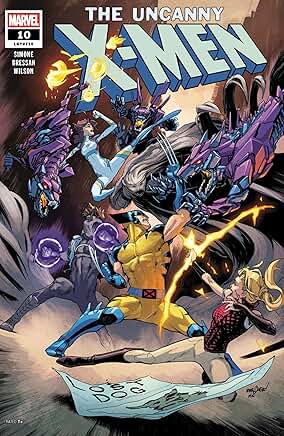 UNCANNY X-MEN vol 6 #10
“Off the Leash, part 2”
Writer: Gail Simone
Artist: Andrei Bressan
Colour artist: Matthew Wilson
Letterer: Clayton Cowles
Editor: Tom Brevoort
THE X-MEN:
Nightcrawler. He regards Haven as a “home” rather than a “school”, “base” or “country”. If we leave aside for a moment the confusing explanations we’ve had about the nature of Rogue and Cyclops’ disagreement, the actual distinction between X-Men and Uncanny X-Men is that X-Men features a mission-focussed strike team operating out of a utilitarian base, while Uncanny X-Men features a quasi-family cast with none of those trappings. Rogue presumably considers that this is the real core of the X-Men. Kurt’s standpoint seems to be that this isn’t really the X-Men, and he rather likes it that way. He isn’t sure he wants to go back to something more formal and seems rather wistful about MacKenzie Deneer and her family.
Chelsea thinks Kurt is worried about the Outliers even before there’s any word of a problem at the mall, although he insists otherwise. He certainly seems to be putting on a cheerful face for her, and perhaps for himself.
Wolverine. Remarkably, with the Outliers in danger, he shows up at a police crash barrier and actually argues with the police officer about whether he should be allowed through. Let’s assume that this conversation starts only seconds before we join the scene and that the cop caves almost immediately (Jubilee certainly reacts as if he’s been good to them). Presumably the cop recognises Wolverine, since there’s no other reason to let him through otherwise.
He congratulates Ransom on his performance, following up on their scene in the previous issue.
Jubilee. She takes a more diplomatic approach to getting past the cop than Wolverine does, and for some reason decides to flirt with the guy in mid rescue. She claims to be “single at the moment… sorta”, whatever that means.
Rogue and Gambit go to the ballet – specifically, it’s Adolphe Adam’s Giselle (1841) – and Rogue is blown away. Much kissing follows. This epilogue scene might well take place some time after the rest of the story; it would probably help simplify continuity if it did.
Deathdream. He’s 15, according to Jubilee. He wasn’t actually killed by the Wolfpack last issue (or if he was, he’s already used his powers to restore himself to life). Jitter says that he has a broken rib and a punctured lung; once she uses her needle on him, he wakes up. At this point things get confusing: Jitter’s treatment seems to be conventional field medic treatment, which seems like it ought to just stabilise him. But instead, Deathdream is immediately able to run and talk as if he was entirely uninjured, and he goes back to his spooky persona. One possible reading is that once Jitter manages to wake him, his “return from the dead” power includes a healing ability that lets him finish the job.
He repeats his claim from last issue that his ghosts (“my unliving things”) can’t see inorganic things such as the Wolfpack cyborgs, but says that he now realises that the Wolfpack include “real biological material from stray dogs” – quite how that explains the ghosts’ inability to see them is unclear. He then says that he can “end their torment”, and apparently defeats the Wolfpack singlehandedly by killing the dogs, which he evidently considers a release. But what power is he using here? If he has the power to make living things in the area drop dead, that seems a lot more powerful than anything we’ve heard from him so far. Or is this something about being able to release creatures that are already on the cusp of death?
He doesn’t recognise All Dogs Go To Heaven (1989) as the title of a film, presumably because it came out 20 years before he was born – however, a quick search suggests that it was called something slightly different in Japan (something like The Dogs Who Came From Heaven), so even if he knew the film itself, he still probably wouldn’t recognise the title.
Jitter. She’s 16, according to Jubilee. Her power to give herself skills for a minute extends beyond mere physical skills to knowledge such as being a combat medic. Evidently she can’t just repeat the effect immediately (or the one minute limit would be meaningless) but we don’t know what the cool-down period is. She does retain some of her combat medic knowledge after the 60 second period expires – the idea seems to be that if she used the 60 seconds to work out what she needed to do, then she can remember the answer and carry it into practice if it doesn’t call for any special physical skills in itself.
At the end of the story, she focusses on Calico and has a heart-symbol in her dialogue.
Calico. Team powerhouse, at least until Ransom gets Ember to power him up instead. In her narration, she’s increasingly framing her mutant identity as a defiance of her mother, and talking about how mutants watch out for one another. But when the Wolfpack have them on the ropes (just before Deathdream sorts it all out) her narration switches to thinking that her mother was right, that “we’re being punished” and “we’re going to die”.
Ransom. Team leader, described by Calico as “the one we look up to”. He certainly seems to be looked to as a figure of support by both Calico and Jitter. (Deathdream doesn’t interact with him enough for the question to arise.)
SUPPORTING CHARACTERS:
Chelsea St Juniors. She has a mutant force field power and wants to be called Dome when she’s older (presumably this is the only shape that the force field takes). For some reason she doesn’t want to tell her saintly father about this. Nightcrawler finds out when she uses the power to stop a paint tray falling on them both – this is hardly a major threat, so it’s not clear whether she’s more comfortable revealing her power to him, or whether she just reacts instinctively.
MacKenzie Deneer. We saw her before in issue #6, when Kurt stopped her daughter Lena Deneer from being hit by a runaway truck. (Lena and her unnamed brother both show up in this issue too.) MacKenzie was effusive in her praise for him in that story, kissed him on the cheek, and told him “you look every bit an angel to me”. This issue, she shows up at Haven – apparently it’s public knowledge that the X-Men are living there – with a large selection of cakes to thank Kurt yet again for saving her daughter. There is, conspicuously, no mention of a Mr Deneer.
Marcus St Juniors has a cameo but doesn’t do anything important.
VILLAINS:
The Wolfpack. One of them goes out of control and starts attacking ordinary humans, so it turns out that they can’t be relied upon to attack the right target after all. They give Calico and Ransom a serious fight, but Deathdream seems to defeat them singlehandedly by killing their organic components.
Corina Ellis. As in the previous issue, she’s appalled that the Wolfpack have been released in a shopping mall, but mainly because it’s bad PR. She also thinks that the Outliers will become local heroes for defeating them. She has the scientist who released the Wildpack thrown into a cell (although to be fair, he has in fact committed a crime).
Captain Ezra. Stands next to Ellis as usual. He’s slightly snarkier than normal this time.
Larry Trask. Last issue had an apparent continuity problem, presenting Trask as the creator of the Wolfpack when in Sentinels the dogs were Ellis’ attempt to replace him. A footnote on the contents page tells us that this issue takes place before Sentinels #4, which would mean we’re between Sentinels #2-3 here. In this issue, Trask simply denies being responsible for sending the Wolfpack out and makes a curious comment that “You think, with my family history, I’d murder kids?” That doesn’t seem to refer to anything in established continuity.
Jerry Greentree. The scientist who released the Wolfpack last issue claims that he did it because Larry Trask told him that their funding was in jeopardy. He didn’t mention this last issue, but the suggestion might be that Trask was trying to sabotage the rival Sentinel program.
FOOTNOTES:
Page 5: “Was in aller welt?” = “What on earth?” “Wilkommen” = “Welcome”. “Apfelkuchen” just means “apple cake”, but presumably MacKenzie looked up a German recipe.
Kurt saved MacKenzie’s daughter from a runaway truck in issue #6. The girl’s name is Lena.
Page 9: Deathdream’s comment about Calico was last issue.
Page 12: Larry Trask already told Corina that he didn’t send the Wolfpack last issue.
Page 13: We didn’t see Calico take Chelsea’s stuffed toy with her to the mall last issue, but she did take it to school with her in issue #6.
Page 17: Ember gave Wolverine a concussion (or at least booted him through a large tree) in issue #6.
Jubilee was talking up shopping malls last issue.

Marvel attempts to kill the completists, or at the very least, bankrupt them ($40+ American for one week). Not a good business strategy.
All Dogs Go To Heaven wasn’t just before Deathdream was born, it was now before all these characters, minus Wolverine, were born. These types of references are getting depressing.
The thought of an adult Logan going to see that movie is pretty funny though.
“In this issue, Trask simply denies being responsible for sending the Wolfpack out and makes a curious comment that “You think, with my family history, I’d murder kids?” That doesn’t seem to refer to anything in established continuity.”
I think this is a reference to Madame Sanctity, who Scott Lobdell revealed was Trask’s sister who vanished into the future when she was a teenager.
A lot of readers didn’t like Jubilee flirting with a guy she just met while teenagers were in danger.
“A footnote on the contents page tells us that this issue takes place before Sentinels #4, which would mean we’re between Sentinels #2-3 here. ”
So there’s no explanation for how differently Trask is portrayed here than he is in Sentinels 2-3.
” She has the scientist who released the Wildpack thrown into a cell (although to be fair, he has in fact committed a crime).”
She says ” I want him running in the Danger Room by morning. Punitive mode”. So presumably she’s doing something nasty to him.
At the end of the story, a mysterious figure with scales who seems to know Remy threatens to skin Rogue alive.
I complained on Bluesky about Jubilee flirting with a cop and Gail responded “he let her thru”, which I guess is meant to be an act of kindness, even if it does read really weirdly.
As people have pointed out: Wolverine stopping to ask and Jubilee stopping to flirt but also idk, maybe I’m in a silo but formerly homeless mallrats with an impetuous streak from a persecuted minority don’t tend, in my mind, to have a particularly positive view of cops, either.
With the benefit of the doubt, I can see Logan very briefly keeping his temper in check for the sake of not making waves in this new town they’ve, for whatever reason, chosen to live.
(I’m sure a reason was given, but whatever it was did not rise to the level of interest necessary for me to retain it)
But that’s the problem with this book in a nutshell. It requires SO much doubt, so often, and I’m less convinced every issue that it deserves so much of it.
Same complaints I always have: powers are poorly defined, too much suspension of disbelief is required for the plots to work, villain motivations are dumb. After the upcoming crossover, I’m dropping this book.
@Michael: I’m not saying this to be confrontational, it’s just that several times I’ve seen you post “a lot of people” having a common opinion. Are you going by social media, which I’m not on, a review aggregator, or some other source? Again, this isn’t me doubting what you write, just curiosity.
@Mike Loughlin- I’m just posting what I see people say online- like on CBR forums, reddit, whatever. I see people make the same complaints a lot sometimes- and Jubilee’s flirting was definitely one of those times.
@Michael: thanks for the answer. I look at the occasional review or blogpost/ analysis, but don’t go beyond. Uncanny X-Men seems to be reviewed favorably on the whole, and I can’t figure out why. It’s not atrociously bad, just not that good.
How old is Jubilee supposed to be now? Something between 18 and 22, I assume?
In any case, it did feel weird to see her flirting with the police officer, but it may just be a bit of spur-of-the-moment zaniness. We don’t see her offering her phone number or anything, and Jubilee may have missed the opportunity for being silly for the heck of it, now that she is no longer either a vampire or a mother figure.
Looks like I was mistaken about Kurt now being a Catholic Priest.
I wonder if we are supposed to find MacKenzie DeNeer creepy. Her behavior in #6 could easily be explained by the shock of the situation, but here she comes across as perhaps a bit too obsessive and controlling for confort, down to deciding how and when to approach and leave without even asking one at any time. It feels like she wants real hard to become the object of Kurt’s curiosity and interest and doesn’t care if that is very obvious and on the nose. I expect her to be a significant source of grief very soon.
@Luis- Fans have been confused about Jubilee’s age ever since she was cured of being a vampire. She shouldn’t have aged during her time as a vampire but in practice she’s written as about the same age as the other members of Generation X.
Well, Jubilee would still be experiencing life as a vampire, she just wouldn’t physically age. Which may explain the confusion, in that she’d remain younger looking, but she’d be written as the same age as the Generation X team. Considering that Jubilee had adopted a child, she must be older than eighteen years old.
Jubilee apparently adopted the baby in Hungary, which means that legally Jubilee could adopt a baby at the age of seventeen. However, Hungarian law does not allow a single parent to adopt a child. So, I wouldn’t put much stock in the real-world legality. I just don’t see an eighteen year old young woman feeling the urge to adopt a baby.
I see some people online calculating her actual age (rather than physical age) as twenty.
Jubilee didn’t adopt the child in Hungary, she picked up the child in Hungary. Very randomly.
IIRC, and I haven’t re-read the Wood run at all becaue it was atrocious, there was a random line many issues later about ‘paperwork coming through’.
But Jubilee basically kidnapped the baby. I don’t think we’ve ever learned if Shogo had any remaining relatives or anything basic like that.
As for this issue of Uncanny – at least I’m starting to like the kids, now that Simone is actually focusing on them.
Now that I think about it, I probably liked these last two issues more than any of the previous in the series so far. So I’m wondering if the focus on Rogue was dragging the title down. At least subjectively, for me.
Of the four Outliers, I think Jitter has the only power I understand. She gets any learned skill she wants for a minute. Crazy, but understandable. (There’s a thought. If it applies to combat skills as well as knowledge of medicine and the ability to act on that knowledge… could she ‘ask’ for magic? Some takes on magic require an innate talent for it, which Jitter most likely couldn’t replicate, but sometimes it’s just the knowledge of the right incantations and so on).
Calico has a horse and fiery… things. Or the horse has the fiery things. And she summons the horse?
Ransom is… strong, I guess? And durable? His heart absorbs… things… and ups his strength?
The creepy kid resurrects? Except he didn’t in this issue, because he didn’t die? And he has ghostly… stuff… and can kill anything living at any time he wants? Is that what he does in this issue? No, I give up.
The secret mastermind begin the All Dogs Go to Heaven franchise? Romulus.
Ceran-I did read the Wood run. Jubilee hacked nto government files (I think it was the Hungarian government she hacked?) to check if Shogo had any living relatives, then stated she was Shogo’s mother. Also, yes, she did later say she received paperwork, which must mean she did start an adoption process for Shogo while in Hungary, but Wood didn’t mention any details.
@Jim: yes! Too bad his sequel, All Cat.(mutant)s Go to Hell, never got greenlit. It would have been the final strike in the war between dog mutants and cat mutants.
I think this is a corollary to Power Creep in comics: new mutants (more and more frequently) don’t manifest a single power, but a suite of powers based on a theme (Deathdream). Or a single power that lets them do basically anything (Jitter). It saps them of a lot of potential as characters because where do you go from “commands life and death”?
[Remember when Dani had a difficult time manifesting illusions of people’s desires as well as their fears? It grounded her character to know that she had to work to make even a little progress. *shakes fist at passing cloud*]
Anyway, while I’m at it: don’t we already have both of these characters already? Jitter is just Prodigy with a time limit. Deathdream is a goth Elixir, more or less. We’ve already had the discussion about why new mutants are constantly being created — I get it — but as long as that has to happen can’t we have ones with new powers.
Romulus programmed secret commands for the Lupines in All Dogs Go To Heaven…
@Chris V:
…you’re not really disavowing me of the notion that Jubilee took a child on a whim. Okay, so she did a google search to see that the kid didn’t have relatives. She still basically abducted him.
It’s really hard to make novel super powers. There must be thousands of characters across the various publishers. And if you do get a gem of an idea, are you going to give it to the company, or keep it for a project you control?
Ceran-Oh no. She definitely stole the child on a whim from some newly killed corpses with the support of the X-Men. That’s just how the X-Men act. They live in a mansion, they’re privileged. Jubilee is to Hungary as Madonna is to Malawi.
Personally, I’m surprised they didn’t find Shogo on that baby garbage dump in Krakoa after Jubilee got bored.
Thom H> [Remember when Dani had a difficult time manifesting illusions of people’s desires as well as their fears? It grounded her character to know that she had to work to make even a little progress. *shakes fist at passing cloud*]
I mean, yeah, but Dani’s powers weren’t good for a fighty book, because they’re very glass cannon, save-or-die – either she solos whoever she’s fighting, or they shrug it off with Sheer Willpower. There’s a *reason* she went on a magical mystery powers tour over time post-New Mutants, including an extended period spent depowered.
@SanityorMaadness- It really started during Simonson’s run, when Dani’s powers changed to “make a wish or fear come true”! But the readers didn’t like it, so when Nicieza brought her back, he gave her the ability to shoot psychic arrows. Psychic arrows are probably her best power- she has to hit her target with the arrow to make it work, so the target can dodge until she finally hits her target.
Does she ever miss though? I figured it was just a visualisation to help her focus her power, and she just had to see the target.
(She gets a semi-pass from me for being an Indian with bow powers because canonically a white kid taught her archery)
@Si- In X-Force 28, Dani shoots at Sunspot, Sunspot yanks Locus into the path of the arrow and Locus gets affected, not Sunspot.
@SanityOrMadness: Yes, that’s the point. Dani didn’t show up as a Valkyrie with psychic powers that she could form into arrows. That happened over time. Was it ultimately too much? Of course. But was it relatable to watch her struggle to improve? Totally.
But maybe Dani’s a bad example. Rahne didn’t have her transitional wolf/person form until a year and a half after she was introduced. Kitty had to learn how to phase people besides herself. It’s more interesting to see power sets expand over time rather than arrive fully formed.
@Si: Good point about saving the best ideas for creator-owned work. But do we really need another “I can do anything” mutant when we just had one in New Mutants a couple of years ago? And when there’s already one on the same team? It just seems kind of played out.
I mean, Prodigy premiered over 20 years ago.
[…] X-MEN #10. (Annotations here.) Sticking with the positive, the core X-Men titles have generally been good. Uncanny X-Men is […]
Thom H.> Yes, that’s the point. Dani didn’t show up as a Valkyrie with psychic powers that she could form into arrows. That happened over time. Was it ultimately too much? Of course. But was it relatable to watch her struggle to improve? Totally.
But the point is that most of those upgrades weren’t organic, from her learning to do better – they were external (or simply random) changes done to her. And one of the main reasons for those is that her original power was badly designed for a superhero book like the X-Men.
Now, let’s be clear here – powers get fudged *all the time*. If Hulk touches you in anger, or Cyclops looks at you in anger, you shouldn’t fall over and then get straight back up again unless you have a forcefield or other invulnerability-type power. You should spend a long time in hospital or just flat-out die. It’s related to the reason why no-one can hit the broad side of a barn in movies – people know bullets are lethal, so it’s easier to have the mooks simply miss.
The problem is when you have a power that is save-or-die by nature, it becomes harder to fudge – the character’s power is either OP or ineffectual with very little in-between (and if they constantly miss like stormtroopers, that’s ineffectual).
I agree that a lot of what Dani went through was just “let’s fix this character by welding new powers to her.” And I agree that strategy is not great.
My point is that she wasn’t broken to begin with. She had a power set that needed expanding, and she was working in-story to make that happen. She wasn’t great in a fight, and she was working in-story to get better. That, to me, is compelling writing: simple, understandable goals that are difficult but not impossible to achieve. Easy to root for.
For whatever reason, Claremont and later writers decided not to pursue the slow-and-gradual route to character development in New Mutants and X-Force. Probably because they abandoned the school aspect for flashier superhero stories. But the NM were never supposed to be superheroes first. They were created to be students. And I think they were better characters during the time they were allowed to be students.
Welding stronger or more battle-ready powers onto existing characters is pretty much the same as creating new characters with a suite of death-defying powers — not interesting, at least to me. If you can kill anyone with a touch and revive yourself whenever you die, then what are the stakes? And how do you even have mastery over those powers at the age of 15, anyway? There’s just nowhere to go with some of these characters narratively.
@Mike Loughin @Jim: yes! Too bad his sequel, All Cat.(mutant)s Go to Hell, never got greenlit. It would have been the final strike in the war between dog mutants and cat mutants.
What cat mutants? Romulus knows of no cat mutants. Feral? Dog mutant. Thornn? Dog mutant. Sabretooth? Prophesised potential leader of the dog mutants!
Come to think of it, Loeb’s Romulus storyline might have made marginally more sense if, instead of Logan and Creed being rivals for the role of lupus sapiens alpha, they were the rival destined leaders of lupus sapiens and felis sapiens. But they weren’t.
@Thom H- It wasn’t Claremont who decided to change Dani’s powers, it was Simonson.
As for why the kids stopped being part of a school, the reason was the decision to revert Magneto to being evil. Since Xavier was in space, that meant there was no headmaster for the New Mutants. (And no one wanted to have Storm, Wolverine or Cyclops become headmaster because it would interfere with the plots in X-Men and X-Factor.) If Cable had been created a year earlier, he could have become headmaster. But unfortunately, he wasn’t. And no one wanted to bring Xavier back from space because then the X-Men and X-Factor would probably both take orders from him, and the writers wanted the teams to be independent.
But the decision to make the New Mutants stop being students had consequences. First, it pretty much doomed the Hellions as characters, since they were supposed to be rival students to the New Mutants. Except for Empath and Warpath, they only appeared in New Warriors 9-10 between New Mutants 62 and their deaths in Uncanny X-Men 281-282. And this also hurt Emma, since her role at the time was Evil Teacher. She only appeared in two major storyline between New Mutants 75 and getting killed off by Trevor Fitzroy- a New Warriors storyline where she goes after Firestar and a Marvel Comics Presents serial where she sends Freedom Force after Firestar.
Thom H.> Probably because they abandoned the school aspect for flashier superhero stories. But the NM were never supposed to be superheroes first. They were created to be students. And I think they were better characters during the time they were allowed to be students.
Quite possibly, but as with Academy X later, Other Stuff Happening (not least from Claremont himself, with his whole “Mutant Wars” plan and all that he never got to finish, for better or worse) overtook it. A “student book” requires some stability in the overall line which the writers of the late 80s were largely bent on tearing apart.
Michael> It wasn’t Claremont who decided to change Dani’s powers, it was Simonson.
Pretty sure Thom’s including the Valkyrie thing.