Daredevil Villains #57: The Kingpin
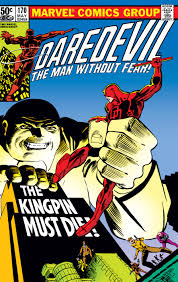 DAREDEVIL #170-172 (May to July 1981)
“The Kingpin Must Die!” / “In the Kingpin’s Clutches”
Writer, penciller: Frank Miller
Finisher: Klaus Janson
Colourist: Glynis Wein
Letterer: Joe Rosen
Editor: Denny O’Neill
We’ve skipped issue #169 (which is a Bullseye story), and so we go straight from Elektra to Frank Miller’s other major addition to the series.
The Kingpin had been around since 1967 as a Spider-Man villain. I don’t normally cover guest villains in this feature. But the Kingpin is an outright import into Daredevil’s rogue’s gallery, even if he’ll continue to be shared with Spider-Man.
On one level, there’s nothing new in Miller’s Kingpin. He’s built entirely out of elements taken from earlier Kingpin stories. But the Kingpin had never really worked before in the way that he does under Miller. So we should take a look at the Kingpin stories that came before this.
The Kingpin debuted in Amazing Spider-Man #50-52 (1965), by Stan Lee and John Romita Sr. It’s the “Spider-Man no more!” story, the one where Spider-Man dumps his costume in a trash can. The Kingpin installs himself as head of the New York mobs, and of course Spider-Man comes out of retirement to defeat him. At this stage, the Kingpin has some Silver Age gimmickry such as an “obliterator beam” in his cane – which will keep showing up for years to come. But the main premise is that the Kingpin plans to run the underworld like business. He seems to think he’s respectable, and takes offence at the idea that killing his opponents counts as murder.
Right from the start, he’s also a physical threat: we’re assured that his bulk is muscle, not fat, and he’s strong enough to take on Spider-Man in a direct fight. But the core concept is there: the Kingpin is a criminal who runs the mob like a business, and who commands respect in the underworld through a combination of money, intelligence, ruthlessness and brute force.
But Stan Lee didn’t really pursue the idea of the Kingpin as New York’s top mobster. When he returns in issues #59-61 (1968), he’s just a gang leader with a plan to brainwash Captain Stacy. He’s mainly a physical threat, beating up Spider-Man to the point of giving him double vision. In issues #68-70 (1969), he’s trying to steal a priceless clay tablet. This one has the first version of the “Kingpin demolishing his hapless sparring partners ” scene, which Miller recycles for Daredevil #170. But for Stan Lee, the Kingpin isn’t a physically imposing character – instead, Lee’s angle is that everyone underestimates the Kingpin because he looks fat and out of shape, and it takes people by surprise to learn that he can actually fight.
The same story introduces the Kingpin’s wife, Vanessa, as someone who is never to be mentioned in his presence. Lee and Romita come back to her in their final Kingpin story, from Amazing #85-85 (1970). We learn that Vanessa and the Kingpin (he still doesn’t have a real name) had a son, Richard, who killed himself after learning that his father was a criminal. The Kingpin refuses to believe that his son could be so weak, and so refuses to tell Vanessa about the suicide. In this version, the Kingpin is using his crime boss status as a way of redirecting his rage at the loss of his son, and Vanessa is the voice of reason trying to talk him out of it.
Miller makes heavy use of Vanessa, albeit as a preoccupation of the Kingpin rather than an active character in her own right. What he absolutely avoids is the story of Richard Fisk, which was a real wrong turn for the Kingpin. Richard shows up alive and well as the Schemer. Vanessa is delighted, but the Kingpin is so upset to learn that Richard hates him that he has a nervous breakdown. The storyline is picked up in Captain America & The Falcon #146-148 (1972) by Gary Friedrich and Sal Buscema. Richard now wants to make his dad happy after all, and so he secretly arranges for his father to take over Hydra. It turns out that Richard in turn is being manipulated by the Red Skull, and the Kingpin teams with Captain America to stop him.
The Kingpin next shows up in Amazing Spider-Man in 1976-77, by which time Len Wein is writing. In issues #163-164, he tries to use Spider-Man’s “life force” to get Richard out of a coma. Once again, the Kingpin is primarily a physical threat, and once again, he’s deeply upset at learning that Richard prefers Vanessa to him. Finally, in issues #195-197 (1979), Marv Wolfman and Keith Pollard have Vanessa set the Kingpin a deadline to sever his ties with crime, under threat of leaving him. The Kingpin tries to kill Spider-Man one last time, but Spider-Man manages to survive until the deadline, so the Kingpin lets him go and heads off into retirement.
And that’s where Miller picks him up, three years later. Miller introduces the Kingpin with the aforementioned scene of him beating up his sparring partners, but also establishes that he’s firmly retired and won’t hear any mention of his previous career. The name “Wilson Fisk” first shows up here, so far as I can see. As part of his efforts to satisfy Vanessa by distancing himself from crime, Fisk is negotiating with the American government to sell them evidence on his ex-colleagues. New York mobsters try to derail these negotiations by taking Vanessa hostage. .
This, of course, is a terribly bad idea. At first, the Kingpin only wants to get Vanessa back and go back into retirement. But Vanessa is seemingly killed in an explosion, apparently engineered by Lynch, a loyal lieutenant who wants the Kingpin to back to crime for good. The Kingpin avenges her by crushing the other mobsters and killing Lynch; Daredevil lets the Kingpin go for now, in exchange for evidence on the Kingpin’s rivals and the chance to capture Bullseye.
This becomes the Kingpin’s role going forward: he’s the implacable head of organised crime, comfortable with a stalemate in a way that Daredevil isn’t. While he remains physically imposing, there’s far less emphasis on his fighting prowess and much more on the original and long-neglected concept of him as a supremely effective criminal organiser. However, the idea of running the mob like a business played less as a gimmick and more straight, as evidence of his competence and his superficial respectability.
Vanessa fares badly in Miller’s stories, getting blown up and then stumbling around in a subplot as an amnesiac bag lady for a while – but then her function was to force him into retirement. Miller had to sideline her somehow, and the alternative would have been simply to kill her. This way he gets to keep her as a weak spot for the Kingpin while blocking her from actively interfering in the plot. He gets the benefit of her humanising him, without her being able to stop him.
Of course, Miller could have just created a new character to be the figurehead of New York crime. But the original concept of the Kingpin was always perfectly good, and underexplored. And despite Stan Lee’s efforts to present the Kingpin as an underwhelming blob, Romita’s character design was always imposing. Miller undertakes an Ultimate-style reboot of the character, stripping him back to the core concept and doing it properly this time.
The Kingpin is a better fit for Daredevil than he was for Spider-Man. Spider-Man used to spend a lot of time dealing with crime lords, but he’s more at home with costumed villains. Organised crime is a much better milieu for Daredevil, the lawyer vigilante who’s operating as a street level character. Corruption and untouchability go to the heart of Matt Murdock in a way that they don’t for Peter Parker, and a character who Matt can uncover but never take down is a strong arch-enemy for him.
He also fits better with Daredevil in terms of power level. The Silver Age Kingpin, able to go toe to toe with Spider-Man, is incontestably superhuman. Apparently he’s meant to just be massively muscular or something, but plenty of scenes only make sense if the guy is a mutant or something. This is necessary if he’s going to fight Spider-Man, but it doesn’t fit with the notion of him as a self-made man. The problem is much less acute when he’s a trained powerhouse fighting a man with a stick.
Miller recognises the Kingpin’s untapped potential and prunes away years of wrong turns in order to get back to it. In theory, it was all there before, but in practice Miller is the first to really make him work, simply by pruning him back to the strongest elements and putting him in a more suitable comic. This interpretation of the character remains the standard, and rightly so.

Miller’s core contribution was to establish the Kingpin as someone who the law couldn’t touch. That worked very well in both Daredevil and Spider-Man.
Miller also introduced the Kingpin’s habit of referring to himself as a “humble dealer in spices”.
Regarding the Kingpin’s strength, it should be noted that even Miller described the Kingpin as having “inhuman strength” during Born Again.
Milller’s revamp enabled the Kingpin to become a major presence in the Spider-Man titles again. Bill Mantlo liked Miller’s revamp of the Kingpin and brought him back in Spectacular Spider-Man 67 about a year after this. That story also featured the first time Boomerang fought Spider-Man outside of Marvel Team-Up (they’d previously fought in Marvel Team-Up 83-84) and help cement Boomerang as a Spider-Man villain.
@Michael: And the Kingpin referring to himself that way is, of course, a nod to Vito Corleone’s front business as an olive oil importer in The Godfather.
I think it’s worth noting that this first Miller arc with the Kingpin does seem to present him as something very close to superhuman. Daredevil just about wrecks himself trying to win a physical fight with the Kingpin, and there’s some reuse of a bit from one of the Lee-Romita Kingpin stories involving a massively heavy door that the Kingpin can open with a bit of effort, but which takes almost all of Daredevil’s physical strength to do the same.
More generally, part of the stalemate between Daredevil and Kingpin is that Daredevil can’t just go in and beat him up in Miller’s stories. Granted that this would hardly dislodge Fisk or prove him a criminal, but Daredevil can’t even get the self-destructive pleasure of winning a fistfight against Fisk.
And this forces DD to use other methods, as he does when he essentially trades a catatonic Vanessa to Fisk in exchange for Fisk tanking his corrupt mayoral candidate.
It’s a nice bit of storytelling, with Daredevil’s inability outfight Fisk reflecting the law’s inability to touch him. He can’t really be brought to justice in Miller’s stories, not even by abandoning the law entirely.
Instead, Fisk can merely be leveraged using things he wants more — Vanessa, for instance — or he can be socially or emotionally damaged, as happens in the finale of “Born Again” and in the Love and War graphic novel that precedes it.
More broadly, I think Miller makes Fisk implicitly just the guy who’s best at filling a niche that’s always going to be there. While the “King” of the sewers will likely get his own entry, a lot of why he exists is to create a parallel to the Kingpin, as if any society has its own Wilson Fisk. Fisk himself says something similar in issue #190.
That’s the other big difference here: partly thanks to the noir genre he’s drawing on partly thanks to a progressive loosening of the Comics Code, Miller can portray Fisk as part of a corrupt society in a way that Silver Age comics wouldn’t and couldn’t. (As Paul noted in an earlier installment of this series, the Organizer/Ani-Men storyline was really hamstrung by these limitations.)
Because there’s always going to be a Kingpin and Fisk is so adept at it, he just can’t get out of it. That’s the problem Miller gives the character. The worst defeats Fisk suffers in Miller’s work are losing Vanessa because of his own monstrousness and being unable to extend his power and reputation beyond the criminal underworld in “Born Again.” Miller’s take seems to be that the worst thing about being the Kingpin of Crime is that you know it costs you any other kind of life and any other kind of connection to others.
I think that’s even present in this first use of Fisk; Lynch was right after all, as hinted at by Fisk’s brutality towards his sparring partners and his lying to Vanessa about it even when he’s “retired.”
Miller’s take on Vanessa is interesting as well. She goes from the imperious, staunchly middle-aged matron from her Spider-Man stories to a younger woman with a physically smaller presence and an alarming degree of naivete about her husband, and from there to a traumatized, almost wordless wreck. As soon as she gets a voice of her own back, she abandons Fisk for good.
In Miller’s stories, Vanessa is much more a symbolic reflection of the qualities Fisk lacks or has worked to destroy in himself and others than anything else, and Miller plays Fisk’s desire for her as a kind of impossible wish for redemption or at least to pretend he can be loved and loving. So the greatest vulnerability of Miller’s Kingpin’s is that he’s lying to himself about what he’s become.
To clarify, in issue #190, Fisk says that societies always have people like him in them.
Miller’s use of Kingpin may very well be his most notable, most lasting contribution to Marvel Comics. It is smart, logical, and very, very effective. It still makes significant waves well over forty years later.
Far beyond just being ingenuous use of available and underused characters, it has significant engaging power. It makes the Marvel Universe feel more real, surprising and dangerous all of a sudden. If someone who was defeated by Spider-Man several times and ended up giving up can so suddenly return and become such a thorny mover and shaker, who knows what else could be waiting in the wings for the proper circunstances?
Adding to the effect, Miller is wise enough not to overexplain – and so are other writers after him. The Kingpin’s family’s dynamics are quite whacko. He is very dangerously overprotective over both Vanessa and Richard, giving each forms of attention that are as intense as apparently unhealthy. Vanessa has a lot of influence towards her husband, but there is a strong hint of denial on how far that influence can go towards redeeming his character and his behavior. Miller establishes very early on that while Fisk is willing to let go of his criminal empire for Vanessa, he is as ruthless and callous as ever and is attempting to hide that from Vanessa. She may tame his behavior, but she did not change his character. As noted by Michael above, he also kept a bit of ambiguity about the exact nature and extent of Kingpin’s strength. So there is plenty left unexplained or unexplored for future stories. Denny O’Neill will in the not too distant future make some use of the ambiguity of the nature of the link between Fisk and Vanessa, and Tom DeFalco and others will explore the pitfalls of his link to Richard right after that (in Spider-Man stories). While Vanessa is a crucial part of later stories up to late 1986’s Graphic Novel “Love and War”, we really don’t meet her in any meaningful way for the longest time, and IMO she remains difficult to read or understand even today, several years after her death. All in all, Vanessa has surprisingly few full appearances and manages to be somewhat enigmatic in most of them. Her son goes the opposite way, having arguably too many appearances and ending up dilluted.
For the Kingpin himself, that provides an underlying suggestion that his ruthlessness in crime and business may be to some extent an attempt at fleeing, denying or compensating his failures as a husband and father. That he is dangerous in no small measure because he is hurting and sees no way forward that can offer healing. Miller seems to embrace that suggestion in the 1986 Graphic Novel; Ann Nocenti uses the Kingpin that bring real question to his supposed love for Vanessa while also providing an out for him; and Brian Bendis will establish Vanessa as a very dangerous and unpredictable character on her own right.
I still wish Kingpin’s story was allowed to actually resolve, but we sure got plenty of character drama from Miller’s decision to recycle and reinvent the character.
Given the Kingpin’s frequent employment of comic book scientists and occasional exposure to exotic substances/energies/etc, I’m willing to accept he’s at least minor-league superhuman on top of his normal physical attributes.
Maybe a knock-off Super-Soldier serum or something. Not enough to propel him into outright supervillain territory, but when you’re regularly dealing with the likes of Daredevil, Spider-Man, and Punisher, or when your chief rivals are Hammerhead, Silvermane, Tombstone, the Owl, and so on, it pays to be just a little tougher than they expect. And I feel like it’s not cheating given all the ambiguity in the past.
I’m just tired of the “Kingpin retires, goes away, comes back, builds it up again” cycle we occasionally get over the years. Except I know he can never be allowed a truly happy ending.
The Kingpin usually has super-scientists working for him when he’s in a Spider-Man comic, but just recruits gifted psychos in Daredevil comics.
Typhoid Mary and Bullet are about as superhuman as his minions get in DD stories, and both of them were heavily flavored with conspiracy and paranormal genre fiction elements.
Now Omar’s got me trying to think of super-powered types Fisk employed in Daredevil comics. Was Bullet (from Nocenti’s run) working for Fisk when he first appeared, or was he just on loan from someone in the government Fisk could exert pressure on (like with Nuke)? He’s sort of a street-level Juggernaut.
Also, how did people like Fisk’s turn as Mayor of NYC? I don’t think I read any comics where it played a big role, but it feels like it was not quite a retirement, but a shift in his perspective, or approach, maybe?
Bullett was similar to Nuke. He was a black ops US government agent that Fisk called in a favour from a US military general to get Bullett to target the environmental NGO that was giving one of his company’s trouble.
It’s crazy how much Vincent D’Onofrio looks to me like, not some random big, bald actor playing the Kingpin, but specifically like the John Romita Sr. version of the Kingpin. It’s as though one of his panels came to life.
I was one of the people at the time disappointed that they didn’t cast Big Van Vader as Fisk in the Ben Affleck movie. Little did I know Michael Clark Duncan might be one of the best parts of the movie.
@CalvinPitt: probably the most major one is his working alongside Purple Man in Devil’s Reign.
I largely enjoyed the use of Fisk as mayor of NYC; I’d argue that, while he’s more impactful in Zdarsky’s run, the use of him is more clever in Soule’s run. I especially loved him nominating Murdock as his deputy mayor specifically to neuter him (which leads to some great twists and turns). I definitely recommend checking them out.
“Little did I know Michael Clark Duncan might be one of the best parts of the movie.”
I’ll take your word for it. I remember virtually nothing about that movie apart from the fact that I know I went to see it. It wasn’t even memorably bad. That means I paid to see a movie with nothing to show for it. No memories of it, good or bad. What a ripoff. At least I can still remember how awful Showgirls was.
Michael Clarke Duncan just didn’t have the aura of menace that Kingpin should have. He acted well enough, but his face was just too friendly-looking.
I quite liked the Daredevil movie, but maybe that was just because I was starved for Marvel heroes back then. I don’t think I’ll risk rewatching it today.
I mean, I liked Alias well enough at the time, but Jennifer Garner as Elektra in hindsight is not great casting. Yes, zeitgeist and all that, but I presume a segment of people would complain if you didn’t cast a Greek or at least Mediterranean actress in 2025.
“He acted well enough, but his face was just too friendly-looking.”
Do you think it’s possible that your perception of him may have been influenced somewhat by his previous roles? He’d been in a number of things, but far and away, he was best known for his role in The Green Mile. After that, I don’t know, maybe Armageddon? He was basically a big teddy bear in both of those films.
It’s entirely possible. But then again, I didn’t think Vincent D’Onofrio looked too much like a car repair Thor when he played Kingpin.
I always wondered if they hoped to cast Ving Rhames as Kingpin based on his role in Pulp Fiction, but pivoted to Michael Clark Duncan after The Green Mile … and he had been in Armageddon with Ben Affleck. I have not seen the Daredevil film though, so can’t offer any comment on her performance.
Vincent D’Onofrio’s performance seems to come straight from the comics like few other comic book characters – J K Simmons as J J Jameson is the other that comes to mind.
Yep, and I’d add Iman Vellani as Ms Marvel.
“I didn’t think Vincent D’Onofrio looked too much like a car repair Thor when he played Kingpin.”
Lol. I think that might be a little too specific of an association, Si. I mean, I didn’t think RDJ looked too much like Chaplin to pull off Tony Stark.
But if an actor is playing the opposite type of a character that they’re largely known for, that can be a tougher sell sometimes. It’s easy to get pigeonholed.
@Mark Coale: Well, nobody complained when Élodie Yung got cast as Elektra. She’s French and Cambodian.
@Si: I’m still amazed at how Iman Vellani pretty much single-handedly carried The Marvels.
@Taibak – Yung was probably seen as markedly improved casting choice for Elektra after (snicker) Jennifer Garner, despite not being Greek. Maybe that’s why fans let it slide.
I never bought Scarlett Johansson as Black Widow either. I thought Famke Janssen would’ve been amazing as Natasha (see Goldeneye and her role as Xenia Onatopp) but she was already 45 by the time Iron Man 2 came along, so I doubt she was even considered.
I just got back from Terrificon, a comic con in Connecticut, and got to meet Ann Nocenti and JR Jr. At the latter’s table were prints of covers and panels that he drew, including the cover of Daredevil: Man Without Fear 1. This was the comic that made me realize he was actually a good artist, if not my cup of tea. Anyway, that’s probably why when I’m reading the character summary all I can think is what we learn in that miniseries:
The Kingpin rose up the criminal ranks by being an unseen masseuse.
I’ve never heard of this obscure character.
He sounds perfect for other media.
@Chris:
Maybe use him in comics first, though?
Just for a few hundred appearances, mind you. He might even be of use in other books at some point.
@Luis Dantas: If they want the character to take off, they should use him in one of the popular books, like Amazing Spider-Man. An idea like this would only be wasted in a third-tier title like Daredevil.