Psylocke #9 annotations
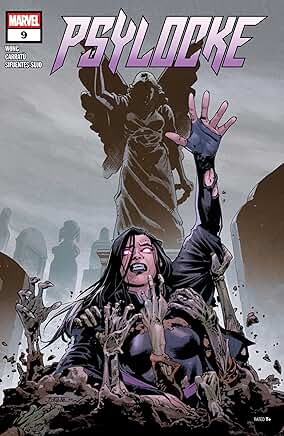 PSYLOCKE vol 2 #9
“A Bird in Hand”
Writer: Alyssa Wong
Artist: Vincenzo Carratú
Colour artist: Fer Sifuentes-Sujo
Letterer: Ariana Maher
Editor: Darren Shan
PAGES 1-5. Mitsuki welcomes Kwannon in and tells her story.
The seal on Mitsuki’s costume is the same symbol that was burned into Kwannon’s wrist by the ghost figure in issue #7. We saw it on the door of Hayashi’s house in the previous issue (though it isn’t visible in the establishing shot at the start of the story), and we were also told that Matsu’o Tsurayaba had it as a tattoo.
Essentially, Mitsuki claims that Hayashi beat her and left her for dead, but she was saved by the yokai that she had previously befriended using her powers.
The umbrella. It’s a kasa-obake, which is a stock form of yokai. Basically an umbrella come to life.
“I thought Master Hayashi killed you.” In flashback in issue #5.
The Lady in White. Mitsuki tells us later that the Lady in White was the creature haunting Psylocke in the last few issues, essentially as an attempt to recruit Psylocke to Mitsuki’s cause. It’s not clear why the Lady first appeared after Psylocke’s encounter with the Taxonomist – it might have been coincidence, or it might be that his hallucinogenics let the Lady in.
The Lady in White is described here is a beautiful woman with white hair, skin and clothes, who cares for and avengers the lost dead. Her body is said to be a frostbitten corpse from the neck down. Mitsuki describes the Lady as being “kind” to her, but since the whole theme of this story is that Mitsuki has survived as a villain, you have to wonder what the Lady did to her; she seems to be presented here as a sort of Snow Queen figure.
The most obvious template for the Lady in White in terms of actual yokai (from my very limited knowledge) would be Yuki-onna, another snow woman figure. But that figure doesn’t bear much resemblance to what’s described here, which is a carer for the lost dead. Mitsuki’s description of the character seems accurate though, since it fits with what the Lady said in issue #7 while possessing Deathdream. (“I’m taking him away to a place where no one can hurt him, or any of the neglected dead.”)
PAGES 6-8. Greycrow and Devon break into the Hand’s Tokyo headquarters.
I’m not sure this very large and prominently branded headquarters has appeared before.
“I stole a page from the Taxonomist’s book and improved on his design.” In issues #3-5, the Taxonomist was using animal cyborgs; this seems to be purely a robot mouse.
PAGES 9-12. Mitsuki reveals her punishment for Hayashi.
Basically, she’s stolen his soul and is keeping his body alive in a state of endless torment, unable to die. Mitsuki evidently considers this reasonable punishment for his abuse of herself and Kwannon in the many flashbacks we’ve seen during this series, and expects Kwannon to want to join in; Kwannon seems genuinely appalled, partly because she isn’t a sadist, but you suspect more because the memory of Mitsuki that she had been holding onto was of the one good person she knew as a child.
PAGE 13. Greycrow and Devon inspect Matsu’o’s corpse.
Essentially, they learn that Matsu’o’s version of the symbol is intended to keep spirits out, but that Kwannon’s version is inverted. The implication is that the Lady placed the symbol on Kwannon in issue #7 so that she could be more easily possessed in this story.
PAGES 14-20. Mitsuki reveals her plan, and Psylocke is possessed.
Psylocke tries to interpret Mitsuki’s behaviour as a sign of trauma, but discovers that Mitsuki has simply joined the Hand anyway and tried to use her powers to take it over; she’s seized one branch of the Hand and is planning to spread out from there. She’s now going by “The Yokai” as a codename.
Mitsuki tries to persuade Psylocke to join with her voluntarily, and then lets the Lady in White possess her. She claims that this is simply honouring her bargain with the Lady, but seems to regard this possessed version of Psylocke as more than good enough.
“How many years did you lose to Betsy Braddock? To the Legacy Virus?” Kwannon was body-swapped with Betsy (without either woman’s consent) in Uncanny X-Men #256 (1989); Kwannon (in Betsy’s body) died of the Legacy Virus in X-Men vol 2 #32 (1994); she wasn’t resurrected until Hunt for Wolverine: Mystery in Madripoor #4 (2018).
“The Lady judges the guilty… and in her eyes, you’re guilty.” Mitsuki doesn’t expand on this, but with hindsight, we now know that the Lady was the creature possessing Deathdream in issue #7. In that story, she accuses Psylocke of “lov[ing] to hurt people”, and cites “Matsu’o – the lover you killed. Himeko – the daughter you abandoned. Mitsuki – the friend who trusted you. No matter how you try to forget, the restless dead remember.”
Since the Lady knows that she’s working for Mitsuki, her inclusion of Mitsuki among the “restless dead” may be significant – or it may simply be describing what she takes from Psylocke’s self-loathing. But the Lady continued in that issue by saying (in Mitsuki’s persona) that “I don’t know what I am any more, but until you set things right, I’ll never be able to rest.” The Lady certainly seems to be implying that Mitsuki is actually a ghost, even she believes herself to have been restored to life by the Yokai.
According to Mitsuki, the Lady wants to punish Psylocke, but is compelled to assist Mitsuki because of her powers over yokai. Giving the Lady control of a human body might, therefore, prove to be a bad tactical move – or the Lady might actively be trying to enlist Psylocke to banish Mitsuki (and free herself).

It sounds like Wong may be partially basing the Lady in White on La Llorona, who is also a ghostly woman dressed in white, although she is associated with water and wailing. There are multiple variations of her myth, but they all revolve around a woman who murdered her children and then herself (for reasons usually relating to something to do with her husband), becoming a vengeful ghost in turn. More recently, La Llorona has been interpreted by some as a more sympathetic spirit than previously. Wong has Filipino heritage, and La Llorona is known in Philippines’ folklore also.
I feel like I’ve been reading the same story for the past three issues. The story simply does’t go anywhere. It’s tiring.