Unbreakable X-Men #3 annotations
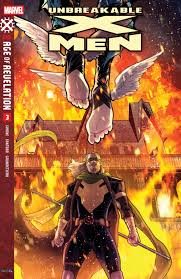 UNBREAKABLE X-MEN #3
“Like Drowning in the Dark”
Writer: Gail Simone
Artists: Mario Santoro with Luciano Vecchio, Tiago Palma, Davide Tinto & RB Silva
Colour artist: Espen Grundetjern
Letterer: Clayton Cowles
Editor: Tom Brevoort
COVER: With Haven House burning in the background, Gambit squares off against Namor the Sub-Mariner – not something that literally happens in the story, but broadly a combination of two plot points, so fair enough.
This is the final issue of Unbreakable X-Men, with Uncanny X-Men resuming next month.
PAGES 1-4. Flashback: The Outliers vow to stop Shuvahrak.
We were told last issue that the Outliers had made a vow to stop Shuvahrak if she ever escaped. This flashback shows them making that vow, and is captioned as “present day” – presumably meaning between Uncanny X-Men #21-22, or at least shortly after the “Dark Artery” arc ended in Uncanny #16.
“Mama warned me about the goblin people.” Calico first mentioned back in Uncanny X-Men #2 that her mother compared mutants to goblins (or possibly even thought that they were goblins or demons).
“I wish you had prepared me more, mama…” Calico’s back story in Uncanny X-Men established her mother as bizarrely controlling (her father never seems to be in evidence), and as keeping Calico in isolation from the rest of the world. Calico clearly recognises her lack of understanding of the outside world and is conscious of her inability to fit in, but still perceives this as more of a parenting defect than the weird behaviour that it actually was.
“When we were in the Penumbra…” The “Dark Artery” arc, in Uncanny X-Men #13-16.
“I know what kind of revenge [Shuvahrak] wants. For being imprisoned for so long.” It was clear in “Dark Artery” that Shuvahrak wanted to escape the Penumbra. Henrietta effectively confirmed last issue that Shuvahrak is Greta, the mutant who created the Penumbra in the first place (something which had always been very strongly implied). Quite why she blames other people for her imprisonment isn’t altogether clear, but the suggestion is that she resents mutants such as Henrietta for keeping her contained in some way.
Shuvahrak’s apparent motivation now – to wipe out life on Earth and turn the whole place into an empty version of the Penumbra – bears no real resemblance to her original motivation of avenging mutants who had been betrayed by their family. Presumably, centuries in the Penumbra have driven her mad.
The symbolic splash page has an eclipse above Shuvahrak’s head, which looks extremely similar to Ransom’s emblem – whatever that may mean.
“Ember is spooked. Normally the only thing he hates is…” Calico tails off before completing this sentence. Ember was also spooked by the Penumbra in “Dark Artery”, and refused to join Calico in entering it.
“She called to us. She brought us here.” Shuvahrak drew the Outliers to Haven House in Uncanny X-Men #1, intending that one of them would replace her in the Penumbra, which in some way would allow her to leave.
PAGE 5. The X-Men watch Haven House burn.
Haven House was set alight by Shuvahrak last issue, in retaliation for its involvement in her imprisonment.
“Jitter, are you sure she’s headed for Atlantis?” Issue #2 ended with Jitter declaring that Shuvahrak was heading to Atlantis in order to go after Namor. Quite why isn’t really explained, but she was remotely woken and apparently freed by Galactus in issue #1, and he’s been lying at the bottom of the ocean since the X-Men defeated him three years ago. So presumably Galactus wants her to free him in turn… or something like that? After all, Henrietta predicted last issue that Shuvahrak’s first targets would be mutants, so it’s odd that she makes straight for the seemingly irrelevant target of Atlantis unless it has something to do with Galactus.
“I know, Ransom. Pretty much everything.” We saw last issue that this future Jitter is able to copy skills permanently, but as a result she’s taken on a lot of voices in her head. Apparently one of the people that she’s taken skills from somehow knows where Shuvahrak is heading, though quite how they’d know isn’t really explained.
“I can get us there, but my domes don’t move.” Quite what Dome’s domes actually do is never directly explained in this story, but they seem to be force fields complete with air inside, thus making them useful in small areas underwater. This is presumably why she can’t simply erect a dome over Atlantis: it would remove the water and everyone inside would suffocate.
PAGE 6. The X-Men approach Atlantis.
The future Calico’s powers apparently extend to creating multiple “horses” with abilities tailored to the circumstances. She’s also responsible for the “pressure auras” around the X-Men, as confirmed in passing on page 9. Quite how these things work isn’t entirely clear – they surely can’t contain enough air for the X-Men to breath, so perhaps they’re meant to be a short term fix until they reach the bottom of the ocean and Dome can put one of her domes in place.
PAGES 7-8. Namor warns the X-Men to leave.
Namor is about as enthusiastic about the state of the surface world as you might imagine – he’s not exactly that keen on it now – and Gambit recognises it as something similar to his own disillusionment.
The two-panel flashback on page 8 consists of a recap of Rogue’s separation into Rogue Green and Rogue Red (from a flashback in Rogue Storm #1), and a recap of Rogue’s transformation into a statue while fighting Galactus (from a flashback in issue #1). The whole two-Rogues thing was glossed over in previous issues, and isn’t really relevant to the plot of this series, but ignoring it entirely did seem a bit odd, since Gambit’s whole motivation is his despair at the loss of Rogue. Rogue Storm explained that Rogue Red was generally understood by everyone, including Gambit, to be a copy rather than an equally valid Rogue, and that Gambit rejected her in favour of the “real” Rogue.
PAGES 9-11. Gambit insists on dealing with Namor.
Everyone seems to regard this as a suicide mission, which would normally be a bit excessive when dealing with Namor. But then Gambit is blind and probably has a death wish.
Calico is particularly aggrieved at this behaviour, presenting Gambit as the father figure who helped her to escape her mother’s indoctrination and “be a person”. We’ve seen bits of this in recent issues of Uncanny X-Men.
“You told me once, you can be a mutant, or you can walk the mutant road.” Uncanny X-Men #20.
PAGES 12-14. Gambit fights Namor.
“Imperius X!” Gambit is making fun of Namor’s “Imperius Rex” catchphrase.
PAGE 15. Deathdream has an idea to stop Shuvahrak.
His proposal here is to “raise the dead”, though he seems genuinely unsure about whether this is a proper use of his powers. We’re told later that what he actually does is to trade his “eternal life” for Rogue’s return – so apparently Deathdream really is immortal, unless he chooses to give it up. Quite who Deathdream traded with is left unclear, but Death would be the obvious candidate.
PAGES 16. Sadurang arrives to help.
Gambit tries to recruit Sadurang last issue, and Sadurang refused to fight Shuvahrak. He is, howver, perfectly willing to save Gambit from Namor. As usual, Sadurang’s appearance changes to a dragon appropriate for his environment.
PAGES 17-19. Rogue returns and defeats Shuvahrak.
Rogue still has Galactus’ power (temporarily), but has escaped statue form. She apparently burns out her copied power cosmic in killing Shuvahrak, and then returns to human form.
“I talked to you. Every night, 9pm.” We saw Gambit’s routine in issue #1. Rogue claims to have heard him, which is a bit odd if she was not just a statue but actually dead. Perhaps she was hanging around as a ghost.
PAGE 20. Epilogue.
“X equals family.” Deathdream has been reciting this slogan in recent issues of Uncanny. Obviously, this is the ending where the X-Men and Outliers are stronger reunited, and get their happy ending. It’s a slightly odd thing to do in a dystopian future timeline, but then this series has pretty much ignored the concept of “Age of Revelation” entirely in favour of simply doing something set in the near future in an unaffected part of North America. Rogue also stressed that Dome was “family” when defending her from Galactus in the opening scene of issue #1, so this brings the book full circle.
Sentinel Boy was a robot X-Man who got destroyed in the fight with Galactus in issue #1. We’re told that Jitter is going to “rebuild” him, so maybe he was just a robot after all.
The “Unbreakable” monolith was a memorial to Rogue, which we first saw in issue #1.

Interesting that Deathdream discovered in the “Dark Artery” story that Shuvahrak wanted to destroy the world. It would be nice if he’d have mentioned that in the actual Dark Artery story.
“Shuvahrak’s apparent motivation now – to wipe out life on Earth and turn the whole place into an empty version of the Penumbra – bears no real resemblance to her original motivation of avenging mutants who had been betrayed by their family. Presumably, centuries in the Penumbra have driven her mad.”
I think that the problem with the Dark Artery story was that it didn’t make clear that Shuvahrak spending centuries torturing people was supposed to be a bad thing. This story seems to be a response to that- OF COURSE spending centuries torturing people will eventually corrupt a person and drive them mad.
It would have been nice to get a clear explanation of how Dome’s powers work. I couldn’t make heads or tails out of what she was supposed to be doing. Of course, that’s a problem with Simone’s writing of Uncanny generally- it’s not clear how some of the Outliers’ powers work either.
Note that Gambit refers to Calico as “like a daughter, the daughter we almost”. Does this mean Rogue had a miscarriage or Rogue and Remy almost adopted Calico?
Note that Remy refers to Calico’s horses as “ghost horses”.
I’ve vaguely been enjoying Gail’s run so far, it’s fine, and I think the new x-kids are fun. However, I’m shocked by how confusing and disjointed this 3 issue story was. It adds nothing to AoR and also manages to be superconfusing about story elements that come from the main Uncanny run. Outside of Jed’s issues, this whole event has been terrible.
@David I’ve had fun with Sinister’s Six, though Omega Kids is decent.
@Maaku J – agreed, though I didn’t like the end of Six, and still don’t really understand what the point of it all was.
I am interested in the Omega Kids, and have wondered if they might appear in some way in future “regular timeframe” stories. I thought it was weird that Rachel Summers was just hanging out in a housing complex during the apocalypse though.
Remember in New Exiles, when Claremont introduced a version of Gambit who was the biracial son of Namor and Sue Storm, yet still spoke with a Cajun accent?
I don’t really have a point, it’s just odd that Gambit’s been randomly connected to Namor again.
Is David the other user who has gone by Dave in the past or is this our time to rise up against the Michaels?
“…is this our time to rise up against the Michaels?”
Count me out. For two reasons:
1. We’re vastly outnumbered
2. I’m a coward
Wait, why did Namor and Gambit fight? This somehow made even less sense than most Simone plots.
Also, the end really felt like they were out of pages and just needed to skip to the resolution. Somehow, Rogue was fine, they rebuilt the house, and no one bothered worrying about what was going on in the rest of the Age of Revelation.
A bit odd that Namor, who shows hardly any signs of having aged since the early 1940s, goes all salt-and-pepper in ten years time.
Jitter says in #2 that she has duplicated Mr. Fantastic’s skills. Civil War established that one of those is now that of predicting the likely future by some form of extreme deduction. Presumably that allows her to make a pretty decent emulation of precognition under certain circunstances, as the Reed Richard’s “voice” works like a computing background service running most of the time beneath the surface. That might also explain why she is living as a hermit and specifically why she is no longer dating Calico despite the feelings being there – her personality is presumably considerably strained from all the extra constant mental processing.
I don’t think we have been given enough explanation of Deathdream’s powers to truly know either way, but as the old person adverse to unnecessary supernatural explanations that I am, I took the claims of “trading” to mean that he can take and give mortality itself as if it were some sort of measurable and trade-worthy energy. In this issue he decides that his own immortality, youth and/or longevity are not as important as giving a second chance at life to both Rogue and Gambit, which is consistent with his just renewed emotional attachment to the Outliers and to his X-Men mentors.
I am not very familiar with Gail Simone’s cosmological views, but it is conceivable that she may be treating Rogue and Galactus in a similar way: neither was truly dead or alive during these three years – instead, Galactus is a cosmic force in humanlike guise, and can simply hibernate underwater to rest and recover, and presumably so did Rogue while holding his powers.
If so, then Shuvahrak going for Galactus might be her deciding that fully waking Galactus right then and there (instead of waiting for him to do so on his own sweet time) would be the best way to deal with the dormant but presumably very real threat of Rogue Green. A conscious Galactus would of course take back what remains of his powers from the inert form of Rogue Green; presumably a reawakened Rogue Green could likewise regain enough control of her own copy of Galactus’ powers to instead ensure that the genuine article remains inert. Shuvahrak and Deathdream had similar yet directly opposite goals and strategies.
Maybe that is also why Atlantis is so interested in Galactus and why Namor has greyed out his facial hair: ostensively or otherwise, the submerged Galactus is still draining “lifeforce energy” and Namor learned the hard way that confronting him directly was very counterproductive.
The Daves and Michaels must be held in check.
Such is the way it has always been.
There will be a civil war. There will be much bloodshed and destruction. Out of the ruins will step the Chrises to show a better path forward. Such is the way it must be.
And which side shall the Chris Contingent be on?
somehow missed V’s last sentence.
@John: Well, Namor’s fed up with people from the surface coming to his house.
But it was weird there wasn’t even a perfunctory attempt from the X-Men to talk him down. And Namor is technically a teammate! An X-Man twice over! (In the Utopia era and later X-Men Red vol 1, though I can’t remember if he and Gambit were in the same issues).
Now, Namor probably doesn’t care about that at all and has never considered himself an X-Man, even when wearing the X, but… it would be nice to have that conversation, short as it would be.
Also, the salt-and-pepper hair bugged me. Makes no sense.
Also! The art is pretty good overall, but in the final stretch it sort of loses sight of Shuvahrak? To the point where, for a time, I wasn’t sure what was even going on in Atlantis and whether Shuvahrak was there or not.
And Gambit says his lung got hit when he’s wounded by the trident, but then he pulls it out of his shoulder. That’s not where lungs are.
Then again, he is a mutant…
I read this summary last night, thought “this sounds terrible” and decided to sleep on it before commenting.
This story sounds terrible. I’m disappointed with Gail Simone’s X-book work. Desperately trying to boost the Outliers so one of them might make it into a MCU movie was not a winning strategy.
Everyone wants to create the next breakout mutant. Eve Ewing’s students and the Outliers take up way too much of their books. MacKay’s new mutants are at least not the focus of every story.
One of the great things about the Hickman run was that he recognized that we had plenty of mutants already and it might be more interesting to just combine them in different ways (various villains joining teams and the council) and to bring some of the background characters into the foreground (I would not have called the return of Goldballs, Gorgon or Proteus).
“Everyone wants to create the next breakout mutant.”
So Marvel/Disney can own that character and reap the benefits? Nobody wants to do that. Nobody wants to be the next Len Wein. Wein made more money from co-creating Lucius Fox for DC than he did for co-creating Wolverine. Lucius doesn’t even have claws.
Out of curiosity, who WAS the last new mutant character to achieve breakout status? I realize that the metrics for this are kind of skewed given how long mass-media X-Men were in FOX Embargo Hell, but it feels like X-23 got some play outside of comics and her original Evolution appearance, and maybe Hisako/Armor for her feature role in the X-Men anime, but all the other teen mutant classes just kind of come and go
@Wiretap- Hisako is nowhere close to being a breakout character and X-23 is a Wolverine knockoff, so I wouldn’t count her.
If we widen the criteria from “mutant character” to “X-Men-related character” then I’d go with Deadpool.
@Sam “This story sounds terrible. I’m disappointed with Gail Simone’s X-book work. Desperately trying to boost the Outliers so one of them might make it into a MCU movie was not a winning strategy.”
Everyone is welcome to their opinion, but at least read the comic before making judgements and assumptions about a made-up “winning strategy.”
@Wiretap – Although, I guess it depends on how you define “breakout character” and perhaps my own definition might be a little strict. To me, a breakout character is a character whose name has entered the pop culture lexicon. A character that most everyone has heard of whether they read comics or not.
In the case of Deadpool, I’m reasonably confident that if I were to approach a completely random stranger on the street, they would take one look at me and say, “Sorry. I don’t have any spare change.” But then I would say, “No, no. I’m just wondering if you’ve heard of Deadpool.” and they would say yes. I can’t think of any X-Men character created after Deadpool where I’d get the same result.
Regarding ‘breakout mutants’:
Does Ms Marvel count?
I actually think it’s less that creators are trying to create hot new characters, and more that ‘superhero students’ is a core part of the original concept of the X-Mem.
I’ve decided that I will decline to pay $4 to read a comic that sounds like it will bring me no joy.
However, on further thought, I realize that I have not particularly cared for any of Gail Simone’s main character original creations that I can recall. I think my favorite of her creations is Sin, a minor supporting character. I quite liked her Birds of Prey, but she started to lose me with her Secret Six.
Yes, it’s the core concept of the X-Men for most creators, the X-Men train young mutants in the use of their powers, like the Original X-Men were being trained by Xavier. It’s why the creators (outside Mike Carey, who gamely went ahead and told some interesting stories) fumbled around for years after “M-Day” trying to figure out what they were supposed to do with the X-teams and “no more mutants” as a concept. After that snag was worked out, creators gamely went back to creating new young mutants who could receive training. It’s about 80% of what creators spend their time doing with the X-Men.
I don’t think Gail Simone’s idea of what to do with Uncanny X-Men is a bad approach. It’s simply the fact that we know that these characters will be instantly forgotten about as soon as Simone leaves, and none of them will make it into the movies, so Marvel won’t care to ever see them again. If there was any plausibility that the Outliers were going to become the next X-Men team, then Simone’s run wouldn’t receive as many complaints. The majority of fans want to see the same core X-Men characters forever though, so we’re never going to see new stories in these books. Every decade or so, someone like Hickman will come along and be allowed to be creative for a year or two, before Marvel says it’s time to go back to using the exact same characters to tell the exact same stories again.
With Deadpool being the last breakout character from the line.
I suppose that if “Unbreakable” takes place prior to “Amazing”, then Hotoru really does die for-realsies at the hands of Logan at the Graymalkin ruins.
@Chris V: We don’t, in fact, “know that these characters will be instantly forgotten as soon as Simone leaves.” Glob Herman is still around; Shark Girl is still around; Oya/Temper is still around; Anole, Egg, Broo, all have outlasted their original writers and were subsequently picked up by others. You never know which characters will catch on and which won’t, so it’s probably a bit premature to dismiss the Outliers as failures.
I was looking at Marvel Rivals t shirts at the shops earlier this week. The only breakout Marvel character for years, mutant or otherwise, is Jeff the bloody Land Shark. I find that hilarious. It turns out fans don’t want tortured backstories and exciting costumes, they want cute fish. I’d put money on him being in an upcoming Marvel movie, if only as a cameo.
Given how popular many of the student characters are, it makes more sense (to me) to focus on them and stop creating new ones.
You’re writing a book of veteran X-Men who need students to train? Great. Give them some combo of Skin, Temper, Eye-Boy, Blindfold, Glob, Armor, Anole, Martha, Scout, Rockslide, Trinary, Escapade, and a new mutant or two.
Boom! You’ve accomplished the goal without creating a whole generation of mutants that are going to slide off into (lowercase-L) limbo.
And stop “graduating” them one at a time onto X-teams. You need students? You’ve got students. Lots of them. Let them be students.
@Moo- I wouldn’t define a “breakout character” as a character everyone has heard of. Take Hammerhead, for example. Most people who don’t read comics have never heard of him. But he’s consistently played a major role in the Spider-Books for decades, he’s appeared in multiple animated adaptations of Spider-Man, he frequently appears outside the Spider-Books. etc. He’s considered one of the core members of Spider-Man’s rogues gallery. So in that sense you could say that he’s a breakout character. (You could say the same thing about Tombstone.)
Using that looser definition, I’d say that Bishop was the last breakout character in the X-Books.
@Si- We need more time to see if Jeff will become a breakout character. He’s only been around seven years.
All I can see is those feet on the cover. Eeeww.
#Michael- Well, let’s agree to disagree because I don’t regard any of those characters you mentioned as breakout characters. What you call a breakout character, I call a fixture character. There are loads and loads of characters like that around. They get a lot of use because they’re familiar, but they can’t stand on their own.
Bishop had the benefit of being introduced at a time when the industry was peaking and the X-Men were smoking hot. Also, he was a new minority character introduced at a time when X-Men could’ve just as accurately been titled “Mostly White People & Storm”.
So, yeah he’s become a fixture character in X-Men since then but put him in a solo series and watch it tank.
“We need more time to see if Jeff will become a breakout character. He’s only been around seven years.”
Doesn’t matter. It sounds like you’re thinking of staying power.
The ’80s sitcom Family Ties was originally supposed to focus on the parent characters as played by Michael Gross and Meredith Baxter. But Michael J. Fox’s character was an instant hit with the audience and the show quickly pivoted in response by putting the focus on Fox’s character. Fox was the breakout star of the show.
@Moo- To be fair, none of the X-Men except Wolverine, Deadpool and Cable really do well in solo series. It’s been pretty consistent throughout the franchise. (So Brevoort, genius that he is, decided that half the line should consist of solos and was shocked when most of them failed.)
#Michael- Yeah, but those actually are breakout characters.
Jesus. Of all the TV shows I could have referenced with an example of a breakout star, I chose Family Ties. A show with two guys named Michael in the cast.
You should have went with Urkel.
This was just flat-out garbage, my goodness.
If someone told me this was a 5-issue story that was cut down to 3 at the last minute, I would both believe it and be thankful that we were spared the other 2.
It’s really difficult to create a new character that will stand out against everyone’s favourites. Marvels biggest hit this century is Miles who is Spider-Man. The next one is Kamala a new idea with a legacy name (though not one that has much support). And the biggest x character is Laura girl wolverine, so that is copy’s of your 2 biggest sellers and new character with a borrowed name. Same for DC whose only real success is a 4th main Robin in Damian
“‘superhero students’ is a core part of the original concept of the X-Mem.”
Yet in the most successful iteration of X-Men the main cast were all adults whose only schooling was Danger Room exercises. And Kitty, the one child member, didn’t go on the junior/school team. Superhero students is the status quo for a B title, and always has been. The main thing is just ‘Mutant superheroes’.
Were the original X-Men ever shown learning trigonometry or whatever? I can only recall them navigating jungle gyms.
They learned how to count to 66 before getting canceled.
“Yet in the most successful iteration of X-Men the main cast were all adults whose only schooling was Danger Room exercises.”
Yeah, the school was much more of a front than a functioning school for a long time. Even in New Mutants, classes and homework were only ever vaguely alluded to. Except for computers — we definitely got some shots of Kitty and Doug huddled around a computer. The school only became a real school again after the movies were popular.