Daredevil Villains #76: The Caviar Killer
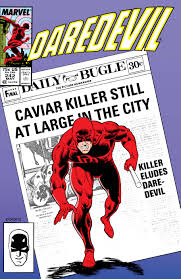 DAREDEVIL #242 (May 1987)
“Caviar Killer”
Writer: Ann Nocenti
Penciller: Keith Pollard
Inker: Danny Bulanadi
Letterer: Joe Rosen
Colourist: Max Scheele
Editor: Ralph Macchio
To be honest, the Caviar Killer is a pretty marginal inclusion in this feature. He’s a serial killer who appears in one story.
But Ann Nocenti’s run opens with Daredevil taking on a string of one-off characters (plus one guest), all of whom are mentally ill in one way or another, and most of whom are homicidal – Jack Hazzard, Sabretooth, Rotgut and the Trixter. The Caviar Killer completes the set before we move on to something else. And this issue is something of a turning point, since the real focus of the story isn’t on the Killer at all, and it’s also the first time that Nocenti starts to branch out beyond Hell’s Kitchen again. This story involves rich people – and, as a result, class conflict.
The opening scene isn’t subtle. Joe, who seems to be some sort of union representative, shows up at the home of the rich man who owns the chemical plant we works. The man lets him in, and gives him a complacent lecture about ambition and trickle-down economics while eating his one-man banquet. He’s massively unsympathetic and condescending, but evidently considers himself to be eminently reasonable. He claims to have worked his way up from poverty himself (and nobody ever tells us otherwise), and seems to genuinely believe that anyone else could do the same. When the man brushes off his pet dog breaking a “pre-Columbian burial urn” and starts feeding it steak, Joe snaps. He yells a bit about the distribution of wealth, then assaults the plant owner and starts shoving caviar down his throat. Somehow or other, this proves fatal – presumably it’s meant to be a heart attack.
After a moment’s panic about his wife and kids, Joe decides that he has crossed a line from which there is no going back, and tries to call the police to turn himself in. But the police put him on hold, so he decides to phone the Daily Bugle instead, and gets put through to journalist Simon LaGrange. Sensing a story, LaGrange strings Joe along by telling him he’s a Robin Hood figure and promises to come right over.
By the time LaGrange shows up at the house, the staff have apparently scattered, and Joe has bought into the Robin Hood idea. He’s painted the walls, and the dead man’s face, with dollar signs. And he tells Simon that he murdered the man, even though he didn’t. Joe claims that he’s seizing control of his destiny in exactly the way that capitalism says he’s supposed to, and instructs LaGrange to “tell your Bugle readers I say rich folk better start givin’ to the poor – or I’m going to come get them.”
So far, this is all pretty standard Eat The Rich stuff. But as it turns out, that’s not where the story is going. LaGrange is thrilled by Joe, not for any political reasons, but simply because it’s a chance to be involved in a big story. Joe’s next attack also involves a massively rich couple – he strangles the wife to death with her own pearls – but they don’t seem quite as bad as his first victim. While Joe is still righteously offended by their enormous wealth, they seem to have more genuine affection for one another (the first guy was banquetting alone), and they’re about to head out to a charity event. We’re told later on that they were really big charity donors. So they were already doing what Joe demanded.
At this point, the focus of the story shifts to the internal argument at the Bugle. LaGrange is keen to make his name and sell papers, while the likes of Ben Urich think that the paper is actively encouraging a murderer. La Grange claims that protecting his sources is a good reason for not turning a serial killer in to the police. There’s a gesture in the direction of that being a reasonable argument, but LaGrange’s colleagues are horrified by this approach, and it seems fairly clear that we’re meant to agree.
Joe continues his killings, with the media continuing to give him breathless coverage. Ultimately LaGrange arranges a secret TV interview with Joe, and a bunch of admirers show up to watch, wearing shirts with Joe’s red dollar-sign logo. They’re apparently some sort of underground support network that’s grown up around him. LaGrange describes them as “the faces of America! Good, solid men who work with their hands as their fathers did, work every day of their lives, yet they will never get rich!” The art does indeed show them all as men, though there seems to be a fairly wide range of age and race. This being the late 80s, I can’t help suspecting that they were meant to be wearing dollar-sign T-shirts, but Keith Pollard’s art renders them as knitted jumpers, which is cosily mundane.
Joe starts making his speech, claiming that his faith in America has been broken by the realisation that it’s impossible to break out of poverty. Daredevil has no interest in the political subtext at all; as far as he’s concerned, this is just a serial killer and the motivations are beside the point. In fact, the political angle doesn’t even seem to register with Daredevil. You’d have thought he might have things to say about it, since he did escape Hell’s Kitchen poverty to become a successful professional – and he’s now returned to it in a rather rose-tinted way following “Born Again”. But as far as Daredevil is concerned, none of this would justify Joe’s murders, and therefore it’s simply irrelevant. All this ties in with a subplot about Daredevil’s own media image, and his lack of interest in how he’s depicted, even though his reputation and intimidation factor are meant to be important to him.
To be fair, Daredevil does recognise this as a story about a media frenzy – it’s the 1980s version of the story that would now be done with social media radicalisation. When the crowd try to defend Joe, Daredevil fights them in front of the cameras. In keeping with the new status quo, he declares himself to a representative of the working man, but it’s notable that we never see any other negative reaction to Joe, except from some of the journalists. Depending on how you view ex-lawyer Matt Murdock at this point, you might well see him too as a class tourist, no matter what his origins were.
The fight ends when Joe surrenders, having conveniently come to his senses with three pages to go. To be fair, there’s a definite implication that this is what Joe was already planning to do before Daredevil interrupted him. If so, all that Daredevil has achieved here is to make Joe into more of a rallying point for his followers. Daredevil accuses LaGrange of exploiting a man who only needed help, and grumbles that the journalist probably hasn’t committed any crimes. Despite that, the police then arrest LaGrange too, though it’s not clear what for.
Joe is one of those Nocenti characters who exists to make a point and, having made it, won’t be needed again. Naturally, he never returns. The moral is spelled out rather directly by the standby journalist who wraps up LaGrange’s broadcast: “So who was the killer – Joe or the media? Can the camera be pointed at someone and fired like a gun?” In fairness, Daredevil and the cops roll their eyes at this continuing babble, but it is a central theme of the story.
Not that there’s any real uncertainty about what side we’re supposed to take. Nocenti clearly thinks that Joe is right about the principle of inequality and wrong about the murder bit; and that while LaGrange isn’t exactly evil, he’s certainly a representative of an amoral and irresponsible media who only care about attention. None of this is exactly a surprising place for the story to wind up, and LaGrange’s arguments are treated as obvious self-justification. Even so, it’s a successful story, since while its central point is hard to miss, there’s a lot more ambiguity going on around the edges, with Matt’s questionable positioning of himself as a working man, and his dubious grasp of image and reputation.
The main issue with this story is simply that we’ve had a lot of villains in the same vein, and it’s time to move on. We’re still a little way off reaching the recognisable names of Nocenti’s run – but from here on, she will be taking the book into different areas again.

Bob Ingersoll wrote a column about this issue in his “The Law is A Ass” series:
https://www.worldfamouscomics.com/law/back20010828.shtml
He seemed to think that LaGrange indeed committed conspiracy to commit murder.
Ah, the beginning of the Ann Nocenti run and the end of her “serial killer tour,” in so many words. I recall getting a few issues of her run after my childhood subscriptions to some Star Comics stuff like Healthcliff ended and I got switched to some other comics to finish out the year. A few thoughts:
“He yells a bit about the distribution of wealth, then assaults the plant owner and starts shoving caviar down his throat. Somehow or other, this proves fatal – presumably it’s meant to be a heart attack.”
The boss man could have also been choked to death; having food force fed into you can do that. It could also induce a heart attack. The cause is ambiguous.
“He’s painted the walls, and the dead man’s face, with dollar signs.”
With the dead man’s blood. Quite an escalation.
“Joe continues his killings, with the media continuing to give him breathless coverage.”
One of those killings, according to a newspaper headline, involved somehow shooting a rich man through the heart with a diamond. That’s a quite unusual, comic book style way to kill someone after two murders of opportunity with nearby objects. Did Joe load a diamond into a handgun? The 1980s were a wild time in comics since the Silver Age was over and content was getting more “mature,” “Gritty,” and “realistic,” but some Silver Age trappings remained out of habit, like shooting people with diamonds or themed cardigans.
Case in point; the next arc involves voodoo and drug dealing. How very 1970s.
I don’t think Joe is meant to be painting in the guy’s blood. He’s holding a paint pot when Simon arrives at the mansion, and casts it aside two panels later.
That’s our Nocenti – didactic soapboxing delivered with all the subtlety of a Muppet News Flash.
That’s a remarkably lame cover.
Yeah, it’s pretty bad when the corner box is better than the actual cover image.
Even though I never read these comics, it’s making me nostalgic for this era. I began collecting in 1988, and bought a lot of Marvel back issues from this time period. It’s fun to remember when comics were villain-of-the-month more often than not.
That’s our Nocenti — writing about worker’s rights; class warfare; media over-saturation; and reporters betraying the public trust in order to serve their own agenda. I can’t believe she thought these themes were still going to be relevant when re-read 40 years later.
Why couldn’t she just write about people punching each other?
She really was ahead of her time.