Uncanny X-Men #24 annotations
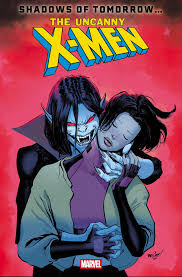 UNCANNY X-MEN vol 6 #24
“Where Monsters Dwell, part two”
Writer: Gail Simone
Artist: David Marquez
Colour artist: Matthew Wilson
Letterer: Clayton Cowles
Editor: Tom Brevoort
COVER: Morbius, about to bite Jubilee.
THE X-MEN:
Rogue. We get a flashback to her watching old monster movies on TV as a kid; she says she finds the Legion of Monsters scary as a result, but also recognises that the X-Men are acting weirdly in this issue – Jubilee isn’t fighting back properly, at least at first, and the group allow themselves to fight separately instead of working as a team. So everyone’s behaviour (in the core team) should be taken with a degree of caution. Their opponents in the Legion of Monsters are out of character to carying degrees as well.
Wolverine. Rogue thinks he’s a bit more violent than usual here, though it’s not really outside normal parameters for him – more a slight throwback to earlier days. An attack on his carotid artery can cause him to bleed out enough to remove him from the fight temporarily. Somehow – presumably because of the bite – he apparently gets turned into a werewolf.
Gambit. Despite his behaviour last issue, when the X-Men were trying to stage an intervention over his addiction to the Eye of Agamotto, he seems relatively normal here. Perhaps he’s the team member most used to keeping up a persona (including for himself). He disdains the theme park as tourist-level Cajun schtick.
Nightcrawler. He seems quite unnerved by the monsters, though he suggests that Frankenstein particularly unsettles him, “as part of my folklore”. (Although Frankenstein isn’t really folklore, or German for that matter, since he was created by Mary Shelley in 1818.) His lines of German are “Mother. I’m really not having any fun at all.”; “My god! It’s the monster, it’s really the monster!”; and “My brother, must we fight?”
Jubilee. She seems paralysed by the monsters, possibly because of her personal association with vampires – though she does ready herself to fight Morbius later in the issue. She admits to missing aspects of being a vampire.
GUEST STAR:
The Rawhide Kid. Presumably – there’s bound to be a reason why Marcus’ story links to the main plot, right? For what it’s worth, the name of the town in the story has changed from “Willow Flats” in the previous issue (which was actually part of Rawhide Kid’s back story) to “Willow Falls” in this one.
Quite reasonably, he’s not willing to guarantee that he can shoot Pete without hurting his hostage.
SUPPORTING CAST:
The Outliers (Ransom, Jitter, Calico and Deathdream) appear almost entirely in the western story segment. In the story, Jitter can imitate Hawkeye, which seems fair enough in terms of her powers. Marcus implies that Calico’s horse Ember is “magic” in his own right.
Marcus St Juniors continues to tell the story, and Chelsea St Juniors serves as a hostage within it, as well as part of the audience.
Waffles. Deathdream’s cyborg dog attempts to defend Haven House from the Mistress and Salem as the issue ends.
VILLAINS:
Mistress. The Legion answer to a woman referred to simply as “Mistress”, who’s accompanied by a large wolf thing called Salem. She vaguely resembles the current design for Agatha Harkness, but that’s probably a coincidence, since she refers to being undead. She says that she plans to claim New Orleans as a city of her own – she refers to it as a “new Darkhold”, and later in the issue Elsa seems to refer to Rogue as a “Darkhold” too. In the Marvel Universe, the “Darkhold” is normally the name of a book of black magic, which is basically Marvel’s version of the Necronomicon.
The Legion of Monsters continue to fight the X-Men at her behest:
- Elsa Bloodstone still appears possessed, with blank eyes, and she’s clearly acting out of character.
- Frankenstein’s Monster only seems able to say the words “Mutant. Bad.” This isn’t normal for him – Marvel’s version of the character is usually quite articulate.
- Werewolf By Night. He doesn’t speak, but he does seem to be fighting intelligently, with a realistic strategy to take down Wolverine.
- Morbius. The one member of the Legion who seems to be acting more or less normally – he at least expresses regret about having to harm Jubilee, and tries to engage her in conversation. It might be significant that Morbius isn’t genuinely magical – perhaps he’s less susceptible to Mistress’s influence than the others?
- Manphibian and the Living Mummy are also there, but don’t get much to do.
Cobra Pete. The villain in the western story may or may not have any sort of counterpart in the real world. He’s certainly not a genuine Rawhide Kid villain. For what it’s worth, the Cobra’s real name is Piet, but that’s probably just a coincidence. Cobra Pete’s coat design seems clearly designed to echo a cobra’s hood, though. In the story, Cobra Pete and his men have been bitten by some sort of zombies and now become undead monsters at night. Like Mistress, he claims to be mainly interested in claiming the town as a home for his monsters; clearly, it defies belief that Marcus would come up with this by coincidence, so something must be going on.
OTHER REFERENCES:
Sweet Water Park. Rogue describes this as a theme park that was abandoned by its owners after Hurricane Katrina in 2005. The likely reference point is Six Flags New Orleans, which never reopened after Katrina, but wasn’t demolished until 2024. Six Flags declared it an economic write-off in 2006, although there was a dispute about whether they were entitled to walk away from the lease, which became academic when Six Flags entered bankruptcy in 2009.

Is it me or are we seeing more homage covers?
This issue reminded of the Dracula/Stork cover from that annual.
Belay that. Ijust looked at Annual 6. Wonder what I thinking of instead.
The point still stands though. 🙂
“In the story, Jitter can imitate Hawkeye, which seems fair enough in terms of her powers.”
Sort of. The major limitation on her powers, beside the time limit, is that she can only imitate the abilities of dead people. Marcus is assuming that she can imitate the abilities of anyone UNLIVING and Hawkeye counts because he wasn’t born yet. It’s not clear if Marcus is right.
Gail still doesn’t quite have the hang of Jubilee’s dialogue. In the FCBD issue Jubilee quoted Corinthians and in this issue Jubilee says “It’s covered in the patina of death and I’d rather have a fraught life.” It just doesn’t sound like Jubilee.
“She vaguely resembles the current design for Agatha Harkness, but that’s probably a coincidence, since she refers to being undead. ”
Also, Agatha is currently stuck working for the Vishanti as a result of a Magical Debt thingie and turning New Orleans into a city of monsters isn’t something they’d probably approve of.
I have to wonder if Mistress is supposed to be Shiklah. She’s ruled over the Monster Metropolis, where the Legion of Monsters reside, before.
“Sort of. The major limitation on her powers, beside the time limit, is that she can only imitate the abilities of dead people.”
Are we sure that’s correct? I thought her ability was to be the best at any one skill for a minute. Best chess player, best tango dancer, best lockpicker. In that vein, “best archer” is easily within her scope.
Now… invoking Hawkeye in the Wild West? That’s a different issue. If we assume Marcus is telling the story, he may have used “Hawkeye” as shorthand for “archery” even though it would be anachronistic and impossible for a character in the Wild West to invoke a future archer. So it’s storyteller’s error/choice.
ALTHOUGH… Hawkeye HAS time traveled to the era of the Rawhide Kid and Two-Gun Kid, so he could very well be alive and well at that very moment -in- that very moment. Synergy! He’s also time traveled to -earlier-, as far back as Ancient Egypt… but now my head hurts.
Now, what if we’re taking about the Kate Bishop version of Hawkeye?
Let’s go back to assuming it’s a storyteller’s error and the Sofia of the story is merely invoking “I’m the best archer in the world.”
Now, WHY are we getting THIS story at the same time as the Monster Squad attacking New Orleans? I wonder if there’s some sort of multi-layered narrative where the power of the story will affect the real world.
I wish we’d gotten an identification for the mystery villain.
@The Other Michael- In issue 16, Shuvahrak says that Jitter “may borrow the gifts of the long since departed”. And Jitter doesn’t contradict her.
I have to question the wisdom in producing a cover that teases the return of something (Jubilee as a vampire) that nobody seemed to much care for the first time around.
That aside, the cover looks really familiar. I swear I’ve seem something like that but I can’t place it.
Are you maybe thinking of the cover of Exeptional X-Men 7 and/or 10?
@Moo,
It’s most likely a homage to a famous Tomb of Dracula cover , which was done at least twice in different volumes over the decades
https://www.marvel.com/comics/collection/82349/tomb_of_dracula_the_complete_collection_vol_4_trade_paperback
https://tvtropes.org/pmwiki/pmwiki.php/ComicBook/TheTombOfDracula
@Si – Nope. Neither. Whatever it is that I’m thinking of, it more closely resembles this cover but with two other characters. Like, it feels like this cover is an homage to some other image.
I’m not even sure if it’s another comic. It might even be a book cover or a movie poster.
Or maybe I’m just imagining it, I suppose.
Regarding the “folklore” comment: In the Marvel universe, Frankenstein is a non-fiction book; it’s not implausible that he has also entered folklore.
There’s also a somewhat complicated / meta element here. As depicted in this story, The Creature is inarticulate, as opposed to his normal literary portrayal. This makes him much more similar to the version seen in the “creature feature” movies that Rogue referenced, which is the version more people are familiar with. The Frankenstein films are also a major source for the popular/folkloric image of the “torch-bearing mob of villagers” — such as the one pursuing Nightcrawler in his very first published appearance. I think this “mob” connection is why Simone had Kurt specifically concerned with the Creature.
“He seems quite unnerved by the monsters, though he suggests that Frankenstein particularly unsettles him, “as part of my folklore”.”
Perhaps Kurt needs a reminder that — while the monster was brought to life in Ingolstadt, Germany — Victor Frankenstein was born in Italy, grew up in Switzerland, and the vast majority of the novel takes place in Switzerland, Britain, and the arctic. If memory serves, I don’t think the creature commits any murders in Germany.
(That said, it’s been a while since I read Marvel’s “The Monster of Frankenstein” series, so maybe they relocated parts of the novel to Germany and I’m just forgetting.)
@Drew- Keep in mind that Max Frankenstein of the Hellfire Brats, the member of the Frankenstein family that the X-Men have had the most interaction with, is German- he was expelled from the University of Munich.
Maybe Kurt is talking in historical terms, considering it was Germanic peoples who were the original settlers of what became Switzerland, and the modern-day country of Switzerland was first unified under Rudolph I, King of the Romans, who was German.
@Michael: Of course, the story that focused on Max Frankenstein wouldn’t have endeared the X-Men to the Monster, either.
After this arc, I imagine they’ll wonder why the real Monster can’t be more like that nice alien robot Frankenstein’s Monster from the Silver Age.
OK, I decided to dig out my Essential Frankenstein’s Monster volumn to do the research. I am spending way too much time on a comic series I did not enjoy. In Frankenstein’s Monster #5, Robert Walton IV informs the Monster (found frozen in the Arctic) that he has one last descendant alive in Ingolstadt, which leads the revived Monster to head to Germany. After he arrives in Germany, he has some adventures at Castle Frankenstein, which of course is a real place in Darmstadt. The Monster discovers that his last descendant, Jason, is long gone, and the army has taken over the castle. The Monster ends up killing the Colonel in charge of the abandoned Castle Frankenstein. This occurred in 1898.
The real Castle Frankenstein was the home of the German alchemist Johann Konrad Dippel, who served as the inspiration for Victor Frankenstein in Mary Shelley’s novel. I don’t know how well any of this was known in the Marvel Universe, but considering there is a real Castle Frankenstein in Germany, and the Frankensteins are an actual lineage in the Marvel Universe, I guess you could see how Kurt might see the Frankenstein’s Monster as part of his native folklore. In real-life, Frankenstein simply means “rock of the Franks”.
I’m still not sure “folklore” is appropriate here. I can see how Kurt might feel a cultural connection to Frankenstein, but folklore typically begins with people trying to explain the unexplained, making their own interpretations, concocting their own stories based on those interpretations, and then passing those stories down through the generations.
But since Frankenstein is real in the MU, and Mary Shelley’s book is a biographical account, I don’t understand how folklore would come out of it when people could just read the book.
@Moo Fiction and non-fiction are weird in Marvel. The Adventures of Sherlock Holmes is a biographical depiction of Kurt’s mothers (Mystique was Sherlock and Destiny was both that Irene Adler and Mystique’s Watson stand-in) for an example.
I don’t think it’s widely known that Mary Shelley based her novel on a true story. If I remember correctly, when the X-Men met the Frankenstein’s Robot, Xavier said he “long suspected that the novel was based on a true story” (apparently Xavier is insane). Probably only select inhabitants of the Marvel Universe realize the truth, and since Castle Frankenstein exists, and Victor Frankenstein and the other characters in the novel were real, it could have led to stories being told in parts of Germany and/or Switzerland based on the rumours about what truly did happen.
Okay, but people are either aware that Frankenstein is real or they’re not. If they’re not, then, to them, Shelley’s book is a work of fiction, which goes right back to Paul’s original point about why the folklore remark didn’t make any sense.
On the other hand, people who are aware that Frankenstein is real have to be aware that Shelley’s book is either biographical account or a work of fiction based on true events, and I don’t see how folklore would come out of that either. Urban legends, on the other hand, sure. Absolutely. Myths and misconceptions surrounding real people is fairly commonplace, but then that doesn’t make Frankenstein all that different from Spider-Man in that regard.
Yes, but Shelley wrote her novel in 1818, while the events she was chronicling took place sometime in the late-1700s.
We have plenty of real-world examples of this type of circumstance with something like cryptids. We’ll use Bigfoot as an example. Bigfoot is often used as part of local folklore in the US or Canada, but there are authors who write fictional accounts based on the true-life folklore about Bigfoot. It would be the same with Frankenstein and his Monster. There is plentiful time for folklore to develop about incidents at Castle Frankenstein or in Geneva about what might have occurred. Shelley then travelled in those areas collecting the local lore to develop into her biographical novel, which many consider to be fiction (just as many people consider Bigfoot to be fictional).
@Chris V- In an issue of Dr. Strange it was stated that Shelley heard the story from one of the surviving members of the Frankenstein family.
Darn. I believed Mary Shelley in the Marvel U was the original John A. Keel.
Hi, Moo.
I also get the vibe from the cover. Could it be this: https://www.reddit.com/r/xmen/comments/1irwpvt/shadowcat_and_colossus/
@AlexC – Hey, I think that’s it! Thank you. Now I can sleep.
…wait, since the Marvel Frankenstein typically looks and acts more like the Boris Karloff version than anything from the original novel, does that mean Marvel Hollywood is a hell of a lot more dedicated to historical accuracy and authenticity than its real life counterpart?
I guess it would explain why Silver Age heroes kept falling for that “We’re shooting this fight scene for the movie about you by having supervillains attack you for real” plot.
Wouldn’t it be fairly obvious in the MU that novels Dracula and Frankenstein that they were “real?” It wouldn’t take much work to verify the existence of the likes of Victor Frankenstein, Mina Harker, and Quincy Morris.
Additionally, there’d be records surrounding transactions surrounding Carfax Abbey, the murders the Monster committed (and the woman who was framed and executed for them), and Renfield’s commitment to an asylum.
Perhaps the MU versions of the novels are very different than the versions in the real world, much as in-universe Marvel Comics are sometimes shown to be very different because they’re written from an in-universe perspective with limited information.
Maybe the MU versions of the novels are more like Poe’s “Mystery of Marie Roget” in contrast to its real-world inspiration in the real death of Mary Rogers.
With Victor Frankenstein, maybe it’s the same as Robert Anton Wilson’s novel The Earth Will Shake. Johann Konrad Dippel used the alias of Victor Frankenstein.
Gail Simone has confirmed that Mistress isn’t Agatha Harkness.
Someday.. I’d love Jubilee to actually have a storyline
@Chris V (apparently Xavier is insane).
I mean, he was right.
You can worry too much about what stories being “real” but also existing in-universe actually means. Sherlock Holmes’s fame supposedly comes at least partly from Watson publishing his accounts of the cases, but he frequently has to explain to clients who Watson even is.
Wait, do either Morbius or Jack Russell have the ability to pass on their vampirism/werewolfism?
I’m no expert on either, especially not Jack, but they’ve both been around and biting people for 50 years, so it’s strange I’ve never seen it come up before.
Morbius can make pseudo-vampires like himself. He can cure them with a serum.
Jack Russell can pass on his curse; at one time in his Marvel Comics Presents series, he had enough control over to avoid doing it involuntarily.
Jack Russell is odd. For the first twenty years of his existence, he was biting and scratching recurring characters all the time and none of them was turned into a werewolf. Then in that Marvel Comics Presents story he encountered a motorcycle gang that had been infected by his curse. This made no sense- Jack had injured Tony Stark and Tony didn’t turn into a werewolf. You could maybe say that Tony had access to a mystical cure from Dr. Strange but that doesn’t really work for supporting characters like Buck Cowan who are unlikely to have ever met Strange.
There was a Legion of Monsters miniseries a decade or two back with solo stories for most of Marvel’s monster characters, and in Morbius’s story, he’s able to transform an ODing junkie into a vampire to “save” her “life.” (Unfortunately she’s already brain dead, so she comes back as a mindless monster.)
I’m not sure any of those stories are considered canon, though.
I don’t see why they wouldn’t be considered canon. There’s nothing in any of the other issues that would preclude them being canonical, and Marvel’s monsters solo tales often had a nebulous place in the wider official continuity of the Marvel U anyway, even though the stories were considered part of continuity.
The Morbius story was by CB Cebulski, so you know he’d went that story to be canon.
There were great stories by Mike Carey (Werewolf by Night) and Jonathan Hickman (Living Mummy) included in those one-shots which deserve to be included as continuity. I’m pretty sure the Living Mummy short story was Hickman’s first work for Marvel too.
I know that the MarvUnApp web-site considers the Legion of Monsters Living Mummy story to be canon, and the Marvel wiki considers the Satana appearance to be contemporary with the wider Marvel U comics of that period.
[…] X-MEN #24. (Annotations here.) What a weird arc. We’re doing fifties throwback with Marvel’s monster movie character […]