Daredevil Villains #83: Typhoid
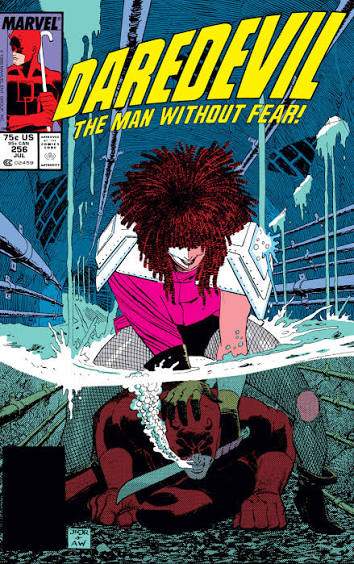 DAREDEVIL #254-256 (May to July 1988)
“Typhoid” / “Temptation” / “Blindspots”
Writer: Ann Nocenti
Penciller: John Romita Jr
Inker: Al Williamson
Colourist: Max Scheele
Letterer: Joe Rosen
Editor: Ralph Macchio
Up to this point, Ann Nocenti has given us a lot of one-off villains, and a few who showed more staying power. But Typhoid really is a major addition to the rogues gallery, and someone who goes on to be used across the Marvel Universe.
She’s also the first Nocenti creation to get an extended storyline. Previous new characters appeared in one or two issues, but Typhoid is around for nearly a year. While I’ve given the credits for issues #254-256 above, she appears in some form in every issue from #254 to #263, except for a fill-in story in issue #258.
Issue #254 opens with a splash page of Typhoid, complete with her swords, her one-armed jacket, her weird metal shoulder plates, her fishnets, her braids, and the white make-up on the right half of her face. She has a serious expression. Meanwhile, the narrator tells us that poisonous people live among without knowing what they are, doing what they have to do to survive. “Touch her, she’s the best,” the narrator adds. The opening scene has her breaking up a mugging, only to enlist the mugger as her sidekick – she “brands” the guy by clawing his face with her fingernails, offers him excitement, kisses him, and declares that “Typhoid’s on top, she calls the shots”. It’s mostly played as if the mugger, Rip, is receiving some sort of infection.
Soon after, Typhoid and Rip burst into a room full of crack dealers and gunning them all down. Although she mentions something about killing scum, Typhoid actually seems to be mainly there to steal their cash. Somehow, the room catches fire. And then she insists on having sex with her befuddled new underling, in the burning building full of dead people.
It’s quite the way to introduce a new villain in a Code approved comic in 1988.
Typhoid carries out a string of these attacks, which attract the attention of both the Kingpin (since she’s interfering with his business) and Daredevil (who takes her to be a Punisher-style vigilante). Via the Kingpin’s investigations, we get a brief origin story. Typhoid has had a multiple personality since infancy: “Mary”, who is fragile and sickly, and “Typhoid”, who is murderous and apparently immune to Mary’s illnesses, but runs a constant fever. Mary is so innocent that she’s oblivious to Typhoid’s very existence. Somewhere along the line, Typhoid has escaped from her institution, spent some time as an actress, and then become a criminal. She also has low-level psychic powers, which will later lead to her being classed as a mutant, but in this story are simply unexplained.
The two personalities have entirely different heartbeats, scents and so forth. The conventional dual identity trope doesn’t really work in Daredevil because Matt ought to be able to recognise the same person in different clothes. Typhoid inverts that – everyone else can tell that she and Mary look the same, but Matt is oblivious. Naturally, the two personalities are played as a distorted parallel of Matt and his Daredevil identity.
The Kingpin decides that this woman’s remarkably convenient qualities are almost perfectly designed to mess with Matt Murdock, and he’s not wrong. For a while now, Kingpin has been trying to lure Matt into litigating against one of his companies, Kelco, which polluted a river and blinded a kid called Tyrone. Kingpin’s idea is to win the case by throwing money at it, and to break Matt’s faith in the legal system. Now he plans to ruin Matt’s personal life too, by having Mary seduce Matt and Typhoid seduce Daredevil. “When the smoke clears,” Kingpin thinks, “you will have destroyed a man as only a woman can.”
Typhoid duly shows up to meet the Kingpin, and tries her psychic schtick on him, but the Kingpin turns out to be out of her league in that regard. After being momentarily taken aback, she changes gear and starts treating him as if they were equals. This is key to their pairing in the coming issues: Kingpin thinks she’s a tool under his control, but tolerates what he regards as her pretensions of autonomy… up to a point.
At any rate, Typhoid accepts the contract. Soon after, while Matt is visiting Tyrone in hospital, Mary shows up claiming to be a volunteer worker with the blind, and starts talking about her blind father and about how incredibly insightful blind men. Matt is naturally smitten.
This is where the story doesn’t quite make sense. If Mary is oblivious to Typhoid, then why is she trying to seduce Matt? And how did she get set up as a volunteer worker so quickly? Apparently she’s not lying – she seems to have some legitimate support role for Tyrone – but does that mean that she was coincidentally already a volunteer working with blind children before Typhoid was hired? Or that the Kingpin set her up with the job overnight, without her being aware of it? On some level, for this to work, we have to accept that Typhoid is able to steer Mary, or that Mary is subconsciously reaching out to Matt to protect her from Typhoid – which certainly seems to be the case in later issues. For whatever reason, though, Mary is flirting with Matt from the off. (Typhoid suggests that Mary is genuinely in love with him and claims to be enjoying the prospect of breaking Mary’s heart too.)
Later in the same issue, they meet again as Daredevil and Typhoid. She presents herself to Daredevil as the unfettered version of his vigilante persona. She also calls him her “merry Christian”, a phrase that she keeps coming back to, in apparent mockery of his professed values. But the Typhoid persona makes far less headway in seducing Daredevil: he perceives her as blurry, indistinct, and finds something about her inexplicably disorienting and repellent. Basically, he reacts to her as if she’s a feverish hallucination.
Meanwhile, the Kelco subplot reaches trial. Nocenti’s grasp of the law is very shaky, and it’s never entirely clear how strong Kelco’s legal defence is meant to be, but the basic angle is meant to be Matt making an overriding pitch to the jurors’ morality. Once the jury are out, the Kingpin can see that things are going badly, so he sends Typhoid to intimidate a juror. Interpreting this remit in her own unique way, Typhoid shows up at the poor woman’s house, lectures her about how boring she is, and calls her a bad feminist for playing by the rules instead of “grab[bing] at power”. Then Typhoid reports back to the Kingpin, claims that the meeting was a massive success, and tries to make the Kingpin jealous by talking up how hot Matt is.
Later that night, Typhoid and Daredevil have an odd underwater fight in a sewer, where she taunts him for having kissed her as Mary, and he completely fails to realise what she’s talking about. Finally, the jury find against the Kingpin and everyone is happy, including Mary.
That’s the opening arc. Here’s where the storyline goes after that. Kingpin confronts Typhoid about the fact that she’s fighting Daredevil when she was meant to be seducing him, and suggests that the Mary persona’s love for Matt is holding her back. Typhoid privately concludes that he’s right, and that Mary is gaining influence because of Matt. Because she doubts that Mary will let her attack Matt directly, she rounds up all of Matt’s villains from the last year or so to attack him instead. That fight ends with Daredevil defeated, and Typhoid chucks him off a bridge while shedding a tear.
The Kingpin isn’t at all happy about this turn of events, because it bears no resemblance whatsoever to the original plan. This lead to Typhoid literally encouraging Kingpin to “beat me, tie me, throw me in a river” and “make me happy”, after which he slaps her about, and they appear to have sex. Again, this was a Code approved book. Afterwards, Typhoid still thinks that she’s the one in charge.
The final two Typhoid issues are an “Inferno” tie-in, with New York transformed by demons thanks to events over in Uncanny X-Men. As with “Fall of the Mutants”, Nocenti treats this simply as a backdrop to her own stories. Supposedly, once “Inferno” was over, Marvel’s New Yorkers wrote it off as a mass hallucination. Daredevil is the book where that makes most sense, as it presents “Inferno” as less a literal transformation and more a delirious mass psychosis. During these events, Mary tells Karen Page about her and Matt – so ironically, it’s Mary, not Typhoid, who actually fulfils Kingpin’s original remit. Later, Typhoid shows up in a subplot, and introduces the Kingpin to Mephisto.
And that’s it. Typhoid doesn’t return to Daredevil until DG Chichester’s run.
But Nocenti did return to Typhoid in a string of Marvel Comics Presents stories, which are rather cluttered by guests like Wolverine and Vengeance. In those, we meet two more personalities: Bloody Mary, who kills domestic abusers, and “Walker”, a unified personality who seems to be the stable one. The core idea is that the first three personalities define themselves in relation to men – “Virgin” Mary seeks protection from men, Typhoid Mary tries to use men, and Bloody Mary hates men – but Walker has escaped this trap and embodies a more coherent feminism oriented around Mary herself.
All that has largely fallen by the wayside. Although the character became a staple of the Marvel Universe, it was predominantly Typhoid that came back, with the innocent Mary showing up to some degree.
Originally, Typhoid was an interrogation of the bad girl trope. Indeed, as a blade-wielding red-clad woman working for the Kingpin and in a love-hate relationship with Daredevil, she seems to be a riff on Elektra. Maybe not a parody of Elektra as such, but at least a sickly distortion of her, and of Matt’s relationship with her.
Later writers have been much more prone to taking the Typhoid persona at face value. That works too; Typhoid is at least a distinctive version of the trope, and she can bring a general hint of madness to proceedings even when nothing deeper is in play. She still fills a unique role in that capacity. She’s certainly one of the Nocenti/Romita creations with the greatest staying power. But it feels like what has stuck is the character’s surface level, rather than her animating ideas.

“If Mary is oblivious to Typhoid, then why is she trying to seduce Matt?”
I think that the idea is that Typhoid can influence Mary to a degree with Mary realizing it.
“Later, Typhoid shows up in a subplot, and introduces the Kingpin to Mephisto.”
I don’t think that was meant to be Mephisto but another demon.
Much later, Frank Miller will do a Daredevil: Man Without Fear miniseries. In it, Matt invades a brothel in search of the men killed his father and winds up kicking a prostitute out a window. This miniseries contradicted previous continuity- it features Matt’s father dying before Matt met Foggy. (it was supposed to be a movie script before being adapted into a comic.) But later on, JM DeMatteis referred to Matt killing the prostitue in his brief run on Daredevil.
So later on Joe Kelly revealed that the prostitute that Matt kicked out the window was Typhoid Mary and that Matt kicking her out the window was the trigger that caused the multiple personalities. I never liked that idea- as noted, Typhoid’s split personalities aren’t just normal alters- they change scent, heartbeat, etc. It’s much more likely that they were there from birth. Anyway, the story ends with Matt disclaiming responsibility for what Typhoid became and feeling glad that he didn’t really kill the hooker- it came across as a bizarre ending.
Deadpool had hoped confronting Matt would be cathartic for Typhoid. Instead, she got even worse- she raped him by using an image inducer to impersonate Siryn and had sex with him.
In the recent Alias Red Band series, the writer seems to write Typhoid like Harley Quinn.
There are a bunch of characters with some subset of Typhoid’s characteristics: Elektra (as mentioned above), Looker, Manslaughter, Kwannon/Psylocke. Once her broader set of identities is revealed, she reminds me of Crazy Jane, although Jane takes those ideas even further. That’s a fun crowd.
If every identity is a “Mary” in some sense, is Walker inspired by this Mary?
https://en.wikipedia.org/wiki/Mary_Edwards_Walker
Nocenti returns to some of these same themes with the Brandi Clark and Number Nine characters in her final few arcs. Mephisto even shows up as the villain, as if to tie it all back to Typhoid’s “Inferno” appearances.
Interestingly, in the “Inferno” tie-ins, Typhoid seems to be quite at home, even as the Kingpin is deeply unnerved. My read on it was that it plays as the end of their struggle for dominance, with Typhoid coming out the winner.
More broadly, the Kingpin’s anger at Typhoid is clearly presented as partly rooted in sexual jealousy. He insists that Typhoid is “his,” and not Murdock’s at a few points.
The writers immediately following Nocenti seem to struggle with using the characrer. Gruenwald, in Captain America, and Chchester in his first few issues both just have her sort of standing around in the background while the Kingpin plays ot his usual characterization.
Then Chichester writes the character out entirely, and nobody other than Nocenti writes Typhoid much until she’s brought into Joe Kelly’s Deadpool series in the mid-1990s.
(This is not counting that utterly bizarre “Acts of Vengeance” story in which Typhoid is set against the youngsters of Power Pack.)
It’s a shame, because, as Paul says, there’s plenty of interesting potential in writing her alters to deliberately reflect social perceptions/cultural archetypes of women in exaggerated fashion.
Nocenti also wrote a Typhoid four-issue mini-series in the ‘90s which received a very rare “rated for mature readers” label from Marvel at that time. It’s very much worth reading and is very dark.
Nocenti had already given Typhoid Mary an origin story prior to Joe Kelly in a MCP story-line. She was severely abused by her father as a baby and the Typhoid persona was the way she managed to survive the abuse. She was later experimented on by the US government, apparently part of the MK-Ultra program. I always thought that rather being a mutant, Typhoid Mary’s pyrokinesis was meant to have been given to her by the government experiments, with Nocenti referencing Stephen King’s Firestarter novel. Apparently that was never the case though.
Finally, Daredevil gets a great villain with staying power that debuts within his own book. Unfortunately, only her creator has any idea how to write her. The half-painted face is a great visual. The name could perhaps have been better.
Matt is, famously, the jerk of his own story, and nowhere is that clearer than in this initial Mary story. Kingpin starts with the premise “obviously Matt will cheat on Karen” and this indeed turns out to be the case. The Mary persona doesn’t have psychic powers, there’s no suggestion Matt is being influenced, he’s just horny.
Typhoid, meanwhile, is comeuppance for Matt’s attitude to women personified. She talks to him like he used to talk to Natasha in the 1970s. Post Miller-Daredevil is very seldom seriously challenged in a (hand-to-hand) physical fight, but Typhoid is able to kick him around. It’s fun to watch.
Nocenti later uses her to interrogate Peter Parker’s attitude to women in Spectacular Spider-Man, in a story that makes a persuasive case that the Spider-marriage should have ended in 1995. I would have liked to see that version of Typhoid, the misandrist Punisher, show up in more stories.
Great villain. Top 3. Shame about later uses of her, Chichester in particular.
Typhoid is a great character because she is so disturbing even after we are used to her modus operandi.
I think that Nocenti expected us to wonder how much of a real separation there is between Typhoid and Mary. The evidence is all over the place; Mary seems to rebel against Typhoid a few times, but she also plays the necessary part to bait Matt flawlessly even in the most crucial and delicate of moments. Arguably, she is most accurately described as an accomplice and willing victim of Typhoid that happens to switch control of the same body when either has gone too far. In equal parts abuser and victim even towards herself. Mary needs Typhoid to survive, but Typhoid needs Mary even more to justify her own continued existence. Nocenti’s writing makes it very clear that, superficial traits and behavior notwithstanding, Mary and Typhoid are fully aware of each other and try very hard not to get in each other’s way even if it brings themselves considerable disconfort, abuse and pain. They are not nearly as much separate personas in conflict as they are separate and often excessive modes of operation trying hard to balance each other, loyal to each other above any external expectations and preconceptions.
It is shocking to see that the sickest trait of someone going around robbing, fighting and raping people may well be what she does to herself, but that is my predominant reading all the same. I think that it is what we see in Avengers Academy much later as well, but of course we can’t have it taken to its logical conclusion while also keeping her around for further use.
That is probably why I am not particularly bothered by Chichester’s use of the character, which may even be what resolved my conflicts about her and perhaps even about Nocenti’s run as a whole. In that respect she _is_ comparable to Punisher, who by rights ought to have been taken down a couple dozen different times already and has no business pretending to have some sort of moral high ground over anyone.
Daredevil/Matt does not look great when he makes his attempt at dealing with Typhoid during Chichester’s “Regicide” storyline. But looking great is not an option on the table. He does not look great when he allows Bullet to be Vance’s guardian either, nor when he arbitrarily leaves the clearly unprepared Number Nine wander off on her own, nor when he presumes to have authority over Eightball and the other Fatboys despite only interacting with them when it is convenient and confortable.
If Matt has any consistent trait through Nocenti’s run, it is that his coping mechanism of choice is changing the scene and avoiding any confrontations that are not of a physical or legal nature. He is quite the emotional cripple through the entire run.
Typhoid is one of my favorite things about Daredevil’s corner, and its extra cool this came out today as I’ve been reading all the Spider-Man series and I just finished Ann Nocenti’s Typhoid-focused guest arc in early 90s spectacular this morning this gives some extra context for that, so more thanks for that
I hope that the brief overview of inferno does not mean Paul is skipping Henry Hoover. That was going be the high light of this series.
It will be interesting to see what she is like when she finally comes back. She played a hero on krakoa will that lead in to a face turn. Will she make her way back to Fisk
Regarding the Chichester issues, the way Matt gets rid of Typhoid is really bad. Matt causes Typhoid to revert to Mary, then has sex with her. Then he arranges for her to be institutionalized under a false name. That seems like Questionable Consent.
Then again, Matt’s behavior throughout issues 297-300 was horrible. Matt can’t think of a way to get rid of the Kingpin’s legitimate business holdings, so he provokes a conflict between Hydra and the Kingpin. Strucker then destroys all the Kingpin’s legitimate business holdings in New York City. Although luckily Strucker decides to spare the lives of the innocent civilians, because former Nazis are known for their compassion toward civilians. Matt endangered hundreds of civilians to achieve his own ends. Chichester had Matt dethrone the Kingpin by restarting to despicable methods and not have to pay for it. Yes, I know, as Skippy keeps pointing out, Matt is the jerk of his own story.
This arc offers another example of Matt being the jerk of his own story. Matt scolds Foggy for representing Kelco without investigating and realizing that the Kingpin owns it. And then Glori O’Breen points out how Matt wields his morality like a club.
@ Luis Dantas- there does seem to be evidence that Mary is only vaguely aware of Typhoid’s existence at the start of the story. In issue 256, for example, Mary starts to realize she’s Typhoid and tries to write a message to warn herself before Typhoid takes over and destroys the message. And in issue 261, Mary wonders where the bruises and cuts come from. And in issue 259, Typhoid says “One of these days, when Mary figures out she’s got another personality, she’ll be so strong, she’ll never let me out!”
@Chris V- In Marvel Comics Presents 151, written by Nocenti, Typhoid’s internal monologue reads as follows: “I had a trauma as a child. Some man abused me. It released power: to protect myself, I became a telepath, a telekinetic, a pyrotechnic. I was noticed by the wrong people and they stole me. They experimented on me, abused me ,tried to harness and steal my power.”
The obvious reading of those lines is that Mary had the powers BEFORE she was experimented on. It’s no surprise that Slott decided she was a mutant whose powers manifested in a moment of danger.
You’re right though that Kelly’s decision to make Mary the prostitute Matt supposedly killed and Matt’s nearly killing Mary the cause of Typhoid emerging was just bizarre. Every writer other than Kelly has written Mary as having the powers and the split personalities since she was a prepubescent child.
@Alastair- Mary recently showed up in the Alias Red Band series. She does wind up working with Jessica Jones.
@Alastair – IIRC, Typhoid and Kingpin were briefly shown together in the Spider-Man issues of “Gang War” very shortly after her appearances in that “Fall of Krakoa” series with the Vanir, so the implication is that they have indeed rejoined at that time.
I don’t particularly disagree with Michael’s accounting of the events above, but I sure weight and contrast them differently. The way I see it, Matt was sick and tired of hoping for easier solutions during the late #290s (in Chichester’s run) and finally decided that an ugly resolution to his unfinished business with Kingpin (and by extension Typhoid Mary) at that time would be far better than the alternative.
Going by the published stories, I can’t find fault in that rationale. Specifically for Mary, I have always felt that she was her own main victim, and questionable as Matt’s handling of her at that time was… it just happens that all the alternatives are worse, up to and including leaving her alone.
Yes, Matt manipulated her emotionally and sexually at the time so that she would be unable to avoid medical supervision. Is that any worse than what she does to herself during her first year worth of stories? And what about the other people she ends up hurting emotionally and physically?
Every single time I remember that episode I wish he had the presence of mind to have tried it in the #260s instead of the #290s.
Matt seduces and has sex with a woman who was severely sexually abused as a small child and created a psychopathic identity so she could survive her life in order to then betray her. That’s beyond what one would expect of John Constantine. Sure, Typhoid Mary was a dangerous threat and needed to be removed, but Matt deciding to do what Typhoid Mary had done to him during the Nocenti run is going way beyond acceptable limits. The point was that Matt was going too far because he felt he had no choice (basically, DD’s “Armour Wars” moment), but this was the point where superheroes were doing these sorts of actions without having to face any sort of repercussions. It was the nadir of the Watchmen/Dark Knight Returns/Frank Miller aesthetic. While Moore and Miller were deconstructing the notion of the superhero, asking what role they would serve in the real world instead of in a power fantasy setting, these later writers in the ‘90s just thought that it was cool for superheroes to ignore morality and go to any lengths to stop criminals.
As an aside, I *really* like Alice Eve’s portrayal of Typhoid and Mary in the Netflix Daredevil series. I thought she did a phenomenal job with the material, although it sounds like a lot of the character’s subtext got lost in translation.
Looks like she’s going to be back in the next season of Daredevil: Born Again though. Fingers crossed.
Fun as it is, I don’t think the demonic vacuum cleaner counts as an enemy really. It’s just a random monster that tries to choke Daredevil while he’s unconscious, then he wakes up and smashes it. The dentist/cop/machinery/demon guy is, if you want an Inferno enemy. It’s basically Daredevil fighting the personification of New York.
Anyway, I like that while Mary is apparently unaware of Typhoid, Typhoid basically is Mary. She even has Mary written on her jacket. You get the sense that rather than being an alternate personality, the Mary identity is just another way for Typhoid to get her way, and just as twisted and sick, behind the sweet facade. I mean she abandons that blind kid immediately to get busy with a man with a girlfriend, while the poor kid is still in the room, asking for help. So does Matt of course, he’s the worst hero.
All the plot about secret identities, sexual politics, her playing the roles different men expect of her, but being the one in control, this is Nocenti at her best.
Micheal, thanks for the update being a redband it’s not on the app so I had not seen that.
Luis I had forgotten about Fisk even being in gang war I was thinking more of his feature in the last DD volume where he was very much alone.
@Alastair- FWIW, the dialogue in the Red Band series implies they’re still together. The plot is basically “Mary helps Jessica protect New York against an outside villain while Fisk is in a coma”. It’s basically plugging Mary into the role Fisk often plays.
Those Typhoid stories in Marvel Comics Presents had some downright gorgeous artwork by Steve Lightle. Marvel released a Typhoid trade paperback about a decade back that collected the MCP stories, the Spectacular Spidey arc, and the Typhoid mini-series; it’s well worth tracking down, though it may be expensive now that it’s out of print.
The “Daredevil by Nocenti & Romita Jr. Omnibus Vol. 2” that came out last month collects the MCP stories and the Spectacular Spider-Man issues, but not the Typhoid miniseries.
The book Chris M is referring to is Daredevil: Typhoid’s Kiss, ISBN 997-80785193265, if you want to track it down.
(It collects zero Daredevil issues, by the way.)
Editing mistake that appears halfway through:
“Meanwhile, the Kelco subplot reaches trial, and once the jury are out, the Kingpin can see that things are going badly.
[later in the same paragraph]:
Once the jury are out, the Kingpin can see that things are going badly,”
I did some checking online as to prices for the Typhoid’s Kiss TPB, and you can still find it used for really decent prices. Considering the cost of the Typhoid mini-series now, itself, and how difficult it was to put together the four issues when I was trying (this was over 20 years ago, mind, so it could be even rarer or maybe it’s not so rare), I’d say it’s well worth finding a decently priced used copy of the Trade. I’m seeing them selling for $15 some places, and that’s a steal with the quality included.
Plus, piecing together all those MCP story-lines is a real pain, as you have to find months of the series to get the full story, and there’s not really anything else contained in those MCP issues worth owning (unless you’re really interested in acquiring a Vengeance solo story or some badly written Arabian Knight one-off.
I think Jim Starlin has a Death serial in the early part of the chapters with the Wolverine/Typhoid Mary meeting, but still, you’d do better ordering the Trade.
Thanks, Don – I’ll fix that.
Oddly, Marvel’s websites and Handbooks have always named the character “Typhoid Mary,” even though the original stories make it clear that the villainous persona uses the name “Typhoid” by itself.
Nocenti was likely playing with the derisive nickname given to Mary Mallon, an asymptomatic carrier of typhoid who repeatedly evaded health authorities in the early twentieth century and insisted on working as a cook. But outside of the “infection” metaphor in her earliest appearances, comics Typhoid has virtually nothing in common with the historical Mary Mallon. And the point of the Marvel character is that she’s fragmented: there’s no “Typhoid Mary,” but rather “Mary” and “Typhoid” (and some additional alters in later stories).
Has Typhoid ever run into Bruce Banner?
@Omar: I would think the idea behind the name, at least at first, is that Mary is the host of a malevolent entity but is unaware that she has it inside of her (or possibly is in deep denial of the fact). That would be a closer match for the historical Mary Mallon, albeit the parallels are completely demolished after her first few appearances as the Mary persona becomes more aware.
The addition of “Bloody Mary” and the recasting of the innocent persona as “Virgin Mary” also doesn’t help at all.
I think that Romita”s art on this run would suffer on the glossy page. Newsprint was always his best medium.
[…] O’Brien continues surveying the varied villains of Daredevil, for House to Astonish, as consideration is given to the legacy of Mary Alice Walker (aka Typhoid Mary aka Bloody Mary aka […]