Last Wolverine #3 annotations
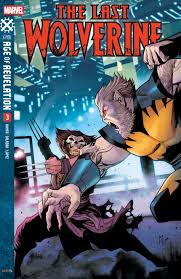 LAST WOLVERINE #3
Writer: Saladin Ahmed
Artist: Edgar Salazar
Colour artist: Carlos Lopez
Letterer: Cory Petit
Editor: Mark Basso
COVER: Leonard fights the original Wolverine.
This is the final issue of the miniseries, with Wolverine resuming next month.
PAGES 1-3. Nightcrawler rescues Leonard from Wolverine.
The previous issue ended with Leonard waking at night to find that Vindicator’s plan to free Wolverine from mind control was simply to kill him with the Muramasa Blade. Leonard and Kurt’s role was simply to get her close enough.
Incidentally, the recap pages on issues #2-3 of this series give Leonard’s full name as Leonard Two Bears, which I don’t think has ever appeared in the body of a story. (Issue #1’s recap page just calls him “Leonard”.)
For the purposes of this story, we seem to be workings on the original, Wolverine: Origins concept of the Muramasa Blade, where its magical powers can cut through adamantium and leave wounds that won’t heal.
Rogue Storm #3 annotations
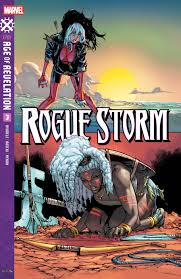 ROGUE STORM #3
“The Gallows and the Executioner”
Writer: Murewa Ayodele
Artist: Roland Boschi
Colourists: Neeraj Menon, Fer Sifuentes-Sujo & Rachelle Rosenberg
Letterer: Travis Lanham
Editor: Tom Brevoort
COVER: Rogue Red with a bunch of arrows through her at the top, and a defiant-looking Storm on her knees in the bottom half of the page.
This is the final issue of Rogue Storm, with Storm: Earth’s Mightiest Mutant #1 solicited for February. Despite Murewa Ayodele insisting that he’s been told it’s an ongoing, the recent solicitation for issue #2 still has it as a five-issue miniseries.
PAGES 1-3. Storm fights her way through Eēgūn’s soldiers.
While Rogue Storm is much easier to follow than the regular Storm series, it would still probably be useful to stick the plot in chronological order before we go any further. It runs like this:
- Flashback in issue #1: Two years into the Age of Revelation timeline, Storm takes in Rogue Red and gives her vibranium knuckledusters. (The timing is confirmed by Gambit in issue #3.)
- Per dialogue in issue #3, the demon Eēgūn escapes “the imprisonment imposed on him by the universe” (presumably his consumption by Maggott in Storm #6).
- Flashback in issue #3: Eēgūn attacks and destroys the Storm Sanctuary. Storm fights him for ten days straight and imprisons him in her body (presumably using magic). Unable to control him, she secludes herself in the Sahara Desert, guarded by the Storm Engines. She loses control of her powers and involuntarily causes worldwide devastation.
- Flashbacks in issues #1-3: Five years into the Age of Revelation, X-Force (Rogue Red, Warpath, Iceman, Gateway, Fantomex and Akujin) fight their way to Storm, and Rogue uses her powers to absorb Storm’s abilities, thinking that she’s going to stop the devastation. As a result, Eēgūn escapes. Akujin turns on the rest of X-Force and kills most of them; she’s an agent of Eēgūn who enlisted X-Force to help get past the Storm Engines in order to free Eēgūn. Storm and Rogue Red are rescued by Dr Voodoo and the ghost of his twin brother Daniel Drumm. Voodoo is killed while holding Eēgūn at bay. Rogue Red dies from her injuries, and discorporates on death.
- Dialogue in issues #2-3: Over the next five years, Storm searches the world for Eēgūn and practices magic. Daniel’s ghost continues to hang around with Storm in deference to his brother’s final wishes.
- Flashback in issue #3 and main story in issues #1-3: Storm gathers various magical weapons with a view to fighting the demon as “Primal Storm”. Gambit turns up looking for Rogue Red. Eēgūn attacks before the conversation can get anywhere. Storm defeats his henchmen and uses magic to trap herself and Eēgūn, apparently forever, resurrecting Rogue Red as a side effect.
X-Men: Book of Revelation #3 annotations
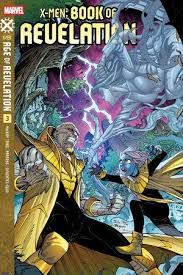 X-MEN: BOOK OF REVELATION #3
Writer: Jed MacKay
Penciller: Netho Diaz
Inkers: Sean Parsons & JP Mayer
Colourist: Fer Sifuentes-Sujo
Letterer: Clayton Cowles
Editor: Tom Brevoort
COVER: Revelation squares off against Elbecca and, oddly, Kitty Pryde, who doesn’t appear in this issue – making this a conflation of scenes from issues #2 and #3. This is the final issue of the series, with the story continuing in the X-Men: Age of Revelation – Finale one-shot.
PAGES 1-2. Flashback: Apocalypse despatches Elbecca to Earth.
We established last issue that Elbecca was not actually a little girl from the Revelation Territories, but an Arakkii spy with a “cover personality” who had been sent to infiltrate the Choristers and weaken Revelation. This flashback shows her being sent on that mission in the first place. Revelation points out later in the issue that this scheme must have been planned long before Arakko received word from Bei of his plans (in X-Men: Age of Revelation – Overture and the World of Revelation one-shot), and thus can’t be a reaction to Bei’s message. This seems likely to be right, and raises the question of why Apocalypse was already scheming to bring Revelation down even before then. Revelation’s explanation of his motives later in the issue probably provides the answer to that.
Daredevil Villains #65: Micah Synn
 DAREDEVIL #202 (January 1984)
“Savages”
Writer: Denny O’Neil
Penciller: William Johnson
Inker: Danny Bulanadi
Colourist: Glynis Wein
Letterer: Joe Rosen
Editor: Mike Higgins
We’ve skipped issue #200, which is a Bullseye story, and issue #201, where the villains are one-off ordinary criminals. That brings us to issue #202, which was part of Assistant Editors’ Month – a stunt event where the assistant editors were supposedly running Marvel’s line for a month while all the regular editors were away at a convention. In practice this meant a lot of wacky gimmicks. Daredevil‘s contribution was a comedy back-up strip which doesn’t concern us – its only effect on the main story was to make it a few pages shorter.
Even so, Micah Synn is by far the most bizarre concept that we’re encountered since Steve Gerber’s Black Spectre arc back in the 1970s. He’s a major fixture of Denny O’Neil’s run – he appears nine times between issues #202 and #214 (and most of the issues where he doesn’t appear are fill-ins). And after that storyline, he vanishes entirely. He’s never been seen again.
Micah Synn is the chief of the Kinjorge tribe, “from Mount Suruba in eastern Africa”. Ah, eastern Africa. That really narrows it down. In 1775, a party of British explorers went to Africa hoping to start a trading post, but got stranded there and “reverted to savagery”. They’re the King George Tribe, if you hadn’t figured it out. They’ve been living in isolation ever since, apparently hiding from hostile neighbouring tribesmen, until being “discovered by a party of Belgian geologists” six months ago. The Kinjorge are entirely white, so it would appear that the eighteenth century traders had enough numbers (and enough women) to make a viable breeding population. Seems unlikely, but that’s the story.
The X-Axis – w/c 8 December 2025
X-MEN: AGE OF REVELATION INFINITY COMIC #6. By Tim Seeley, Phillip Sevy, Michael Bartolo & Clayton Cowles. The final part of the Magik story. The basic idea here seems clear enough: because Belasco conjured those Bloodstones from her years ago, when Magik dies her soul gets split in two, and the Illyana part winds up with Belasco while the Darkchild somehow ends up with S’ym. I don’t really get why the Darkchild ends up with S’ym – did he find her wandering Limbo or something – but she does? So Illyana and Darkchild engineer a war between Belasco and S’ym in order to bring themselves together again. They promptly kill Belasco, but then Darkchild seizes control once and for all. It all feels a bit rushed, and honestly it probably needed to be either told at greater length or left to implication.
A bigger problem is that Tim Seeley seems to want this story to be about Illyana learning that Darkchild reflected a dark side that was present in her all along. That’s not quite on the same page with the recent Magik series, but it’s not a million miles away either – that book also wants Darkchild to be a side of Illyana that she’s wrongly interpreted all these years as an infection when it was actually a defence mechanism. But it creates a problem both in having Illyana learn a slightly different version of a lesson that she only just learned in her own book, and in the fact that the actual plot – Darkchild usurps Illyana and replaces her once and for all – doesn’t really dovetail with the message.
Unbreakable X-Men #3 annotations
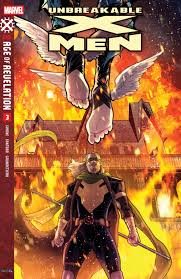 UNBREAKABLE X-MEN #3
“Like Drowning in the Dark”
Writer: Gail Simone
Artists: Mario Santoro with Luciano Vecchio, Tiago Palma, Davide Tinto & RB Silva
Colour artist: Espen Grundetjern
Letterer: Clayton Cowles
Editor: Tom Brevoort
COVER: With Haven House burning in the background, Gambit squares off against Namor the Sub-Mariner – not something that literally happens in the story, but broadly a combination of two plot points, so fair enough.
This is the final issue of Unbreakable X-Men, with Uncanny X-Men resuming next month.
PAGES 1-4. Flashback: The Outliers vow to stop Shuvahrak.
We were told last issue that the Outliers had made a vow to stop Shuvahrak if she ever escaped. This flashback shows them making that vow, and is captioned as “present day” – presumably meaning between Uncanny X-Men #21-22, or at least shortly after the “Dark Artery” arc ended in Uncanny #16.
The X-Axis – w/c 1 December 2025
X-MEN: AGE OF REVELATION INFINITY COMIC #5. By Tim Seeley, Phillip Sevy, Michael Bartolo & Clayton Cowles. Part 2 of the Magik story, then. The basic idea here is that thank to the Bloodstones that were conjured by Belasco back in her origin story, when Illyana dies, she gets split into Illyana, whose soul goes to Belasco, and the Darkchild, who for no discernible reason winds up imprisoned by S’ym. So the story seems to be them manipulating S’ym and Belasco into going to war with each other in order that they can be reunited and escape Limbo. Since we know that the Darkchild winds up running Providence, this evidently doesn’t work out as planned. I can’t say I find any of this especially interesting. By its nature, it’s re-treading previous stories – to be fair, that’s partly the point – but they aren’t stories that I have any great desire to revisit in the first place. Belasco and S’ym aren’t very compelling characters and I don’t really see the point of this. I can imagine a world where the 2026 direction includes a bunch of things that were foreshadowed in “Age of Revelation”, which could run to Cyclops reporting back to Magik that she needs to do something about this before she died. But that’s still a Belasco story and I’m not very interested in that either.
AMAZING X-MEN #3. (Annotations here.) This is more like it. Sure, the pacing of Amazing X-Men is weird if you try to see it as a three-issue miniseries, because it isn’t one – it’s issues #2-4 of a storyline that also includes the Overture and Finale one-shots. And sure, all that the characters have really achieved in three issues is to travel to Philadelphia, without any apparent plans for what they’re going to do when they get there. But I don’t really mind any of that, because the relatively sparse main plot is leaving plenty of space for more subtle character work and for hints about the wider story. It’s not so much having Glob Herman turn into a psycho, which is kind of obvious. It’s having Psylocke seem more sympathetic than any of the supposed X-Men, and Schwarzchild coming across as the reasonable one among the future team when we’ve only seen him as a glorified henchman to date. The Beast subplot is working nicely – it seems fairly clear at this point that this is the Krakoan Beast, but it’s being set up in such a way that it’ll feel satisfying when it’s actually revealed – and throwing in the fact that nobody remembers the storyline about Magneto’s supposed degenerative disease is intriguing. Asrar’s art is consistently excellent as well, and playing to the book’s more character-driven strengths. Even though Jed MacKay’s two books are the ones carrying the weight of the plot for “Age of Revelation”, you can make a case too that Amazing X-Men does benefit from the existence of the wider event, since it’s helping to fill out a more-or-less consistent world that this book only has space to touch on.
Laura Kinney: Sabretooth #3 annotations
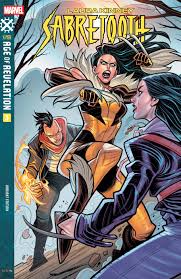 LAURA KINNEY: SABRETOOTH #3
Writer: Erica Schultz
Artist: Valentina Pinti
Colour artist: Rachelle Rosenberg
Letterer: Cory Petit
Editor: Mark Basso
COVER: Laura fights Apocalypse.
This is the final issue of Laura Kinney: Sabretooth, which was the stand-in book for Laura Kinney: Wolverine. That book isn’t returning in 2026, though Laura is moving over to a new title called Generation X-23.
PAGES 1-3. Revelation sends Laura to Arakko.
Last issue, Laura failed to stop dissident mutants from escaping through their gate to Arakko, a group that included Gabby, Akihiro, Laura’s son Alex, and Shark Girl. Laura sustains a head injury in that story, which she rather oddly ascribes here to “Sage’s force field”. Sage did have a sort of energy bubble thing in the previous issue, but it injured Laura’s arm, not her head.
At any rate, the basic idea seems to be that when her healing factor repairs damage that affects her mind, it also shakes off some of Revelation’s control over her. That would be consistent with Revelation’s need to reprogramme Wolverine in Amazing X-Men #1.
Binary #3 annotations
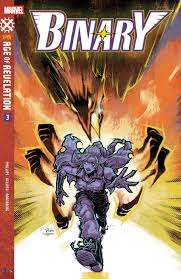 BINARY #3
Writer: Stephanie Phillips
Artist: Giada Belviso
Colourist: Rachelle Rosenberg
Letterer: Travis Lanham
Editor: Annalise Bissa
COVER: Um… well… it’s a woman running away from Phoenix. I assume she’s meant to be Carol Danvers, but she looks absolutely nothing like Carol Danvers beyond the fact that she’s white and blonde (as far as you can tell given that she’s coloured entirely in grey-blue, which means there’s a murky shape as the centre of focus). Her expression doesn’t seem scared, but more like she’s leading the Phoenix after her. I have no idea what it has to do with the story.
This is the final issue of Binary, which in turn was a continuation of Phoenix. That book isn’t returning in January, so the series truly does end here.
PAGES 1-7. Binary realises that she’s dealing with Madelyne Pryor, and Jean Grey manifests.
The basic plot so far is that Carol Danvers inherited the Phoenix Force after Jean Grey apparently burned herself out while containing the X-virus on Earth; that Carol has been using the Phoenix Force to protect her home town of Beverly, Massachusetts by shielding it from the X-virus in a psychic dome; that she started seeing Jean again last issue, since Jean and the Phoenix are one and the same as per Rise of the Powers of X; and that Madelyne Pryor has been scheming against Carol in an attempt to get the Phoenix powers for herself. (more…)
Amazing X-Men #3 annotations
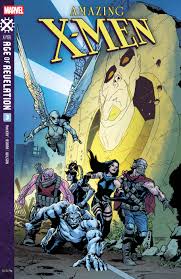 AMAZING X-MEN vol 3 #3
“Philadelphia”
Writer: Jed MacKay
Artist: Mahmud Asrar
Colourist: Matthew Wilson
Letterer: Clayton Cowles
Editor: Tom Brevoort
COVER. The X-Men in the ruins of Philadelphia (rather worse than it actually looks in the stories), with a mural of Revelation.
Notionally this is the final issue of the miniseries, but in practice the story continues into X-Men: Age of Revelation – Finale. Counting the Overture issue as well, this is really more issue #4 of 5 than issue #3 of 3.
PAGES 1-4. Psylocke tells the X-Men what she learned from Bei.
Last issue, Cyclops won a duel against the Darkchild, who agreed to transport them from her territory in Providence to Revelation’s capital city of Philadelphia. Presumably that happened between issues and she’s dropped them off on the outskirts. Glob Herman seems genuinely surprised that they escaped Darkchild, which is clearly not a common experience – certainly the Age of Revelation X-Men seemed terrified of the place when they arrived there in issue #1.
All the material about Glob killing Topaz, and Psylocke being sent to kill Bei, comes from Overture. Psylocke’s account of what happened is correct as far as it goes. Interestingly, she comes across as much more sympathetic than the future X-Men – certainly than Glob Herman, who actively laughs about it, but all of the X-Men seem to have much more of a “this is war” attitude than Psylocke. Compared to the others, Schwarzchild seems the most reasonable, since at least he makes a fair point about Psylocke’s selectivity rather than just brushing Topaz’s death off.
