Daredevil Villains #55: Edwin Cord
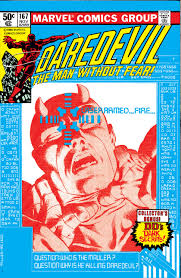 DAREDEVIL #167 (November 1980)
“…The Mauler!”
Writer: David Michelinie
Penciller: Frank Miller
Inker: Klaus Janson
Letterer: Joe Rosen
Colourist: Glynis Wein
Editor: Denny O’Neil
So here’s what happened since our last instalment. Issues #163 and #164 don’t have villains: the first one guest stars the Hulk, and the other is the story where Daredevil admits his secret identity to Ben Urich, who decides not to publish. Issue #165 has Dr Octopus, on loan from Amazing Spider-Man. Issue #166 brings back the Gladiator. And that’s the end of Roger McKenzie’s run as writer.
By this point, Denny O’Neil has taken over as editor, and as of issue #168, Frank Miller will be writing as well as pencilling. But first, we have another fill-in.
This one is a rather better fit than the Steve Ditko story we looked at last time. For a start, it still has the regular art team of Frank Miller and Klaus Janson. But this time, our guest writer is David Michelinie. At this point, he’s about 30 issues into his run on Iron Man, and he’s already completed “Demon in a Bottle”. So this feels like a contemporary Marvel comic from 1980.
Daredevil Villains #54: Mr Hyle
 DAREDEVIL #162 (January 1980)
“Requiem for a Pug”
Writer: Michael Fleisher
Artist: Steve Ditko
Colourist: Petra Goldberg
Letterer: Jim Novak
Editor: Allen Milgrom
So here’s where we are. Frank Miller is already established as Daredevil‘s artist. In just a few issues time, he’ll take over as writer and bring the book back to commercial success and critical acclaim. Daredevil will go into the 1980s as the book of the moment.
But we’ll get back to that. In the meantime, here’s a fill-in issue by Michael Fleisher and Steve Ditko. “Requiem for a Pug” is a melodramatic throwback which re-enacts Daredevil’s origin story and dares to ask: what if the Fixer had been a black guy with a leopard?
The story opens with Daredevil helping to shut down a “meson-reactor” which is about to explode. In the process, he’s exposed to vast amounts of radiation. Radiation, as we all know, is magic stuff that makes the plot happen. So as Matt makes his way home that night, he collapses in an alley. Then he wakes up the next morning as an amnesiac. Because that’s what radiation poisoning does.
Daredevil Villains #53: Eric Slaughter
 DAREDEVIL #159 and #161 (July & November 1979)
“Marked for Murder!” / “To Dare the Devil”
Writer: Roger McKenzie
Penciller: Frank Miller
Inker: Klaus Janson
Colourist: Glynis Wein
Letterer: Jim Novak (#159) and Diana Albers (#161)
Editors: Mary Jo Duffy & Al Milgrom
As I explained last time, Roger McKenzie’s run largely rested on existing villains. There are only two candidates for inclusion in this feature, and even they both debut playing second fiddle to more established bad guys. The new Ani-Men were henchmen of Death-Stalker, and Eric Slaughter is hired by Bullseye.
But their stories are also the earliest issues to be drawn by Frank Miller. And Slaughter has a better claim to inclusion than the Ani-Men, since he makes several repeat appearances over the next few years. Most notably, he’s the villain in issue #168, the debut of Elektra. He’s not exactly the focal point of that story either, mind you, but he does enough to justify us looking at him.
Slaughter’s debut story is simple. Bullseye hires him to kill Daredevil. The story is rather vague about Slaughter’s actual role in the underworld. He’s an elderly man who has a gang of thugs working for him, and who it seems are expected to do the actual killing. Daredevil has heard of Slaughter, but “thought he’d retired years ago”. Still, there’s no suggestion here that Slaughter has to round up some men in order to take on this contract. So apparently he’s some sort of gang leader who’s managed to avoid Matt’s notice. Frank Miller isn’t much clearer on this point, to be honest. Issue #181 describes Slaughter as running a “freelance assassination operation”, but in issue #168 he’s providing bodyguards. Either way, the operation can’t be particularly elite, because Turk holds down a job there, and he’s a comic relief moron.
Daredevil Villains #52: The Ani-Men II
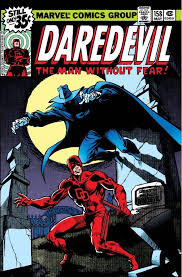 DAREDEVIL #157-158 (March-May 1979)
“The Ungrateful Dead” / “A Grave Mistake”
Writers: Roger McKenzie (#157-158) with Mary Jo Duffy (#157)
Pencillers: Gene Colan (#157) and Frank Miller (#158)
Inker: Klaus Janson
Colourist: Glynis Wein (#157) and George Roussos (#158)
Letterer: Joe Rosen
Editor: Al Milgrom
The second iteration of the Ani-Men only just about merit inclusion in this feature. They’re supporting players in the a Death-Stalker story, and a retread of an idea from the 1960s. But they scrape their way in because the second part is the debut of Frank Miller on art – and because there are only two real candidates for inclusion the whole Roger McKenzie run.
McKenzie takes over with issue #151, and his run offers the Purple Man (#151 and #154), Death-Stalker (#152 and #155-158), Mr Hyde and the Cobra (#153), Bullseye (#159-161) and guest villain Dr Octopus (#165-166). Issue #162 is a fill-in. Issue #163 has no villain – the Hulk guest stars to serve as the antagonist. And issue #164 is mostly a recap of Daredevil’s origin story. And that’s it. That’s the whole run. Bear in mind that the book is bimonthly at this point, so that’s two years of mostly retread villains.
This run does introduce Ben Urich, a genuinely major character who debuts in issue #153. He spends this run figuring out Daredevil’s dual identity and then deciding to keep it secret anyway. The run also introduces Becky Blake, a wheelchair-using lawyer, who promptly disappears into the background.
Daredevil Villains #51: Smasher
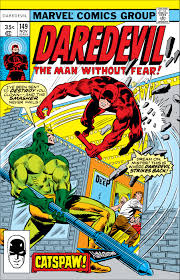 DAREDEVIL #149 (November 1977)
“Catspaw!”
Writer: Jim Shooter
Penciller: Carmine Infantino
Inker, colourist: Klaus Janson
Letterer: Denise Wohl
Editor: Archie Goodwin
Marv Wolfman is gone, and next up is Jim Shooter, whose short run lasts from issues #144 to #151. Even some of those are co-written: the first two are co-credited to Gerry Conway, while the last sees him hand over to incoming writer Roger McKenzie. By this point, Daredevil is floundering. With issue #147, the book is relegated to a bimonthly schedule, and it’s going to stay there until the 1980s.
This is the only Shooter issue that we’ll be covering, since the rest of his run relies on existing villains: the Man-Bull (#144), the Owl (#145), Bullseye (#146), Death-Stalker (#148) and the Purple Man (everything else).
There were reasons for this. For one thing, on Shooter’s own account, he was generally averse to creating new characters on Marvel’s 1970s work-for-hire terms – although he did introduce Paladin as a supporting character in issue #150. But in any event, Shooter’s top priority was to tie up some storylines that had been left unresolved by Marv Wolfman.
Daredevil Villains #50: The Mind-Master
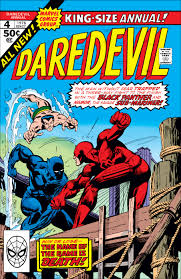 DAREDEVIL ANNUAL #4 (1976)
“The Name of the Game is… Death!”
Plotter, editor: Marv Wolfman
Scripter: Chris Claremont
Penciller: George Tuska
Inker: Frank Chiaramonte
Letterer: Anette Kawecki
Colourist: Bonnie Wilford
Once again, we’ve skipped a few issues. Issues #134-137 resolve a long running subplot about conspiracy theories being spread by deepfake TV broadcasts created by what sounds awfully like an LLM. It’s the highlight of Wolfman’s run, but the villain is the Jester, so it’s outside our remit here. Issue #138 is a crossover with Ghost Rider, with Death-Stalker as the villain.
That brings us to Daredevil Annual #4. The previous two annuals were reprint books (the first is Daredevil versus a team of established villains), but this one contains an original story. How successful was this issue? Put it this way: Marvel didn’t publish another Daredevil Annual for thirteen years. And when they did, they numbered it as a second Daredevil Annual #4, because they’d literally forgotten that this one existed.
This issue slots neatly into the ongoing storyline between issues #138-139, but it’s something of an afterthought. Wolfman only plotted it, leaving the script to Chris Claremont, and the whole thing is basically an excuse to have Namor and the Black Panther as guest stars. It does have a new villain, but he exists simply to drive the plot rather than to be a focal point of the story in his own right. And when he does get around to doing something, it’s… um… well, look, I’ll explain what happens.
Daredevil Villains #49: Mind-Wave
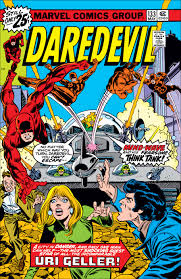 DAREDEVIL #133 (May 1976)
“Mind-Wave and his Fearsome Think-Tank!”
Writer, editor: Marv Wolfman
Penciller: Bob Brown
Inker: Jim Mooney
Colourist: Michele Wolfman
Letterer: Ray Holloway
Because we’re only looking at the Daredevil stories that introduce new villains, we’re going to get a very distorted view of Marv Wolfman’s run. He was on the series for nearly 20 issues, but he didn’t create that many new villains in that time. There are four new villains in his run, plus another one in an annual. The standout is obviously Bullseye, who we covered last time round. But there’s a gulf of quality between him and the others. For example, here we have “Mind-Wave and his Fearsome Think Tank!”
Mind-Wave is a man in a garish green and yellow costume who can read minds. He pilots a giant futuristic tank. The tank has satellite dishes all over it. Mind-Wave himself mans a gun, and two henchmen have their own little plexi-glass bubbles at the front. It looks like something from the GI Joe toy line, or maybe even Masters of the Universe. The narrator calls it a “clanking, titanium-steel destructoid”. Mind-Wave’s basic plan is to use the tank to create a distraction so that his henchmen can commit bank robberies.
Daredevil Villains #48: Bullseye
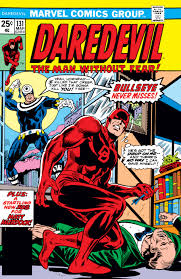 DAREDEVIL #131-132 (March & April 1976)
“Watch Out for Bullseye, He Never Misses!” / “Bullseye Rules Supreme”
Writer, editor: Marv Wolfman
Penciller: Bob Brown
Inker: Klaus Janson
Colourist: Michele Wolfman
Letterer: Joe Rosen
Well, it took us 48 goes and over a decade of comics, but we’ve finally reached one of the really big names. We’ve had enduring second-tier villains like the Gladiator, the Jester and the Owl. We’ve had some villains who were big deal for a short time, like the Masked Marauder and the Death-Stalker. And we’ve had a whole bunch of one-off villains. But truly A-list villains? There’s the Purple Man, perhaps, but his claim to that status rests largely on stories published long after he stopped appearing in Daredevil.
Bullseye is in a different position. He still appears in Daredevil today. He’ll get his own minis. He’s a recognisable figure around the Marvel Universe. He’ll even make it to the Dark Avengers. But it’ll take him a little time. He made it into the first Official Handbook of the Marvel Universe but didn’t make the cut for the Deluxe Edition – which means he was ranked below the likes of the Death-Throws, a team of evil jugglers. He didn’t get back in until Update ’89. So why didn’t he click immediately?
Daredevil Villains #47: Brother Zed
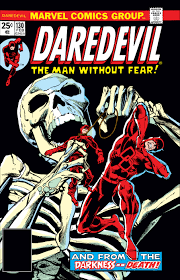 DAREDEVIL #130 (February 1976)
“Look Out, DD – Here Comes the Death-Man!”
Writer, editor: Marv Wolfman
Penciler: Bob Brown
Inker: Klaus Janson
Colourist: Michele Wolfman
Letterer: John Costanza
Once again, we’ve skipped some issues. Issues #126-127 are the debut of the Torpedo, a rookie rival superhero who does the obligatory misunderstanding-and-fight routine. He actually had some legs: he returns in issue #134 as a supporting character, then gets a try-out as a solo hero in Marvel Premiere , and finally winds up as a supporting character in Rom. But he’s not a villain, so he’s outside our remit. Issue #128 is another Death-Stalker story. And issue #129 brings back the Man-Bull.
In fact, focussing on the new villains will give us a rather unrepresentative view of Marv Wolfman’s run. He’s the first writer who seems to have looked at Daredevil’s pre-established rogue’s gallery and deemed them to be basically serviceable. There are only a handful of new villains in his run. And one of them is a very big name, but we’ll get to him.
It’s not that Wolfman didn’t create new characters for the book. He absolutely did, but they were mostly supporting characters. As well as the Torpedo, the issues we’ve skipped introduce Daredevil’s new love interest, Heather Glenn. We might not have much reason to talk about her here for a while, since her first major storyline involves the Purple Man, but she’s a major character who’ll stick around well into the 1980s. At this point, she’s a sort of prototype manic pixie dream girl.
Daredevil Villains #46: Copperhead
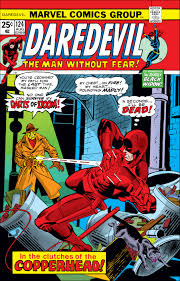 DAREDEVIL #124-125 (August & September 1975)
“In the Coils of the Copperhead” / “Vengeance is the Copperhead”
Writers: Len Wein (#124 part 1) & Marv Wolfman (#124 part 2 & #125)
Pencillers: Gene Colan (#124) and Bob Brown (#125)
Inker: Klaus Janson
Colourists: Michelle Wolfman (#124) and Klaus Janson (#125)
Letterers: Joe Rosen (#124) and John Costanza (#125)
Editor: Len Wein
Tony Isabella lasted only five issues on Daredevil before editor Len Wein removed him from the series. The next issue, issue #124, opens with the Black Widow departing – again, but this time it will finally stick. The narrator certainly seems to be taking the opportunity to put the boot in. “Good-bye”, he declares. “There is no sadder, more bittersweet word in all the languages of man… Good-bye: The word is truly tragic when those who say it really don’t want to say it at all.”
Issue #124 has a truly odd writing credit – instead of the usual plotter/scripter distinction, it credits editor Len Wein with writing the first half of the issue himself, with the rest being credited to Marv Wolfman. It all looks a bit shambolic and last minute. Nonetheless, this is the start of Marv Wolfman’s run, which will see us through to issue #143 before he leaves in mid-storyline.
