Midnight X-Men #1 annotations
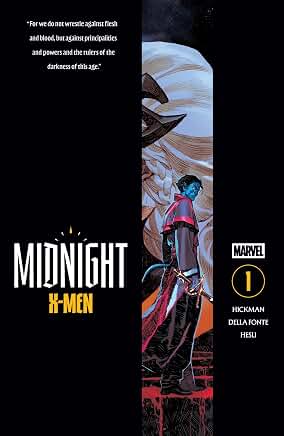 MIDNIGHT X-MEN #1
“Teeth”
Writer: Jonathan Hickman
Artist: Matteo Della Fonte
Colourist: Arthur Hesli
Letterer: Cory Petit
Editor: Jordan D White
COVER: That’s an image of Nightcrawler with Storm in the background. As with all the Midnight books, the cover only shows a vertical stripe of the art, but the full page art appears on the interior.
I’m not sure I’ll be covering this book regularly, but it’s the only X-book out that week, because Marvel decided to give the three Midnight books a clear run this week – the others being Midnight Spider-Man #1 and Midnight Fantastic Four #1. They are, in fact, rather less grimdark than the promotion for this line might have led you to expect.
PAGES 1-6. Cardinal Stryker visits Kurt Wagner.
The Midnight Universe. For the most part, the Midnight Universe as seen in this week’s three titles looks pretty normal on the surface. It comes across as a world where the fantastic elements of the regular Marvel Universe are mostly hidden from view so far as the general public are concerned. Mostly, but not entirely.
Cardinal Stryker. Obviously, this is the Midnight Universe version of William Stryker, the anti-mutant priest best known from Marvel Graphic Novel #5 (“God Loves, Man Kills”). In this world, he’s a Catholic Cardinal of a somewhat traditionalist bent. He prefers to converse in Latin but doesn’t insist on it. He says that he’s been sent by the Pope as part of a programme of action to “solve the unique problem that plagues this city” – in other words, to vampires. Specifically, he says he’s been sent to deal with mutant vampires.
At least on the surface, he disavows any broader anti-mutant agenda and seems perfectly willing to deal with Kurt as a legitimate member of the church. That said, his insistence that he’s not among Kurt’s detractors comes across as disingenuous, and it’s not clear why he’s focussing solely on the mutant vampires.
The Purifiers. Stryker’s men are a sort of Catholic militia, here to guard Stryker and fight vampires. They share a name with the MU’s anti-mutant lynch mob, but so far as we see in this issue, these Purifiers may just be Catholic vampire hunters. Their leader, Major Corvo, is clearly a military figure. He doesn’t seem to match up with any MU character.
The Sword of Faith. Stryker tells the Purifiers that they can’t come into St Patrick’s Cathedral with him because “the only weapon allowed within is the Sword of Faith”. On the face of it this sounds figurative, but Kurt is actually carrying a sword in his waistband, in reference to his MU version’s fencing skills.
Sister Aquilla. This is the Midnight version of Amara Aquilla – Magma from the New Mutants. As in the MU, she’s from Nova Roma and her first language is Latin. In the MU, Nova Roma was essentially a lost Roman colony in the Amazon – the original idea was for it to be a Roman/Incan hybrid, but that never really came across. We don’t hear much about the Midnight Nova Roma, but Stryker and Kurt both know about it, and talk as if something very regrettable happened there.
Kurt Wagner. He’s a bishop operating out of St Patrick’s Cathedral in Manhattan. Obviously this references many MU stories in which he was religious or training to be a priest. Stryker mentions in passing that Kurt’s position in the church “remains shrouded in mystery”, which tends to suggest that his role isn’t public. That said, the existence of mutants is public knowledge in the Midnight Universe – they’re openly discussed in Midnight Spider-Man #1.
There is at least a school of thought that Kurt is somehow personally responsible for the vampire problems in New York, for reasons which aren’t elaborated upon – Stryker and Kurt both seem to know what’s being referred to. He hasn’t been given advance warning of Stryker’s arrival, apparently out of a concern that he would leak the information to the mutant vampires. Given his dealings with Storm later in the issue, this seems to have been a reasonable concern.
PAGES 7-8. Flashback: Storm bites Jean Grey.
This is basically an out of context flashback to “years ago”, with some narration about how good and evil no longer seem relevant. The art shows Storm as a vampire in her late 70s MU costume biting a woman who appears to be Jean Grey in her Dark Phoenix costume (who seems to be crying blood).
Aside from the specifics, this seems to indicate that at some point in the past, the X-Men were active in this world as a normal superhero team. There are no other signs of superheroes existing in this week’s issues – Spider-Man and the Fantastic Four are only just experiencing their origin stories.
PAGE 9. Data page.
Simply a graphic which reads “The Peace Must Hold” – a mantra which will come up a lot.
PAGES 10-13. A group of humans find the Reavers.
There are three separate strands in these pages. First, the narration on pages 10-11 is an underground broadcast by “Citizen Tilby” – presumably the Midnight version of Trish Tilby, the journalist character from 90s X-Men. She talks about monsters walking among us, but being hidden from both humans and technology, leaving them to be traced by the gaps in the information. Trish is presumably the woman we see from behind on page 10 panel 3.
Second, we see Magneto looking out from his office window. We’ll come back to him.
Third, we have the group of humans who have been listening to Tilby’s broadcasts, following her request to investigate something. This building is identified later in the issue as being underneath “the Watchtower”.
One of the humans is a newbie – she later turns out to be a mutant who doesn’t realise it, and her name is Hope, so apparently she’s the counterpart of Hope Summers. One of her colleagues helpfully recaps their understanding of the general set-up of the book: vampires exist in family houses and clan names going back thousands of years, but due to unspecified “events of the last decade”, a power struggle has broken out between regular vampires and mutant vampires (or “empyres”). We’re told elsewhere that there’s a truce of some sort, which is what the mutants are preoccupied with keeping in place – this is “The Peace Must Hold”.
They force a door which, for some reason, is surrounded by Missing posters. It’s not clear whether there’s a particular reason for them to be there, or whether Missing posters are really that ubiquitous in New York due to its vampire problem. (No such problem comes up in the other Midnight books.)
The man who watches them go into the tomb is Quicksilver, as confirmed in the next scene.
The tomb contains four “strongholds” – hi-tech coffins – occupied by cyborg vampires who are labelled as the Reavers, and products of “the Body Shop”. In the regular MU, the Reavers were cyborg mercenaries aligned with Donald Pierce, with varying degrees of anti-mutant motivation. Some of them had initially been turned into cyborgs by Spiral and her Body Shop business. The humans have made a serious error in disturbing these guys.
PAGES 14-15. The House of X group decide what to do.
More Missing posters are seen on the street in the first panel.
The House of X is presumably the building, rather than the people inside. Note that at no point do they refer to themselves as the X-Men. This faction consists of:
- Magneto, who has his cape and helmet, and seems to be making metal globes hover around his head for some reason.
- Quicksilver, who addresses Magneto as “father” – the traditional relationship between the two, though it was technically retconned out of the regular Marvel Universe.
- The Scarlet Witch, Quicksilver’s sister and traditionally the daughter of Magneto.
- Polaris, also the daughter of Magneto in the MU.
- Havok, traditionally Polaris’s partner.
- The Toad, Magneto’s Silver Age sidekick.
- Unus, a Silver Age villain with a force field power who sticks out a mile here as a curious inclusion in what’s otherwise basically the Magneto family. Unus wasn’t even a member of the Brotherhood of Evil Mutants.
Other than Unus (whose codename is a shortened version of his surname anyway), nobody actually uses their codenames. But they are wearing greyed-out versions of their traditional costumes. All of these characters are vampires. Actually, hold on, no – as pointed out in the comments, they don’t have the inverted-colour speech balloons of other vampires (and they seem to be comfortable standing near a window in daytime, though that could be treated glass given what we’re told later about the definition of “sunlight” for this purpose).
Unus has sources who have tipped him off about the Reavers being in storage; Quicksilver was there to verify the claim. Unusually, this Quicksilver seems to be less cynical and more compassionate than his colleagues – he seems to think something should be done to save the humans, but everyone else is more preoccupied with not breaking the truce. Except for Magneto, who decides to send someone deniable.
PAGES 16-18. The Reavers kill all the humans except Hope.
A vampiric Gambit shows up, but instantly denies any claim that he’s come to save Hope. It seems unlikely that Gambit is the actual agent sent by Magneto, because he gets there far too quickly, he’s a recognisable mutant vampire, and he doesn’t seem to have the slightest interest in saving humans. If anything, he seems outright predatory. He says later on that he couldn’t care less about the compact and doesn’t regard his tribe as a party to it.
Gambit is accompanied by:
- Psylocke, wearing a version of her Lady Mandarin costume from the late 1980s.
- Glob Herman, of all people – he seems to have absorbed human body parts floating about in his gel.
- Empath, wearing a subdued version of his Hellions uniform.
PAGES 19-20. Kurt and Stryker talk further.
The cathedral appears to have a garden containing a statue of Exodus, the eccentrically religious mutant from the regular MU.
Stryker argues that killing vampires has been regarded as acceptable by the church for centuries, due to them being, you know, undead murderers. In this scene, he comes across as rather more sincerely compassionate towards Kurt – he’s understandably sceptical of Kurt’s ability to remain objective when dealing with his vampirised friends, but seems to want to build a working relationship.
PAGE 21. Data page: How to kill vampires.
This bears to be a report from the Muir Institute, presumably to do with Muir Isle from the regular MU. If so, Moira might show up at some point…
We’re told that vampire mutants differ from other mutants “in areas relating to enthrallment, progenitorial kinship and generational control chains”. What that seems to mean is that mutant vampires don’t have the innate loyalty to the vampires who turned them, and therefore form their own mutant clan instead of being subsumed into the existing vampire clans – hence the fighting.
All vampires, mutant and human, can be destroyed by decapitation, sunlight (including artificial sunlight in some cases), and “adamantium”. So adamantium exists in this world, and Wolverine’s probably not having a great time of it, if he exists. How long sunlight takes to kill a vampire depends on their age and power; some are destroyed in seconds, others can last several minutes.
Forge is mentioned, and is apparently still a non-vampire mutant. His experiments on artificial sunlight include something called “the Five Lights Experiment” – in the MU, the Five Lights were the first new mutants to emerge after most mutants lost their powers on M-Day.
PAGES 22-29. Cyclops rescues Hope.
Vampire mutants can smell other mutants, and so immediately identify Hope as a mutant.
The Healer referred to by Gambit is presumably a version of the Morlock Healer from the regular MU. Apparently he can patch up severed limbs, at least when dealing with a vampire.
Cyclops is not a vampire, and is presumably the person that Magneto sent word to. While his costume doesn’t directly match up with anything specific from the MU, it’s a jumpsuit not a million miles away from the New X-Men era. A brief flashback implies some previous disaster in which Cyclops failed to save his team. Gambit derides him as “the last X-Man” – the only actual mention of the X-Men name in this issue, so presumably Magneto’s crew don’t regard themselves as the X-Men.
Cyclops blasts a hole in the ceiling to let the sunlight in, which seems to destroy Empath more or less instantly. Gambit appears to survive long enough to get away.
PAGES 30-33. Kurt meets with Ororo.
As Stryker suspected, Kurt wants to tip off Ororo about the Purifiers. Ororo regards Kurt as a friend but still hopes for him to agree to be turned into a vampire. She doesn’t seem inclined to force it on him. She isn’t too bothered about the warning, since she doesn’t take the church seriously.
Ororo alludes to owing Kurt for something he has done in the past, which places him under her protection.
Kurt claims to be searching for a cure that can restore the X-Men. Ororo derides this as a “dream”, under obvious reference to Xavier’s dream in the regular X-Men stories. Incidentally, Xavier is completely unmentioned in this story, which is an obvious gap that must mean something.

You seem to contradict yourself. “It was not new reader friendly.” “It did not respect continuity.” “It was too confusing to make sense of what was on the page.” “It was very unpretentious.” Well, which is it?
No, as the run progressed, it was no longer reader friendly. That’s an odd thing to ask of a coherent narrative. It’s like picking up a creator-owned Vertigo Comic at issue #25 and saying, “It feels like I missed 25 issues of this self-contained story!” Well, yeah, the reader did miss 25 issues of the series.
If I picked up DNX #3 as my first issue of Jed McKay’s X-Men run, would I have any idea what was happening? Should I?
Maybe it’s a better idea to go back to House/Powers of X TPBs to start, instead of picking up “Sins of Sinister” and expecting to know exactly what is occurring.
It was new-reader friendly at the beginning because it wasn’t caught up in prior continuity or characterization, in the same way that a reader could pick up the first issue of, say, Alan Moore’s Swamp Thing and not need to be familiar with every Swamp Thing story that happened prior to Moore taking over the book. House/Powers was a fresh starting point that a reader who had never read X-Men before could pick up and immediately figure out the world of the mutants because it wasn’t based in the sixty years of continuity and characterization that preceded it. You didn’t enjoy this. I get it. That’s fine. To say it is not new reader-friendly, when you yourself are critiquing Krakoa for not respecting the prior continuity is just contradicting yourself.
If you want to consider a history that is told across three radically different time periods with no transition, across two distinct books, with a about a couple dozen _main_ characters with decades of history each, and that is told out of sequence to boot new reader friendly, then there isn’t anything that I can say that will convince you that it is not.
No. Most of what you are describing is complicated storytelling, not anything that makes the books non-new reader friendly. If someone buys each issue of House and Powers, the story is there for them to piece together by reading it. You’re basically arguing, “David Foster Wallace’s Infinite Jest is not new reader friendly.”, which makes zero sense.
As far as multiple main characters with history, again, you are contradicting yourself because you say that the continuity and characterization was either lacking or all wrong. Why might that be? Maybe because it can be read as a fresh start for the X-Men where a new reader, unfamiliar with the characters past history or their sixty years of continuity are able to pick up the book and engage with these characters, while it bothers you because you know these characters’ history and the past sixty years of continuity.
Does Apocalypse showing up and joining the Quiet Council next to Xavier make any sense with the history of X-Men? No. If you are unfamiliar with Apocalypse and his history though, Apocalypse is a mutant powerhouse who is one of the three leaders of mutantkind, alongside Xavier and Magneto. That’s what you need to know at the beginning of HoX. Not X-Factor, Cable, “The Twelve”, the Search for Cyclops, etc.
Moira was dead and she was never a mutant. For all intents and purposes, Moira might as well be a completely new character created by Hickman for the role. To a new reader, they have no idea that Moira was ever anything other than Moira X.
You don’t need to know the minutiae of these characters’ histories to jump into the Krakoa story. Hence, “new reader friendly”.
@Luis Dantas: Setting aside the factual inaccuracies (every time period transition had a caption; House and Powers were alternating as they came out and were collected as such, making it very clear that’s the order you’re meant to read them; “characters with decades of history” would be as much of a barrier to new readers pre-Krakoa as during), you seem to have a very poor opinion of the literacy and generic competence of these hypothetical new readers.
If modern audiences can handle Everything Everywhere All at Once, House of Leaves and One Hundred Years of Solitude, they can probably handle HoXPoX and Sins of Sinister.
The reading order of HoXPoX wasn’t exactly alternating (it blipped right in the middle), but the correct reading order was listed in every issue, so easy enough to follow.
Also, what kind of “new reader” are we trying to be friendly to? At this point, I think some X-characters are pretty universally known, at least in broader nerd culture. Any comic reader with no prior X-Men reading experience probably knows at least a few of the basics from osmosis. And lots of readers enjoy a puzzle box, not to mention expensive comics that actually reward a reread.
I doubt that anyone was coming to HoXPoX from so far outside the bubble of X-Men cultural literacy that they were genuinely baffled by who was who. The comics business just doesn’t work that way anymore. I’m not sure if Marvel is even trying to court anyone outside of current comic readers, honestly.
I don’t think the continuity aspects of HoX/PoX was more alienating to new readers than, say, Uncanny X-Men 273. That was my first issue of the ongoing X-Men title. I knew the characters who had appeared in the Dark Phoenix Saga, in an couple issues of New Mutants, or on Spider-Man & His Amazing Friends. That’s probably the equivalent of seeing a few of the movies or episodes of the cartoons. I had no idea who Cable, Gambit, Psylocke, Boom Boom, Forge, Jubilee, Rictor, or Lila Cheney were. I had no idea why the mansion was destroyed, who the Shadow King was, or what happened to Wolfsbane in Genosha. It was still enough to get me hooked.
I was one of those lapsed readers who came back with HoX/PoX. I didn’t grasp all of it (I still think the scale of the cosmic stuff doesn’t make sense), but the main points- mutants go to an island for a better life, former enemies become uneasy allies, time jumps, Moira’s multiple lives, humans and AI are threats- were clear.
“I doubt that anyone was coming to HoXPoX from so far outside the bubble of X-Men cultural literacy that they were genuinely baffled by who was who…”
Not baffled, no, but there would have been plenty of people who didn’t know anything about The Five, for example. But HoXPoX makes it perfectly clear why they’re important.
I read Age of Apocalypse when it came out with almost all of my X-Men knowledge coming from Secret Wars, Dark Phoenix, Days of Future Past and the cartoon (oh, and FF vs X-Men, because it had a TPB). I had no idea who many of the characters were, and it didn’t matter. It was a lot of fun piecing things together in the next few years afterwards, and that was at a time where the internet wasn’t that helpful.
That reminds me of when I was new to Legion of Super-Heroes back in the ’80s. I loved being immersed in that world without knowing much about it. So much to learn and so many dots to connect.
I dropped the book at one point and picked it up again almost a year into the 5YL period and got to do the same thing all over again. That time was even more fun because the story was already so dense and I bought the back issues I needed out of order.
I’m actually curious how many readers enjoy that kind of experience and whether that’s changed over time. Maybe we had more patience for not knowing because we didn’t have multiple wikis at our fingertips.
I suspect streaming services (and before that, DVDS, I guess) have diminished people’s appetites for that kind of experience. Once upon a time, starting mid-stream and slowly piecing together everything you missed was essentially the only way to catch any TV series. It was just what everyone did. Nowadays, everyone’s used to starting from episode 1, and playing that kind of catch-up game feels more alien.
@Luis Dantas: Ororo says Nightcrawler was one of the living.
X-Men: Blue #14 is when Bloodstorm (a vampire Storm) joined the team.