Knights of X
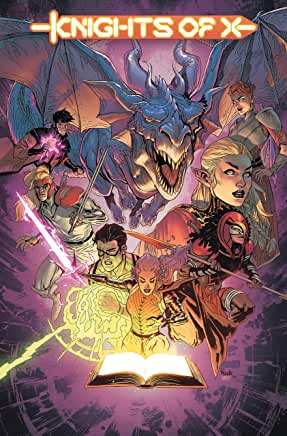 KNIGHTS OF X #1-5
Writer: Tini Howard
Artist: Bob Quinn
Colourist: Erick Arciniega
Letterer: Ariana Maher
Editor: Sarah Brunstad
So before you ask, yes, this did finish a while back, but the collected edition isn’t out till December, and that makes this Still Timely. Somewhat. My plan right now is to clear the backlog of minis and completed Infinite Comics that I haven’t written about yet, and then go back and catch up on ongoing titles that I’m writing about as they come out anyway – but since Knights of X wound up being a five issue series, let’s cover it here.
Marvel’s approach to this series is… let’s say confusing, shall we? It’s the sequel to Excalibur, a book that had its fans, but I had a few problems with. Part of that was that magic stories have never really been my thing where the X-books are concerned, and that’s just a matter of taste. But part of it was that the book always rang painfully false to me when it went anywhere near Britain, and since a major part of the plot was “who gets to be Captain Britain”, that was a big problem.
So Knights of X, refocussing the book simply on Otherworld, seemed to me like a good move. It was focussing on the book’s strengths and letting it get on with some world building. It was clearly intended to be an ongoing title, and it winds up being cancelled after five issues. Okay. These things happen. But… it’s then being relaunched again in 2023, with the same writer, as Betsy Braddock: Captain Britain. That’s just weird. That’s mixed signals if ever I saw them.
And this reads like a truncated book. You can see the early issues setting up for a lengthy quest, and you can see about halfway through a sudden lurch as it has to jump straight to the finale. Clearly, the book is meant to be setting up for an extended quest around Otherworld, the idea being partly that it’s X-Men meets fantasy (if that’s your thing), and partly that it’s the “world that fears and hates them” set-up that the regular X-books aren’t currently doing. But the quest turns out to be, more or less, that they drop by three parts of Otherworld and then cut straight to the finale. It doesn’t help that, because the group split at the outset, half of them actually just go to the Crooked Market and then cut straight to the finale. I’m sure that can’t have been the plan.
At any rate, it feels like a truncated story. And that has all the usual problems – the groundwork hasn’t really been laid for the ending, there are reveals that don’t feel like they were properly set up to have impact, there are cast members like Bei and Kylun who never really get to do anything. That’s just what happens if you jump straight to the final act, but knowing that doesn’t change the fact that it’s a problem.
The book starts with Betsy leading the Captain Britain Corps as they and Roma hold out against Merlyn’s reactionary rule of Otherworld. Even allowing for the rushing, there’s something a bit odd about the fact that there’s suddenly meant to be a whole mutant population of Otherworld for Betsy to protect – almost none of whom we ever meet or see, aside from one refugee from Krakoa. Depending on how you think Otherworld is meant to work, it makes a degree of sense; if you think the humans in Otherworld have either come from Earth or been copied from Earth, then I suppose it makes sense that they ought to include mutants. Quite why it’s a priority for either side is never really very clear, though.
Since Otherworld is based on story (or its magic is, at the very least), Roma can’t simply summon up an army of mutants from Earth to help tip the balance, but she can round up some mutants to participate in a quest. That quest, by the way, was meant to be “deeply personal and test each of our souls”, which I guess is kind of what issue #4 is rushing through, but it was surely meant to happen at greater length. As part of that, they resurrect Arthur’s son Mordred, who turns out to have the mutant power to make everyone hate him (which at least explains why he’s always the bad guy in the stories).
The team are meant to be on a quest for the Siege Perilous, which leads them to the domain of Mercator. The question of what’s going on in there has been a mystery since the current incarnation of Otherworld was set up. It’s not particularly a surprise to have it confirmed that Mr M – Absolon Mercator – is involved in this, since he’s the missing Omega Mutant. But it feels like a bit of an anticlimax, since he’s just thrown out there as a reveal, and we’re never really introduced to him (beyond a data page recap) or given any particular reason why his identity matters. He turns out to be rather interchangeable.
Once Mercator’s domain is open, everyone rushes there for the big fight. There’s a perfectly reasonable effort to focus on the big stuff, but it means that the whole plot of Mordred and Arthur winds up getting resolved off panel. And then there’s a sudden swerve into Betsy deciding that the Corps no longer need to be answerable to any of the potential rulers of Otherworld, which doesn’t feel like an idea that was set up at all. Gambit dies and gets resurrected, in a series of continuity references that even the current Marvel editors thought needed a footnote, and the rest of the mutants come through a portal to save the day in one double page spread.
It’s not especially satisfying, but you can see how it might have played out over the course of a year or more. It probably still wouldn’t have been to my tastes, but most of the story arcs that it gestures at seem like sound enough ideas. Some kind of redemption arc for Arthur to re-embrace the heroic figure that he’s meant to be, in a world based on narrative, while Mordred tries to escape the role in which he’s been cast, seems really quite interesting. It just doesn’t take place on the page.
The book does look wonderful. One real strength of the current Otherworld set-up is to provide a range of completely dissimilar worlds so that we’re no longer just working on elves, hobbits and trees. You can do all that, but you’ve got the freedom to invoke other tropes as well. Bob Quinn does a really great job of making the locations distinct; I love the look of his Sevalith in particular. His characters feel passionate about everything that’s happening, and that does a great job of selling that emotional stakes are there, even if the story is forced to rush through them. He’s a great choice of artist for this book, which absolutely plays to his strengths.
Ultimately, though, it feels like a rushed book sketching the outline of something longer that would have had more impact.

I’ve been reading lots of Neil Gaiman interviews lately where he reflects on his expectations starting the Sandman comic. He figured he’d be canceled after a year, and they’d tell him around issue #8. These days, they aren’t even giving a book *half* a year to find an audience.
It was a continuation of Tini Howard’s Excalibur. Surely the audience would have been found with that series and followed the plot into the new series.
This isn’t anything new. There was a period where Marvel was cancelling books after only five issues seemingly at random. They cancelled Doctor Voodoo at five issues back in 2010, which was a very enjoyable book. They must have barely any had sales figures and they decided to drop the book. I remember it happening quite a bit around that time at Marvel. Back in the mid-1970s, Black Goliath was another book they dropped almost immediately (also five issues), and it’s not a lone example.
That’s two Howard ongoings (X-Corp, Knights of X) cancelled/become 5 issue minis in a row.
There’s something here about editorial control. Why allow Howard to plan for and write with the intention of a much longer story only to compress it in an unsatisfactory way?
Why relaunch this again under a new name so swiftly? I’m really puzzled by the marketing thinking behind this. There’s obviously enough of a market for some kind of Captain Britain mythos x-book. But just not quite enough?
I note you have neatly sidestepped the Betsy/Rachel pairing. Again, I think this is a symptom of rushing to tell a story. So instead it does come off as a bit tokenistic.
I’m not confident in the solicitations for the Captain Britain mini: “a Captain without a country…”. Again maybe goes to another issue, a lack of understanding of the UK.
All this aside – I just read reviews on this series and didn’t pick it up. Howard’s Excalibur frustrated me so much in parts, I wasn’t prepared to invest again!
Considering how Jed Mackay’s Black Cat is now just stealth-continuing in the form of one 5-issue limited series after another, and likewise Non-Stop Spider-Man turned into Savage Spider-Man after five issues…
Is Marvel’s new strategy for lower-selling books just to chop them up into a parade of 5-issue minis?
And if you check the solicitations for any given month, Marvel is releasing an insane glut of 5-issue miniseries. Are there any that aren’t 5 issues? Anything 4 or 6 or 12? I’m reminded a bit of the Jemas era where literally everything was mandated to fit into 6 issues, whether that meant drawing out a shorter story or truncating a longer one.
K said: Is Marvel’s new strategy for lower-selling books just to chop them up into a parade of 5-issue minis?
Maybe they’re big fans of Venom going back to the mid-to-late 1990s? (It would explain King in Black…)
More practically, I see this as the acceleration of several trends.
First, the quick turn from cancellation to rebranding means that there’s more format flexibility. If it sells well enough, it gets a new mini, and each mini can easily be packaged as a well-defined collection for other markets, and the hope could be that the collection does well enough to recoup costs or even support a lower-end series.
Bear in mind that the markets include buyers such as libraries, digital sales, and booksellers.
Second, it means a new #1 and a rebranding, both of which can offer some kind of sales boost by drawing in customers who are either in the collector mentality or who see the rebrand as something new to try out.
Third, I think there’s a sense that the more consistent fans follow characters and writers, so even a less-successful book, when truncated, might still be reaching a reliable fanbase beyond that “1” boost. And it’s a great way to keep completionists on board and paying attention.
Fourth, and less frequently, some of this seems tied to simple brand exposure. Can’t sell this book with the “Excalibur” legacy brand? Try it with the “of X” branding instead. Can’t sell it that way? Try it with the headliner character or characters as the title. Can’t sell it no matter what? Well, then it probably does just go away.
Similarly, note that the “Savage” branding for that Spider-Man series probably draws from “Savage Avengers,” which was a Conan tie-in branding exercise. with the Conan license moving on, this is another way to keep that brand alive and keep a third Spider-Man book going.
This last model is just an extension of the absurd overuse of title elements from the 2010s, a time when Marvel marketing figured that if “New” Avengers/”New” X-Men or “Superior” Spider-Man was a hit, you’d just stick that word into the title of the next new launch in hopes of capturing some of the sales magic.
Heck, whenever DC has a hit miniseries, the non-character-specific title elements become the branding for their next relaunch.
Evilgus: The Betsy/Rachel pairing was set up in Excalibur, at least to a degree. I can see where it would look like tokenism if one just read Knights of X (which I didn’t, I’m going by reviews/ news), but Howard laid enough of the groundwork in the previous series that I picked up on it.
I came here to say what Omar said, more eloquently, in his point 4. It still doesn’t explain Marvel’s devotion to Tini Howard and the story she’s trying to tell. Or why they apparently haven’t told her that she’s only getting 5 issues at a time. But the retitling makes some sense.
On the flipside, every time you restart at #1 and/or retitle the next installment of the same story, you’re giving readers a perfect jumping off point. Especially if you’re frustrating them in the meantime by not pacing the story very well.
And the new devotion to 5-issue minis (instead of 4, 6, or 12, as in olden days) stems from their perfect length for collection. I believe Tom Brevoort confirmed that fact in one of his recent newsletters, but I’m too lazy to doublecheck.
“Maybe they’re big fans of Venom going back to the mid-to-late 1990s? (It would explain King in Black…)”
On a related tangent, can I just say how insane I think it is (good insane) that, as far as I’m aware, Bryan Hitch has drawn over 12 consecutive issues of, of all things, a Venom series? Has Hitch drawn more than 12 issues of anything since Ultimates? And has Hitch drawn every issue of a monthly series ON A MONTHLY SCHEDULE? EVER????
The Betsy/Rachel kiss is both the sweetest and most memorable moment of this run, and Quinn did a fantastic job with it, and it also underlines how much the cancellation hurt the story.
The big impetus for the kiss is that they’ve been reunited and Rachel is deeply relieved and happy to see Betsy again. But since the plot’s been cut down so much, the direct impetus of their separation starts on page 5 of #4 and is over by page 21, and that separation seems to last maybe ten minutes. And them being on separate sub-teams prior lasted an issue an a half in prior issues. If Rachel and Betsy had been apart for seven or eight issues, instead of less than two, as I suspect was the plan, it would’ve landed harder.
“This last model is just an extension of the absurd overuse of title elements from the 2010s, a time when Marvel marketing figured that if “New” Avengers/”New” X-Men or “Superior” Spider-Man was a hit, you’d just stick that word into the title of the next new launch in hopes of capturing some of the sales magic.”
Now continuing but with a hint of irony, with Immortal Hulk > Immortal X-Men > Immoral X-Men. Looking forward to Immoral Ant-Man or some such.
If Erin O’Grady had an Irredeemable Ant Man book, he can also have an Immoral Ant Man book.
Yeah, the 5 issue mini has been a strategy that seems to be espoused by current EIC CB Cebulski in particular. Peter David’s books might be an interesting case study. Notice how all of his projects from the past few years have been series of 5 issue series (four or so Symbiote Spider-Man books, three Maestro series). His work for the past few years before that had been ongoing books in the Spider office that lasted about two years each (Scarlet Spider, Spider-Man 2099).
PAD is a writer with a small but distinct and loyal fanbase, and each of these projects are marketable enough to succeed in that short-medium term sense. In this way, Symbiote Spider-Man is not really different than Spider-Man 2099. Functionally, we’re getting about as many issues of these new series, in the form of several subsequent miniseries, as we had from his “ongoing” books which lasted exactly 25 issues apiece. Or at least, about as much overall time on the stands and in Marvel’s overall publishing line. And with minis, you don’t have to deal with fill-in artists (as much), so it probably is a win for editorial as much as for sales.
But there’s also a difference in repackaging something not enough people are liking repeatedly (Excalibur -> Knights of X -> Betsy Braddock: Captain Britain), and in packaging something as a mini and doing more of them if people like it enough (Sabretooth -> Sabretooth and the Exiles). With the former, you end up with truncated storylines and repurposed/reformatted storylines (remember when the Trial of Magneto seemed obvious it was probably supposed to be a whole year’s worth of X-Factor?). With the latter, you get writers with the ability to plan it out arc by arc, always with the awareness that might be all they get, so each chapter ends up more satisfying because they sort of have to be.
I guess I’m realizing I think the series of miniseries approach works better creatively than the rebranded continuation of a canceled series approach. But that’s kind of annoying, because as a fan I love a good long, uninterrupted run, and those are very, very hard to come by these days.
Josie
Hitch drew a full 12 issues of the Hawkman reboot a couple of years ago on a monthly schedule (before DC pulled him off that to go and do that Warren Ellis Batman series that nobody remembers, which also more or less came out on schedule).
Hitch has talked a bit of about his scheduling difficulties on Twitter in recent years and said that, particularly between the early 2000s and mid-2010s, he was experiencing undiagnosed mental illness which he was eventually able to seek help for thankfully.
He’s talked about struggling to like a lot of the work he did during that era (particularly his JLA stuff but even the Captain America and Ultimates stuff to a point) because they remind him of his struggles.
Personally I’ve always loved his Ultimates run. Say what you will about Mark Millar and his writing, but that book looked absolutely stunning and unlike anything else on shelves at the time.
It’s funny – had it come out on-time, month in and out, the Millar/Hitch run would have concluded in early-mid 2004 (when in reality it hit the halfway mark then and didn’t conclude until mid-2007).
I think it’s time for an ‘Immovable Blob’ series.