X-Men Legends #3-4
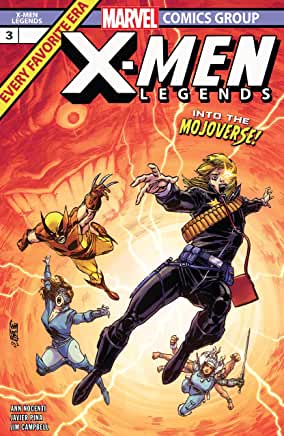 X-MEN LEGENDS vol 2 #3-4
Writer: Ann Nocenti
Artist: Javier Pina
Letterer: Joe Caramagna
Colourist: Jim Campbell
Editor: Mark Basso
You can’t say X-Men Legends lacks range. The previous arc was Roy Thomas doing mid-70s continuity patching. The next arc is Whilce Portacio doing the early 90s. And here we have Ann Nocenti revisiting Longshot. Those are three very, very different creators. In fact, you have to wonder what the market is, beyond completists like me, for a book whose premise boils down to “literally anything from over 25 years ago”.
Although Ann Nocenti was the X-Men’s editor for most of the 1980s, her own writing was always very unusual – technically within the bounds of the superhero genre, but satirical, brittle and almost abstract at times. Nocenti is a writer of ideas, and her stories often function more as concept delivery systems than as character studies. The original Longshot series is very much like that, the core being the contrast between the pure and naive Longshot whose luck powers distort the plot in his favour, and the grotesque Mojo. Both of them are rather one note characters, but it’s the way they react with one another.
Longshot and Mojo both became incorporated into the X-Men, with Mojo settling into the role of media satire. That’s certainly an element in the original series – Mojo makes movies, Longshot is a reluctant stuntman – but Mojo started off as a somewhat broader force of anti-life. The stuff about flowers dying in his presence has been largely forgotten over the years, but it makes a return here.
If there’s a continuity bridge being performed here, it’s to get Mojo to the point where he’s developed an interest in the X-books – sorry, the X-Men – but that’s kind of secondary. A major reason why the movie angle was played up so much in the late Claremont period was that Marvel were, at the time, owned by New World Pictures, and so Mojo represented Marvel’s owners. That’s why Mojo was expanding the line to the point of absurdity by creating the X-Babies. And Mojo is very much in that role here, as he enlists Longshot, Kitty Pryde and Wolverine for his latest war movie. (Don’t worry, continuity fans, there’s a mindwipe.)
You might wonder whether this take on Mojo is drifting behind the times. But really, the character has aged remarkably well. He is surrounded by long-suffering hangers on trying their best to steer him away from his worst impulses or to do something creative within the limits allowed by the ludicrous framework that he sets. He doesn’t care about quality, or rather, he doesn’t understand quality as a concept distinguishable from popularity. He thinks appeals to basic standards of reason and logic are elitist and pretentious. He’s a powerful, capricious, talentless moron who believes his own hype and thinks his success is evidence of genius. He doesn’t trust people talking where he can’t hear them and he demands that everyone sit with him and “have fun”. And he has recently entered the field of social media. He literally could not be more topical.
Javier Pina does a wonderfully grotesque Mojo; the character has become a little over-familiar down the years, but there’s a nice sense of horror to him here that I haven’t seen in a while. He seems more distended than usual. There’s something nicely understated about his Spiral and his Major Domo, as well – and this is really their story, for all that we do the usual routine of sending captive heroes to appear in his films. Major Domo represents the people in management who understand what a moron this guy is but are content to play along while quietly appreciating something better in their own time. Spiral is plainly Nocenti – and of course, she’s Ricochet Rita, who was drawn to resemble Nocenti – doing the actual hard work of turning Mojo’s hazy ideas into something actually coherent and (in theory) finding a way to get something interesting in there anyway. (Spiral also objects to Longshot, whose luck powers generate ridiculous plot logic in other ways.)
Still, it’s Mojo’s blunt dismissal of the whole concept of quality that really sticks. Pressed for some detail about the actual plot of his film, he replies “It’s a war movie. They fight. They die. How do the characters change? They’re alive at the beginning of the film and dead at the end. That enough change for you?”
All this is very funny. Whether it adds up to a particularly satisfying story is maybe another matter. By the very nature of a Mojo story – where the core premise is that Mojo can’t write – stuff just kind of happens, and then after a while it stops happening. Most Mojo stories are about the captured heroes and what all this says about them; but here there’s a sense of going through the motions with the heroes being a bit confused for a while before shaking it off. Wolverine throws himself into the war role a bit more enthusiastically than everyone else, but the in-movie scenes aren’t all that satisfying – nor is it really obvious that Spiral actually does make any changes that make the end result more interesting. Very vaguely, the experience is meant to give Kitty some motivation to feel that she could be a leader in future, but that comes across as a bit tacked on.
So, this is a two-parter that I admire in theory, and that has moments I really enjoyed, but that feels rather half-formed as an actual story. For better and worse, it really is all about the ideas.

I’ve never been a huge Mojo fan, if only because stories about him are always frenetic, chaotic, media/culture-saturated satires punctuated by bad jokes and moments of pure insanity, and since he’s a character incapable of genuine change or growth, too many of those stories are a little one-note. The theme stays the same, it’s only the details and participants who change.
But then again, you can say that about most antagonists.
But then again, Paul’s summary is absol-fucking-lutely spot-on and all too familiar to US readers of late. ” He’s a powerful, capricious, talentless moron who believes his own hype and thinks his success is evidence of genius.”
(“Who? Trump, or Musk?” asks my wife when I read this to her…)
As a continuity implant, this story serves very little purpose, especially since mindwipes are needed to preserve continuity.
I feel like Spiral is a character with potential under the right pen– a mixture of comedy and pathos, always trying to escape Mojo’s dominance and break the cycle. But as much as she’s Nocenti’s creation and even stand-in, I don’t know if Nocenti is who I’d want to write her.
Now I kind of want to see someone do a story about Mojo deciding to become a political grifter and being invited to speak at the Republican National Convention.
Note that this would have happened before House of X, so presumably Wolverine does now remember this happening.
One of the things I like about Nocenti’s writing is there’s always more to it than just the basic plot, even if I can’t always parse exactly what that is.
I think the changes Spiral makes are when Longshot, Logan, and Kitty start talking and work together to get Longshot off the land mine rather than continuing to kill each other. There’s a bright blue snake in the foreground of one panel about then I assume was some sort of symbol for Spiral’s influence in Mojo’s garden. Maybe?
I did like that Pina draws Mojo as this immense figure who dominates the panels. Any panel where he’s the only character, he basically fills it. If there are other characters, they’re shoved to the fringes. Mojo wants everything to be about him, so Spiral and Major Domo are both forced to do what they can in the margins or when he’s not around. As Paul noted, topical.
Also want to add, I’ve been rereading the highly underrated Swamp Thing run by Soule, Saiz, and Pina. I’ve always clocked Pina as a fill-in guy and a lesser substitute for Jesus Saiz, but I have to admit lately that he deserves a bit more credit. Yes, he usually is the fill-in guy, but he’s quite excellent at maintaining the qualities of those he fills in for, and does seem worthy of carrying a book on his own.
I always like it when “that fill-in artist” catches my attention often enough and seems to have developed enough over time that they seem ready for “the big leagues,” be that a monthly or a notable project. (Unfortunately, I can’t say that for the guy drawing DC’s Dark Crisis event now. I’ve never liked his fill-in art and I definitely don’t want to see him headline a series I might be interested in reading.)
This series worked as a venue for stories that never got a chance to be told, like Nicieza’s Adam-X one that started the first volume (and I recommend his interview on the Cerebro podcast for more info on that, and because of his amusingly dismissive attitude towards the whole business).
But I’m not feeling any love for most of what’s in it now, as well as all those 5-issues miniseries set in back continuity (Gambit, Wolverine Patch, X-Treme X-Men). They rarely seem to matter, and I guess we could debate what it means to matter or whether it’s important for everything to matter… But I just find them kind of dull.
I love the idea of a meaningless continuity implant that has to be mindwiped because it will otherwise break continuity. Only in comics.
Oh, this sounds appealing! I realize it’s all pretty obscure now, but at the time I did find myself feeling like I’d missed some kind of important link, despite collecting all things X-Men in the mid- to late 80s, between the Longshot mini and those characters’ appearances in Uncanny X-Men (and the Annuals) besides the always-welcome Arthur Adams as artist. Speaking of Adams, there was certainly an unsettling horror edge to his depiction of Mojo sometimes, like he could just as easily slice you up or eat part of you as merely tear you down verbally; nice to hear that visual discomfort makes a return too.
Even if this isn’t a perfect bridge, it does satisfy a longstanding headscratcher I’ve had, and I’ll definitely check it out. Also I always enjoyed Ann’s sense of humor and its targets. Kind of astonishing how apropos THIS target is (and kudos, Paul, on your masterful paragraph distilling the utterly hollow narcissism of Mojo).
@Ben K: Art Adams’s Mojo started out as a grotesque figure of terror, with the obvious absurdity thrown in. Even Adams himself started drawing him “cuter” after the initial Longshot and X-Babies stories. The Mojo of Excalibur: Mojo Mayhem is a much more cartoonish figure. I don’t remember getting a sense that Mojo was an existential threat until an Exiles story in the early ’00s.
Speaking of art, did anyone else catch the Kevin Eastman cover to issue 4? I know he’s done a handful of covers for DC/TMNT crossovers, but it’s wild to me that one of the Turtles guys would do something for Marvel.
“did anyone else catch the Kevin Eastman cover to issue 4?”
No, but it only recently occurred to me how amazing an artist he actually is. I flipped through some of The Last Ronin and caught his jaw-dropping pages. I’ll gladly have more of Eastman wherever he wants to show up.