Storm: Earth’s Mightiest Mutant #4 annotations
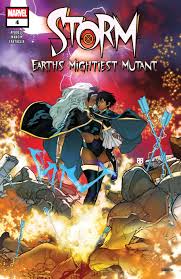 STORM: EARTH’S MIGHTIEST MUTANTS #4
“Mama”
Writer: Murewa Ayodele
Artist: Federica Mancin
Colour artist: Java Tartaglia
Letterer: Travis Lanham
Editor: Tom Brevoort
STORM:
We’re still “two days before Akujin’s invasion of Earth”, as in the previous issue. Storm is still outside the Marvel Universe proper at “the Wall” (the edge of the DC Universe), though in this issue it seems more like an area of metafictional swirl, complete with fan mail floating around. Storm seems to disregard all of the explicitly meta elements.
The alt-N’Daré’s basic pitch to Storm is that she should let Death destroy the Multiverse and then they can go back and restart it. Not surprisingly, Storm isn’t on board with this idea, not least because she’s working from an in-universe perspective and isn’t remotely convinced superhero universes work this way. However, we also get a flashback to the Krakoan era to remind us that, when she was infected by a techno-organic virus, she chose to fight it rather than just take the easy option of resurrection. This was Giant-Size X-Men: Fantomex and Giant-Size X-Men: Storm. The latter issue does indeed have a speech from Storm implying that she thought Krakoan resurrection undermined the value of life.
X-Men #29 annotations
 X-MEN vol 7 #29
“Danger Room, part 4”
Writer: Jed MacKay
Penciller: Netho Diaz
Inker: Sean Parsons
Colourist: Arthur Hesli
Letterer: Clayton Cowles
Editor: Tom Brevoort
COVER: A collective gravestone for the X-Men, with a gloating Frank Bohannan and Maxine Danger reflected in a puddle. Neither of them actually appears in the issue. Shouldn’t it be “Here Lie The X-Men”?
THE X-MEN:
Psylocke. The opening flashback explains how she and Xorn survived the attack from Beyond’s men at the start of last issue: Xorn used his gravity powers to bend Beyond’s laser away from the Marauder, and then Psylocke blasted the Beyond vehicle with the Marauder’s missiles. This fits well enough with the previous issue, though issue #27 had the Marauder dodging hails of attacks as opposed to the single major assault shown here.
Daredevil Villains #79: Bushwacker
 DAREDEVIL #248-249 (November/December 1987)
“A Cage in Search of a Bird” / “Kiss and Kill”
Writer: Ann Nocenti
Penciller: Rick Leonardi
Inker: Al Williamson
Letterer: Joe Rosen
Colourists: Petra Scotese (#248) and Max Scheele (#249)
Editor: Ralph Macchio.
For the first time in a while, we’ve skipped a couple of issues. Issue #246 is a fill-in issue by Jim Owlsey and Tom Morgan, and the guest villain is Chance, on loan from Spider-Man. Issue #247 is the second Project Reptile story, and we’ve already covered them. That takes us to issues #248-249, which lead into the second phase of Ann Nocenti’s run. Up to this point, we’ve had a lot of one-off villains, but from here on we start hitting names that stick around.
Somehow, a year into her run, the book still doesn’t have a regular penciller. That will finally change in the next story when John Romita Jr comes aboard. In the meantime, the last of the guest artists is Rick Leonardi. He was fairly well established by this point. Although Marvel hadn’t yet given him a regular assignment on an ongoing title, he had drawn Vision & The Scarlet Witch and two Cloak & Dagger minis, and fill-ins on high profile books like Amazing Spider-Man and Uncanny X-Men. Naturally, he brings a lot of grace to Daredevil, and his Hell’s Kitchen is brightly kinetic. Under Leonardi, Daredevil looks like an optimistic comic.
The X-Axis – 29 April 2026
UNCANNY X-MEN #27. (Annotations here.) Well, this is a weird storyline. The Outliers are off in a version of early New Mutants, and a bunch of supposed New Mutants have shown up in their place. The first part had me a little worried that this story might be overestimating how much readers actually remember about the details of those early New Mutants stories, but this second part doesn’t really turn on any of that – which is for the best. It’s more of a loose parallel between the Outliers and the original rookie class, with increasingly surreal dream-like elements creeping in along the edges. The organic Sentinels are particularly nightmarish, and a great riff on the original design. Luciano Vecchio’s art really captures the feel of how the original New Mutants looked in their early issues, too. I’m not quite so sure what Devil Dinosaur and Moon Boy robots are doing in here – the Rawhide Kid stuff didn’t really come to anything, after all – but for the moment I’m assuming that all of this is somehow to do with Inmate X trying to escape Graymalkin as the ailing Scurvy is no longer able to contain him. Presumably that’s why the story opens with Corina and Scurvy’s otherwise unrelated scene. I’m not a huge fan of the Graymalkin plot in general, but I do like their relationship as a low-key background development, and it’s nicely handled here to play into the general sense of Ellis trying to hold on to her persona with disaster looming for her on the horizon.
GENERATION X-23 #3. (Annotations here.) You can’t look past the fact that this is a book which opens with an obituary for its own artist, or at least the artist of the first third of the story. Jacopo Camagni does get to go out on a high, though, with his last pages including a striking sequence in X-80’s bedroom, minimally furnished, but covered in Post-it notes swirling to the ceiling. The framing of X-92 as they gently draw Laura’s attention to the things she’s missing is really nice, as if the character fades into the background so much that the panels don’t even keep them in shot. The rest of the issue is completed by Marco Renna, and the transition is actually pretty smooth – he does a rather good X-Infinite in particular, switching from passive-aggressive casualness to fighting back.
Generation X-23 #3 annotations
 GENERATION X-23 #3
“A Numbers Game, part 3”
Writer: Jody Houser
Artists: Jacopo Camagni & Marco Renna
Colour artist: Erick Arciniega
Letterer: Ariana Maher
Editor: Mark Basso
COVER: Laura lies seemingly dead on the floor, and Gabby is held back by two of the Generated. The one on the right is X-66; the one on the left is closest to X-92 but far too tall. This scene doesn’t happen in the issue.
The issue opens with an obituary for artist Jacopo Camagni, who died in March; he drew the first seven pages of this story.
WOLVERINE:
Laura is still bedridden at the start of the issue, so she must have taken a remarkable amount of damage when X-73 blew up last issue. That said, she doesn’t seem to have any significant injuries by the start of the issue – perhaps once she gets back to a certain level of recovery, her healing returns to normal speed.
Uncanny X-Men #27 annotations
 UNCANNY X-MEN vol 6 #27
“Who’s Been Sleeping in My Bed?, part 2”
Writer: Gail Simone
Artist: Luciano Vecchio
Colour artist: Matthew Wilson
Letterer: Clayton Cowles
Editor: Tom Brevoort
COVER: White silhouettes of the Outliers, with a montage in the background of the X-Men hunting for them.
THE X-MEN:
Gambit. Following on from last issue, when he attempted to persuade Rogue that they should adopt the Outliers, Gambit is desperate to find the missing group. He offers to restore his deal with the Vig if the Vig can find them – this might seem a bit random, but then Gambit has no real leads to go on and it’s not unreasonable for him to assume that they at least might have been taken by someone that the Vig knows. Gambit doesn’t seem to suspect that the Vig is actually responsible – he talks as if the Vig simply might be well connected enough to find out.
Rogue, Nightcrawler, Jubilee and Wolverine hunt for the missing Outliers, and instead find a version of the early New Mutants at Haven House.
Daredevil Villains #77: The Nameless One
 DAREDEVIL #243-244 (June & July 1987)
“Don’t Touch Me” / “Touch Me”
Writer: Ann Nocenti
Penciller: Louis Williams
Inkers: Al Williamson, Danny Bulanadi & Tony DeZuinga
Colourists: Christie Scheele & Paul Becton
Letterer: Joe Rosen
Editor: Ralph Macchio
(Note: I skipped this post by mistake last time, so it’s appearing out of sequence. For #78, see here.)
After a string of one-off villains, most of whom are mentally ill serial killers, Ann Nocenti goes in a different direction: magic. Specifically, voodoo.
The last time Daredevil did voodoo was in issue #130, cover date February 1976. That’s a story by Marv Wolfman, Bob Brown and Klaus Janson, in which a voodoo priest called Brother Zed uses his illusion powers to convince his followers that he has real magical power, and then exploits their belief for his own gain. The basic concept isn’t too bad when taken in isolation, but the story came out at a time when black characters were largely absent from Daredevil, and if your sole representation of black America is to have them decapitating chickens in Central Park, then that’s a problem.
Eleven years have passed, since then, but in terms of the diversity of its cast, less has changed in Daredevil than you might think. The generic bystanders certainly have a lot more variation than they used to. But the book’s most prominent black character is still Turk, a comic relief character, and even he hasn’t appeared in Nocenti’s run. The Hell’s Kitchen supporting cast is small, and consists of Karen Page and a group of street kids called the Fatboys – they aren’t all white, but the ones with developed personalities are. Rotgut and his mother were black, to be fair, although Rotgut himself was an albino. So while things have changed in 11 years, this still stands out as a Story With A Lot Of Black People In It.
The X-Axis – 22 April 2026
WOLVERINE #19. (Annotations here.) The Adamantine storyline, which has been going since issue #1, seems to be building to some sort of a conclusion. I certainly hope it is, because at this point it’s taxing my patience. When it started, I figured that Saladin Ahmed was doing something about how adamantium was a human imitation of the mythical adamantine, and perhaps some kind of Tower of Babel angle, which felt like it might work. But by this point we’re being told that the Adamantine is “the very idea of the Earth’s metal made alive and aware”, which has some sort of objection to “man’s creation, adamantium, which it calls false metal”. And, erm… what? What does any of that mean, and more importantly, what is any of it about?
What even is “the very idea of the Earth’s metal”? Metal as a naturally occurring phenomenon? Which is… what, ore? Meteorites? But it can’t be that, because the adamantine keeps going on about how it was used to forge weapons in the past – there’s meant to be some angle where this personification of weaponry has discovered from seeing Wolverine that a weapon can be self-animating. So the Adamantine is about war and weapons, then? But that’s not the same thing as metal. If the Adamantine is meant to personify “metal”, why is it so interested specifically in war? Why not farming tools and jewellery? And if it’s okay with metal as forged by humans, what’s its problem with adamantium? If the objection is simply that it’s a man-made metal, what makes adamantium different from steel? It just doesn’t hold together, either in terms of plot logic or in terms of theme. Again, what’s this story supposed to be about?
Wolverine #19 annotations
 WOLVERINE vol 7 #19
“Wisdom and War”
Writer: Saladin Ahmed
Artist: Martín Cóccolo
Colour artist: Jesus Aburtov
Letterer: Cory Petit
Editor: Mark Basso
Once again, Martín Cóccolo’s name appears in the credits as “MART N C CCOLO”. This also happened in (at least) issues #14 and #17. Has anyone thought of putting in a call to IT? It feels like the sort of thing that shouldn’t be giving a professional publishing company this much trouble.
COVER: Wolverine fights Hercules. This happened, uh, last issue.
WOLVERINE:
The previous issue ended with Athena intervening in the fight between Wolverine and Hercules. This one opens with her magically calming them both down. Although it was only Hercules who was directly under the Adamantine’s influence in the previous issue, Athena talks as if it had been influencing Wolverine too. (“My magic has banished the Adamantine’s cruel influence long enough for you to remember yourselves… You have let yourselves be used by ancient evil.”) It’s possible that she simply assumes the Adamantine was influencing them both, but more likely she means that the Adamantine manipulating Wolverine by goading him into a fight. He was uncharacteristically berserker for 2026 last issue, so it might be a bit of both.
The X-Axis – 15 April 2026
X-MEN UNITED #2. (Annotations here.) Erm. Right. Well. So… this is certainly a thing, isn’t it?
I liked Exceptional X-Men, but this is a mess. Exceptional‘s strength was always in the character work; a slow pace, a down-to-earth tone and a small cast suited it. X-Men United, with a sprawling cast, a high concept setting and some sort of X-Men Team-up remit, takes all the wrong things from that book. I described the first issue as a misfire which at least had some moments with the Exceptional cast. The closest this issue comes to that is a scene with Kitty and Magneto. The art is okay, to be fair, and does a reasonable job on talky scenes.
Beyond that, it’s pretty much a train wreck. Why can’t it explain the concept of Graymatter Lane? If people are travelling there physically then what’s all this stuff about how if you die in Graymatter Lane then you die in real life? Wouldn’t that be obvious? But if they’re only travelling there psychically, how do they exit to different locations? This is rudimentary and two issues in, the book still hasn’t explained its basic premise intelligibly. It gets worse, though: the resolution of last issue’s cliffhanger is “false peril”, Cyclops feels wildly out of character compared to his home book, and then that plot just goes away. Instead, we move on to a story about Captain America and a supporting player from Truth: Red, White and Black. It’s not exactly obvious why that’s an X-Men story in the first place, though there are some throwaway lines about hoping that Captain America learns something about mutants in the process. But it’s an utterly bizarre choice of story for issue #2, when the book has such a sprawling cast and hasn’t done a proper story with its own setting yet. If the idea is to sell the concept of a team-up book, it certainly doesn’t do that by picking X-23, Melée and Jitter out of a hat and getting them to stand interchangeably next to Captain America. This is going very badly.
