Hellions #14 annotations
As always, this post contains spoilers, and page numbers go by the digital edition.
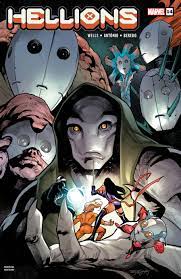 HELLIONS #14
“Don’t Look Back Part II: The Judgment of Angels”
by Zeb Wells, Rogê Antônio & Rain Beredo
COVER / PAGE 1. Tarn holds the Hellions in his hand.
PAGE 2. Opening quote from Tarn, the mad sadist. Tarn is obviously a counterpart of Mr Sinister as Arakko’s mad scientist. That said, Tarn seems to be a scientist for the purposes of sadism, while Sinister seems more of an amoral scientist.
PAGES 3-4. The Great Ring of Arakko.
The Great Ring are Arakko’s equivalent of the Quiet Council, first described in a data page in X-Men vol 5 #16. They’re meant to sit in groups representing Dawn, Dusk and Day. There’s also a hidden “Night” grouping who don’t appear here, but the room layout shown in X-Men #16 suggested that they might not sit at the table, in which case they could be behind the camera in page 3 panel 2. From left to right, these characters are:
- Sobunar, standing beside his chair for some reason. Identified as a member of the Day group in X-Men #16, he appeared in Planet-Size X-Men #1.
- Storm, apparently appointed to the Ring after becoming regent of Arakko/Mars in S.W.O.R.D. vol 2 #6. Since there are Day members either side of her, she’s apparently taken one of the Day seats. (The name of the third Day member was blanked out in X-Men #16.)
- Lactuca the Knower, another Day member, and also seen in Planet-Size X-Men.
- Isca the Unbeaten, from the Dawn group, who appeared extensively in “X of Swords”.
- Idyll, the prophet who was mentioned occasionally in “X of Swords” and its lead-in. Another Dawn member.
- Tarn the Uncaring, also in the Dawn group.
- What seems to be an empty chair.
- Xilo the First Defender, the caterpillar. Xilo appeared in Planet-Size X-Men #1, and is apparently sitting as a Dusk member. However, the Dusk members listed in X-Men #16 were Ora Serrata, Stulgid and Lodus Logos, so apparently something has happened to one of them.
- Someone with blue skin in a white robe, who isn’t named, and is presumably one of the aforementioned Dusk members, making their debut.
X-Factor #6-10
 X-FACTOR vol 4 #6-10
by Leah Williams, David Baldeón, David Messina & Israel Silva
Well, that was sudden.
Abrupt cancellations used to be a fact of life at Marvel. For a while they even had a fun little experiment with cancelling new ongoing titles before the first issue had shipped. But before that there was the sudden cancellation, where a series ended out of the blue with a final issue in which the writer was blatantly scrabbling to tie up as many loose ends as possible and vaguely hoping that anything else might get picked up in Marvel Two-in-One.
The second volume of X-Factor is just that sort of old-school cancellation. It’s an odd thing to encounter in a line that, in the Krakoan era, has generally felt quite masterplanned. Sure, Fallen Angels was quietly taken out behind the woodshed and put out of its misery after one arc, but that was a book that obviously didn’t work, and it ran to a somewhat natural break point. X-Factor is just a guillotine.
And books like this are tricky to write about, because inevitably the stories don’t achieve their potential. We can speculate about how they would have played out at full length, but there’s a risk there of wishful thinking.
But let’s start with the positive. There’s a lot that X-Factor does very well – or at least idiosyncratically – even in these closing issues. One of the book’s great strengths is its use of offbeat detail to make the characters feel more rounded. Prodigy and Eye-Boy sitting around reading about nineteenth-century beekeeping? Sure, why not! An entire body farm being set up in the back garden so that Prodigy can study decomposition? Absolutely. Of course, it’s a zombie supplier for the Morrigan arc. But it feels like it was going to be more than that. X-Factor is the sort of book where characters can decide to take up the study of corpse decay and it feels natural.
The Incomplete Wolverine – 1991
Part 1: Origin to Origin II | Part 2: 1907 to 1914
Part 3: 1914 to 1939 | Part 4: World War II
Part 5: The postwar era | Part 6: Team X
Part 7: Post Team X | Part 8: Weapon X
Part 9: Department H | Part 10: The Silver Age
1974-1975 | 1976 | 1977 | 1978 | 1979
1980 | 1981 | 1982 | 1983 | 1984 | 1985
1986 | 1987 | 1988 | 1989 | 1990
We’re now firmly into the 90s, and the Larry Hama run is just getting underway. For those who skipped the previous chapter, the tail end of Chris Claremont’s Uncanny X-Men run is in there (even though it came out in 1991), because the reading order makes more sense that way. All of that is going on alongside the comics we’re about to look at. Does skipping Uncanny X-Men leave us with a quiet 1991? No, of course it doesn’t…
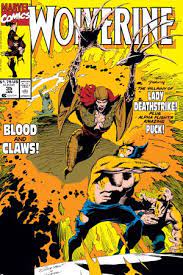 WOLVERINE vol 2 #35-37
“Blood & Claws”
by Larry Hama, Marc Silvestri, Dan Green, Glynis Oliver & Mark Chiarello
January to March 1991
Lady Deathstrike is back on her revenge kick. Figuring that Gateway is always trying to frustrate the Reavers by looking for loopholes in their instructions, she tells him to send her to “the place that Wolverine gazes upon this very moment.” Of course, this instruction contains a loophole: Logan and Puck are reminiscing over photographs of Puck’s time fighting in the Spanish Civil War. And so Gateway sends all three of them back to 1937, where Logan and Puck hook up with the partisans that Puck fought alongside back in the day. Hama continues to set the tone for his take on Wolverine by having the group include Ernest Hemingway and “Ricky Blair” (i.e. George Orwell) – this Logan is hyper-masculine, but smarter than he first seems, even if he plays that side of himself down. Hama even has him observe that in war, everyone misses everyone else when humanly possible – in reality, a quotation from Orwell’s Homage to Catalonia (1938).
Meanwhile, Deathstrike hooks up with Nazis to pursue our heroes, and mulls over trying to change her father’s history, so that she never ends up with a duty to avenge him. When she finally catches up, Hama restates Claremont’s take on her: she’s given up her humanity because of an obsession over his adamantium, when Wolverine would much prefer to be rid of the whole thing. The fight ends inconclusively when Deathstrike kills a German soldier who was meant to survive the war, creating a time vortex that sends everyone home. In a subplot, this alteration of history causes a distraction that leads to Donald Pierce’s new robot, Elsie-Dee, accidentally getting genius level intelligence. But we’ll get to that.
Wolverine #14 annotations
As always, this post contains spoilers, and page numbers go by the digital edition.
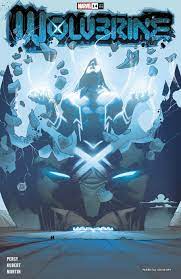 WOLVERINE vol 7 #14
“The Unusual Suspects”
by Benjamin Percy, Adam Kubert & Frank Martin
COVER / PAGE 1. Um. Well, it’s a landscape of two tiny figures looking at a giant Wolverine head which is being shattered from the inside by Solem, and which seems to have some sort of circuitry on it. The connection between this image and anything in the actual issue is obscure, beyond the general fact that Solem is manipulating everyone. Maybe it’ll make more sense as a cover for the trade paperback.
PAGES 2-4. How the Marauder ended up in Madripoor.
The footnote to X-Force #20 is an oversimplification. The Shi’ar showed up at the Hellfire Gala with their logic diamonds in Marauders #21. They were loaded onto the Marauder in X-Force #20. Christian was attacked and left floating in the North Atlantic in Wolverine #13, and the Marauder showed up on fire in Madripoor in the same issue. Apparently, the Marauder sailed through a “sea gate” to get it to Madripoor. This is the first mention we’ve had of sea gates, but sure, why not? It helps explain how the Marauder gets everywhere so quickly.
The significance of logic diamonds, as I’ve mentioned before, is that they’re used to provide the memory for Cerebro and its backups of memories and personalities. (It’s maybe time to spell that out explicitly for those readers who don’t remember them getting a passing mention back in Powers of X, though Wolverine does at least mention here that they’re something to do with Cerebro.)
S.W.O.R.D. #7 annotations
As always, this post contains spoilers, and page numbers go by the digital edition.
 S.W.O.R.D. vol 2 #7
“Full Spectrum Diplomacy”
by Al Ewing, Stefano Caselli & Fer Sifuentes-Sujo
COVER / PAGE 1. Frenzy, Abigail Brand, Hulkling and Manifold ready themselves for action, while an image of Dr Doom at his diplomatic dinner with Storm looms over them.
Last Annihilation. This is a tie-in to “Last Annihilation”, which is basically a Guardians of the Galaxy storyline that has some tie-in one-shots and also crosses over into this issue of S.W.O.R.D. Of this book’s seven issues to date, five have been crossovers, which seems a bit much.
PAGE 2. This is the Utopian Kree’s We-Plex Supreme Intelligence System recapping the plot of Last Annihilation in rather disjointed fashion – we saw one of these pages in issue #5. For present purposes, all you really need to know about Last Annihilation is that Dr Strange villain Dormammu has possessed Ego the Living Planet and he’s invading our dimension again, this time by attacking in outer space, with his usual Mindless Ones army from the Dark Dimension.
PAGE 3. Captain Glory arrives to join the fight.
Captain Glory was called up to help at the end of Guardians of the Galaxy #16. He debuted in Avengers #676 (part of the “No Surrender” storyline), where he was leading the Lethal Legion. He’s basically a Kree super-soldier. He was jailed in Empyre for attempting to sabotage the Kree/Skrull alliance and prolong the war, but it’s perfectly reasonable to trust him in a situation like this.
Cable #12 annotations
As always, this post contains spoilers, and page numbers go by the digital edition.
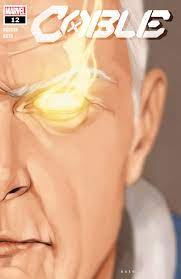 CABLE vol 4 #12
“Shakespeare in the Zark”
by Gerry Duggan & Phil Noto
COVER / PAGE 1. A close up of the older Cable’s face. This is a companion piece to the cover of the previous issue, which features the other half of the young Cable.
PAGE 2. The opening quote – “Cable, you’re relieved of your duty” – is what the younger Cable said when he killed his older self in Extermination #1. This issue completes the exercise of reversing all that, as the young Cable goes back to his own time to pick up his life as it ought to have proceeded, while the older Cable resumes his place as… well, Cable.
This is the final issue of Cable, though there’s a “Last Annihilation” tie-in oneshot to follow.
PAGE 3. Recap and credits.
PAGE 4. Cable Classic and Stryfe fight.
“Maybe I’ll keep you alive until Krakoa burns.” Stryfe might be anticipating that he’s going to burn down Krakoa, or he might be aware of how Krakoa turns out. Certainly Destiny’s instructions to Mystique in X-Men #6 were to “burn that place to the ground”, hence the title of the upcoming Inferno miniseries.
X-Men #16-21
It’s past time I started on another batch of reviews, which I was planning to start as soon as the Hellfire Gala finished, but, well, close enough.
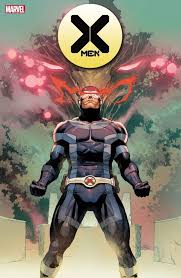 X-MEN vol 5 #16-21
by Jonathan Hickman, Phil Noto, Brett Booth, Mahmud Asrar, Francesco Mobili & various others
These six issues complete volume 5 of X-Men, which promptly gets relaunched for a new season under Gerry Duggan. So, in a sense, these issues complete Jonathan Hickman’s X-Men run.
Except of course they don’t, because Hickman remains the moving force behind the X-books as a whole. And that’s going to be an odd thing to have lurking in the background behind Duggan’s run, though I suppose no more than in the days when we had heavier input at the editorial level. Still: the point here is that volume 5 of X-Men is going to read very strangely if you try to take it as a thing in its own right. It only really makes sense when understood as part of the wider picture of the Krakoa-era X-Men books.
There’s nothing wrong with that. It’s how the book is intended to be read. In some ways it’s a throwback to the time when the X-books were marketed much more heavily around their contribution to wider continuity, but this time round there’s more of a sense of it being driven by a creative agenda (even if it’s one that was no doubt developed with an eye to supporting a line of books). Still, Hickman’s X-Men is a strange, fractured thing – it doesn’t feature an X-Men team, or even a regular cast, but instead offers a selection of short stories that don’t directly connect to one another, instead feeding in various ways into the big picture. There isn’t even a regular artist, so much as a common talent pool.
New Mutants #20 annotations
As always, this post contains spoilers, and page numbersgo by the digital edition.
 NEW MUTANTS #20
“Secrets & Lies”
by Vita Ayala, Alex Lins & Matt Milla
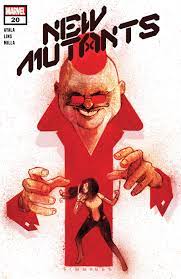
COVER / PAGE 1: The Shadow King looms over Scout. Seems like a cover that would have fit better an issue or two back.
PAGES 2-4. Anole, Cosmar, Rain Boy and No-Girl decide what to do with Scout.
The previous issue ended with them finding Scout’s body. The strong implication was that Scout had been killed by the Shadow King, after she confronted him in issue #18 about her concerns over his influence over these four.
The group is named later in the issue as “Lost Club”.
“Cosmar asked for their help, and they gave her platitudes.” Issue #15. Cosmar, who believes that her distorted appearance is not a feature of her powers but merely a self-inflicted injury when her powers were out of control, asked Dani to kill her in the Crucible so that she could be resurrected in her original form. Dani refused and gave her a mutant-pride speech, which went down very badly.
Marauders #22 annotations
As always, this post contains spoilers, and page numbers go by the digital edition.
 MARAUDERS #22
“The Morning After”
by Gerry Duggan, Matteo Lolli, Klaus Janson & Rain Beredo
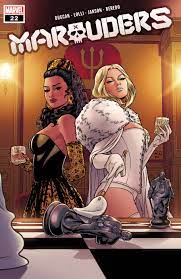
COVER / PAGE 1: Lourdes Chantel and Emma Frost stand over a chessboard, with Emma laying a figure of the Black King (Sebastian Shaw) on his side. Normally in chess you’d put your own king on its side as a way of resigning, but okay. The other identifiable chess piece represents former Black Bishop, Harry Leland.
This is a callback to the cover of issue #2, in which Sebastian and Emma are shown in the same poses, with Emma using the same… whatever you call it, the shoving thing… to move a figure of Kitty and Lockheed over a map.
PAGE 2. News coverage of the aftermath of the Hellfire Gala.
“I’m glad I never wanted to visit the fifth planet in our solar system.” Referring to the terraforming of Mars in Planet-Sized X-Men #1. Mars is the fourth planet from the Sun (the fifth is Jupiter), so it’s a Fox News joke.
“Feilong Industries.” Referencing a storyline from Duggan’s own X-Men #1.
X-Corp #3 annotations
As always, this post contains spoilers, and page numbers go by the digital edition.
 X-CORP #3
“The Madrox Workflow”
by Tini Howard, Valentine de Landro & Sunny Gho
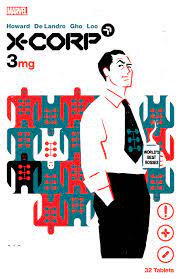
COVER / PAGE 1. Corporate Madrox, with a bunch of dupes tessellated behind him.
PAGES 2-3. Who is Dr Jamie Madrox?
This is a more or less straight recap of Madrox’s back story. Madrox’s family tie to Los Alamos, and his powers emerging at birth, both come from his debut in Giant-Size Fantastic Four #4, as does the panel of him with Professor X and Mr Fantastic. I’m pretty sure the bit about his childhood interest in science is new. When first introduced, Madrox’s gimmick was that he was a naive farmboy (his parents moved to Kansas soon after he was born) whose parents had died and who was living alone on the farm as a community of one.
The idea that some Madrox duplicates were going out to learn about entire skills and then return with what they had learned, contributing to the skills of the whole, comes from Peter David’s X-Factor. Howard entirely ignores the usual depiction of Madrox as a bit of a comedy figure or (at the very least) everyman, which admittedly wouldn’t make much sense for something written in the tone of X-Corp pseudo-advertising. The idea that Madrox is “brilliant” is, um, novel. Still, the idea that his accumulated skills would allow him to work efficiently by churning out the duplicates and then reabsorbing them periodically to work as a one-man team… that makes sense.
