X-Corp #1 annotations
As always, this post contains spoilers, and page numbers go by the digital edition.
 X-CORP #1
“Simply Superior”
by Tini Howard, Alberto Foche & Sunny Gho
X-CORP. This is the first X-Corp series. X-Corporation was introduced in the Grant Morrison run, specifically in the 2001 New X-Men Annual. As described in the newspaper article on page 34, it was originally a sort of nonprofit organisation which existed to support mutant rights, rather than a corporate business as such. It was largely closed down after M-Day, but we’ve seen it mentioned from time to time during the Krakoan era. (Interestingly, it wasn’t mentioned in the data page in X-Force #4 that catalogued Xavier’s business assets.) Warren and Monet were shown running it in Empyre: X-Men.
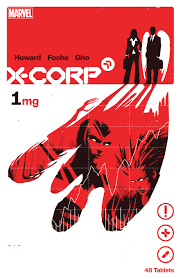
COVER / PAGE 1. Well, it’s vaguely pharmaceutical-packing themed, but it’s also got corporate graphs and charts. Broadly, you’ve got Monet and Warren in businesswear, casting a shadow which shows themselves as Archangel and Penance.
With the corporate theme, mock branding and stylised colour palette, it’s very reminiscent of some of the early covers from Wildcats Version 3.0, which also did the superheroes-go-corporate angle.
PAGES 2-4. Warren and Monet film a promotional video.
It’s not exactly clear who this video is aimed at – it’s all vague aspirational corporate-speak, the idea (I suppose) being that we’re meant to take it seriously because it’s Krakoan. But who is X-Corp marketing itself to? The only product it has in this story is Krakoan drugs, and from the sound of it it just manufactures those; if it’s also selling them, what’s Hellfire Trading for? It’s odd that the relationship between those two entities isn’t really explained here – it is the premise of Marauders, after all.
Children of the Atom #3 annotations
As always, this post contains spoilers, and page numbers go by the digital edition.
 CHILDREN OF THE ATOM #3
“Unusual Dinner Guests”
by Vita Ayala, Paco Medina & David Curiel
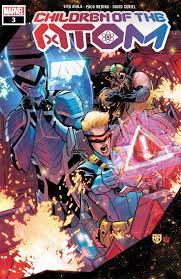
COVER / PAGE 1. The group panic aboard a crashing spacecraft. As we’ll see, the scene in the story is somewhat different, since it’s a flashback and they’re not in costume.
PAGES 2-4. Carmen readies herself for live streaming.
Carmen. Each issue so far has focussed on a different member of the cast, and been told from their perspective. This time it’s Carmen / Gimmick, who gets a full name for the first time. The basic angle is that Carmen feels that people appreciate her because of the stuff she does, and because they depend on her, but worries that they’re not all that worked up about her as a person. Of course, she leans into this by seeking validation in the form of a loyal audience for her cosplay livestreaming. There was a hint of this in issue #1, with Buddy asking Carmen “When do you sleep, huh?”
This is the first appearance of Carmen’s family. Carmen’s room has a Dazzler poster on the wall (consistent with last issue’s concert). In the first panel, she’s holding a photograph of herself, Buddy, Gabe and Benny – but not Jay Jay. Maybe he’s holding the camera? Carmen is gazing fondly at Benny, while the other three are looking at the camera.
The Incomplete Wolverine – 1988
Part 1: Origin to Origin II | Part 2: 1907 to 1914
Part 3: 1914 to 1939 | Part 4: World War II
Part 5: The postwar era | Part 6: Team X
Part 7: Post Team X | Part 8: Weapon X
Part 9: Department H | Part 10: The Silver Age
1974-1975 | 1976 | 1977 | 1978 | 1979 | 1980
1981 | 1982 | 1983 | 1984 | 1985 | 1986 | 1987
At the end of last year, the X-Men set off for Dallas, to appear in “Fall of the Mutants”. After that story, the X-Men will be off limits for guest appearances for a while – but there’s time to shoehorn one in first!
 INCREDIBLE HULK vol 2 #340
“Vicious Circle”
by Peter David, Todd McFarlane & Petra Scotese
February 1988
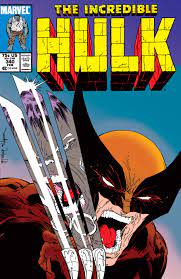
On their way to Dallas, the X-Men stumble upon the Hulk on a rampage. At first, Wolverine resists the temptation to go after his old rival, he but changes his mind when he sees the scale of the damage. He tries to keep his composure when facing the Hulk, but finally flies into a berserker rage which does indeed bring the Hulk down – briefly. The fight ends when Rick Jones and Clay Quartermain break it up. Dutifully following Uncanny X-Men, this story lays heavy stress on Wolverine’s discomfort with the unaccustomed role of team leader. Rather harshly, Wolverine feels that after all the progress he’s made, he let himself down by backsliding into berserker mode when confronted with the Hulk. The Hulk simply leaves without appearing to learn anything at all.
The Marvel Index lists a flashback in Wolverine vol 4 #12 as taking place during this story. It shows Wolverine fighting the grey Hulk and being treated as the hero who saves the day. But the disruption caused by the fight means that a man called Roger fails to get his pregnant wife to hospital in time to save her life. Roger goes on to join the Red Right Hand. The rationale for placing this flashback here is a bit wonky – the weather’s all wrong, for one thing – but you can treat it as an inaccurate recollection and it avoids the need for a second Wolverine/Hulk encounter during this period.
Hellions #11 annotations
As always, this post contains spoilers, and page numbers go by the digital edition.
 HELLIONS #11
“Funny Games Part III: Kill Screen”
by Zeb Wells, Stephen Segovia & David Curiel
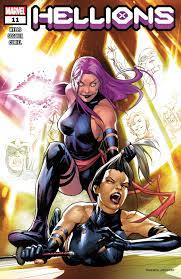
COVER / PAGE 1: Psylocke is pinned down by a Mojofied version of herself, while Arcade watches and we see the other Hellions on screens. Kind of an arbitrary choice of a dramatic image for the cover.
PAGES 2-4. Greycrow and Psylocke meet up.
In the previous issue, Psylocke’s illusion involved her living a seemingly idyllic life with her lost daughter, and being tormented by a horrific version of herself wearing the Psylocke costume with Mojo’s eye retractors. (That refers to the 1980s storyline in which the original Psylocke lost her vision and Mojo gave her bionic eyes.) Greycrow, meanwhile, was a soldier angst-ridden about the people he had killed, but being assured by his colleagues that he had been a good person. When Psylocke came under attack, she apparently reached out for help instinctively, with a telepathic call to Greycrow in the next room.
Marauders #20 annotations
As always, this post contains spoilers, and page numbers go by the digital edition.
 MARAUDERS #20
“Windriders”
by Gerry Duggan, Stefano Caselli, Edgar Delgado & Chris Sotomayor
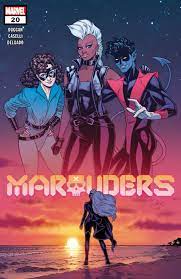
COVER / PAGE 1: Storm on a beach, reflecting on her days with a more traditional X-Men. The version of Shadowcat’s costume, with the studded gloves, places this image just before the Mutant Massacre (i.e. just as things started getting really dark) – specifically, the reference seems to be the splash page of Uncanny X-Men #208.
PAGE 2: Data page. Emma gives Kate a brooch. The silver bullet in the brooch refers to the Joss Whedon storyline from Astonishing X-Men where Kitty phased an entire giant bullet through the Earth, and then got stuck in the thing for a while.
An E-grade diamond is the second highest grade of diamond (in terms of how colourless it is). The scale starts at D and runs down to Z, apparently to avoid confusion with previous “A/B/C/” grading systems. The difference between D and E is pretty much invisible to the naked eye.
Cable #10 annotations
As always, this post contains spoilers, and page numbers go by the digital edition.
 CABLE vol 4 #10
“Depression”
by Gerry Duggan & Phil Noto
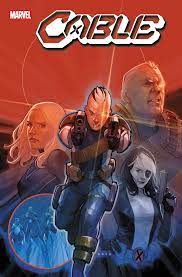
COVER / PAGE 1. Cable surrounded by his supporting cast and plot elements from the series, basically. That’s Esme and Domino, the older Cable, Stryfe in the background, and the Order of X cultists.
PAGE 2. Data page. The point is obvious enough: Cable’s history is mired on time paradoxes, and if you’re trying to kill him, the important thing is to do it at the right point in the timeline.
PAGE 3. Recap and credits.
PAGES 4-8. Emma stop Cable from taking Cerebro.
Cable has come to the point of deciding that he’s not up to the job of being Cable, and that it was a mistake to replace his older self in the Extermination miniseries. Quite why he felt the need to kill the older Cable was always a little hazy. But the broad idea is that he believed it was necessary in order to unscramble a time paradox which his older self had allowed to emerge, in part by tolerating the presence of the Silver Age X-Men in the present day for such an extended period (in All-New X-Men). Cable has now decided he wants to reverse that.
New Mutants #17 annotations
As always, this post contains spoilers, and page numbers go by the digital edition.
 NEW MUTANTS vol 4 #17
“Follow the White Rabbit”
by Vita Ayala & Rod Reis
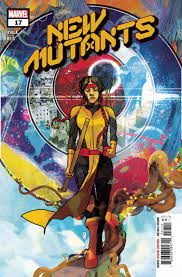
COVER / PAGE 1: Well, that’s Dani walking a mystical path before a surrealist backdrop, I guess. Doesn’t really have much to do with the issue beyond the general weirdness of Otherworld.
By the way, issue #16 came out in the last week of February. So if it feels like some momentum has been lost in this story… well, that’s a big part of it.
PAGES 2-3. Amahl Farouk enlists the help of Wolfsbane.
Wolfsbane. In the previous issue, Wolfsbane learned that her son Tier was still alive (at least according to Cerebro). She was very upset about that, because she figured that if he was fine, he would have been in touch. The issue ended with her returning home to find nobody there to support her (since Dani and Xi’an had unexpectedly gone off on a mission to Otherworld).
Amahl Farouk. This scene seems to confirm that Farouk is indeed living openly on Krakoa. However, he seems to be speaking here not as the Shadow King but as the original Amahl Farouk. Wolfsbane also seems to accept this, since it’s inconceivable that she would believe the Shadow King itself had any sort of benign agenda. Or maybe she’s just vulnerable to psychic manipulation right now. Even allowing for the general Krakoan amnesty, we really could do with an explanation as to how this guy was allowed onto Krakoa bearing in mind that he’s traditionally the host of a massively dangerous (and non-mutant) psychic demon. Did he get his original personality back on resurrection or something?
The Incomplete Wolverine – 1987
Part 1: Origin to Origin II | Part 2: 1907 to 1914
Part 3: 1914 to 1939 | Part 4: World War II
Part 5: The postwar era | Part 6: Team X
Part 7: Post Team X | Part 8: Weapon X
Part 9: Department H | Part 10: The Silver Age
1974-1975 | 1976 | 1977 | 1978 | 1979
1980 | 1981 | 1982 | 1983 | 1984 | 1985
1986
We left off just after the Mutant Massacre crossover, which ran through to January. That leads us to a string of aftermath issues as the X-Men roster rebuilds.
 UNCANNY X-MEN vol 1 #214
“With Malice Toward All!”
by Chris Claremont, Barry Windsor-Smith & Glynis Oliver
February 1987
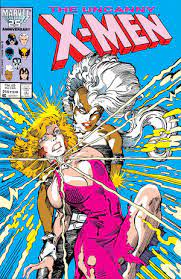
The X-Men investigate Dazzler’s unusually aggressive behaviour, and wind up freeing her from possession by the disembodied psychic Malice (Alice McAllister). Malice then hops between the X-Men until Storm defeats her by sheer force of will. With her reputation wrecked by Malice’s antics, Dazzler reluctantly joins the X-Men.
In a surprising coda, Wolverine wrongly concludes that Storm is still under Malice’s control and attacks, realising at the last moment that he’s got it wrong – the idea is that Malice screws with Wolverine’s usual ability to rely on his senses, inverting the usual trope where he’s the one who can sense the truth.
S.W.O.R.D. #5 annotations
As always, this post contains spoilers, and page numbers go by the digital edition.
 S.W.O.R.D. #5
“Giallo”
by Al Ewing, Valerio Schiti & Marte Gracia
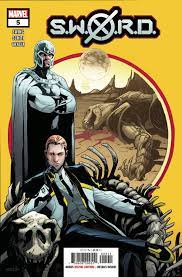
COVER / PAGE 1. A relaxed-looking Fabian Cortez with Magneto standing behind him, and a dead Snark. One of these two things happens in the issue, and it’s not the one Cortez would prefer.
PAGE 2. Data page, of sorts. These are the thoughts of the We-Plex Supreme Intelligence System, which is the version of the Supreme Intelligence from the home timeline of Noh-Varr (Marvel Boy). The 18th Kree Diplomatic Gestalt was Marvel Boy’s group in his home timeline. I’m not particularly up on Utopian Kree continuity, but basically they’re a more peaceful offshoot of the Kree Empire under Plex’s government.
The top right panel lists a bunch of problems that Plex has been dealing with lately: Knull (from King in Black), the Olympian gods (from Guardians of the Galaxy), the mainstream Kree (just generally), and “the Korvac apotheosis” (presumably referring to the return of cosmic villain Korvac over in Iron Man). But right now, Plex is mainly concerned with the Snarkwar – the war for succession among the Zn’rx, which began over in Guardians of the Galaxy and has already been mentioned in earlier issues.
X-Force #19 annotations
As always, this post contains spoilers, and page numbers go by the digital edition.
 X-FORCE vol 6 #19
“Dead of Nightmare”
by Benjamin Percy, Garry Brown & Guru-eFX
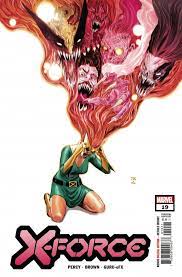
COVER / PAGE 1. Marvel Girl is plagued by demonic images of X-Force.
PAGE 2. Phoebe calls Jean for help.
Jean is talking about the nightmare vision she had in the previous issue, one of a number of nightmare hallucinations that were presumably caused by XENO’s evil copy of Quentin Quire.
PAGE 3. Recap and credits.
PAGES 4-7. Quentin is pursued through his mindscape.
Last issue, Quentin went to the astral plane to confront the predatory thingy, and found himself in this laboratory setting – which he correctly infers later on to be the XENO lab where his copy was cloned. As in that issue, astral Quentin doesn’t have his regular glasses, but instead has a pink energy shape, the same effect as is used for any psychic weapons that he conjures up. What use a pair of psychic glasses is, it’s not immediately obvious. At any rate, this is clearly meant to be symbolic, because Quentin starts using a similar effect in the real world later in the issue.
